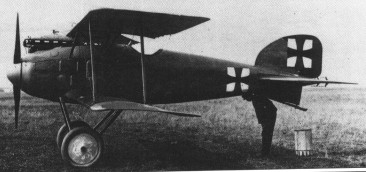
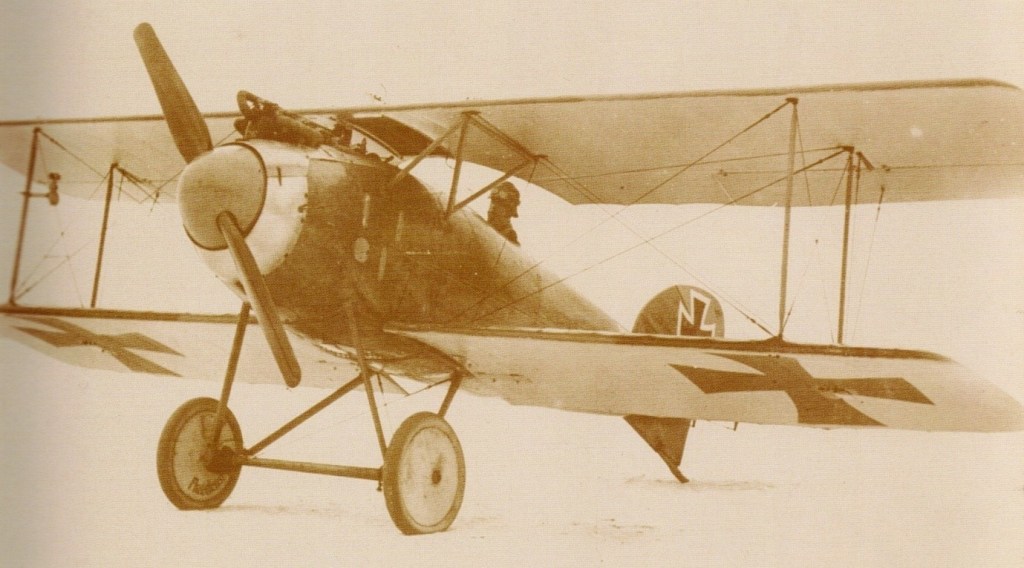
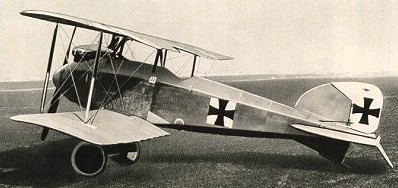
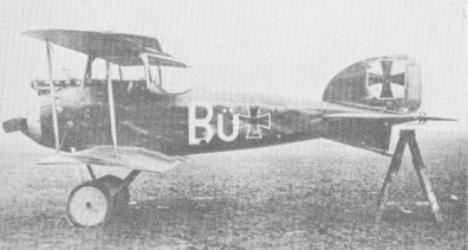
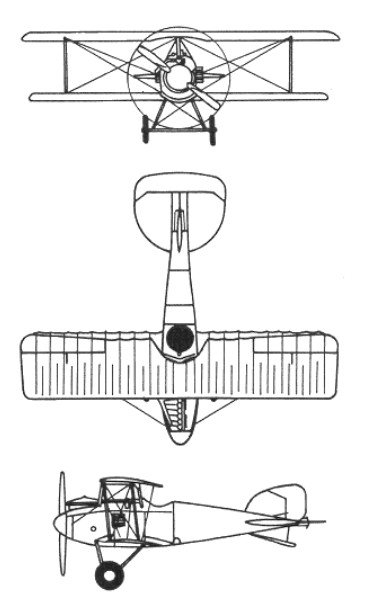
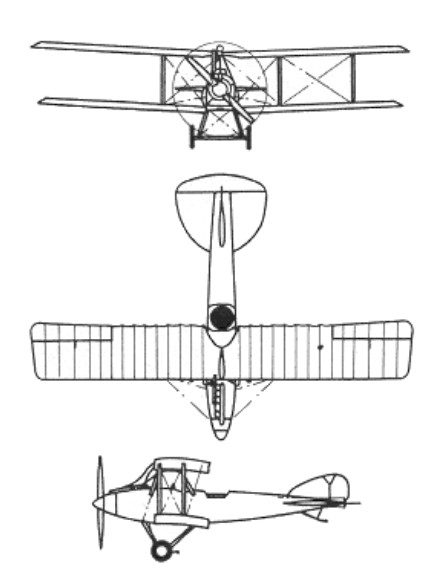
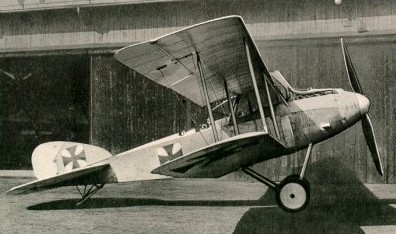
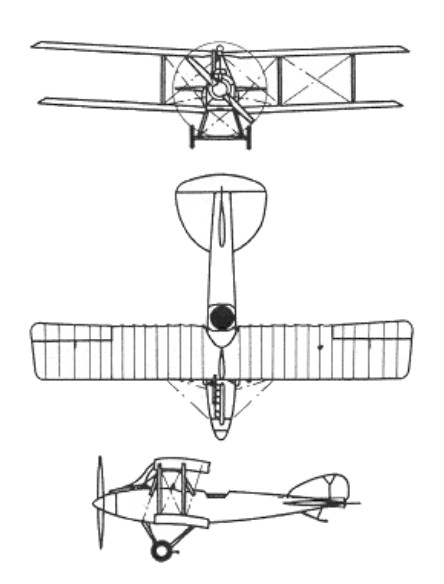
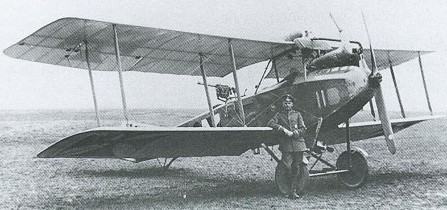
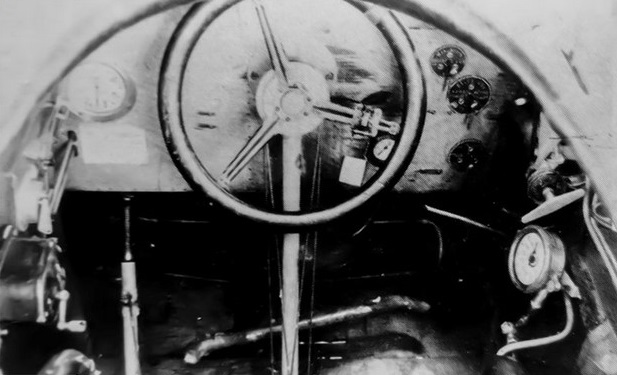
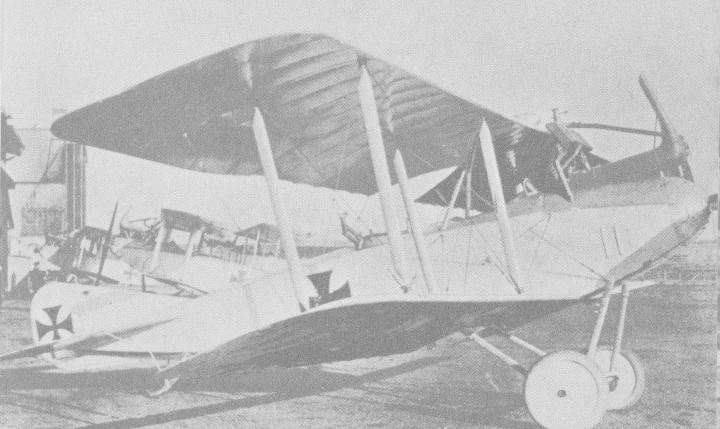
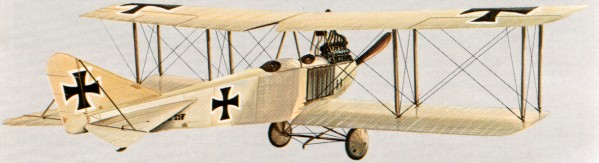
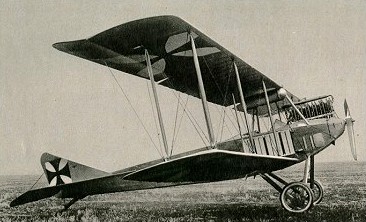
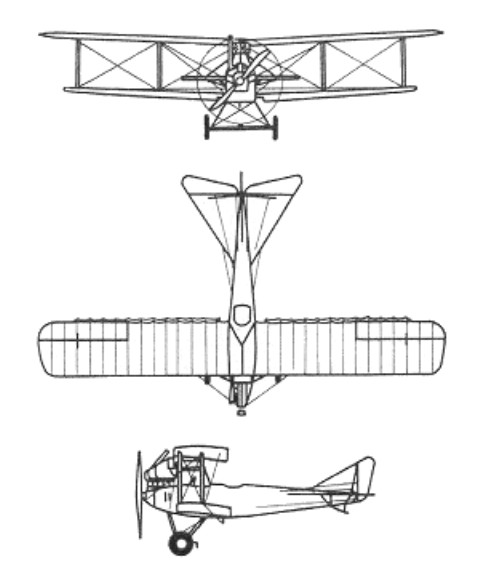
The Albatros D.II became a further development of the Albatros D.I. In the D.II, the top wing was brought down to improve pilot visibility and also allowed for the improved radiator to be mounted in the center of the upper wing section.
The Albatros D.I was initially designed and produced to counter the Nieuport and de Havilland series of “Fighting Scout” aircraft, winning superiority back by 1917. Initial D.I’s were modelled after the Albatros “C” series of aircraft, including some of the internal working components and overall building methodology used in production.
The D.I and D.II represented Germany’s second successful bid within a year to gain total air superiority over the Allies (the first with the Fokker E monoplanes in 1915-16). They were vast improvements over the previous Fokker and Halberstadt biplane fighters.
They were an unequal-span equal-chord biplane with a plywood-covered semi-monocoque fuselage, having the Albatros C.III rounded tailplane coupled with the new rounded fin and rudder of C.V/16 type. The major difference between the D.I and D.II was that the upper wing of the D.II was lowered to reduce the gap between it and the fuselage to improve forward and upper vision. Powered by either a 112kW Benz Bz.II or 119kW Mercedes D.III engine they armed with two synchronized Spandau machine-guns, firing through the propeller – the first successful installation of twin guns on a German fighter.
The D.I first flew in August 1916, and were first flown on an operational mission in September 1916, led by the ace Oswald Boelcke. Twenty D.II, powered by 138kW Austro-Daimler engines, were also licence-built by the Oeffag company for the Austro-Hungarian Air Force. At the peak of their operational careers with the German Air Force, about 260 D.I and D.II fighters were in service. In October 1916 the D.1 was replaced in production by the D.II.
Albatros D.I Engine: 1 x Mercedes D.III, 119kW / 160hp Length: 23.95ft (7.3m) Wingspan: 28.22ft (8.60m) Height: 9.51ft (2.90m) Empty Weight: 1,422lbs (645kg) Maximum Take-Off Weight: 1,980lbs (898kg) Maximum Speed: 120mph (193kmh; 104kts) Maximum Range: 180miles (289km) Rate-of-Climb: 547ft/min (167m/min) Service Ceiling: 16,998ft (5,181m) Armament: 2 x 7.92mm machine guns Accommodation: 1
Albatros D.I Engine: 1 x Benz Bz.III 112 kW / 150 hp Take-off weight: 900 kg / 1984 lb Empty weight: 674 kg/ 1486 lb Wingspan: 8.5 m / 27 ft 11 in Length: 7.4 m / 24 ft 3 in Height: 3.0 m / 9 ft 10 in Wing area: 22.9 sq.m / 246.49 sq ft Max. speed: 175 km/h / 109 mph Ceiling: 6000 m / 19700 ft Range w/max.fuel: 300 km / 186 miles Armament: 2 machine-guns Crew: 1
The Albatros production of the C.X model supplanted the earlier C-series by improved aerodynamic design and powerplants.
The C.X was fitted with the newly-designed Mercedes D.IVa engine that improved performance and reliability. The C.X would be fielded in the Front from the summer of 1917 onwards.
The C.X biplane sat two crewmembers back-to-back in the cockpit area. The pilot was positioned at front, offering up a traditional field of view under and behind the top wing system and behind the engine. An observer/rear gunner manned a ring-mounted array of 7.5mm Parabellum machine guns. Additional stores in the way of light bombs could also be carried.
As successful as the C.X was in the reconnaissance role, the C.X was replaced with the C.XII.
Albatros C.X Engine: 1 x Mercedes D.IVa, 240 hp Length: 30.02ft (9.15m) Wingspan: 47.11ft (14.36m) Height: 11.15ft (3.40m) Empty Weight: 3,677lbs (1,668kg) Maximum Speed: 109mph (175kmh; 94kts) Service Ceiling: 16,404ft (5,000m) Armament: 2 x 7.5mm Parabellum machine guns in ring-mounted rear cockpit position. Accommodation: 2 Hardpoints: 2
It was generally recognised that the Mercedes engine had been the greatest problem with the C.V and so the new C.VII was fitted with a 149kW Benz Bz.IV. A return to the C.V/1s lower wing and radiator layout was made and the resulting aircraftt was successful in the reconnaissance and other roles. C.VII served during 1916 and 1917 in all battle areas and were often used as tactical light bombers.
Though 400 full examples of this model were produced, the C.V would see operational from early 1916, eventually being replaced in full by a more potent Albatros C.VII design by 1917.
Initially built as the C.V/16 and powered by the new 164kW Mercedes D.IV engine, but this model proved heavy to fly and experienced problems with its cooling system. To remedy this the C.V/17 was produced, featuring a new lower wing with rounded tips, a new radiator fitted to the upper wing (instead of the two rounded radiators previously fitted to the fuselage sides forward of the wings), balanced ailerons and elevators and other refinements. These made a considerable difference to the handling and cooling, but the problems with the crankshaft of the engine remained and meant that only a small number of C.V became operational.
The C.V was in effect an entire departure from previous C-series type designs. This particular model was fitted with a Mercedes D.IV 8-cylinder liquid-cooled engine capable of 220 horsepower. The aircraft was crewed by a pilot in the front cockpit area and an observer/gunner in the rear cockpit area. The rear gunner had access to an arrangement of ring-mounted 7.5mm Parabellum machine guns for defensive purposes. Up to 220lbs of external ordnance could be mounted for the bomber role. Wing design was of a conventional biplane approach and the fuselage was aerodynamically refined for maximum performance.
The Albatros C.V would eventually be replaced by the more capable C.VII series. The C.V would also go on to hold an Albatros production line distinction of being the 2,500th such aircraft produced by the firm, this event occurring in the war year of 1917.
Albatros C.V Engine: 1 x Mercedes D.IV, 220hp / 164kW Length: 29 ft 6 in (8.95m) Wingspan: 41.93ft (12.78m) Wing area: 43.4 sq.m / 467.15 sq ft Height: 11.68ft (3.56m) Empty weight: 1035 kg / 2282 lb Maximum Take-Off Weight: 3,494lbs (1,585kg) Maximum Speed: 106mph (170kmh; 92kts) Maximum Range: 280miles (450km) Service Ceiling: 16,404ft (5,000m) Armament: 2 x 7.5mm ring-mounted LMG 14 Parabellum machine guns in rear gunner position Bombload: 220lbs Accommodation: 2 Hardpoints: 2
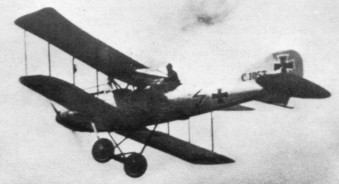
Appearing outwardly nearly identical to the Albatros B.III of 1914, the C.III model entered service in 1915. Like the unarmed B.III, the C.III had a fish style tail that not only improved handling but became a distinguishing feature of the Albatros single-seat scouts. With a two-bay biplane of two-spar wooden construction (ailerons on top wing only), the ply covered fuselage had a roomy rear cockpit for the observer, with Schneider ring mount for the Parabellum machine gun. Nearly all also had a fixed Spandau (almost the same 7.92 mm gun) firing ahead on the right side of the engine, and equipped with synchronization gear to enable it to fire between the propeller blades.
Albatros C-III
Though used mainly for reconnaissance and artillery spotting, the C.III could carry 100 kg (220 lb) of bombs in a compartment between the cockpits. Powered by the 160 hp Mercedes D.III engine, the C.III was built by seven manufacturers and served on all fronts until mid 1917 when it was withdrawn for use in the training role.
Albatros C.III Engine: 1 x Benz Bz.III, 150 hp or Mercedes DIIIe, 160hp. Wingspan: 38 ft 4 in (11.70m) Wingarea: 397.3 sq.ft Length: 26 ft 3 in (8m) Height: 10.17ft (3.10m) Empty weight: 1876 lb Maximum Take-Off Weight: 2,983lbs (1,353kg) Fuel capacity: 56 Gal Maximum Speed: 87mph (140kmh; 76kts) Service Ceiling: 11,155ft (3,400m; 2.1miles) Endurance: 4 hr Accommodation: 2 Armament: 1 or 2 x 7.92mm Parabellum machine gun and 1x Spandau 7.92 mm machine-gun (most) Bombload: 100 kg (220 lb)
The Albatros C.I series of aircraft was the next evolution in the brand’s reconnaissance aircraft line. Stemming from the development of the production Albatros B.II, the C.I shared many of the common characteristics in the initial design including the biplane wing assembly and basic fuselage design. Where it differed from the B.II, however, was in crew layout, the implementation of self-defense armament and improved performance capabilities. The C.I would become the aircraft on which many a German ace would be introduced to aerial combat and hone his skills on before graduating to the new breed of true fighter.
The C.I, like the B.II before it, featured crew accommodations for two personnel in the form of one pilot and a rear “observer” that doubled as a gunner. Unlike the B.II, the C.I switched the positions of the pilot and observer to a more traditional layout, putting the pilot forward just behind the engine, and the observer to the rear. This allowed the pilot a more traditional viewpoint from the front of his machine while allowing the rear observer/gunner a greater area to which train his gun in for self-defense. Armament consisted of a single 7.5mm Parabellum machine gun in the rear gunner area. Beyond that, the system was a reconnaissance aircraft not built for straight up engagements, though the C.I did find its fair share of success in that field.
The Albatros C.I offered up performance improvements thanks to the Mercedes D.III liquid-cooled inline engine. Performance increased the maximum speed from the B.II’s 66 miles per hour to the C.I’s 87 miles per hour. The endurance of the newer C.I did suffer quite a bit, however, from 4 hours of flightier in the B.I to just 2 hours of flight time in the C.I. Nevertheless, the powerplant was one of the best and most powerful available when compared to its contemporaries and handling was reported as good to excellent, making for a lethal weapon despite these shortcomings.
Albatros C.I Engine: 1 x Mercedes D.III, 160hp. Length: 25.75ft (7.85m) Wingspan: 42.32ft (12.90m) Height: 10.30ft (3.14m) Maximum Speed: 87mph (140kmh; 76kts) Service Ceiling: 9,843ft (3,000m) Armament: 1 x 7.5mm Parabellum machine gun in rear gunner position. Accommodation: 2 Maximum Take-Off Weight: 2,624lbs (1,190kg)
The Albatros B.I and smaller B.II were developed in 1914, before the outbreak of war and were roughly equivalent to the British Royal Aircraft Factory B.E.2, although slower. Of conventional layout, with the pilot occupying the rear cockpit and the observer the front. No armament was carried. Powered by a 74.5kW Mercedes D.I or an 82kW Benz Bz.II engine.
B-1
In October 1916 Kondor Flugzeug-Werke was awarded an order for 50 Albatros B.IIa (Kon.) s/n 390-439/16 or use as trainers. The B.IIa designation denotes a change in engine and Kondor did some redesign of the empennage.
Albatros B.IIa (Kon.) 417/16 built by Kondor Flugzeug-Werke GmbH of Essen
The Albatros B.II was a reconnaissance biplane used in the early years of the First World War. Though phased out after several months in the reconnaissance role, the B.II would live on throughout the war and even some years later as a trainer elsewhere. In 1917 the B.II was ordered back into service as the B.IIa dual-control trainer, powered by an 89.4kW Mercedes D.II or Argus As.II engine.
The Albatros B.II was of a standard biplane design, with a twin-bladed propelled and engine mounted at front, followed by the upper and lower wings. The fuselage was slim and square, allowing for two crewmembers. The aircraft was not armed and served as a true reconnaissance platform.
In the beginning of its service tour, the B.II was able to attain altitudes of nearly 15,000 feet. The system would later be fielded in quantity throughout 1914, though it was already outclassed and being replaced as soon as 1915. Though its days as a frontline reconnaissance platform were over, the aircraft played a role in the training until the closing months of the war.
Manufacture was undertaken by several companies. A seaplane version was also built in small numbers and a few B.II were operated by Austro-Hungary.
Long time in the arsenal VVS of Sweden were found Albatros aircraft, the basic model of which was B.IIa. One of such aircraft arrived in Sweden in 1914, but it was damaged on landing. Albatros B.IIa’s were operated by the Swedes until 1926 as Sk.I (training type 1). In August 1925 they were replaced by the Heinkel HD.35.
Engine: 1 x Mercedes D.1, 74kW Take-off weight: 800 kg / 1764 lb Empty weight: 600 kg / 1323 lb Wingspan: 14.3 m / 46 ft 11 in Length: 8.6 m / 28 ft 3 in Height: 3.5 m / 11 ft 6 in Wing area: 43.0 sq.m / 462.85 sq ft Max. speed: 100 km/h / 62 mph Ceiling: 3000 m / 9850 ft Range w/max.fuel: 650 km / 404 miles Crew: 2



 All Aero