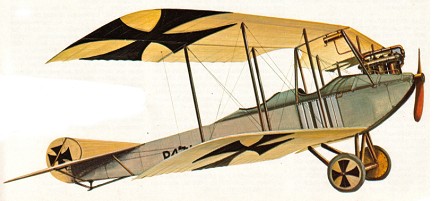
On the outbreak of the First World War, the company moved from Miffilhausen, which was near the Western Front, to Freiburg im Breisgau, on the other side of the Rhine. Here the B.I was designed, and flown in late 1914 (probably in November). A two seat biplane, it was powered by a 100 hp Mercedes D.1 six cylinder water cooled engine. A small series was built for the Imperial Air Service, supplementing the pre-war aircraft of similar design, one of which became the first aircraft to be shot down in air combat, on October 5, 1914.
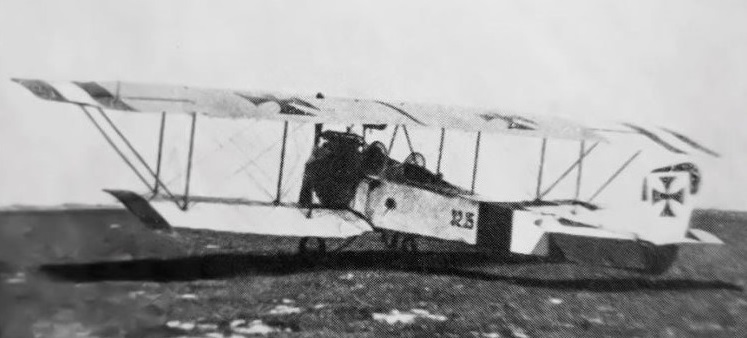
During the winter of 1914 15 the company’s Austro Hungarian subsidiary, Osterreichisch Ungarisch Flugzeugfabrik Aviatik of Vienna, designed and went into production with a developed version, the B.II. Powered by a 120 hp Austro Daimler, this differed mainly from the B.I in having angular elevators and rudder with large horn balances; it could also carry two 10 kg (22 lb) bombs, but guns were not originally fitted. Limited production, designated Serie 32, was undertaken for the Austro Hungarian Flying Service, and from about April 1915 the B.II was an observation machine on the Russian Front.
B.II Series 32
In the spring of 1915 production switched to the more powerful B.III, with a 160 hp Austro Daimler with the radiator repositioned above the cylinders. The wings were larger, with swept back tips, and pilot and observer sat in a single large cockpit, the observer having a rifle or often a 7.92 mm Schwarzlose machine gun either on an infantry tripod or a spigot mounting on the upper longerons. The B.III had a sluggish response to control, so production reverted to the Serie 34, which was virtually a B.II with the 160 hp engine (but B.II side radiator) and machine-gun; most Serie 33 (B.III) and Serie 34 had racks for three 10 kg bombs. Hundreds were delivered, but by 1916 they were all being relegated to training.
Span: 14.00 m (45 ft 11 in) Length 8.00 m (26 ft 3 in) (small variations according to sub type) Gross weight (B.I) 860 kg (1900 lb) Gross weight (B.II) 870 kg (1918 lb) Maximum speed (all): 110 km/h (68 mph) approx
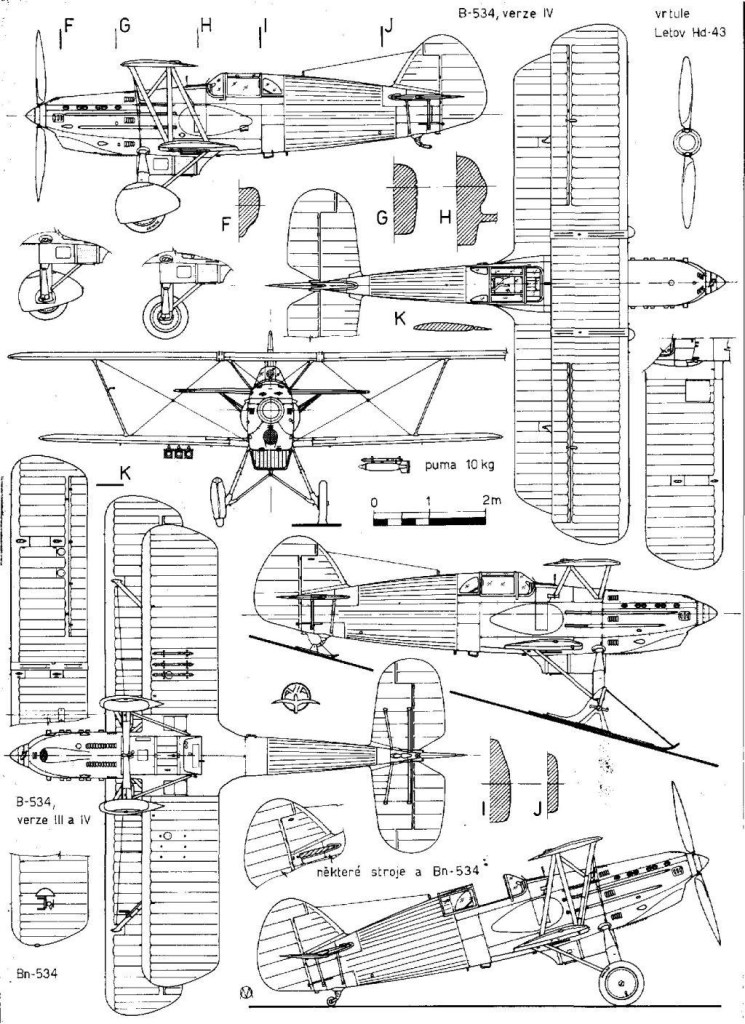
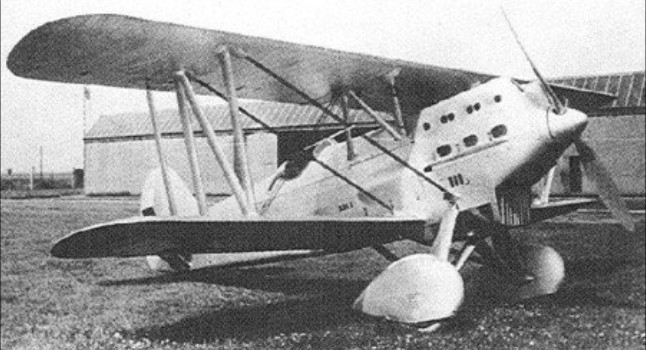
The B.534 featured a fixed undercarriage and biplane wings. Fuselage construction of the Avia B.534 was a mix of fabric-covered steel-structured wing assemblies. Armament was two or four 7.7mm synchronized machine guns and six 44lb bombs. Only some machines of the Nos I-II batches had a cockpit canopy.
The B-534 prototype was flight-tested in August 1933.
The operational flight ceiling was over 30,000 ft.
The 99th production Avia B-534 was tested for use of a Letov-made metal propeller.
The Nos I-II batches being built from Feb 1935 were equipped by wooden propellers, the Nos III-IV batches with composite ones.
Two machine guns were typical for the first 100, in the lower wing they were mounted into both sides of the fuselage. The No IV batch cockpit was covered by a canopy and hooded wheels. Aircraft of all the batches were equipped by racks for small splinter bombs.
No IV batch Avia B-534
The 190th production B-534 fighter was the fourth one armed by four machine guns. In addition to two side-fuselage-mounted machine guns, the Bk-534 was armed also by a HS No 402 via propeller-axle shooting canon.
B-534 No.190
The B-534 turned out from 1936 were of higher empty as well as take-off weight, top speed, service ceiling and climb up to 5 000 m.
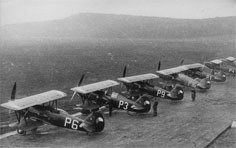
Avia B-534 fighters assigned to the Prague Flight under 1938 Mobilization in Eastern Slovakia
Because all three Aeroplane Works within a range of German bombers were, a new plant was built at the village of Kunovice in South Moravia. B-534s were turned out there in 1937.
Avia B.534’s would eventually see combat against the invading German forces, for the conquering German forces against the Soviet Union and ultimately phased out of service after completing several, less note-worthy, roles.
The Czechoslovakian Avia B.534 series of biplane was highly regarded. Such was the performance of the machine that the German Luftwaffe would briefly setup a fighter squadron utilizing captured B.534 aircraft.
Avia B-534 2nd batch Engine: Avia HS 12 Ydrs 750 hp Wingspan: 9.4 m Length: 8.1 m Empty weight 1385 kg Take off weight: 1913 kg Armament: two machine guns.
Avia B-534 Engine: Avia HS 12 Ycrs Empty weight: 1631 kg Loaded weight: 2222 kg Top speed: 375 kph Range: 500 km Rate of climb: 15m/sec Service ceiling: 9500 m
Avia B.534-IV Engine: 1 x Hispano-Suiza HS 12Ydrs, 850hp. Length: 26.90ft (8.2m) Width: 30.84ft (9.40m) Height: 10.17ft (3.10m) Maximum Speed: 245mph (394kmh; 213kts) Maximum Range: 360miles (580km) Rate-of-Climb: 2,953ft/min (900m/min) Service Ceiling: 34,777ft (10,600m) Armament: 4 x 7.7mm synchronized machine guns 6 x 44lb bombs Crew: 1 Hardpoints: 6 Empty Weight: 3,219lbs (1,460kg) Maximum Take-Off Weight: 4,674lbs (2,120kg)
The B 34, designed by Ing Frantisek Novotny, owed nothing to previous Avia single-seat fighters, and was an all-metal fabric-covered single-bay biplane powered by a 740hp Hispano-Suiza 12Nbr 12-cylinder liquid-cooled engine. Flown for the first time in 1932 by Vaclav Koci, the B 34 initially proved disappointing and the prototype was promptly returned to the factory for modifications, re-emerging as the B 34/1 with a new propeller, a redesigned engine cowling in which the face of the underslung radiator bath was cut back, and redesigned vertical tail surfaces. With these changes flight testing was resumed, and a production batch of 12 B 34 fighters was ordered for the Czechoslovak air arm.
The production B 34 embodied further redesign of the vertical tail surfaces, which were enlarged, and other changes by comparison with the prototype, including narrower-chord interplane bracing struts and the discarding of the streamlined mainwheel fairings. Power was provided by an Avia (Skoda) Vr 30 (licence-built HS 12Nbr) rated at 760hp for take-off, and armament comprised two 7.7mm fuselage-mounted Mk 28 machine guns.
B-34 Prototype Engine: 1 x 650hp Avia Vr 36 Wingspan: 9.40 m / 31 ft 10 in Length: 7.25 m / 24 ft 9 in Max. speed: 315 km/h / 196 mph Rate of climb: 12 m/s Range: 600 km / 373 miles Armament: 2 x 7.7mm Crew: 1
B-34 Engine: 1 x 760hp Skoda Vr 30 Wingspan: 9.40 m / 31 ft 10 in Length: 7.25 m / 24 ft 9 in Height: 3.10 m / 10 ft 2 in Wing area: 23.90 sq.m / 257.26 sq ft Max take-off weight: 1730 kg / 3814 lb Empty weight: 1305 kg / 2877 lb Max. speed: 315 km/h / 196 mph Cruise speed: 298 km/h / 185 mph Ceiling: 8200 m / 26900 ft Rate of climb: 610 m/min / 2000 ft/min Range: 600 km / 373 miles Armament: 2 x 7.7mm Crew: 1
During the course of 1926, Avia tested the Gnome-Rhone version of the Bristol Jupiter nine-cylinder radial air-cooled engine in a BH-21 airframe, and elected to employ this power plant for a new fighter, the BH-33. This, the last fighter design to be produced by Benes and Hajn for the Avia concern, was the first Avia fighter to feature a fixed tail fin from the outset, and commenced flight trials in 1927.
The wood-framed wings and fin were partly covered by plywood and wholly by fabric. A steel-framed fuselage, rudder and elevator were covered by fabric. Sheet metal plated cowling.
Avia Ba-33 of No 1 Fighter Regiment
It was ordered into production for the Czechoslovak air arm with a Walter-built Jupiter VI rated at 543hp for take-off, armament comprising two 7.7mm machine guns.
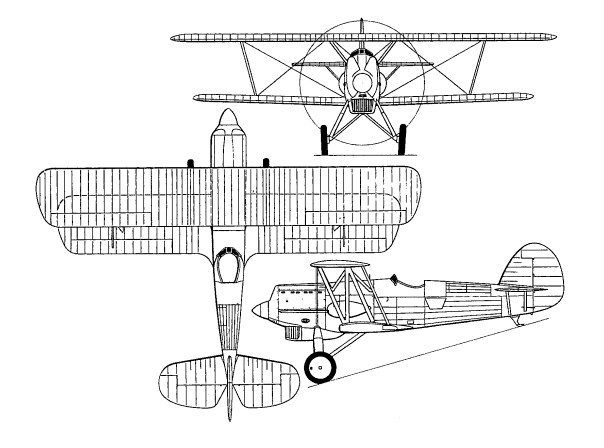
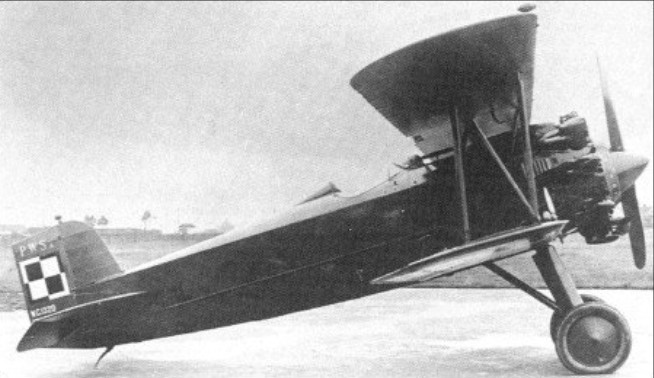
A manufacturing licence for the BH-33 was acquired by Poland in 1928, PZL building 10 pre-production fighters of this type and PWS building some 50 production examples for the Polish Air Force as the PWS A from 1930.
Three BH-33s were supplied to Belgium in 1929.
Avia Ba-33 of No 1 Air Regiment at Cheb
Engine: Walter Jupiter Mk VI, 450 hp Propeller: two blade wooden Wingspan: 8.90 m / 29 ft 2 in Length: 7.04 m / 23 ft 1 in Wing area: 22.20 sq.m / 238.96 sq ft Max take-off weight: 1253 kg / 2762 lb Empty weight: 830 kg / 1830 lb Max. speed: 285 km/h / 177 mph Rate of climb: 10.5 m/s Range: 450 km Armament: 2 x synchronized 7.7mm Crew: 1
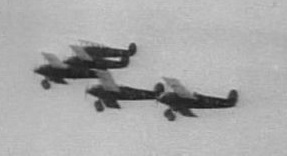
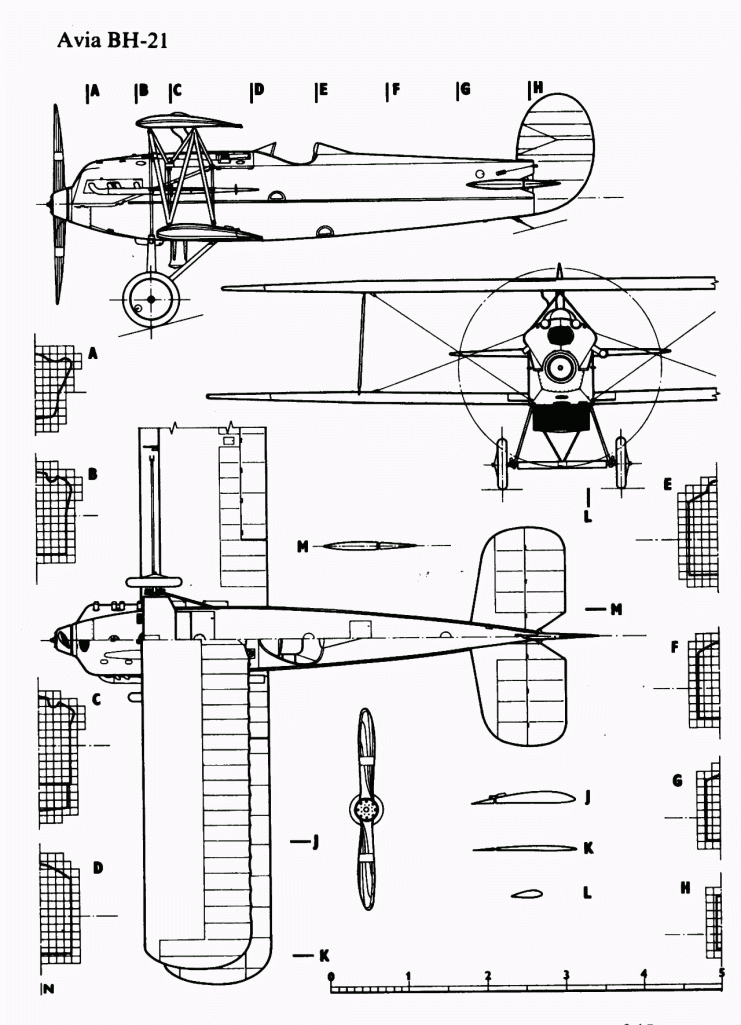
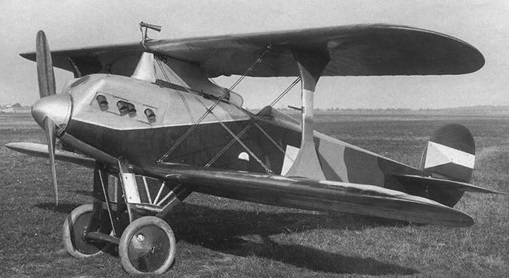
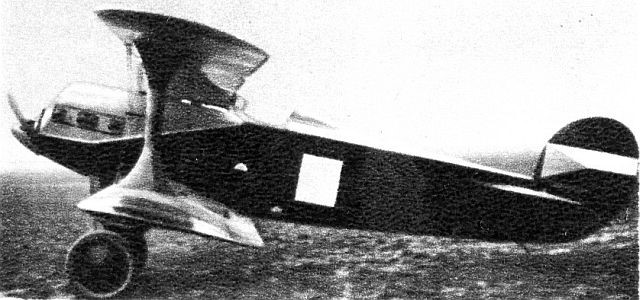
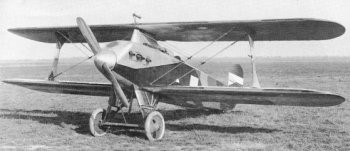
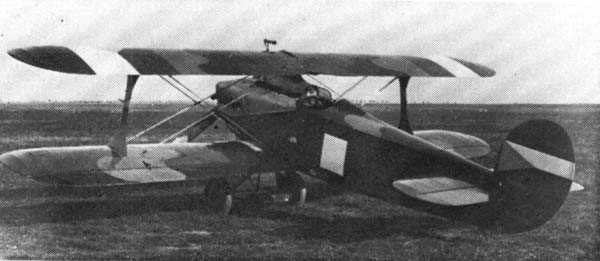
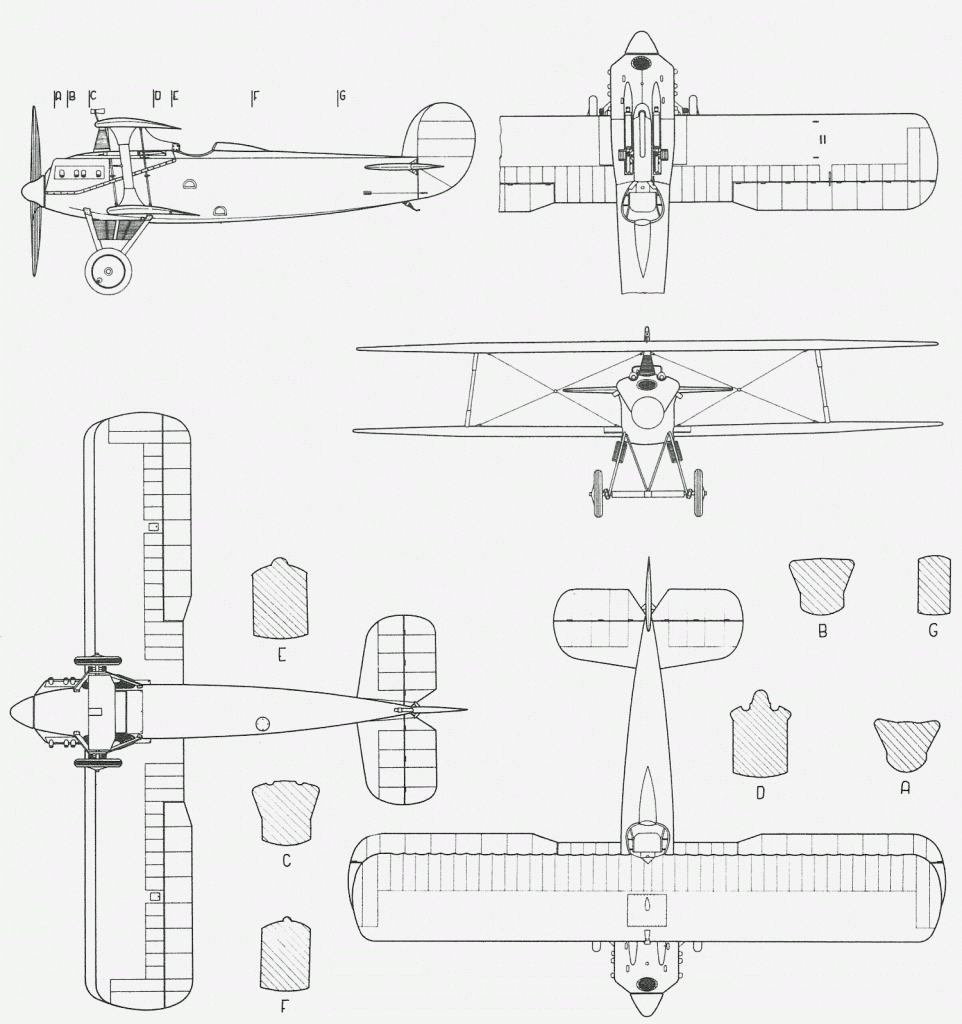
The 1925 BH-21 single-piston-engine one-seat biplane fighter/racing aircraft was a forerunner of a BH-22 military training fighter. A conventional biplane, the predecessor of the BH-21, the Avia BH-17, was designed by Pavel Beneš and Miroslav Hajn in 1922 as a response to a Czechoslovak Defense Department requirement for a new fighter aircraft. The BH-17 was actually only part of five Avia designs submitted to the Defense Department along with competing designs from the Letov Kbely and Aero companies. After extensive review, the BH-17, one of Avia’s three biplane designs, was chosen and limited production initiated for evaluative purposes.
Wings, tailplane, rudder and elevator wood-framed, covered by fabric. The steel-tube skeletal structure of fuselage covered by plywood, and fin fabric-covered.
Testing revealed some deficiencies in the BH-17 and a subsequent redesign in 1924 morphed the BH-17 into its final form as the BH-21 which included straightened interplane bracing and allowed for better field of view for the pilot.
A special training version, designated the BH-22, was also created. Both versions utilized 224 kW (300 hp) Hispano-Suiza 8fb engines built under license by Škoda.
The BH-21 was put into production in 1925 and had a one-year production run which yielded 182 aircraft with 137 being produced by Avia for the Czechoslovak Air Force, one more was built by Avia for SABCA and another 44 were produced under license by the Belgian company, Société Anonyme Belge de Constructions Aéronautiques “SABCA” for the Belgian Air Force.
There were also two experimental variants: BH-21J with Bristol Jupiter engine (predecessor of BH-33) and a single-seat clipped-wing race plane BH-21R with boosted HS-8Fb engine (298 kW/400 hp).
While in service, the BH-21 saw no combat as it was retired before the outbreak of World War II. In spite of this, it served as a stepping stone to the more advanced BH-33 and BH-34 types.
The BH-21’s most lasting achievement came when a racing version, the BH-21R, won several national air-race competitions in 1925 sporting an upgraded HS 8Fb engine producing over 298 kW (400 hp).
Avia B.21.96, nicknamed “Red devil”, which flew Czechoslovak acrobatic flyer František Malkovský. He died in its cockpith after the crash in Karlovy Vary on 8th June 1930
BH-21 Engine: 1 × Hispano-Suiza 8Fb, 227 kW (304 hp) @ 1,850rpm Wingspan: 8.9 m (29 ft 2 in) Wing area: 21.96 m2 (236.4 sq ft) Length: 6.87 m (22 ft 6 in) Height: 2.74 m (9 ft 0 in) Empty weight: 720 kg (1,587 lb) Max takeoff weight: 1,085 kg (2,392 lb) Maximum speed: 245 km/h (152 mph; 132 kn) at 3,000 m (9,843 ft) Endurance: 2 hours Service ceiling: 5,500 m (18,045 ft) Rate of climb: 521 m/s (102,600 ft/min) Time to altitude: 5,000 m (16,404 ft) in 16 minutes Crew: 1 Armament: 2 × 7.7 mm (.303 in) Vickers machine guns
Although the prototype BH-8 designed by Pavel Benes and Miroslav Hein, beat competing Letov S-7 and Aero A-20 types in competition, it was never accepted by the military. The IMO and engineers were not fully satisfied with its performance and characteristics. The original model BH-8 was reworked, as the Avia BH-17.
A number of characteristics of BH-8 was maintained – still it was the all-wood biplane upper wing seated on a central pylon, box structure of the fuselage and tail surfaces were not changed. Among the most significant structural changes include reduced wingspan, increased area of the wings and extended fuselage. Coolers were moved between the undercarriage struts. The oil tank was placed in the leading edge of the central pylon.
The first prototype was powered with a Hispano-Suiza 8Fb engine of 310 hp, and first flew September 5, 1923 with a demonstration to the Army on December 31 the same year. The BH-17 was armed with two 7.7-mm machine guns Vickers, mounted above the engine.
After successful completion of military trials, in June 1924 were ordered 24 BH-17. The first was B-17.2, which first flew 16 July 1924 (pilot Černohous). On August 16, 1924 it was followed by B-17.1 (Karl Fritsch).
The BH-17 first entered the fighter squadron in 1924. 32 and 34 squadron Aviation Regiment 1 in Prague received BH-17 from January to April 1925.
Although the aircraft Avia B-17 represented a considerable improvement to the previous BH-6 and BH-8, there were still problems. The fuel system failures occurred after just a few hours flown. Several times there was fire and subsequent destruction of virtually new aircraft. All B-17s were therefore withdrawn from use and passed back to the factory where they reconstructed fuel installations, and also rebuilt wings and tail.
Refurbished machines were returned to combat units, but were handed over to the fighter pilot school in Cheb. Here they lasted into the late twenties, when they were replaced by B-21.
Coloring all machines were classic – on upper and side surfaces tri-color camouflage, lower surfaces painted with aluminum paint. Engine cover, center pylon and spinner remained in the color of unpolished aluminum. Feathered coats of arms on the wing and tail, the fuselage side regimental emblem and the model and serial number. Propeller remained in the color of wood, varnished.
Further development of the B-17 was the construction of Avia B-21.
BH-17 Engine: Hispano-Suiza 8Fb, 221 kW / 310 hp Propeller: Two-blade wooden Upper wing span: 8.73 m Lower wing span: 8.86 m / 29 ft 0,81in Wing chord: 1.80 m Length: 6.73 m / 22 ft 0,95in Height: 2.65 m / 8 ft 8,32in Wing area: 21. 30 sq.m / 229.27 ft 2 Empty weight: 762 kg / 1680 lb Normal takeoff weight: 1072 kg / 2363 lb Maximum speed: 238 kph / 147.9 mph Cruising speed: 206 kph / 128 mph Practical range: 500 km / 310 mi Rate of climb: 358 m / min Practical ceiling: 8000 m / 26247 ft Climb to 3000 m: 7 min 10 s Climb to 5,000m / 16404 ft: 13 min Load factor: 10 Crew: 1 Armament: 2 x 7.7-mm Vickers Mk. 09 machine gun, 300 rpg
In 1948 the RCAF first obtained the Auster Mk VI, an improved, post-war model with a DeHavilland Gypsy Major engine, more fuel capacity and a longer undercarriage. The first of the Auster VI’s served with 444 (AOP) Squadron at the Joint Training School (JTS), Rivers, Manitoba. The RCAF retired the last of their Austers in 1958.
After taking the Auster AOP 6 and 7 from service, Beagle did buy them and refurbished them to civil use. They were sold to private customers as the A.61 Terrier.
A.61 Terrier
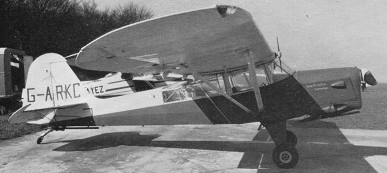
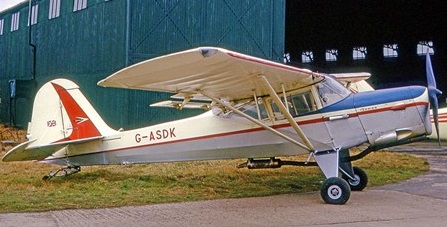
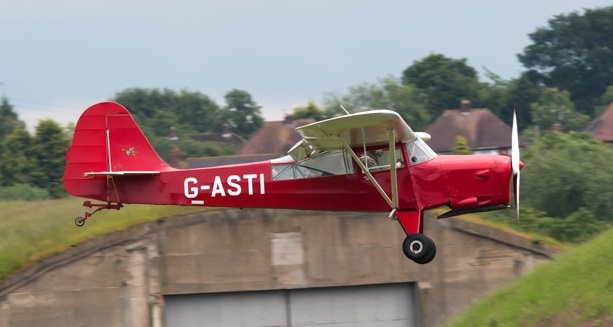
The Beagle Terrier was the name given to the modified Auster AOP (Air Observation Post) 6, after the Auster Aircraft Company was sold. The Auster Aircraft Company purchased a large number of former British Army Auster aircraft during the late 1950s. These were Auster AOP.6, T.7 and T.10 aircraft which were updated and modified with a de Havilland Gipsy Major 10-1-1 engine.
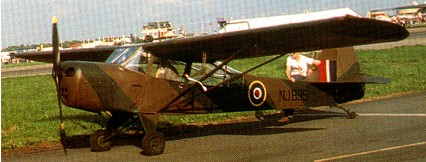
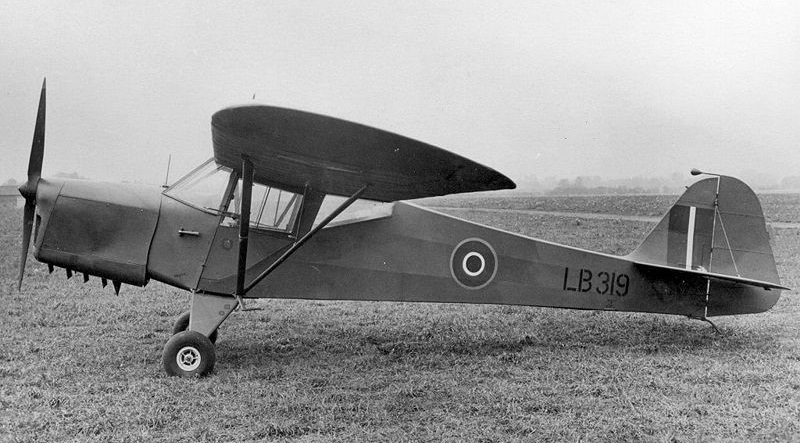
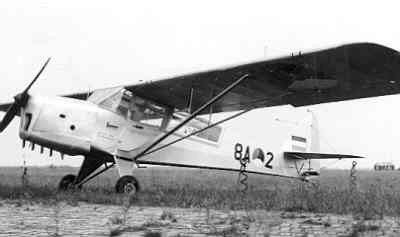
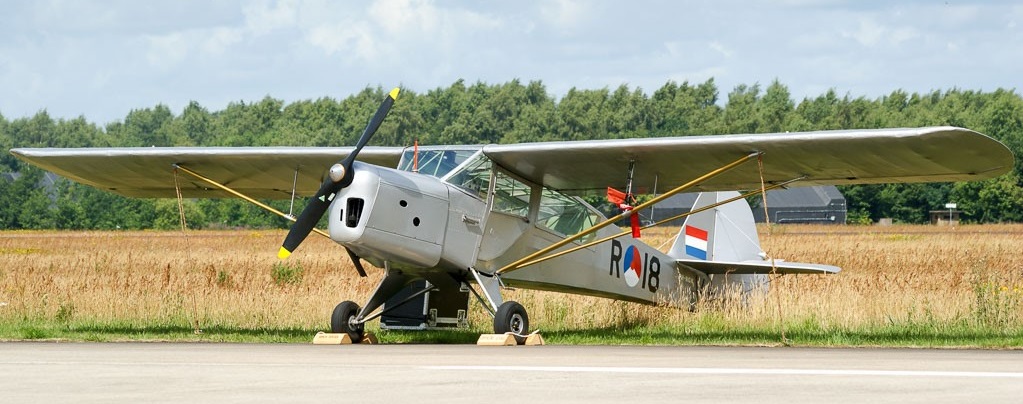
The AOP.6 and AOP.6A were modified AOP.5 with a strengthened rear fuselage, external flaps, increased MTOW, and 145 hp Gipsy Major 7. The prototype AOP.6 appeared in 1945 and 296 were supplied to the RAF, some of these being transferred to the Belgian Air Force. Others were supplied to the RCAF and SAAF, and a two-seat trainer version, the Auster T.7, was converted to full AOP standards in 1947. Initial production of the AOP.6 was completed in 1949, but further production was undertaken in 1952.
AOP.6
Initially two versions were offered for sale in the civilian market from 1960:
Auster 6A Tugmaster – a utility and glider towing aircraft
Auster 6B – a three-seat luxury version. When the company became part of Beagle Aircraft in 1960, the Auster 6B was renamed the Beagle A.61 Terrier 1.
Eighteen Terrier 1s conversions were built. The first conversion flew 13 April 1961 from Rearsby.
In 1962 the Beagle A.61 Terrier 2 was introduced with a greater span tailplane, wheel spats and a metal propeller. First flight of a Terrier Series 2 was made on 25 April 1962. The type is a three-seat touring and training monoplane. Sixty of these were sold by the beginning of March 1964. The conversions includes the complete overhaul of the airframe and engine, the provision of new tail surfaces and ailerons, and a sound-proofed three-seat cabin trimmed and upholstered. As a glider tug, the Terrier can tow an average two-seater to 2000 ft in 6 min 30 sec.
Forty-Five Terrier 2s conversions were completed at Rearsby. A small number of airframes were converted subsequently to this standard by other companies.
One Terrier 3 powered by a 160 hp Lycoming O-320-B2B engine was essentially complete at Rearsby when Terrier production was stopped in 1966. In 1967, an incomplete Terrier 2 was modified to this standard by British European Airways engineering apprentices and registered G-AVYK.
The Terrier was not an economic success for the manufacturer as it was found that more man-hours were spent on rebuilding each aircraft after its military use than were spent in building the new aircraft for the Army. Examples of the type were purchased by owners in the United Kingdom, Eire, Germany, Netherlands, New Zealand and Sweden. 23 Terriers were registered in the UK in 2013.
Of a total of 380 of AOP6 built, less that 100 were converted to Terriers between 1946 and 1953.
Auster 6A Tugmaster
The 6A Tugmaster and Terrier 1 were also rebuilt Auster Mk 6, but to lower standards.
Later adopted as the Auster T.7
The AOP.6 was developed from the Mk 5 with a modified fuselage and increased all-up weight and powered by a Gipsy Major 7 engine. Equipped with all-metal auxiliary aerofoil flaps below and behind trailing edge, and wings strengthened to take two 52.25 litre fuel tanks, the pilot and observer seated in tandem. Lengthened landing gear struts allowed a larger airscrew. Production completed in 1949. The T.7 was a two-seat trainer which could be quickly converted to full AOP standard. Equipped with side-by-side seating with dual controls, a third seat could be fitted.
AOP.6 Engine: de Havilland Gipsy Major VII, 145 hp Wingspan: 36 ft 0 in Wing area: 184 sq.ft Length: 23 ft 9 in Height: 8 ft 4.5 in Empty weight: 1413 lb Loaded weight: 2160 lb Max speed: 124 mph at 1000 ft Cruise: 108 mph ROC: 810 fpm Service ceiling: 14,000 ft Range: 315 mi
T.7 Engine: de Havilland Gipsy Major 130hp. Cruise speed: 114 mph.
T.7c Engine: de Havilland Gipsy Major VII, 145 hp.
Auster 6A Tugmaster
A.61 Terrier 60 converted from military AOP.6
A.61 Terrier 2 Engine: 1 x DH Gypsy Major 10, 145 hp / 107kW Take-off weight: 1090 kg / 2400 lb Empty weight: 727 kg / 1600 lb Wingspan: 11.0 m / 36 ft 1 in Length: 7.1 m / 23 ft 4 in Height: 2.7 m / 8 ft 10 in Wing area: 17.1 sq.m / 184.06 sq ft Max. speed: 191 km/h / 119 mph Cruise speed: 172 km/h / 107 mph Ceiling: 3500 m / 11500 ft Rate of climb: 530 ft/min (2.7 m/s) Range: 450 km / 280 miles Seats: 3
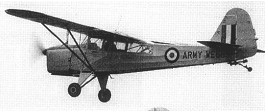
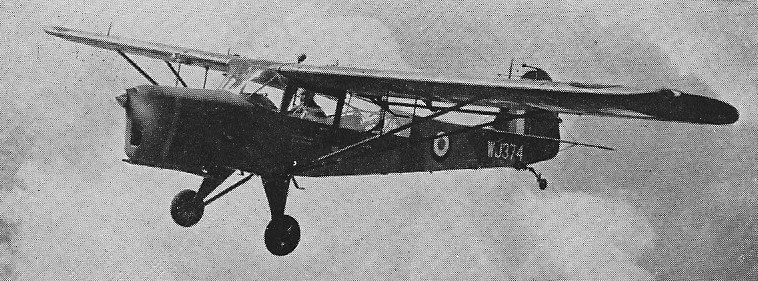
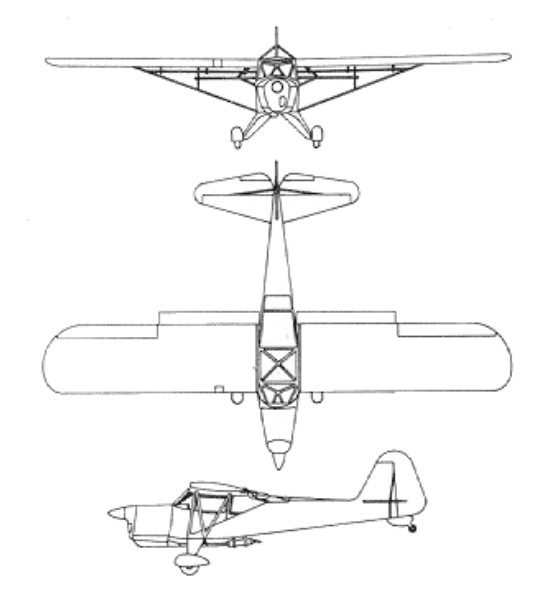
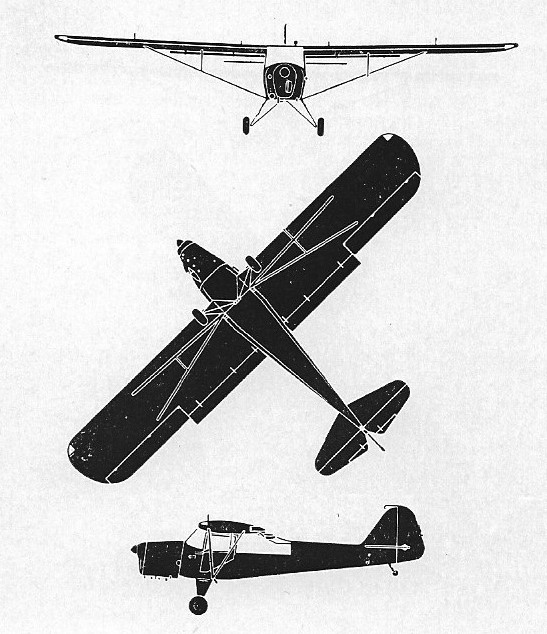
The Auster AOP.9 was designed as a successor to the Auster AOP.6. The AOP.9 was a completely new aircraft and not a development of a civil type. Apart from plastic tips and a fabric covering aft of the main spar, the wings are all-metal and are built round a stiff leading-edge torsion box. The split flaps have a hydraulic assist. Drooping ailerons assist with short landings and take-offs. One of its main features is the Dowty liquid spring undercarriage with large diameter tyres, capable of withstanding a vertical rate of descent of 9 ft/sec and allowing operation from virtually any type of landing surface.
It was a braced high-wing single engined monoplane with a fixed tailwheel undercarriage. The AOP.9 was a new design, the wing and tail metal-skinned, but the fuselage and ailerons were fabric-covered. The fin and rudder assembly were more angular in the new aircraft with a noticeable dorsal fillet. A combination of the 180 hp (134 kW) Blackburn Cirrus Bombardier engine, larger wings and large flaps gave it an improved take-off and landing performance compared with the AOP.6. It could operate from ploughed fields and muddy surfaces using low pressure tyres and strengthened undercarriage.
On the insistence of the British Army the fuselage is welded steel and fabric covered. A third seat can be fitted. A unique feature is the rear cockpit floor, designed to allow a complete and rapid change of role. With the removal of six bolts the floor may be lowered out of the aircraft and a new floor, complete with equipment, can be substituted in a few minutes.
The cabin held three seats, pilot and passenger side-by-side and the observer behind, facing either forwards or rearwards. The aircraft was also designed to be convertible into a two-seat light transport with an interchangeable rear floor. In this configuration the observer sat alongside the pilot.
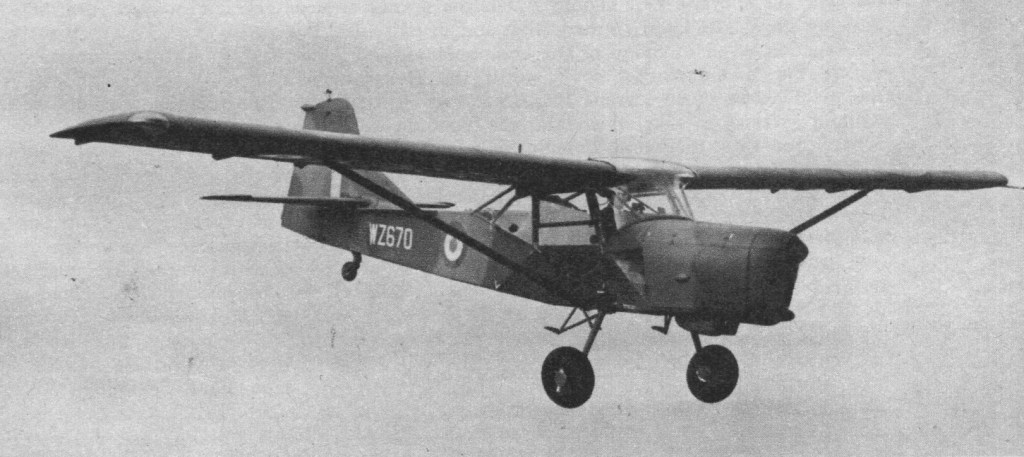
The prototype WZ662, which was also the first production machine, first flew 19 March 1954 with a 180 hp / 134kW Blackburn Cirrus Bombardier 203 (military version of 702) engine. Auster Aircraft allotted its model designation B5 to the AOP.9 design.
Deliveries started to the Royal Air Force in February 1955, replacing AOP.6s in the regular AOP squadrons, the auxiliary squadrons disbanding in March 1957 before receiving AOP.9s. Until the formation of the Army Air Corps (AAC) in September 1957, Army personnel flew RAF aircraft based in RAF squadrons.
The aircraft were in action with No. 656 Squadron from September 1955, flying an average of 1,200 sorties per month. By the end of Operation Firedog in Malaya on 31 July 1960, 656 Squadron’s AOP.6 and AOP.9s had carried out 143,000 sorties.
Over 6 million leaflets were dropped by Austers of no.656 Sqn RAF dring the Malayan conflict.
The AOP.9s were involved in several of Britain’s other end of Empire conflicts; 653 Squadron AAC used them in Aden in the early 1960s, flying from Falaise, Little Aden. They stayed in service until 1966 and were the last fixed wing AOP aircraft used by the AAC, though their light transport role was taken over by Beavers.
AOP.9s were supplied to the Indian Air Force and the South African Air Force operated its AOP.9s from 1957 to 1967.
The Army Historic Aircraft Flight maintain an AOP.9 in flying condition at Middle Wallop.
A total of 182 were built and in the 1970s, 19 AOP.9s joined the UK civil register, and in 2008 14 remained, though only about three of these had a current certificate of airworthiness.
A number of army surplus aircraft were bought by Captain Mike Somerton-Rayner in 1967. One was converted as an Auster 9M with a 180 hp (134 kW) Avco Lycoming O-360-A1D piston engine. The 9M first flew on 4 January 1968, and gained a Certificate of Airworthiness on 30 April 1968. The aircraft was still airworthy in 2009.
Operators Military operators
Hong Kong Royal Hong Kong Auxiliary Air Force about 4 ex-British AAC aircraft various ACC AOP and Independent Flights stationed in Hong Kong in the 1950s and 1960s
India – About 35 aircraft Indian Air Force Indian Army
South African Air Force about 2 aircraft
United Kingdom – about 145 aircraft
Army Air Corps 653 Squadron 656 Squadron Advanced Fixed Wing Flight Army Flights: 2, 3, 5, 6, 7, 8, 10, 11, 12, 13, 14, 16, 18, 20, 21. Various Army Regiments
Royal Air Force 651 Squadron 652 Squadron (1956–1957) 656 Squadron (1955–1957) 657 Squadron Light Liaison Flight, South Korea Christmas Island Flight, 160 Wing 1900 Flight (Hong Kong) 38 Group Communications Flight Upavon Light Aircraft School Middle Wallop
AOP 9 Engine: Blackburn Bombardier 203, 173 hp (129 kw) Span: 36 ft 5 in / 11.10 m Wing area: 197.6 ft² / 18.36 m² Length: 23 ft 8.5 in / 7.24 m Height: 8 ft 11 in / 2.72 m Empty weight: 1,460 lb / 663 kg Max. takeoff weight: 2,330 lb / 1,057 kg Max speed: 127 mph / 204 km/h Cruise speed: 110 mph / 178 km/h Range: 242 miles / 389 km Service ceiling: 18,500 ft (5640 m) Rate of climb: 920 ft/min / 280 m/min Crew: 2/3
Auster Beagle built over 1600 Mark (Mk) I-V’s for the British Army, which used all but the Mk II in their Air Observation Post (AOP) squadrons. The Auster’s main roles were artillery spotting, supply drops, liaison, casualty evacuation and photographic reconnaissance, for which it was well-suited; its short take-off and landing (STOL) abilities enabled it to operate from small landing fields.
254 Mk.IV were built, based on the Mk II but with a larger cabin for one extra person.
Auster Mk IV Type: three-seat air observation post. Engine: one 130-hp (97-kW) Lycoming 0-290-3. Maximum speed 130 mph (209 kph) at sea level Range 250 miles (402 km). Empty weight: 1,100 lb (499 kg); Maximum take-off weight: 1,850 lb (839 kg). Wing span 36 ft 0 in (10.97 m) Length 22 ft 5 in (6.83 m) Height 8 ft 0 in (2.44 m) Wing area: 167.0 sq ft (15.51 sq.m). Armament: none.
The Auster II was a re-engined aircraft with an American 130 hp (97 kW) Lycoming O-290 engine. Due to the shortage of American engines that version was not built but led to the two-seat, composite wood and metal structure, fabric covered, Auster III (Model E), which was the same as the Auster I but had a 130 hp (97 kW) de Havilland Gipsy Major engine.
Auster Beagle built over 1600 Mark (Mk) I-V’s for the British Army, which used all but the Mk II in their Air Observation Post (AOP) squadrons. The Auster’s main roles were artillery spotting, supply drops, liaison, casualty evacuation and photographic reconnaissance, for which it was well-suited; its short take-off and landing (STOL) abilities enabled it to operate from small landing fields.
Auster AOP Mk.3
In January 1945 the Dutch Auster squadron RAF became operational. It was equipped with 19 Auster III’s which were mainly used for liaison purposes.
AOP.3
The RAAF Auster AOP Mk IIIs, of which A11-1 was originally a Mk II, were allotted to Nos 16 and 17 AOP Flights, and the official history ‘Air War Against Japan’ describes these aircraft in operations. Somewhat surprisingly, the volume also pictures A11-5 with aggressive “sharks teeth” markings.
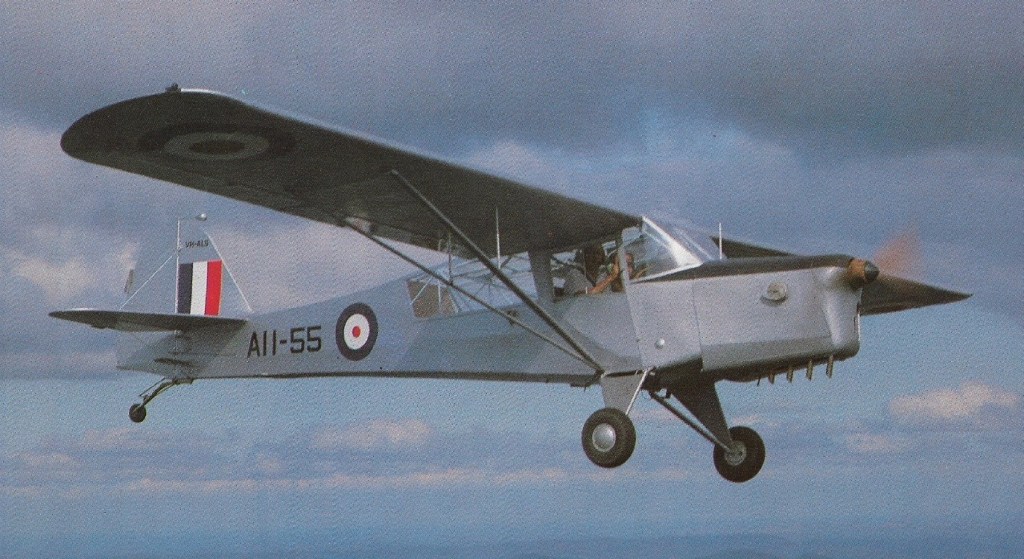
Auster III VH-ALS / A11-55 (c/n 293)
In post-war years, Auster continued to operate with No 16 AOP Flight until 24 July 1959 when A11-41 and A11-53 were flown from Canberra to Tocumwal by Captain Doyle and Lieutenant Constable, the latter being the last Auster-trained pilot before the arrival of the Cessna 180As. In all 56 Mk III and two Mk V Austers appeared on the RAAF register.
A small number of these aircraft (23+) were used in Greece by 345, 346 and 347 Reconnaissance Flights from 1945 to 1948, before being replaced by the T-6 Harvard. They were also used as medical transport and liaison airplanes and at least one was used by the Anti-malarial Squadron. They were all withdrawn by 1953.
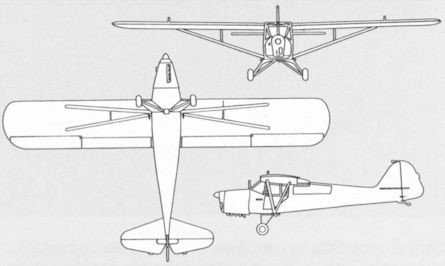
Auster AOP Mk III Engine: 130-hp/97-kW de Havilland Gipsy Major I Wingspan: 10.97 m (36 ft) Length: 7.14 m (23ft 5in) Height: 2.44 m (8ft). Empty weight: 476 kg (1100lb) Loaded weight: 771 kg (1,700lb). Maximum speed: 209 km/h (113 kt) Cruising speed: 174 km/h (94 kt) Initial climb: 213 m (700 ft)/min Ceiling: 15,000ft (4572 m) Range: 402 km (217 nm) Armament: None Crew: 2





 All Aero