
The HP.25 Hendon naval torpedo bomber of 1923 was a two-seat version of the earlier Hanley.
The HP.25 Hendon naval torpedo bomber of 1923 was a two-seat version of the earlier Hanley.
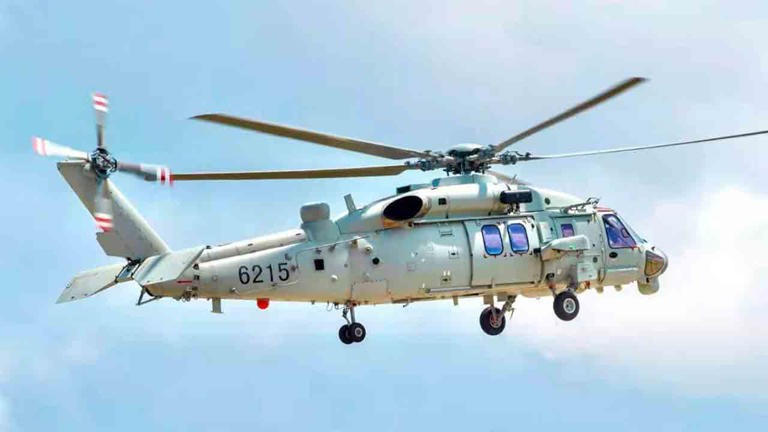
As part of this modernization, the Zhi-9S and Ka-52 helicopters were being replaced in 2025 by the new Zhi-20F anti-submarine helicopters aboard the fourth production batch of Type 052D guided-missile destroyers.
Zhi-20F Specifications:
Engines: two WZ-10 turboshaft engines, 2,100 – 2,700 hp
Length: 20 meters
Height: 5.3 meters
Maximum speed: 360 km/h
Cruising speed: 290 km/h
Maximum takeoff weight: 10 tons
Service ceiling: 6,000 meters
Flight range: 560 km

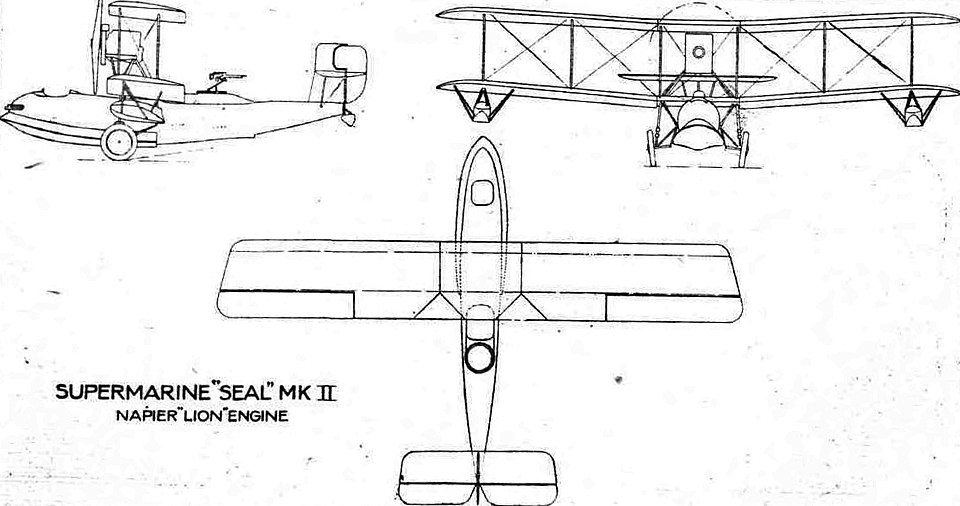
The Supermarine Seagull was a flying boat produced by the British aircraft manufacturer Supermarine. It was developed by Supermarine’s chief designer R.J. Mitchell from the experimental Supermarine Seal II.
Development of the Seagull started during 1920. In June 1921 it was evaluated for military applications but was rejected, and so Supermarine developed the aircraft as a private venture. During February 1922, an initial order for two aircraft was placed by the Air Ministry; subsequent production of the Seagull is believed to have assisted Supermarine to survive during a period when the aircraft industry struggled to attract customers.
The Seagull was used by the British Fleet Air Arm for gunnery spotting and reconnaissance duties. It was operated by the Royal Australian Air Force for similar purposes. During the early 1930s, when the type was being replaced by the more successful Supermarine Walrus, a number of Seagulls were re-used for civilian purposes.
The origins of the Seagull are heavily interconnected with the Supermarine Seal and the Supermarine Commercial Amphibian. Work on the Seal, which started in 1920, sought to build upon the Commercial Amphibian. A range of alterations and improvements were incorporated, many of which were drawn from the Commercial’s official review. The Commercial Amphibian was later designated as the Seal Mk I—and the new design, initially known as the Seal Mk II, later became the Seagull.
N158, the prototype of the Seagull, flew for the first time in May 1921. On 2 June 1921, having completed manufacturer’s trials, it was handed over for service trials with the Royal Air Force. Attention was paid to the aircraft’s seaworthiness and handling characteristics at low speeds, including its relatively low landing speed. Trials revealed that the rudder gave poor yaw characteristics. New designs were tested until a fin extension was found to solve the issues, which was incorporated into the prototype. Having been sufficiently impressed by the aircraft’s performance, two aircraft were ordered by the Air Ministry in February 1922. The prototype was shown at the 1922 RAF Display at Hendon Aerodrome.
The Supermarine Seagull was an amphibian flying boat, powered by a single Napier Lion engine. This engine was mounted in a nacelle slung from the aircraft’s upper wing and powered a four-blade propeller in a tractor configuration. The Seagull employed gravity feed to supply fuel for the engine, and was the first single-engined flying boat to use this method.
The lower wing was set in the shoulder position and had two bays. The floats were attached to the lower wing near the wingtips via struts, their positioning maximised buoyancy. For land operations, the Seagull was equipped with a retractable undercarriage; pilots lacked aids such as indicators or alarms, thus were reliant on training and memory to deploy the undercarriage when applicable. For easier stowage on board ships, the wings were designed to be folded, which necessitated mounting the wings in a relatively forward position on the fuselage.
The fuselage had an oval cross-section and had a planing bottom with two steps. The interior of the fuselage was divided into several watertight compartments. The three-man crew—pilot, observer, and radio-operator—each had an open cockpit. The pilot was seated in a relatively forward position, at a distance from the other crew members, being directly ahead of the fuel tanks; the cockpit was provisioned with a single retractable machine gun. The radio operator was located just behind the wing, while the rear gunner position was further back still. The majority of the aircraft was constructed from wood.[9] Previous Supermarine aircraft had incorporated the fuel tanks into the hull; with their removal to the upper wing, the Seagull’s crew gained full access within the interior of the aircraft.
On 4 July 1922, the name Seagull was adopted for the type. The prototype was designated as the Mk I; the subsequent production aircraft were given the designation Seagull Mk II. The two versions were similar, although an alternative powerplant in the form of a single more powerful Napier Lion III engine, a reduced wingspan, and a larger fin were used in the Mk II. Production of the Seagull (with serial numbers in and around N9642–N9647) began in 1922. In total, 25 aircraft were built for the Air Ministry and the Royal Navy; their production has been seen as critical to the survival of Supermarine at this time, and the first orders were intentionally built in small batches to ensure that the firm received enough business to stay operational.
In 1925, construction of the improved Mk III began for the Royal Australian Air Force (RAAF), following an order being placed in January of that year. This type featured a more powerful Napier Lion V engine, and the radiators were redesigned so as to be able to operate in tropical regions. The RAAF received six Mk IIIs were between 1926 and 1927. In 1928, one of the Seagull Mk IIs (the so-called Mk IV) was rebuilt with Handley-Page leading edge slots and twin fins and rudders.
Seagull III were delivered to the RAAF in 1926-27 to replace Fairey IIID. They were flown by No 101 Fleet Co-operation Flight, an RAAF unit under the operational control of the RAN. They flew briefly from the RAN seaplane carrier HMAS Albatross and subsequently from cruisers. Under-powered, incapable of catapult launch the Seagulls were withdrawn from service in 1934.
Powerplant: 1 × Napier Lion IIB W-12, 492 hp (367 kW)
Wingspan: 46 ft 0 in (14.02 m)
Length: 37 ft 9 in (11.51 m)
Height: 14 ft 0 in (4.27 m)
Wing area: 593 sq ft (55.1 sq.m)
Empty weight: 3,820 lb (1,733 kg)
Gross weight: 5,691 lb (2,581 kg)
Maximum speed: 98 mph (158 km/h, 85 kn) at 3,000 ft (914 m)
92 mph (80 kn; 148 km/h) at 6,500 ft (1,981 m)
Endurance: four hours, 30 minutes
Service ceiling: 9,150 ft (2,790 m)
Time to altitude: 3,000 ft (914 m) in7 minutes 43 seconds
Armament: Guns: One × .303 in (7.7 mm) Lewis gun
Crew: 3 (pilot, wireless operator & observer)

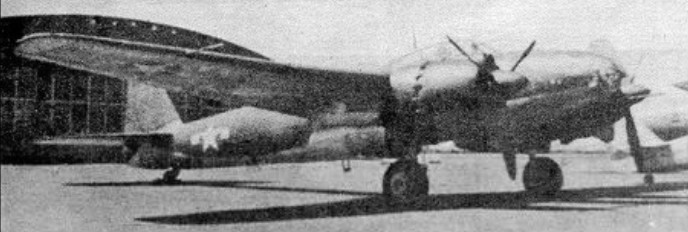
Designed to meet a Yugoslav Air Force requirement for a twin-engined crew trainer / transport, the prototype Type 214-D flew in 1951, powered by two 480 hp Ranger SVG-770 engines. A change to 600 hp Pratt and Whitney R-1340-AN-1 radials was made for production aircraft, which entered service in 1957.
As a transport the 214-D can carry a crew of two and eight passengers. In its primary role as a crew trainer, it is able to provide simultaneous instruction for pilots, navigators, bomb-aimers and radio operators.
Construction is of all-wood, except for the tail control surfaces, which are metal with fabric covering. Provision is made for carrying practise bombs and rockets under the wings.
Engines: 2 x 600 hp Pratt and Whitney R-1340-AN-1
Wing span: 53 ft 1.5 in
Length: 35 ft 9 in
Gross weight: 11,080 lb
Max speed: 226 mph
Range: 670 miles

The Shenyang FC-31 Gyrfalcon (also referred to as the J-35 in its naval variant) represents China’s second stealth fighter program and its first carrier-capable fifth-generation aircraft.
The FC-31 features a conventional twin-engine layout with canted vertical stabilisers similar to the F-22.
The aircraft incorporates internal weapons bays to preserve stealth characteristics and uses advanced composite materials to reduce weight and radar signature.
Powered by Russian-designed RD-93 derivatives (the Chinese WS-13 engines), production variants are expected to receive the more powerful WS-19 engines currently under development. These will enable the FC-31 to reach speeds of Mach 1.8 (2,205 km/h) and achieve supercruise capability.
With an estimated unit cost of $70 million, the FC-31/J-35 represents China’s strategic push to modernise its naval air arm. Initial operational capability on China’s newest carriers is expected by 2026, potentially altering the balance of power in the Western Pacific.

First flown in mid-1917, the Zeppelin-Staaken R VI, with 18 examples built, was to be by far the most numerous of the giant, long ranged R-planes. Powered either by four 245hp Maybach Mb IVs, or four 260hp Mercedes D IVa engines, mounted back to back in twin nacelles to drive two pusher and two tractor propellers, the R VI’s top level speed was 135km/h, while its normal range with a 1000kg bomb load was around 880km. Delivered to Rf Abt 501, by now transferred to the Western Front, the RVIs sometimes operated alongside their smaller G type bretheren in raids against the English mainland and more distant French ports and cities.
The Navy operated a sole, float-equipped example of this bomber under the designation Zeppelin-Staaken Type L, serialled 1432. It was wrecked during trials in 1918.
R.VI
Engine: 4 x Maybach Mb.IV, 183kW
Max take-off weight: 11848 kg / 26121 lb
Empty weight: 7921 kg / 17463 lb
Wingspan: 42.2 m / 138 ft 5 in
Length: 22.1 m / 73 ft 6 in
Height: 6.3 m / 21 ft 8 in
Wing area: 332 sq.m / 3573.61 sq ft
Max. speed: 135 km/h / 84 mph
Ceiling: 4320 m / 14150 ft
Range: 800 km / 497 miles
Crew: 7
Armament: 4 x 7.92mm machine-guns
Bombload: 2000kg
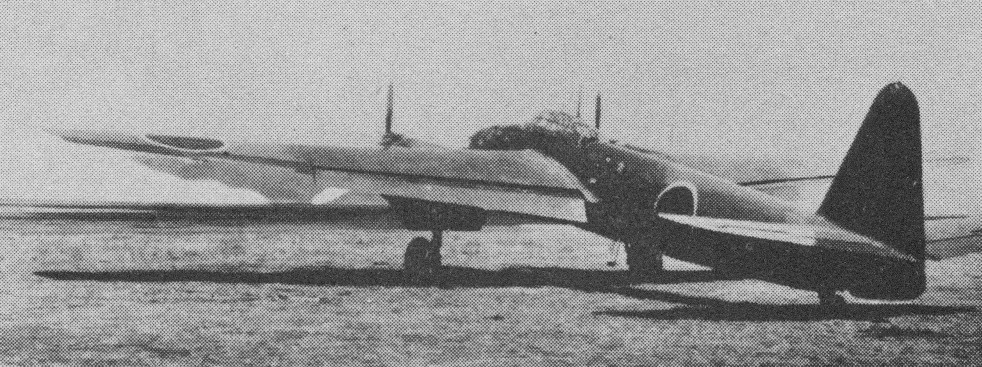
Requiring a fast medium bomber for dive-bombing, low-altitude bombing or torpedo attack, the Imperial Japanese Navy instructed the Yokosuka First Naval Air Technical Arsenal in 1940 to begin design of such an aircraft. The resulting Yokosuka P1Y prototype flown in August 1943 was a mid-wing, all-metal monoplane, powered by two Nakajima NK9B Homare 11 radial engines. Its performance was satisfactory, but the P1Y suffered from maintenance problems that plagued its service life.
The entry into service of the P1Y1 Navy Bomber Ginga Model 11 was in 1943.
As the war neared its end, Japan required defensive fighters and steps were taken to produce a night fighter version of the Ginga.
The contract for this was awarded to Kawanishi, who’s P1Y2-S Kyokko (Aurora) utilised the less troublesome 1850 hp Kasei 25 engines, was fitted with an AI radar ad three 30mm cannon. Only 97 P1Y2-S were completed before VJ day, although a few P1Y1-S conversions from Nakajima-built bombers saw limited operational service.

Production totalled 1098, built by Kawanishi (96) and Nakajima (1002), and if there had been adequate manpower to service these aircraft before each operational sortie they would have proved formidable adversaries. This was not possible and as a result the Ginga (Milky Way), allocated the Allied codename ‘Francis’, was tried unsuccessfully in a variety of alternative roles; its brief operational life of only six months was terminated by the end of the Pacific war.
P1Y1
Engines: 2 x Nakajima Homare-21, 1370kW
Max take-off weight: 10500 kg / 23149 lb
Empty weight: 7265 kg / 16017 lb
Wingspan: 20.0 m / 66 ft 7 in
Length: 15.0 m / 49 ft 3 in
Height: 4.3 m / 14 ft 1 in
Wing area: 55.0 sq.m / 592.01 sq ft
Max. speed: 550 km/h / 342 mph
Cruise speed: 380 km/h / 236 mph
Ceiling: 9400 m / 30850 ft
Range w/max.fuel: 4650 km / 2889 miles
Range w/max.payload: 1900 km / 1181 miles
Crew: 3
Armament: 2 x 20mm cannons
Bombload: 1000kg
P1Y1
Engines: 2 x Nakajima Homare-11, 1820 hp
Wingspan: 65 ft 7 in
Length: 49 ft 3 in
Height: 14 ft 1 in
Empty weight: 14748 lb
Loaded weight: 10500 kg / 23149 lb
Max speed: 345 mph at 19,260 ft
Service ceiling: 33,530 ft
Max range: 1600 mi
Armament: 1 x 20mm cannons / 1 x 13.2mm mg
Bombload: 1760 lb or 1 x 1875 lb torpedo (externally
Crew: 3


Japan’s naval officers, in the summer of 1944, were faced with the almost sure knowledge that their country’s defeat was simply a matter of time. Even before Vice Admiral Ohnishi ordered the creation of the Kamikaze Special Attack Force in October 1944, some naval officers were seeing suicide attacks as the only way to defeat the Allied fleets. One of these men was a transport pilot of the 405th Kokutai, Ensign Mitsuo Ohta. He conceived the idea of a rocket-propelled suicide attack plane, and with the aid of personnel from the University of Tokyo’s Aeronautical Research Institute, he drafted preliminary plans for his brainchild. In August 1944 he submitted his drawings to the Naval Air Technical Arsenal at Yokosuka. The Navy decided that Ensign Ohta’s idea had merit, and so the Arsenal was instructed to prepare a set of detailed blueprints – the engineers involved were Masao Yamana, Tadanao Mitsugi, and Rokuro Hattori. The Ohka (Cherry Blossom) was, in effect, a manned anti-shipping cruise missile of the Pacific War.
The MXY7, as the design was named, was intended as a coastal-defense or anti-invasion weapon, launched by a “parent” aircraft. Once released by its “mother” ship – usually a G4M twin-engined bomber – the MXY7 would glide downwards, and once the pilot had selected a target, the weapon would accelerate to attack speed using the power of three solid-fuel rockets mounted in the tail. These rockets could be fired one at a time or all three simultaneously. Theoretically, when it was at its terminal velocity, the MXY7 would be virtually impossible to stop, and only pilot error could cause it to miss. This small but lethal aircraft was to be built of wood and non-critical metal alloys, utilizing unskilled labor, and as it would be flown by pilots with only limited aerial experience, flight instruments were to be kept to a bare minimum and good maneuverability was required to achieve accuracy in flying and aiming the “manned missile”.
The actual aircraft itself looked like a torpedo to which wings and twin tail surfaces had been added. Barely 20 feet long, and with wings spanning just over 16½ feet, its sliding canopy was hump-backed. In front of the canopy was a ring sight, with a bead sight in front of that, for precise aiming when in the terminal dive on a target. The Ohka was built by unskilled workers using as much non-strategic material as possible. The fuselage was a standard aluminium structure, but the wings were made of moulded plywood covered in fabric. Cockpit instrumentation consisted of only four instruments: a compass, an airspeed indicator, an altimeter and an inclinometer for turn indication.
Ten MXY7s were completed by the end of September 1944. Unpowered flight trials began at Sagami the following month, and in November the first powered flight was made at Kashima. The MXY7 was accepted for Navy service under the name Navy Special Attacker Ohka Model 11. It was powered by a battery of three Type 4 Mark 1 Model 20 rockets, which produced 1,764 pounds of thrust, combined, for 8 to 10 seconds of powered flight. Performance measured during an unmanned flight at Kashima in January 1945 indicated that the Ohka could reach a top unpowered speed of 288 mph and a top powered speed of 403 mph, both speeds being attained at a height of 11,485 feet.
The Imperial Navy didn’t bother to wait for all test results to come in; production began with the first ten Ohka Model 11s in September 1944, and 755 were built by the end of March 1945, when production of this variant ceased. One hundred and fifty-five were built by the Naval Air Technical Arsenal at Yokosuka, and 600 more by the First Naval Air Arsenal at Kasumigaura; Nippon Aircraft Ltd. and Fuji Aircraft Ltd were subcontractors for the wings and tail units. But barely a hundred of them were actually used in operations.
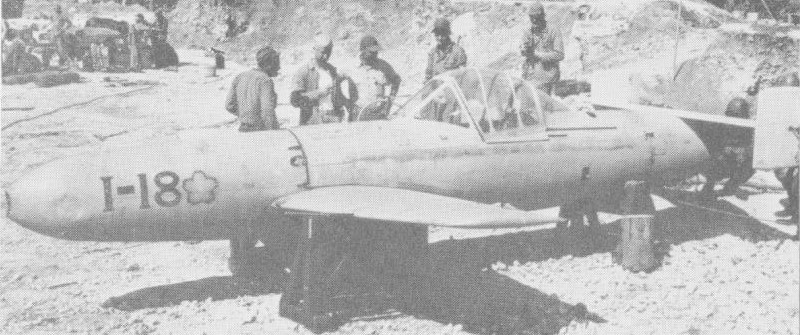
The Ohka’s debut was highly inauspicious. Sixteen G4M2e mother planes of the 721st Kokutai, each carrying a single MXY7, took off from Kanoya on March 21, 1945 to attack an American carrier task force 320 miles off the coast of Kyushu, the southernmost of the four main Japanese home islands. Two additional Bettys went along as navigation and radio planes. Their commander was Lt. Cdr. Goro Nonaka, a veteran torpedo bomber pilot. Nonaka’s last words, just before he entered his bomber for the mission, were “This is Minatogawa.” He was referring to the battle in the 14th Century Japanese civil war between the Northern and Southern imperial courts, where one of Japan’s greatest military heroes, the Southern commander, Masashige Kusunoki, killed himself after losing, saying, “Shikisei hokoku!” (I wish I had seven lives to give for my country!) The attack was a complete, humiliating fiasco. Fifty-five Zero fighters from the 201st Kokutai were assigned to fly escort, but mechanical failure caused by poor maintenance forced some fighters to abort without leaving the ground, and others had to abort when airborne. Only 30 Zeros actually accompanied the 18 Bettys to the combat area, where fifty F6F Hellcats attacked them well before they reached optimal launching range. Ignoring the escort fighters, the American carrier fighters concentrated on the bombers and their strange under-belly cargo. All of the Ohkas were jettisoned (the pilots remained with the mother ships), but 15 of the Bettys were destroyed.
Three more, including Cdr. Nonaka’s, tried to take cover in a nearby bank of clouds, but they were soon found and shot down as well. Fifteen of the 30 escorting Zeros were also lost, with the remnant returning home in varying states of damage.
This episode pointed up the worst failings of the Ohka, or Baka (“stupid” in Japanese. Widely known as Gizmo before Baka was selected on the suggestion of a US Navy Petty Officer) as the Allies called it: the mother aircraft, when carrying it, was a fat, wallowing aerial whale, lacking speed and maneuverability, easy meat for defending interceptors. And the Ohka lacked range, even when gliding; it had to be launched from no more than 20 nautical miles (23 statute miles) away from its prospective target. Very few Ohkas actually struck their targets, as it was so difficult to launch and to maneuver under its pilot’s hands. But once released, and once the rockets were ignited, the Ohka was impossible to stop. Its first successes were scored the first day (April 1, 1945) of the American invasion of Okinawa, when the battleship West Virginia and three transports were hit, and on April 12, an Ohka scored its first sinking by sending the destroyer Mannert L. Abele to the bottom of the sea. The destroyer-minesweeper Shea was hit by an Ohka on May 4, and barely escaped total loss, as a fire started by the Ohka almost reached the ship’s magazines before the damage-control men brought it under control. Its last success came on June 16, when an Ohka and a bomb-carrying Zero almost simultaneously struck the destroyer Twiggs, which sank within a few minutes.

In all, the Okinawa campaign cost the US Navy 40 ships sunk or damaged beyond repair and 368 damaged to varying extents, often seriously. The US Navy lost more sailors dead and wounded than the Army and Marines lost in the ground combat, making Okinawa, next to the Guadalcanal campaign, the bloodiest and most difficult of the war for the Navy. The Japanese lost about 7,600 planes, more than half of which were suicide planes; the Americans lost 763 planes of their own. It is not known for sure exactly how many Ohkas scored hits and sinkings.
It might be well to mention here that a number of Ohkas were captured on Okinawa itself. Apparently, the Japanese shipped several Ohkas to that island before the campaign opened, probably meaning to use the airfield at Yontan as a refuelling and arming point. But American aerial supremacy never allowed the Japanese to base any aircraft there after about March 25, and the Americans took Yontan very quickly after the landings. And so, the MXY7s were never used, and quite a few “Baka bombs” were captured intact. Most of the surviving examples in museums came from this source.
Further development of the basic Ohka theme continued, but no other variants other than the Model 11 were used in combat.
K-1
Forty-five examples of the Ohka K-1, an unpowered trainer with water ballast replacing the powerplant and warhead, were produced by Yokosuka to provide pilots with limited experience in handling a simulation of the real thing in flight. Both water ballast tanks would be emptied during the practice terminal dive, slowing the landing speed to 138mph, and the glider would then land on retractable skids.
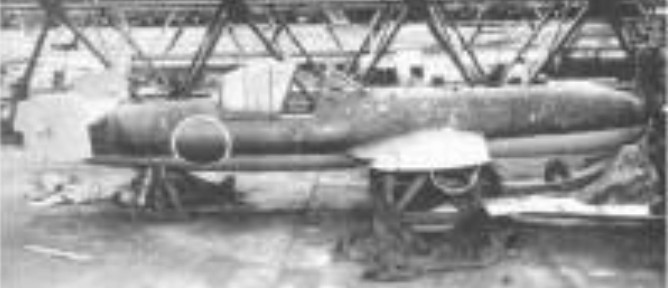
Ohka Type 22
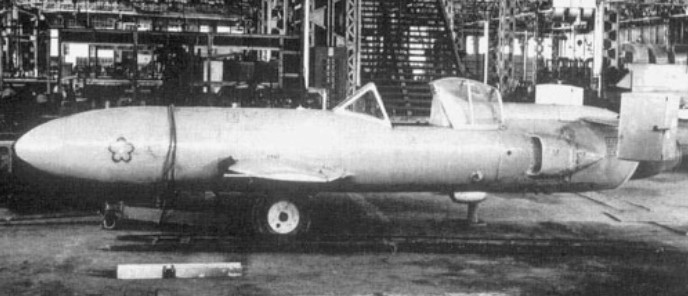
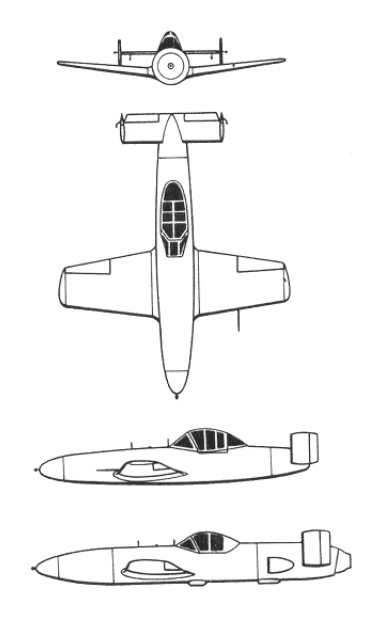
The Ohka Model 22 was intended as an improved version to be launched from the faster and more maneuverable P1Y3 variant of the Navy’s Ginga bomber. Because the Ginga could not carry the same payload as the G4M2e, and because of the limited space under the P1Y3 compared to the Betty mother plane, the Ohka 22 was to have shorter wings and a lighter explosive payload (1,323 lbs.). The Ohka 22 received a Tsu-11 turbojet – a Campini-type jet engine – with a 100-hp Hitachi HA11 four-cylinder inline engine driving a single-stage compressor as a gas generator. The engine was fuel injected but engineering analysis after the war suggests that this had limited effect and that in reality the unit was little more than an afterburning ducted fan engine as the majority of the thrust came from the compressor. The Ohka was adapted to accommodate the engine by lengthening the fuselage with intakes on the side. It was hoped that the Ohka would have greater range with this jet engine, and so the mother ships could more easily survive attack by releasing the Ohka 22 farther away from target.
Fifty Ohka 22s were built by Yokosuka, and an ambitious production scheme was planned, with Aichi doing most of the final assembly and with the smaller concerns of Murakami, Miguro, and Fuji serving as subcontractors. But due to the increasingly bad war situation, Aichi was unable to begin production, so the Imperial Navy planned to concentrate Ohka 22 production in underground factories managed by the Air Arsenal at Kasumigaura. The war ended before any of the underground factories could be completed. One Ohka 22 was test-flown in July 1945, launched by a Betty because the proposed P1Y3 Ginga was not yet built, but auxiliary rockets installed under the Ohka’s wings ignited prematurely just after release, and the Ohka 22 went into an unrecoverable stall, killing its pilot.
A single example of a Tsu-11 engine is preserved at the National Air and Space Museum in Washington DC. In 1997 it was installed in the museum’s Ohka 22 during its restoration.
Ohka Model 43 K-1 Kai Wakazakura (Young Cherry)
The Ohka Model 33 was an enlarged Model 22 powered by a Ne-20 turbojet and fitted with a 1,764-lb. warhead. Its intended mother ship was the G8N1 Renzan four-engined bomber, but the low priority given the G8N program led to the Ohka 33’s cancellation before any examples could be completed. Also unbuilt was the Ohka 43A, a still larger variant with folding wings intended for launching from surfaced submarines. The Model 43B, a development of the 43A, was to have been a shore-launched manned missile, stored in and catapulted from caves. Once in the air, the Ohka 43B’s wingtips would’ve been jettisoned to increase the type’s speed, but no prototypes were built by the time of Japan’s capitulation. But three examples of a two-seat training version of the 43B, designated Ohka Model 43 K-1 Kai Wakazakura (Young Cherry), were produced before the surrender. These had retractable skids and flaps for landing, and the warhead was replaced by a second cockpit for the student. One Type 4 Model 1 Mark 20 rocket was mounted in the tail for limited powered-flight experience.

Other Ohka developments included a single example of the Model 11 experimentally fitted with wings fabricated by Nakajima out of thin steel; the Ohka Model 21, a hybrid consisting of the rocket powerplant of the Model 11 married to the airframe of the Model 22; and the Ohka Model 53, to be powered by a Ne-20 turbojet, and towed aloft like a glider and released over the target by its towplane. Total production of all Ohka variants was 852 examples.
Yokosuka MXY7 Ohka (Baka) Model 11
Type: Single-seat suicide attack plane
Powerplant: 3 x Type 4 Model 1 Mark 20 solid-fuel rockets with a total thrust of 1,764 lb
Wing span 5.12 m (16 ft 9.5 in)
Length 6.07 m (19 ft 10.75 in)
Height 1.16 m (3 ft 9.5 in)
Wing area 6.02 sq.m (64.6 sq.ft)
Empty weight 440 kg (970 lb)
Max¬imum take off weight 2140 kg (4,718 lb).
Max level speed: 650 km/h (403 mph) at 11,485 ft
Terminal diving speed 927 km/h (576 mph)
Range 37 km (23 miles)
Warhead: 2,646 lb / 1200kg
Yokosuka MXY7 Ohka (Baka) Model 21
Type: Single-seat suicide attack plane
Powerplant: 3 x Type 4 Model 1 Mark 20 solid-fuel rockets with a total thrust of 1,764 lb
Yokosuka MXY7 Ohka (Baka) Model 22
Type: Single-seat suicide attack plane
Powerplant: 1 x 551-lb.-thrust Tsu-11 turbojet, with a Hitachi 100-hp four-cylinder inline gas generator
Wingspan: 13 ft. 6 7/32 in
Length: 22 ft. 6 7/8 in
Height: 3 ft. 9 9/32 in
Wing area: 43.055 sq. ft
Empty weight: 1,202 lb
Loaded weight: 3,197 lb
Wing loading: 74.3 lb./sq. ft
Maximum powered speed: 276 mph at 13,125 ft
Range: 81 statute miles
Warhead: 1,323 lb
Yokosuka MXY7 Ohka (Baka) Model 33
Type: Single-seat suicide attack plane
Powerplant: 1 x 1,047-lb.-thrust Ne-20 axial-flow turbojet
Warhead: 1,764 lb
Yokosuka MXY7 Ohka (Baka) Model 43A
Type: Single-seat suicide attack plane
Powerplant: 1 x 1,047-lb.-thrust Ne-20 axial-flow turbojet
Warhead: 1,764 lb
Yokosuka MXY7 Ohka (Baka) Model 43B
Type: Single-seat suicide attack plane
Powerplant: 1 x 1,047-lb.-thrust Ne-20 axial-flow turbojet
Wingspan: 29 ft. 6 11/32 in
Length: 26 ft. 9 ¼ in
Height: 3 ft. 9 9/32 in
Wing area: 139.930 sq. ft
Empty weight: 2,535 lb
Loaded weight: 5,004 lb
Wing loading: 35.8 lb./sq. ft
Maximum powered speed: 345 mph at 13,125 ft
Range: 173 statute miles
Warhead: 1,764 lb
Yokosuka MXY7 Ohka (Baka) Model 53
Type: Single-seat suicide attack plane
Powerplant: 1 x 1,047-lb.-thrust Ne-20 axial-flow turbojet
Yokosuka MXY7 Ohka (Baka) Model K-1
Type: Single-seat trainer
Powerplant: None
Warhead: None
Yokosuka MXY7 Ohka (Baka) Model 43 K-1 Kai
Type: Two seat trainer
Powerplant: 1 x 573-lb.-thrust Type 4 Model 1 Mark 20 solid-fuel rocket

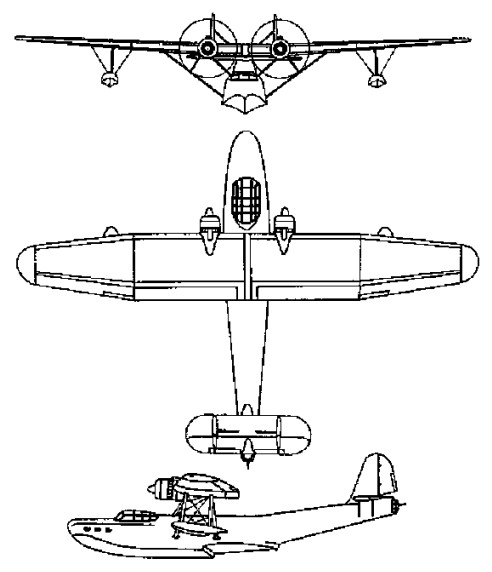
In 1934 the staff of the Yokosuka Navy Arsenal turned their hand to the design of a twin-engined flying-boat, the Yokosuka H5Y powered by two 895kW Mitsubishi Shinten 21 radial engines. Although built to a total of 20 during 1936-40 as the Navy Type 99 Flying-Boat, its performance was disappointing and, consequently, was deployed only on second-line duties.

Early in the war an unidentified twin-engined flying boat was spotted on non-combat duty around Japanese Naval bases. The allied code name ‘Cherry’ permitted identification before the manufacturer’s name and designation was discovered through prisoner interrogation over a year later.
H5Y1
Engine: 2 x Mitsubishi Shinten-21, 895kW
Max take-off weight: 12500 kg / 27558 lb
Wingspan: 31.57 m / 104 ft 7 in
Length: 20.52 m / 67 ft 4 in
Max. speed: 305 km/h / 190 mph
Ceiling: 5200 m / 17050 ft
Range: 4700 km / 2921 miles
Crew: 6
Armament: 3 x 7.9mm machine-guns
Bombload: 500kg

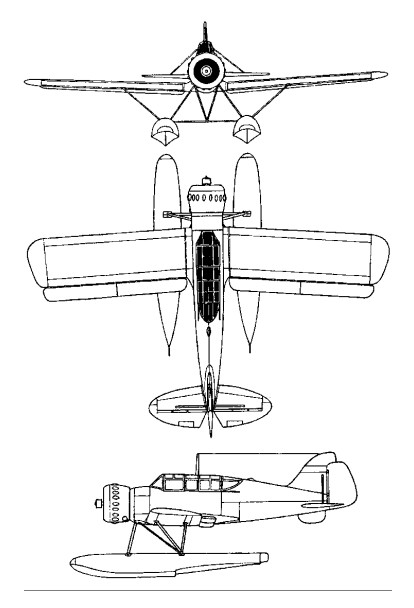
The Yokosuka E14Y1 was built to a total of 126 as the Navy Type 0 Small Reconnaissance Seaplane. Used aboard ocean-going submarines of the Japanese fleet, these aircraft made some notable flights: one from the submarine 1-7 made a post-attack assessment of damage at Pearl Harbor.
On 9 September 1942, launched from the Japanese submarine I-25 under Frigate Captain Meija Tagami, Naval pilot N.Fujita used a Yokosuka E14Y1 seaplane to bomb forests in Oregan, USA. The first raid on the United States of America. On 29 September a second raid was made at the same spot, 50 miles west of Cape Blanco. This was the last raid made on the USA.
E14Y1
Engine: 1 x Hitachi Tempu-12, 255kW
Max take-off weight: 1450 kg / 3197 lb
Empty weight: 1119 kg / 2467 lb
Wingspan: 11.0 m / 36 ft 1 in
Length: 8.54 m / 28 ft 0 in
Height: 3.8 m / 12 ft 6 in
Wing area: 19.0 sq.m / 204.51 sq ft
Max. speed: 245 km/h / 152 mph
Cruise speed: 165 km/h / 103 mph
Ceiling: 5420 m / 17800 ft
Range: 880 km / 547 miles
Crew: 2
Armament: 7.7mm machine-guns, 60kg of bombs
 All Aero