(John Nicholas) Sparling Propeller & Aeroplane Factory E St Louis MO. USA
In 1912 the Sparling Propeller & Aeroplane Factory built a single-place, open biplane, personal representation of the Curtiss headless design with trailing-edge top-wing ailerons.
Societe Provisoire des Aeroplanes Deperdussin Societe Parisienne des Avions Deperdussin Societe des Productions Armand Deperdussin Societe Pour Aviation et ses Derivees
Silk merchant Armand Deperdussin (1867-1924) was associated from 1910 with a series of notable monoplanes. Built precursor in 1909 for show in a Paris store.
By 1914 monoplanes bearing Deperdussin name were used not only privately but by several military authorities. Designed by Louis Bechereau, these aircraft were especially noted for speed performances in 1912-1913, and in some instances for monocoque construction. Deperdussin, a great promoter, became involved in financial difficulties and in 1915 the company was declared bankrupt.
In 1913 Deperdussin was arrested for embezzlement and the company was taken over by Louis Bleriot and renamed Societe Pour I’Aviation et ses Derives in 1915, thus retaining these initials. Chief technician was at first Bechereau, later Andre Herbemont.
The Deperdussin name had links with several companies, including the British Deperdussin Company with which John Porte was connected. Initials SPAD were also ascribed to Societe Provisoire des Aeroplanes Deperdussin and Societe Parisienne des Avions Deperdussin, as well as Societe des Productions Armand Deperdussin.
Company became world famous for SPAD single-seat fighters and fast reconnaissance adaptations. More than 2,000 fighters built at Suresnes factory alone; great numbers under license in France and elsewhere. Classic tractor single-seat biplane flown late 1915 as SPAD V; developed into SPAD VII of 1916, thus establishing company’s name in aviation history. Characteristic design feature was two-bay wing cellule with special form of bracing. Combination with Hispano-Suiza 8-cylinder vee engine was major factor in success. SPAD XII had a 37 mm engine-mounted gun. From May 1917 improved two machine-gun type XIII replaced VII. Large numbers ordered by U.S. SPAD XX of late 1918 was two-seat fighter to Herbemont design and precursor of new Bleriot-SPAD line of single-strut monocoque-fuselage biplane fighters, built after Bleriot took over SPAD company in 1921 SPAD became Bleriot-SPAD.
The Central Design Bureau for Hydrofoil named after R.Ye. Alekseev (Central Design Bureau for SEC) was developing a project for an ekranoplan ocean zone with a take-off weight of about 500 tons. About this on Tuesday at the forum “Marine Industry of Russia” said the director and chief designer of the concern “Morinformsystem-Agat” Georgy Antsev.
The International Forum “Marine Industry of Russia” takes place from May 19 to 21, 2015 in Moscow, in the Gostiny Dvor exhibition complex. The forum presented a project of a coastal zone WIG with a take-off weight of 60 tons.
“We need WIG ocean zone with a take-off weight of 500 tons. Such developments are conducted in the CDB Alekseev. Today there is a reboot of the Soviet period, a search is underway for the customer, certain research and development, modeling, and prototyping, ”said Antsev. – It has a very good direction – it is necessary both for passenger transportation, and for northern tasks, and for tasks of protecting state borders. He can use the airfield infrastructure and be at some point, in essence, an airplane. “
The ekranoplan, or a ship on a dynamic air cushion is a high-speed vehicle flying at a height of up to several meters from the surface of water, land, snow or ice. This is a kind of hybrid between an airplane and a watercraft, with equal mass and speed, the winged surface of an ekranoplan is much smaller than that of an airplane, and according to the international classification it belongs to sea vessels. Ekranoplans capable of tearing themselves off the surface for a long time and moving into “airplane” flight mode are called echo flight.
The very first developments, as well as actually operating samples, were obtained by designers of the USSR. The direction was developed by two independent teams. One, under the leadership of Rostislav Alekseev, who, as early as October 1, 1941, defended his thesis “Hydrofoil Glider”. After that, he devoted his life to the development and creation of ekranoplanes. The CDB for SEC was founded in the early 50s.
СМ-1
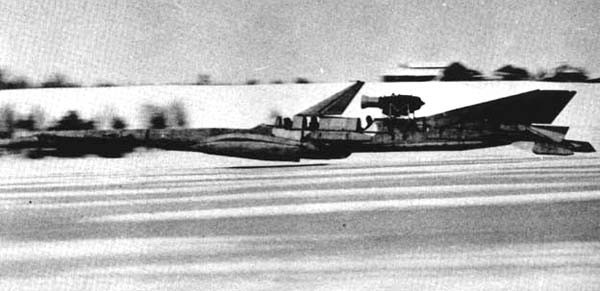
In the early 60s, a test base for these devices was built on the Gorky Reservoir. In 1961, the first flight of the SM-1 / CM-1 screening vehicle took place, and the following year, the SM-2 / CM-2.
СМ-2
Developed by the Soviets from the 1960s onwards, particularly by Dr Rostislav Alexeyev’s Central Hydrofoil Design Bureau, the leading exponents in the design and operation of Wing in Surface Effect types are now located in the Russian Federation. Far ahead of the West in terms of construction and flying experience, the Soviets planned a fleet of 120 surface skimming WISE military transports in the 1980s and four prototypes were built. However, with the end of the Cold War the funds and the cause for the manufacture of the planned balance-of-power-altering transport fleet ceased.
Southern Sailplanes proprietor Ralph Jones was the agents in Britain for Schempp-Hirth KG.
Southern Sailplanes were converting a 17.6m span Cirrus to have a wing of 24m, with a centre-section of 5m span having spars constructed with carbon-fibre reinforced plastic. The estimated competition date was 1971.
The commercial rights of the Helicom H-1 were sold to Southern Pacific Aircraft Co and then to International Helicopter Inc of Mayville, New York, with the machine being refined along the way as the Commuter II.

 All Aero