1926: Pacific Aircraft Co
Founder: William D Tremaine
Brea CA.
USA
Airplane builder
1926: Pacific Aircraft Co
Founder: William D Tremaine
Brea CA.
USA
Airplane builder
Established in 1921 at Detroit, Michigan, USA, to produce the Trella Speedster two-seat lightweight biplane, powered by a 65 hp Le Blond radial engine.
1924: (Frank, Fred, George, Henry & Joe) Trella Aircraft
1269 E Grand Blvd
Detroit MI.
USA
1947: Trella Brothers.
Custom Sail was bought out by Trekking in 1996, though Trekking has a policy of reviving old names to retain the loyalty of its clients.
1998: B.P 41, F-13410 Lambesc, FRANCE
Manufacture was by Korean constructor Paracond.
Santa Monica CA.
USA
Airplane builder circa 1938.
Lomita CA.
USA
Airplane builder circa 1952-61.
USA
Division of Kearney & Trecker Corporation which in early/mid-1960s assembled at Milwaukee, Wisconsin, Italian Piaggio P.136L-1 s and L-2s under names Trecker Gull and Super Gull.
Brian Heath
28 Jul 13
Kearney & Trecker Milling Machine Company was — probably still is — located in Milwaukee, Wisconsin. In the 1950’s and 60’s they leased 2 hangers on the west side of General Billy Mitchell Field in Milwaukee next to the Air National Guard with it’s F-86’s. The north hanger housed the business aviation division of the milling machine company. They had a DC-3, a Cessna 182, a Piaggio Royal Gull, and an aero-coupe. Hope I got the names right.
I was 10 years old in 1958 and my dad was the mechanic for the operation, co-pilot on the DC-3, and pilot on the others. They flew milling machine sales people and maintenance people around the eastern U.S. And they often flew the company owners and brass on vacations and fishing trips.
The south hanger housed Kearney & Trecker’s other business investment — a contract with Piaggio in Italy to assemble and sell Royal Gulls. Later the P-166 executive plane was added. My recollection is that the first P-166 at Mitchell Field was a prototype. It was the only one I ever saw, but I did ride in it several times. While the two businesses were legally separate, the mechanics/pilots often consulted with each other.
I recall being there one day when a lively discussion was held between 4 or 5 people about the length of the main forward hull that floats. Mid ship there was a step, and the rear part of the fuselage was not in the water. Some of them, including dad, thought the plane would take off and land better if the floating part of the hull extended back a foot or so. Not everyone agreed, but there was a consensus to try the idea by building a block (out of wood, I think) that would extend the floating hull back. They did that and tried it out. It worked and I think that Piaggio accepted the idea and modified the design.
I went to the airport with dad when there was a vague hope of getting a plane ride. Perhaps he was going to do a short test flight after doing some work. Or perhaps he was flying a low level company person that he knew would not mind a kid on the trip. Sometimes he had to deliver a milling machine part to a customer in, say, New York. On some of those trips I got the right hand seat — several times on the Gull.
I believe it was in the early 60’s that Kearney & Trecker sold a dozen or so of the Royal Gulls to Peru’s air force. They were looking for pilots to deliver the planes and for someone to teach Peru’s pilots and mechanics how to fly and maintain them. Dad volunteered and was selected to fly one plane from Milwaukee to Peru, and then spend a month or so teaching before returning. No, I was not invited. But I thought that what he did was cool. They bought the supercharged engines for going over mountain passes and landing on mountain lakes at over 12,000 feet. Neat planes. Sounds like Kearney & Trecker got out of the airplane business shortly after dad left.
Walnut Creek
California
USA
Walter treadwell flew combat in New Guinea, Phillippines and Okinawa during World War 2 in the left seat of a B-25 with the 345th Bomb Group. He did manage a familiarisation flight in a P-38.
Travel Air Inc
The Winstead Special was derived by the Winstead brothers from an initial metal fuselage frame developed at Swallow by Stearman and Walter Beech, and subsequently discarded by Swallow. The rejection of the metal frame concept, by Swallow president Jake Moellendick, triggered the departure of Stearman and Beech, and the creation of Travel Air.
Walter H. Beech formed the Travel Air Manufactuing Company in Wichita, Kansas, USA, in 1924. The Travel Air Manufacturing Company was in essence Waiter Beech, Lloyd Stearman and Clyde Cessna, all backed by Walter P. Innes. In 1926, Stearman quit to go it alone. Cessna followed a year later. Cessna’s bone of contention was that he thought the monoplane was the way to go, while Walter Beech felt there was life left yet in the biplane.
26 Jan 1925:
Travel Air Mfg Co,
471 W First St,
Wichita KS
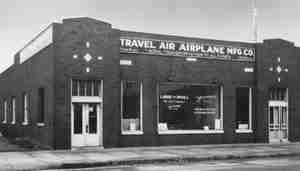
Noted chiefly for its Model 2000 / 3000 / 4000 / 8000 / 9000 family of commercial and training biplanes of the mid/late 1920s.
Renamed Travel Air Inc in February 1925, the Wichita, Kansas, based company built many famous aircraft with designations starting with No.1 and Model A, through to model 11 and the Model R Mys¬tery Ship. Travelair Model R ‘Mystery Ships’ came first in 1929 Thompson Trophy race and 2nd in 1930, easily beating best U.S. Army and Navy entries.
1926:
535 W Douglas Ave.
Wichita KS
Lycoming Co claims that on 3 Apr 1929 the first appearance of a Lycoming aircraft engine, a 215hp R-680, was used for trial flights on a Travel Air biplane, but on exactly which model was not stated. We’re still searching …
In August 1929, stock changed hands, and the Curtiss Wright Corporation be¬came the controlling power in Travel Air. Travel Air’s production had been one tenth of the total U. S. output of commercial airplanes, so it must have looked like a good buy to Curtiss Wright. That same year was the year of the highly successful Mystery Ship racers.
Around 1930, Walter and one of the designers at Travel Air, Ted Wells, began discussing plans for a high-performance, four place cabin biplane. Both men were firm believers in biplanes and hoped to convince Curtiss Wright that it should build the plane. Wells and his group completed the design, but since the Depression was already upon them, C W was not about to introduce a new airplane and soon was forced to cease all Travel Air production with the Model 16. As the Depression hit, Beech found himself with a pocketful of cash from the sale of his stock in the Travel Air Corporation and a job as sales boss of the Curtiss Wright headquarters in New York. It seemed a good time to quit, and he did.
Travel Airs generally featured overhanging “elephant ears” ailerons on 1000, 2000, 3000, A-4000 and W-4000; round wingtips all others. V-type gear with shock cords on 2000, 3000, A-4000, E-4000, K-4000 and W-4000; knee-type, oleo strut gear all others.
1931:
Curtiss-Wright Airplane Co,
Lambert Field,
St Louis MO.
But Beech believed in the new airplane and wasn’t going to be dissuaded by corporations, depressions or the immutable laws of economics. In 1932, he and his wife and a handful of others started the Beech Aircraft Company specifically to build the Ted Wells design. Continuing with the Travel Air numbering, it would be called the Model 17. Although Beech and Clyde Cessna had philosophical disagreements on biplanes versus monoplanes.
The Transland Company was formed in 1946, designing and manufacturing components for North American aircraft, including the T6 Texan, P-51 Mustang, F-86 Sabre and the F-100 Super Sabre. A Division of Hi-Shear Rivet Tool Company, in 1951, Transland began producing spreading equipment, hopper doors and spray gear for agricultural aircraft and among these products was the Sellers Swathmaster, widely used on Cessna 180 and 185 aircraft, as well as Fletcher FU-24s and Piper Cubs.
1946: Transland Co,
Torrance CA.
USA
Built Ag-1 agricultural research aircraft in about 1953, followed 1956 by Ag-2, using components from Vultee BT-13. Plans to build five Ag-2s in late 1950s thwarted.
1957: Transland Aircraft,
div of Hi-Shear Rivet Tool Co (pres: George S Wing).
By 1962, George Wing had moved on to the development of John Thorp’s little twin, which eventually became the Wing Derringer, and a few years later Conrad Barlow took over the assets of Transland, renaming the company the Transland Corporation and moving it to Harbour City in California.
Plans to build Ag-2s revived in 1965, but still none produced.
1946: Transcendental Aircraft Corp founded by Mario A Guerrieri, Robert Lichten, former Piaseski personnel).
Glen Riddle PA and New Castle DE.
USA
Lichten had earlier worked for pioneer helicopter designers Dr Wynn Laurence LePage and Haviland Hull Platt, who initiated the study of a large tilt-rotor aircraft, an outgrowth of their XR-1 lateral twin-rotor helicopter.
1952: Sold interests to William E Cobey.
Lichten had moved to the Bell Helicopter Co seeking support of a major rotorcraft manufacturer in developing the tilt-rotor aircraft. He led the team that got Army and Air Force funding for the development of the XV-3.
c.1957: Holdings acquired by short-lived Helicopter Div,
Republic Avn Corp,
Farmingdale NY.
USA
A Kellett Aircraft Co vibrations expert, William E Cobey, bought out Guerrieri and constructed the model 2, but continued funding could not be obtained—the government was by then backing the Bell XV-3—and the company ended operations in 1957.
 All Aero