The Standard Cirrus was manufactured in Serbia by Vazduhoplovno Tehnicki Centar (later Jastreb Fabrika Aviona Jedrilica), first the Cirrus 75 and 75B version, and subsequently a modified Cirrus 81 with roomier cockpit and variable incidence tailplane.
Manufacturer
Vaxmistrov, Vladimir Sergueyevich

Vladimir Vaxmistrov was born on June 27, 1897 in Moscow. In 1915 he finished his studies at the Royal School in Moscow. At the age of 17 he voluntarily entered the army and was posted to the Mikhailovsk Artillery School (Petrogradsky). At the age of 19 he participated in several combats, but his interests were far from artillery. In 1916 he managed to be admitted as an aviation observer (partly thanks to his brother Boris who commanded a brigade in this group.
With the triumph of the October Revolution he joined the Red Army. He already participated as a pilot in battles over Orenburg and later the aviation group in which he served was sent to Turkistan. In 1921 he was able to continue his studies, initially at the Turkistan State University and later at the Air Fleet Academy.
The study stage coincided with the period of development of gliding in the USSR. His first design was the AVF-8 “Kondor” of 1924. Together with MK Tijonrarov he built the AVF-22 “Zmei Gorinich” glider in 1925. This glider was so effective that it was selected to participate in international flying competitions in Penske, Germany.
From that year on, Vaxmistrov participated in all competitions in Crimea. In 1927, together with Dubrovin and Tijonrarov, he presented the “Zhar-Ptitsa” glider, which established a 15 km range record in the competitions of that year. A year later these three friends presented the “Gamayún” glider in which for the first time in the USSR the pilot AB Yumashiev soared in a thermal over the plain for 375 meters. The “Skif” glider, also built by the trio, established in the VI National Competitions in 1929a Soviet altitude record at 1,520 meters and an improved version of the “Zhar Ptitsa-2” glider set a new range record of 32 km with return.
Between February and April 1926 Vaxmistrov participated as a crew member during the state tests of the Túpolev R-3 (ANT-3) reconnaissance aircraft, which were flown by MM Gromov.
Upon finishing his studies at the Air Fleet Academy in 1930, VS Vaxmistrov went on to work at the NII VVS, where he was able to develop his idea of combined aircraft. The first step in this direction came through a competition for an aerial target promoted by the institute and in which the idea presented by Vaxmistrov was the winner. The aerial target was fixed to a Polikarpov R-1 and at the precise moment it was released. The mother plane left the firing zone as the target began gliding.
The idea of transporting a small plane on a larger plane gradually took shape and became the famous “Zvenó” or “Chains”. In the next few years Vaxmistrov’s work was directly linked to the development of these combined flying structures that were used successfully in some missions during the initial stage of the Great Patriotic War.
In 1937 after the arrest of Mikhail Tukhachevsky the project of the “Zvenó” was stopped. Vaxmistrov was able to escape the process with only a demotion from principal constructor to brigade chief in KB-29 itself. Between 1937 and 1940 new versions of the “Zvenó” were developed. A version known as SPB was used successfully at the beginning of World War II in the attack against a bridge of strategic value in Romania.
In the pre-war years the KB-29 under the leadership of Vaxmistrov also developed a novel idea of fighting against enemy bomber formations known as PTP. It was a three kilogram bomb tied to a 100 meter rope that ended in a parachute. These bombs were to be dropped in large quantities to meet the bomber formation. When the enemy plane’s wings or fuselage met the rope, the resistance of the parachute caused the rope to move upwards. Making contact with the body of the plane activated the fuse that made the bomb explode. Despite satisfactory results in state tests, this method was never used.
From 1940, Vaxmistrov went to work in the OKB of NN Polikarpov, being soon appointed his replacement in aircraft development group and directed parallel the repair of I-16.
Between 1943 and 1945 Vaxmistrov worked on two new composite aircraft projects. The first known as TP (Transport Glider) was composed of gliders linked by fighters that guaranteed the motive power and the second included fighters linked with bomb planes.
After the Great Patriotic War, Vaxmistrov kept working in the aeronautical industry. In 1949 he worked on the development of an in-flight refuelling system.
He died in 1972 in Moscow.
Aeronautical production
Stage at the Air Fleet Academy
AVF-8 “Kondor” Glider (1924)
Glider AVF-22 “Zmiei Gorinich” (1925)
Glider “Zhar-Ptitsa” (1927)
Glider “Gamayún” (1928)
Glider “Skif” (1928)
Glider “Konsomolskaya Pravda” or “Zhar Ptitsa-2” (1929)
Glider “Skif-2” (1931 ).
Stage at TsAGI and KB-29
Zvenó or Zvenó-1 (1931).
Zvenó-1A (1933).
Zvenó-2 (1932) Project.
Zvenó-2A (1934)
Zvenó-3 (1934)
Zvenó-4 (1934)
Zvenó-5 (1935)
Zvenó-6 (1935)
Zvenó Aviamatka PVO (1935)
Zvenó-SPB (1937)
Vaxmistrov I-Ze (1937) Project.
Zvenó-7 (1938)
Other projects
An unrealized project of Vaxmistrov’s composite aircraft based on a TB-7 bomber.
Vladimir Vaxmistrov designed even other more complex versions such as the I-16 8-fighter transport project(Two fighters under the wing, and the other 6 in special structures located on the wing structure). Five of these fighters had to fly with the engines running to ensure the necessary power thrust. To avoid wasting its own fuel, the feeding was conceived directly from the tanks of the mother plane. The patrol time of this version was estimated at 6.5 hours, which was quite high for the time. Once the mission was over, the planes made contact with the bomber at a speed of 150 – 170 km / h. The bomber crew had to manually ensure the fixation of the fighter to the attachment point on the structure. The fighter-bomber contact system was tested in 1938 by the experienced NII VVS test pilots. Stepán Suprún and Piotr Stefanovski , demonstrating the feasibility of the system. However this version of 8 fighters was never built.
In the first half of the 1930s VS Vaxmistrov presented the preliminary design of a flying aircraft carrier which he also called Aviamatka. Vaxmistrov’s Aviamatka was designed as a monoplane with a parabolic-shaped flying wing scheme. 10 M-34FRN engines were placed in pairs on the wing leading edge moving 5 traction propellers. The parasitic fighters were located semi-inserted in the thick wing and were raised to the extraction by means of elevators, as is customary in aircraft carriers. This gigantic aircraft was also envisioned as a transport and tanker aircraft.
After the successful realization of the SPB project, Vaxmistrov conceived other improved variants of “Zvenó” SPB among which the following stand out:
A Pe-8 bomber (ANT-42 or TB-7) loading two I-16 SPBs or two more modern MiG-3 or Lavochkin-Gorbunov-Goudkov LaGG-3 fighters with two FAB-250 bombs each. The maximum takeoff weight of this configuration did not exceed 33,500 kg and the maximum speed had to reach 405–420 km / h at 6,000 meters of altitude working the six engines at nominal speed, with a range of 1,320–1450 km. The Petlyakov Pe-8 was withdrawn from production in 1942 and the project was left on paper.
A flying boat GST (version the Consolidated PBY Catalina in the USSR ) carrying an I-16SPB on each wing.
An MTB-2 (ANT-44) heavy hydrofoil with two fighters.
Other projects included:
A composite transport glider raised by fighters installed under the wings and designed to guarantee the change of base of fighter squadrons in the absence of transport aircraft.
A double empennage glider attached to a fighter with two 1000 kg FAB-1000 ropes, one on each tail cone (a concept generally similar to the German Mistel of the final stage of the war).
A missile with delta wing configuration propelled by a ramjet and combined with a fighter.
None of these projects went beyond the drawing board. Vaxmistrov never managed to realize his idea of winged aircraft carriers.
Vashon Aircraft
Vashon Aircraft is a company named after a small island in the Puget Sound region of Washington state, off the coast of Seattle’s metropolis. The company’s first airplane is the Ranger,
At the Woodinville factory, co-located with Dynon in an industrial park, Vashon produces structural components and puts fuselages and wings together. The parts are then transported to a hangar at the Paine Field Airport (KPAE) in Everett, where final assembly takes place down the street from Boeing’s massive facility.
Varga Aircraft Corp
In 1965 this company acquired from Shinn Engineering Inc full manufacturing rights, tooling and spares for Shinn Model 2150A. Put into production by Varga in 1977 as Model 2150A Kachina. Design originated from Morrisey Nifty of 1957, built by a former Douglas test pilot.
Varga, László
Aircraft were primarily (but not exclusively) designed for RMI by László Varga. As a result, RMI designs are often given the Varga name (in some cases, even when he was not a major designer).
Vardax Corp
USA
Produces turboprop conversion of de Havilland Canada DHC-3 Otter, as Vazar Dash 3 Turbine Otter.
Vans
Richard (Van) Van Grunsven’s Van’s Aircraft, Inc. began in 1973 with partial kits for the RV-3. These were manufactured by Van himself, working in a small shop behind his house in Reedville, Oregon. Later the company moved to North Plains, Oregon, a small town about 25 miles west of Portland. After twenty years and several expansions, Van’s had exhausted the available opportunities in North Plains, so in 2000 the company moved to a new 60,000 square foot facility on the Aurora, Oregon airport. The company employed 70 people (and hundreds more in sub-contract roles) and keeps them busy producing several hundred complete aircraft kits a year and shipping them all over the world.
The RV-3’s performance gained an enthusiastic following, and naturally, many pilots wanted to share the experience with a friend. Van resisted for a while, reasoning that a bigger, heavier airplane just couldn’t perform as well as a light single-seater, but eventually he recognized the depth of the demand and began developing a two-place airplane. Tandem seating was chosen for the RV-4 because of the lower drag, superior centerline visibility, lighter weight, and overall fighter-like sportiness. It was a combination well suited to the market it entered in 1981. With performance nearly that of the RV-3 and an extra seat as well, the RV-4 became an immediate favorite and soon surpassed the RV-3 in popularity.
In the early to mid 1980s, the homebuilt market began to shift toward efficient touring, rather than pure sport airplanes. In response, Van’s developed the side-by-side RV-6. Careful design and attention to aerodynamic details resulted in a new airplane that retained the delightful handling and short field qualities of the RV-4, and despite the wider fuselage, had a top speed only 3 mph less. The trigear RV-6A was developed from the RV-6 to better fill the needs of the modern pilot. The addition of the nosewheel reduces the top speed only 2 mph.
In 1995, Van’s revisited the tandem concept and came up with the RV-8, a new design incorporating improvements learned from years of experience with the RV-4 and RV-6/6A. With a wider cockpit than the RV-4, two baggage compartments and increased instrument panel space, the RV-8 offers greater cross-country comfort without compromising the fighter-like sportiness of centerline seating. The RV-8 was designed to handle engines of 150-200 hp, and with the 200 hp IO-360 Lycoming, it sustains cruise speeds of 212 mph. Top speed is 222 mph. The RV-8A made its first flight in April 1998 and kits were available soon after.
1996-7: PO Box 160, North Plains, OR 97133, USA.
The RV-9A, a side-by-side tricycle-gear design, was first flown in December 1997. A completely new wing with a higher aspect ratio and new airfoil gave excellent low speed flying qualities and very efficient cruise. Similar in size and weight to the RV-6, it cruises at about the same speeds, but stalls several miles per hour slower. This wing permits the use of lower-powered engines, providing an alternative for those who don’t feel the need for a “bigger, faster, more powerful” airplane. Somewhat later, the RV-9 tailwheel version was developed.
In the spring of 2001 the 2-seat side by side RV-7/7A was introduced, replacing the RV-6/6A. The RV-7/7A has slightly more leg and headroom than the RV-6/6A, carries more fuel, and has a higher allowable gross weight. It will accept all 4-cylinder Lycoming engines from the 150 hp O-320 to the 200 hp IO-360. The kit incorporates all of the advanced technology that Van’s learned designing and producing the RV-8/8A and the RV-9/9A.
In 2003, Van’s ventured into a whole new world and offered the RV-10, our first four-place airplane. Designed as a true four-person airplane (the ability to carry four people is different than having four seats) the RV-10 will carry four full-sized adults, sixty gallons of fuel and baggage. Speeds and performance are comparable to the two seat RVs, and better than most four-place production airplanes.
In 2005, about 4,000 RV kits (an average of almost 130 per year for the history of the company) have been completed and flown, and thousands more are under construction. Completion rates have exceeded one per day for the last few years. RVs are flying in at least 26 different countries and are under construction in more than fifty.
The RV-2 was a wooden flying-wing sailplane. Van started construction in the early 70s but the airplane was never finished or flown. Parts of it still hang on his hangar wall. The RV-5 was a very small metal single-seater, designed by Van and built by a group of friends from a local EAA chapter. Although it flew quite successfully with a small two-stroke engine, only one was ever built. It is still in Van’s hangar and one of Van’s engineers recently surveyed it with an eye toward restoration…it may fly again.
Van Pomer, John
Fort Edward NY.
USA
John Van Pomer built a copy of a Curtiss A in 1910.
Vaniman, Melvin
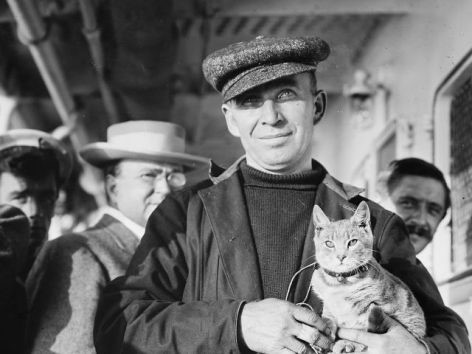
Born in Virden, Illinois to parents George and Luisa, Vaniman was the oldest of four sons. The short fiery red-head and his siblings were raised within a Christian sect called the Dunkards (via the German Baptist church)… a sect that disagreed with the concepts of modernization and even sad no to instrumental music in the agricultural community they lived in.
They lived on a farm and Vaniman was the kid who learned how to fix all kinds of machinery – even engines on the farm.
Like many kids, Melvin Vaniman wanted to escape the small town and seek his fortune elsewhere… turning his back on farming to study music, initially at Mt. Morris College run by the German Baptist Bretheren, before gaining further study at Valparaiso University in Indiana and later at Dexter College in Iowa, where he stayed on to become a music teacher – guitar and singing – before joining a touring opera company in Louisiana in 1887.
Vaniman built his own aeroplane in 1906… a triplane, in fact… the first ever triplane.
Calvin Vaniman completed a scaled miniature trans-Atlantic passenger airship, “Atlantic No.1”, on June 23, 1912.
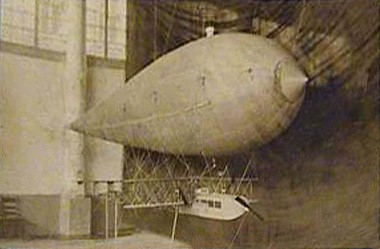
It was made for the American inventor-aeronaut-adventurer Melvin Vaniman, who died alongside his younger brother Calvin and three other crew members in the airship “Akron” trial-flight disaster on July 2, 1912 near Atlantic City, New Jersey.
Vanguard Air and Marine Corp
1958
Vanguard Air and Marine Corp
(pres: Edward Vanderlip)
Radnor PA.
USA
In February 1959, two former Piasecki engineers formed the Vanguard Air and Marine Corporation to design and build an executive VTOL aircraft. Their first design was the unregistered Vanguard 2 Omniplane.
 All Aero