Founded 1982 by Commonwealth Aircraft Corporation, Government Aircraft Factories and Hawker de Havilland Australia to develop A1 OB turboprop trainer. Taken over by Hawker de Havilland.
Manufacturer
Austin Motor Company (1914) Ltd.
The Austin Motor Company Limited was an English manufacturer of motor vehicles, founded in 1905 by Herbert Austin.
Centered at Northfield, Birmingham, Warwickshire, Austin Motor Company (1914) Ltd engineering company became a War Office contractor for airplanes during the First World War, building over 2,000 subcontract aircraft. In 1917 the aircraft department, managed by J. D. North (best known for his later Boulton Paul associations) contemplated aircraft of original design. The Austin-Ball A.F.B.1 (fighter) and Osprey (1918) was a triplane single-seater designed by C. H. Brooks; the Greyhound two-seat fighter was flown after the Armistice; and civil types were the Kestrel side-byside two-seater (awarded 2nd prize in an Air Ministry competition) and the tiny Whippet single-seater, for which high hopes were entertained but only five were built. Aircraft activities ceased 1920, but in 1936 the “shadow factory” scheme ensured that the Austin name once again had aircraft connections. Production of Fairey Battles began October 1937; first aircraft tested July 1938.
In 1952 it was merged with Morris Motors Limited in the new holding company British Motor Corporation (BMC) Limited, keeping its separate identity. The marque Austin was used until 1987. The trademark is currently owned by SAIC after being transferred from bankrupt subsidiary Nanjing Automotive which had acquired it with MG Rover Group in July 2005.
Austflight ULA Pty. Ltd.
Markets the Drifter tandem two-seat microlight, as a modified variant of former Maxair Drifter.
Auster / Taylorcraft Aeroplanes (England)
In 1936 the Taylorcraft Aviation Company was established in the USA to design and built light planes for civil use. In 1938 the company established its Taylorcraft Aeroplanes (England) Ltd as its British subsidiary. British production was mainly of the Plus C and Plus D models, and in 1939 the Royal Air Force impressed 24 of the 32 aircraft for evaluation as observation and artillery spotter aircraft. The evaluation confirmed the soundness of the concept, and a derivative of the Plus D was ordered into production as the Auster Mk 1. This entered service in August 1942.
Taylorcraft Aeroplanes (England), in March 1946, was changed to Auster and the factory transferred from Thurmaston, Leicester, to Rearsby, Leicester.
Became Auster Aircraft Ltd on March 7,1946, by which time it had built more than 1,600 Taylorcraft C, Plus C, Plus D and Auster I, II, III, IV, and V, as well as early Auster J-1 Autocrats and prototype of J-2 Arrow.
Auster name was well established in Second World War by light observation (AOP) monoplanes known as Taylorcraft Austers, and many of these made an important contribution to the development of postwar light aviation. The type mainly concerned was the Auster 5, or Model J, three-seater with Lycoming engine. As war neared its end Taylorcraft designers were already looking to the civil market, and the outcome was the Autocrat, often British-powered and widely used not only for ordinary tasks but also, for instance, to test the Rover TP.90 gas turbine. In the 1950s came the Aiglet and the Autocar, one of the latter being used to test the Saunders- Roe hydro-ski landing gear. The Aiglet Trainer differed greatly from the Aiglet, and the Agricola was an entirely new low-wing agricultural aircraft, first flown December 1955. To supersede the AOP6 the entirely new military AOP9 was tested in March 1954, by which time the British Army and RAF had received nearly 2,000 Austers.
After the war, Auster Aircraft Ltd was formed and commenced a series of variations on the basic theme until 1960 when it was absorbed into Beagle Aircraft Ltd. Production of the basic Auster type continued until the low-wing Pup emerged.
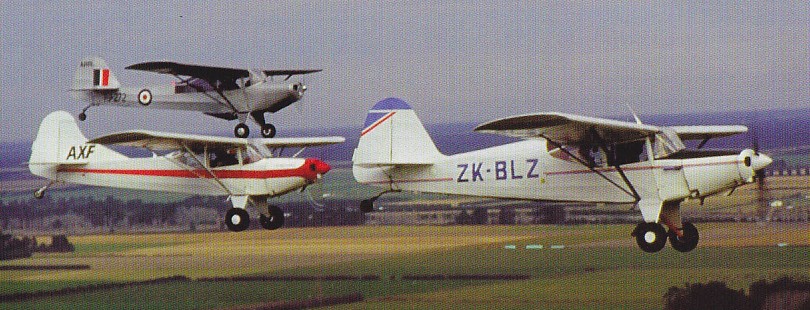
All production work on Auster designs finally ceased in 1967 when Beagle sold all rights to Hants and Sussex Aviation. Although there is some conflict in the official records, it is believed that around 3868 Austers (not including licence-built aircraft) had been built.
The Pup evolved into the Bulldog basic military trainer that was taken up by Scottish Aviation Ltd after Beagle went into receivership in 1970 and finally found its last home with British Aerospace.
Aurore
1998:
rue de St Exupery ZA Aeroport de Pau
F-64230 Sauvagnon
France
LSA builder
Augur Ros Aero Systems
Augur Ros Aero Systems of Russia launched production of several types of balloons.
Audenis & Jacob
Charles Audenis (1889-1972) started his aviation career as a mechanic at Bron (Lyon, France). He qualified for his licence (no. 788) on a Farman in 1912. He built two machines together with his friend Jean Jacob in 1912-1913, in which he participated in several regional meetings in the Lyon area.
Aubert-Aviation / Aubert
Aubert-Aviation was formed 1932 and commenced aircraft design in 1936. In 1938 name was changed to Societe Anonyme des Avions P. Aubert and PA-20 Cigale trainer which, after successful trials, was shown at Paris Salon.
Aubert and undertook considerable work for the nationalised industry. A direct contract for the production of Morane-Saulnier MS.230 trainers was placed with the company by the French Government, but all work ceased with the capitulation of France in June 1940.
After war PA-20 was revived as PA-201 and PA-204 (high-wing cabin monoplanes with cantilever undercarriage; common name Cigale). As Cigale Major PA-204 was certificated in 1951.
Atwood Aeronautic Co / Carolina Aircraft Corp
1912:
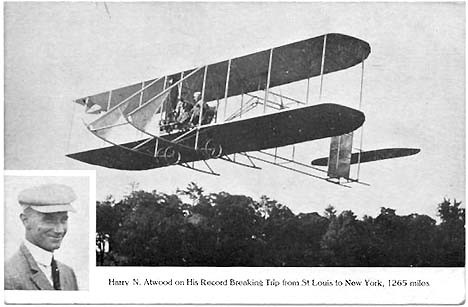
Harry N Atwood
Saugus MA (possibly).
USA
1913:
Sandusky OH.
USA
(Harry N) Atwood Aeronautic Co,
Williamsport PA.
USA
Engine and airplane builder circa 1915-16.
1918:
Carolina Aircraft Corp
Raleigh and Smithfield NC.
USA
c.1935:
Greenfield and Nashua NH.
USA
710 S Main,
Burlington NC.
USA
c.1948: Ended operations.
Atol Avion Ltd
The Atol amphibian flew for the first time in Rovaniemi, Finland on August 23, 1988.
The first prototype was destroyed in a storm in the fall of 1989 but, with insurance indemnity and by using the first prototype’s front fuselage and wings, the second prototype was built. The second prototype made its first flight in Norvajärvi on October 12, 1990.
Martekno Finland Ltd delivered assembly kits for five airplanes.
In 1993 Atol Avion Ltd was established, and the company acquired Martekno Finland Ltd’s bankruptcy estate.

