
Curtiss, who was a motorcycle fiend and engine genius, had actually asked the Wright Brothers if they wanted one of his 50 hp engines when he went to discuss some aviation data, but they said no, unaware that Curtiss and the AEA would soon be a major competitor.
As a member of Alexander Graham Bell’s Aerial Experiment Association (AEA), Glenn Curtiss built the engines for the Red Wing and the White Wing early in 1908, piloted his first plane, and built and flew the June Bug that June.
The AEA disbanded in 1909, and Curtiss formed the Herring-Curtiss Company on 20 March 1909 with Augustus Herring. Its first customer was the Aeronautic Society of New York. Curtiss delivered his first plane to them, the Curtiss No. 1, built to their specifications, on May 29, 1909.
When the Herring partnership split up, Curtiss founded the Curtiss Exhibition Company, the Curtiss Aeroplane Company in December 1911 in Hammondsport, New York, and the Curtiss Motor Company.
As business expanded, the Hammondsport factory became unable to fill all the orders. Curtiss extended its operation to Buffalo, where it rented the site of the company that had supplied Curtiss with his first bicycle engine years before. Curtiss also opened a new plant in Toronto. The quarters in Buffalo quickly became inadequate, and a new 120,000-square-foot (1,115-square-meter) building was constructed that became the company headquarters. Soon after, a new plant that sprawled over 72 more acres was added.
1909-early 1911 – While A, B, and C models are known (or thought) to have existed during this historically important period for Curtiss, where they were applied is not. Numerical assignments, as well, were guesses—Model 2 has appeared for both Rheims Racer and Charles Willard’s Banshee Express but not verified (Willard unjustifiably claimed authorship of that design). By 1910, Model D had been established, in some references tied to Curtiss-Herring, which was actually built after the partners’ dissolution. But there were at least 9 aircraft known to have been produced in this period, the “official” Model D, in one of its many forms, formally appeared in the first company catalog on mid-1911 along with its companion Model E. Production of concurrent Curtiss-Aero Society Model Ds unknown but the design quickly evolved into the Curtiss D (Standard). A Herring-Curtiss, for which plans were published for home-builders of the time, differed from Curtiss D with its ailerons on the front wing struts instead of the rear wing struts. Herring’s contribution, besides that as a temporary partner, was his alleged invention of a gyroscopic stabilization device (claimed, but unsubstantiated, 1909 US patent #12,256), which would circumvent the Wright’s aileron patents, but which was never used on any Curtiss machine.
Curtiss designed and built the following planes
during 1908 – 4,
1909 – 2,
1910 – 4,
1911 – 5,
1912 – 3,
1913 – 3,
total – 21.
In 1916, the Curtiss Aeroplane & Motor Company, Ltd. went public with Curtiss as president. By that time Curtiss had become the world’s largest aviation company, employing as many as 18,000 at Buffalo and 3,000 at Hammondsport.
The Curtiss Aeroplane and Motor Company was created 13 January 1916 from the Curtiss Aeroplane Company of Hammondsport, New York and Curtiss Motor Company of Bath, New York. Burgess Company of Marblehead, Massachusetts, became a subsidiary in February 1916.
In 1916 the company moved its headquarters and most manufacturing activities to Buffalo, New York, where there was far greater access to transportation, manpower, manufacturing, and much needed capital. It became the largest aircraft manufacturer in the world during World War I, employing 18,000 in Buffalo and 3,000 in Hammondsport, New York. Curtiss produced 10,000 aircraft during that war, and more than 100 in a single week.
A third factory (Garden City, Long Island, NY) became boat hull department for flying-boat production. Burgess Company of Marblehead, Massachusetts, became a subsidiary in February 1916. Aircraft built during First World War included A and AH biplanes for USN, Models D and E for U.S. Army, Model F flying-boats for USN, H-4 Small Americas, H-12 Large Americas and H-16 Large Americas (plus 150 by Naval Aircraft Factory).
Best-known were JN-4/JN-6 “Jenny” trainers (5,000 built, plus 1,200 by Canadian Curtiss), HS flying-boats, MF flying-boats, N-9 floatplanes, British S.E.5a fighters, Orenco D fighters, and 5L flying-boats. Total wartime was 4,014 aircraft and 750 aero engines.
After the war, Curtiss, fell on hard times. In August 1920, the company was forced into receivership. Clement Keys, a Canadian financier, obtained funds to manage the company’s debt and led it again to sound financial status. The Buffalo facility became the major facility, and the company remained the largest U.S. aircraft company through the 1920s.
Postwar production, mostly in 1920s, included NC- 1/2/3/4 transatlantic flying-boats (four only); Oriole, Eagle, and Seagull civil types (little success achieved with the few built). Followed by a series of Army (R-6/R-8 etc.) and Navy (CR/R2C/R3C etc.) racers. Twelve B-2 Condor biplane bombers were followed by PW-8 biplane fighters, P-1/P- 6 U.S. Army Hawks, F6C U.S. Navy Hawks, and O-1/11/39 and A-3 Falcons for U.S. Army. The few Carrier Pigeons and Larks were followed by one Tanager biplane, which won 1929 Guggenheim Safe Airplane Competition. Subsequently produced N2C Fledgling, F8C/OC Falcon, and F8C/02C Helldivers for USN.
Foundation of Curtiss-Robertson division in 1928 was followed by, on July 5, 1929, Curtiss Aeroplane and Motor Company became part of Curtiss-Wright Corporation, together with 11 other Wright and Curtiss affiliated companies.
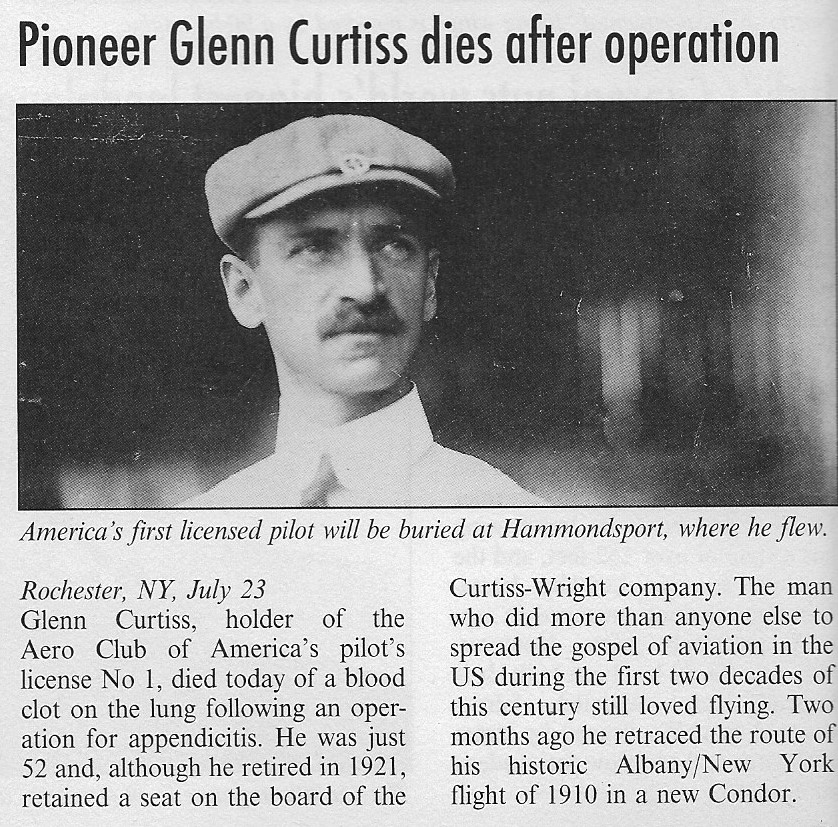
In 1929, shortly before Curtiss died, the Curtiss Aeroplane & Motor Company, Ltd., merged with the Wright Aeronautical Corporation to form the Curtiss-Wright Corporation.
Neither Curtiss or Wright successfully made the transition to the jet age and substantially all aircraft assets were sold to McDonnell and North American by 1950.

