Entwicklungsring Süd GmbH was formed of a Bölkow, Heinkel, and Messerschmitt design consortium on February 23,1959 at the suggestion of the Federal German Defense Ministry, to develop a Mach 2 VTOL intercepter. By May 1963 70 flights had been made with VJ 101C research aircraft, which had tilting jet-pods at wingtips. Studies were made for an entirely different VJ 101D fighter. Heinkel withdrew in late 1964, and in July 1965 EWR changed from a consortium into a limited company. There was later an unsuccessful partnership with Fairchild Hiller.
Manufacturer
Entler-Werke
Germany
Based at Wilhelmshaven. Built in 1922, in conjunction with Prof. Junkers, a small two-seater cantilever biplane which had corrugated sheet-metal covering. Development was intended, and in summer 1922 an English selling price of £222 was mentioned. By 1925 the firm had ceased to exist.
Enstrom Helicopter Corp. / R.J.Enstrom Corp.
As R. J. Enstrom Corporation, was formed in 1959 by Rudy Enstrom in Menominee, Michigan to develop experimental helicopter, first flown November 1960. Developed type (F-28) flown May 1962; and deliveries of further-improved F-28A began in 1968. First year’s production was 43 aircraft. In 1968 first tests were made with turboshaft installation.
Enstrom sold only nine F¬28s before being purchased by the Purex Corporation in early 1968, and Purex suspended all operations in February 1970.
In Janu¬ary 1971, defense lawyer F. Lee Bailey purchased the majority in¬terest in Enstrom and embarked on an ag¬gressive reorganization and production resumed in 1971 under Enstrom Helicopter Corporation title. Between ear¬ly 1972 and June 1975, the gross income of Enstrom Helicopter rose at a compounded growth rate of nearly 45 percent.
1977: Enstrom Helicop¬ter Corporation, Menominee, Michigan, USA.
After intervening acquisitions, including operation as part of Pacific Airmotive Aerospace Group, 1980 purchase by Bravo Investments BVC of the Netherlands, and acquisition by US investors, resumed manufacture. By June 1977 the 500th Enstrom helicopter had been delivered. The Enstrom Helicopter Company, offering the piston-engined three-seat F28F (first flown December 1980 as improved F-28 type) and 280FX (available since 1985), latter based on F28F but with airframe and cabin refinements. Also offers the five-seat 480 Turbine (first flown October 1989), using an Allison turboshaft engine.
Enstrom was acquired by Chinese firm Chongqing General Aviation Industry Group (CGAG) in December 2012. CGAG offers a bundle of other products and services, including emergency rescue, aerial forest fire protection, agricultural spray application, aerial photography, and a host of others through its subsidiaries.
The new owner tried to turn the storied brand around by investing up to $8 million to upgrade Enstrom’s factory. They nearly doubled the space, expanding it to a 160,000-square-foot FAA-approved manufacturing facility. The company also hired more than 200 new employees.
The company showed signs of tenacity when it celebrated its 60th anniversary in 2019.
In 2019, the company ranked third in sales of piston helicopters, with 38 sold between 2018 and 2019, but the overall rotorcraft market was in the midst of a slump. The 2019 annual report from General Aviation Manufacturers Association (GAMA) that tracks aircraft deliveries showed that 2019 was the slowest year for rotorcraft sales in the preceding seven years.
Then the pandemic hit.
GAMA’s data showed that from 2019 to 2020, the overall piston helicopter market sales and deliveries decreased by 20.7 percent.
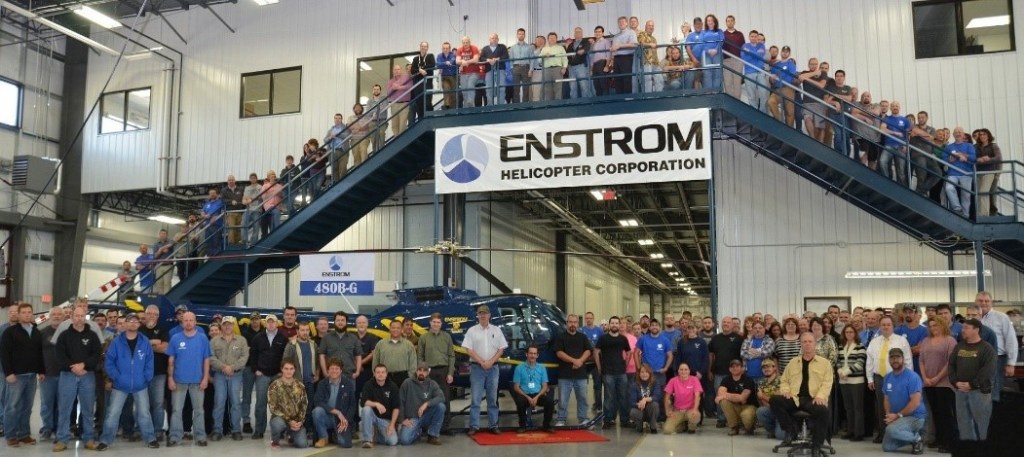
After nearly 65 years in business, Enstrom Helicopter Corp. closed its factory doors on 21 January 2021 after declaring Chapter 7 bankruptcy.
Despite building more than 1,300 helicopters that were sold to customers in more than 50 countries, the Michigan-based company announced that “several financial difficulties,” some related to the pandemic, compelled its owners to close the company.
Dennis Martin, Enstrom’s director of sales, shared the news in a letter to its suppliers and dealers in which he confirmed “all existing contracts and agreements [with the company] will become null and void.”
All employees, about 30 in total, lost their jobs.
Enstrom’s final delivery—a pair of 280FX aircraft—was to the Peruvian Air Force in December 2021. Meanwhile, Enstrom ceased its parts and overhaul supply services on January 7, before ending its technical support on January 19.
They have already fielded multiple requests from interested parties who would like to buy the company’s assets out of bankruptcy, and maybe invest in revamping the company.
In a Chapter 7 bankruptcy, the assets of a company are usually liquidated and the proceeds are used to pay off outstanding debt to creditors.
English Electric
Though this company became part of British Aircraft Corporation in 1960, its origins date back to 1911 at its Coventry Works (Coventry Ordnance Works Ltd.), where quantity production of other manufacturers’ designs was undertaken during First World War. After the Armistice development centered on the Kingston flying-boats, following the lines of the Cork, a product of the Phoenix Dynamo Manufacturing Company Ltd., which was then also part of English Electric. Original features manifest in Ayr flying-boat and Wren ultralight monoplane (1923), but aircraft work ceased in the mid-1920s. In 1938 it was resumed, with contracts for the Handley Page Hampden (followed by the Halifax). In May 1944 an order was placed for de Havilland Vampire jet fighters. Over 1,000 Vampires built before production got under way on company’s own Canberra, the first British jet bomber and the first to serve with the RAF. Canberra production continued for ten years, totaling over 1,300 examples, including 403 license-built Martin B-57s for the USAF. Numerous variants developed, notably for reconnaissance; other countries using the type included Ecuador, France, Peru, Rhodesia, Sweden, and Venezuela. Many records broken (e.g. London-Cape Town December 1953). Lightning twin-jet single-seat fighter of 1952 was RAF’s first supersonic fighter (in level flight); entered service December 1959. Much development of this type was undertaken by British Aircraft Corporation, but two-seat version emanated from English Electric.
British Aircraft Corporation was formed out of Bristol, English Electric, Vickers-Armstrong and Hunting Aircraft Ltd, in 1960.
Engineers Aircraft Corp / EAC
USA
Engineers Aircraft Corporation was founded at Stamford, Connecticut, to manufacture a lightweight two-seat monoplane designated EAC-1. Powered by a Wright-built version of the British Gipsy four-cylinder in-line air-cooled engine, an example was exhibited at the New York show in 1930.
Engineering Division, Bureau of Aircraft Production
USA
A division of the U.S. War Department, created in 1918. Responsible for U.S developments of de Havilland designs, and 14,000 were ordered, though not delivered. Division also experimented with other types of original design. In 1920 it completed its most remarkable product, the GAX (GA-1) very large heavily armoured pusher triplane (one 37mm cannon and eight Lewis guns), of which Boeing built ten. Also made TP-1 two-seat fighter and TW-1 trainer, but a special racer was canceled. The Bureau was later called Engineering Division, Air Service; subsequently Material Division Air Corps (1926). Moved from McCook Field (where GAX was built) to Wright Field October 1927. Numerous types and variants had associations with the Engineering Division, including Pomilio, Bristol Fighter, and Packard-LePere developments. Also VCP-1 single-seat fighter, which won first Pulitzer Race (1920).
Engels Aeroplanbau
Schorndorf, Germany
Achim Engels’ company set up a small factory production line (2010) of airworthy reproductions of WW 1 aircraft.
Engel
Hügelstraße 13-
D-82178 Puchheim-Ort
Germany
Hang glider builder
Endicott Airplane Co
J L Endicott Airplane Co
Medford
Long Island NY.
USA
In 1910 produced aero engines for use in their produced airplanes.
Enaer / Empresa Nacional de Aeronautica Chile / INDAER / Industria Aeronautica
INDAER / Industria Aeronautica was established in 1980 by military FAdeC to assemble/manufacture Piper and CASA aircraft, and co-develop Pillan trainer. Became Empresa Nacional de Aeronautica Chile in 1984.
ENAER’s first major undertaking was production of the piston-engined T-35 Pillan basic trainer, developed with Piper assistance and using many structural components from existing Piper lightplanes, and first flown as a prototype in March 1981, the first production aircraft flying in 1984. The current version, the Pillan 2000 with new wings of greater span developed by Technoavia in Russia, is offered with a piston engine or a turboprop. ENAER’s second industrial program was assembly from kits and later construction of Spanish- developed CASA C-101BB and CC jets, delivered to the Chilean Air Force from 1983 as T-36 Halcon advanced jet trainers and A-36 Halcon light tactical attack aircraft respectively. From 1997 A-36s were redelivered by SAGEM of France as Halcon Us, after avionics upgrade. In 1995 production began of the Namcu aerobatic, training and utility lightplane of composites construction (first flown April 1989), which is also being assembled by EuroENAER in the Netherlands as the Eaglet. Other current activities include aircraft modernization, maintenance and repair, component construction and satellite work.

