France
Company built experimental aircraft designed by Ing Roland Payen, who had been involved in research and development of delta-winged aircraft since 1933. Payen’s Pa.49, flown January 22,1954, was the first French jet-powered delta-wing aircraft.
Manufacturer
Flanders, L. Howard Ltd
UK
First machine, F.2 single-seat monoplane, flown August 1911 then altered to two-seater as F.3. Built four F.4 two-seat monoplanes for RFC in 1912. Two-seat B.2 biplane, powered by 70 hp Gnome Rhone rotary engine, first flown 1912 and acquired by Admiralty 1914.
Fläming Air GmbH Oehna
Berlin, right after the re-unification, was the assigned German capital with an area of roughly 5 million people. Agricultural flying had been very popular in the GDR so there were a lot of adandoned airfields at that time.
Starting the organisation and finding the right spot to start was a challenging task. Even better, finding the right aircraft for training, getting all the licences and building the network of flight instructors, clients and maintenance facilities.
The property question was still a major obstacle as a lot of land had to be reassigned to old and new owners. Infrastructure of old adminstration had to be carried over to the new administration, validation of old licences, ald maintenance standards and while facing all that trouble, we opended our new company and found a spot to start Fläming Air.
Fläming, the name for an area south of Berlin, is flat land and called “Fläming” for about 900 years after some early settlements of the Flame tribes. In the early 90s, Fläming had their first airfield and fuel station. 40,000 flights from that field showed the importance of Fläming Air for the south Berlin flying community. By 1995 they had the first hard runway which was extended to 850 m in 1998. Another grass runway for gliders and tail dragger was added in 1998 as well as illumination for night VFR. 20-30 students filed their PPL at the facilities every year.
The repair and maintenance facility is certified to JAR 145 and a little later the JAR 21G Production certification for Rotax conversions of Cessna C150 was achieved. 1999 saw the first licence production of an ultralight aircraft made from GFR/CFR. In 2003 Fläming launched their own microlight/ultralight/experimental – the Smaragd, which had it’s maiden flight on March 22nd, 2003 and was licensed on December 29th, 2003.
Flaglor
1980: 1550A Sanders Rd, Northbrook, IL 60062, USA.
LSA builder
Fishercraft Inc.
1984: Fishercraft, Inc., 4356 Narrows Road, Perry, OH 44081, USA.
LSA builder
Fisher Aero Corp / Lite Flite Inc / Aero Visions International / Fisher Flying Products Inc
Founded by Michael E. Fisher and Wayne Ison in the early 1980s as Lite Flite Inc, Aero Visions and later Fisher Aero Corporation.
The first two designs the company built were the Fisher Flyer, which incorporated a new fuselage and tail and the existing wings from the UFM Easy Riser hang glider and the Fisher Barnstormer, a negative stagger biplane. Plans and kits for the latter design were offered in the early 1980s.
1982: Lite-Flite Inc, Rt.2, Box 282, South Webster, OH 45682, USA.
1982: Fisher Flying Products Inc, RL2, Box 282, South Webster, Ohio 45682, USA.
Markets kits and plans to construct Avenger single-seat monoplane (appeared 1994), Celebrity tandem two-seat biplane, tandem two-seat Culex twin-engined monoplane, Horizon 2 tandem two-seat high-wing monoplane, Mariah tandem two-seat low-wing monoplane (first flown 1993), and Youngster single-seat biplane.
1995-7: Fisher Aero Corp, 7118 State Route 335, Portsmouth, OH 45662, USA.
2008: Fisher Flying Products, PO Box 468, Edgley, ND 58433, USA
2011: Factory Address: Fisher Flying Products Inc, Brampton Airport Hanger 100-C, 13691 McLaughlin Road, Caledon, Ontario L7C 3L7
Mailing Address: Fisher Flying Products Inc, PO Box 68, Stn Cheltenham, Caledon, Ontario L7C 3L7
Ownership of Fisher Flying Products passed to Gene and Darlene Jackson-Hanson in 1984.
The company was originally based in South Webster, Ohio and later Edgeley, North Dakota, USA.
1995-8: PO Box 468, Edgeley, ND 58433, USA.
In 2007 the Jackson-Hansons decided to sell the company and retire.
The company was purchased and moved to Woodbridge, Ontario, Canada. By early 2009 the new owners had re-established the manufacturing operation and commenced producing kits, starting with the Dakota Hawk and the FP-202. By late 2009 all kits were once again available.
2009: 71 Marycroft Ave, Unit #24, Woodbridge, Ontario L4L 5Y6, Canada.
The company’s kits all feature wooden construction with aircraft fabric covering. Many of the designs are reproductions of classic aircraft, such as the company’s 80% Fisher R-80 Tiger Moth that is based upon the de Havilland Tiger Moth.
Fisher, Ed
2001:4387 Sunnybrook Dr, Warren, OH 44484, USA.
Ultralight builder
Fisher Body Division, General Motors
Fisher entered aircraft production in the 1940s with design team headed by Don Berlin, formerly of Curtiss. Developed the Eagle fighter with an Allison engine, and the prototype first flew on September 30,1943. Eight XP-75s and five P-75As were built before the program ended.
Fisher, Percy
“The planes were attached to what was really an endless belt, revolving around two drums, one placed higher than the other, to allow the planes to meet on an independent stratum of air. The planes were set at an angle on the belt, and when in motion gave a strong lifting impetus to the machine. The propelling apparatus also consisted of planes fixed to an endless band, so designed that the planes pushed the air when traveling in one direction, and feathered when returning in the opposite direction.”
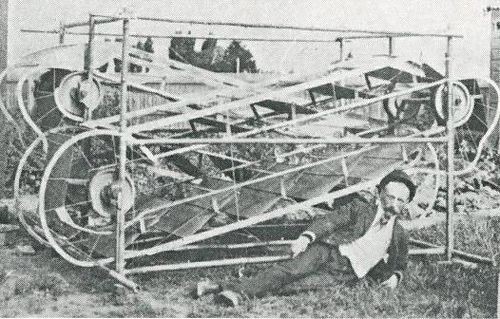
Direct-lift flying machine invented in 1909 by Harry Fisher, an early experimenter from Tauherenikau, New Zealand.
He went on to build a monoplane in 1911.
Percy Fisher died in 1941.
First Strike
1984: #4 Wade Ave, Dept. GR, Piggott, AR 72454, USA.
UL builder
 All Aero