1980: Box 5070, Raleigh, NC 27607, USA.
Glider and LSA builder
1980: Box 5070, Raleigh, NC 27607, USA.
Glider and LSA builder
In 1981 Flight Designs Inc was incorporated into Pioneer International Corporation which has been well known for half a century in the aerospace industry as specialising in parachutes.
1982-3: Flight Designs, PO Box 1503, Salinas, California 93902, USA.
Flight Designs was bought out by Pioneer Parachute in 1982.
Offered the CT two-seat very light composites cabin lightplane (first flown 1996 and produced in association with Albert Schulze-Oechterding from ASO Flugsport), hang gliders and paragliders.
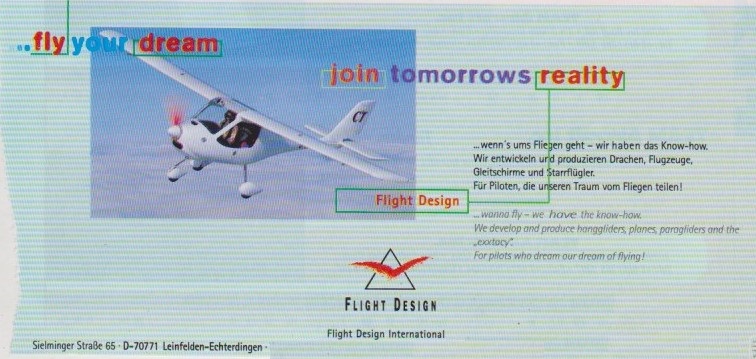
1998: Sielmingerstr.65, D-70771 Leinfelden-Echterdingen, Germany
Flight Design entered receivership in 2016. Work on the C4 had come to a standstill after the company ran into financial difficulty. Production had also slowed to a trickle as the company workforce was trimmed to 10 people in Germany and around 60 in the Ukraine.
German investment group Lift Holding purchased Flight Design in 2017, allowing for the resumption of production of the C4. Flight Design completed the sale of all major company assets to the German investment group Lift Holding, allowing for the resumption of work on the C4, a Part 23-certified four-seater with a projected selling price of $250,000.
The newly realigned company was to be based at a new facility near Eisenach in the Thuringia region of Germany. The company will now be called Flight Design General Aviation GmbH. Lift Holding will combine the technical expertise of Flight Design with its other recently acquired aviation asset, gyrocopter producer Rotorvox. Both companies were to be headquartered at the Kindel Airport near Eisenach.
1982: Flight Concepts Inc
Los Angeles CA.
USA
1982: Skyfox Corp.
1986: Acquired by Boeing Co, Seattle WA.
Hauptstr. 15
91090 Effeltrich
Germany
Manfred Fliegerböhm manufactured the Flight Design Exxtacy, Axxess and Axxesss+ hang gliders.
Anton Flettner G.m.b.H
Anton Flettner (1885-1961) was born in Germany and attended the Fulda State Teachers College in Germany. On finishing his studies, he was employed by Zeppelin on development work into remote-control systems for lighter-than-air craft. When he was teaching mathematics and physics in a high school in Frankfurt, he began to develop ideas leading to his work for Germany in World War I.
After the war, he was named managing director of the Institute for Aero and Hydro Dynamics, Amsterdam, The Netherlands. He held that post until 1931.
From 1926 to 1945, Mr. Flettner was president of the Anton Flettner Aircraft Corporation in Berlin.
The “Anton Flettner G.m.b.H.” was a small engineering company dedicated to helicopters. It is believed that the firm was founded in Berlin in 1935. The earliest document the author has been able to find is a letter from the Military Economics inspectorate (W.I.) III, Berlin to the RLM concerning firms involved in production for the Luftwaffe and dated October 2, 1936. The letter states that the W.I. III first became aware that the firm had been given important work by the RLM (LC II) as the result of a formal application for an exemption from military service for one of Flettner’s skilled workers.
The same inspectorate sent the secrecy agreements to the Flettner Company, Berlin-Johannisthal, Segelfliegerdamm 27, for signature on January 22, 1937.
Due to the growing number of air raids on Berlin, in August 1943 the company began transferring its operations to Schweidnitz in Silesia (approx. 50 km SW of Breslau); due to the deterioration of the transportation system the operation took several months. The Fl 282s on hand with the company were also flown to Schweidnitz to continue the test program. In February 1944 the workforce reached approximately 120 men, its highest level ever.
With the Red Army approaching Silesia, in January/February 1945 the company moved back to Berlin-Tempelhof. Any systematic work or further production was of course out of the question under these circumstances. To make matters worse, two days after its arrival the rest of the company’s equipment was destroyed in a night raid on Tempelhof. What was left of Flettner was subsequently evacuated to Bad Tolz (Upper Bavaria); two Fl 282s were also flown there. The history of the Anton Flettner G.m.b.H. ended there with the arrival of American troops.
1995: 2165 Xavier Ave, Turlock, CA 95380-1852, USA.
UL trike builder
Fletcher Aviation Corporation was an aircraft manufacturer founded by three brothers, Wendell, Frank, Maurice Fletcher, in Pasadena, California in 1941, developing FBT-2 trainer and CQ-1A two-seat target-control aircraft. The initial aim of the company was to produce a wooden basic trainer aircraft (the FBT-2) that Wendell had designed, but despite brief interest by the Army in the type to use as a target drone, nothing came of this aircraft. FL-23 two-seat observation/liaison aircraft built for 1950 USAF competition, followed in 1953 by FD-25 Defender light ground-support aircraft. After relocating to Rosemead, California, later projects involved a family of related designs, including (the 1954 FU-24) with 296 produced in New Zealand as an agricultural aircraft with many still operating today.
During the Korean War the company purchased Rosemead Airport from Bob and Jack Heasley. The roughly triangular property is located south of the 10 freeway, although the airport pre-dates the freeway. The property extended from Rosemead Boulevard on the west to the Rio Hondo river basin on the south and east.
In 1953, the same year the FU-24 debuted, they also produced a prototype amphibious vehicle known as the Fletcher Flair. The vehicle was powered by a 4-cylinder Porsche 356 drivetrain, modified to make it a four-wheel drive. The company hoped to sell the vehicle to the US Army but the vehicle performed poorly in the water and the Army passed.
Purchased by AJ Industries, it changed its name to Flair Aviation in 1960, and produced aircraft fuelling equipment, including drop tanks and hose reels for inflight refuelling. Moved to El Monte, California, its name was changed back to Fletcher and then Sargent Fletcher in 1964 before abandoning aircraft manufacturing in 1966. Manufacturing and sales rights for FU-24 series sold to Air Parts (NZ) Ltd. in 1964.
Fleetwings Division Of Kaiser Cargo Inc was formed 1929 and acquired Keystone Aircraft Corporation factory in 1934. Specialized in stainless-steel structure, including wings for the Douglas Dolphin and company’s own Sea Bird amphibian, the first stainless-steel aircraft to receive U.S. Approved Type Certificate. Wartime production included subcontract parts manufacture. Acquired by shipbuilder Henry J. Kaiser in March 1943 and developed Model 23 Tandem and Model 33 trainers. Designed XBTK-1 torpedo bomber in 1943; only three completed.
Reuben H.Fleet launched in 1923 in Buffalo, N.Y. the Consolidated Aircraft Co. Consolidated built flying boats for the U.S. Navy. The creation of the civil Model 14 “Husky”trainer led to the creation of the Fleet Aircraft Division in 1929.
Originally created as a means for Consolidated to enter the civil market, the company abandoned this ambition shortly before the completion of the first prototype. The manufacturing rights were purchased by the designer and Consolidated company president Reuben Fleet to put into production under his new enterprise, Fleet Aircraft. It was an immediate success, and in the first year of production alone, over 300 machines were sold. Consolidated quickly responded by buying Fleet Aircraft and retaining it as a subsidiary while opening a second production line at Fort Erie, Ontario, Canada.
Fleet produced the Fleet Model 2 with Kinner engine, and built a military two-seat primary trainer for the U.S. Army Air Service. Designated PT-6, it was an improved version of the PT series initiated by Consolidated Aircraft Corporation.
Manufacturing rights of the Fleet trainers were sold in 1939 to Brewster Aeronautical Corp.
Fleet Model 80 Canuck two-seat light-plane also built in quantity 1946- 1947, after which aircraft production ceased. In 1952 Fleet acquired type certificate for Super-V twin-engined Beech Bonanza conversion from Bay Aviation Services Co, Oakland, California.
 All Aero