Henry Ford provided backing for William Stout’s Stout Metal Airplane Company, maker of the 2-AT single-engined eight passenger airliner. Ford purchased Stout in 1925 and provided premises at Dearborne where Stout designed the first Ford 3-AT Tri-Motor, a modified 2-AT with three Wright J-4 engines. Howard Hicks replaced Stout and developed the 4-AT, 78 of which were built. The larger 5-AT, with three 420 hp Pratt & Whitney Wasps, was introduced in 1928, the last “Tin Goose” being built in June 1933.
In 1941 Ford built a new factory and airfield at Willow Run, Michigan, where 5,107 Consolidated B-24E/H/J/L heavy bombers were built. A production run of 5,168 B-24Ns was cancelled at the end of the war. XC-109 bulk fuel tanker prototype converted from B-24E. A Ford factory at Iron Mountain, Michigan made 4,190 Waco CG- 4A gliders.
Manufacturer
Ford, Selby Avon
Selby Ford was an engineer-in- charge of the Beverley Electric Supply powerhouse. He was born in 1901 in Perth, and commenced work at the powerhouse owned and operated by his father, soon after leaving school, and after his father’s death, he took over the role completely. His aviation interests were inspired by a joyflight in a biplane in 1919 piloted by West Australian aviation pioneer Major Norman Brearley. Nine years later he decided he would build his own aeroplane. With his only knowledge of aerodynamics and aircraft design gained from reading aircraft publications, Ford developed his design concept from photographs of other aircraft. He started the project – a two seat bi-plane – with rough chalk plans on the powerhouse floor on 24 May 1928.
Folland
Folland Aircraft Ltd had its foundations in February 1936 at Hamble, Hampshire, when British Marine Aircraft Ltd was formed with the intention of producing the Sikorsky S-42A flying-boat under licence. This scheme came to nothing and in May 1937 the company underwent a complete reorganisation and change of name. H. P. Folland, formerly chief designer of the Gloster Aircraft Company, became managing director, and the firm initially undertook sub-contract work.
Undertook subcontract work on Bristol Blenheim and Beaufort, de Havilland Mosquito and Hornet, Short Sunderland and Supermarine Spitfire, among others.
Henry Folland, Gloster’s chief designer, would leave Gloster when it was taken over by Hawker to form
Folland Aircraft. His most successful aircraft design of all time, the Folland Gnat jet trainer (449 built).
First original design was Fo 108 engine testbed aircraft, 12 built to Specification 43/37. Further subcontract participation in Comet, Sea Vixen, Britannia, Hunter, and HS 748 programs.
Lightweight fighter designed by W. E. W. Petter flown initially as Fo 139 Midge, then as Fo 141 Gnat with Bristol Orpheus engine. Sold to Finnish and Indian Air Forces as fighter aircraft and developed as Fo 144 Gnat T.1 trainer for the RAF.
Became Hamble Division, Hawker Siddeley Aviation, in 1959.
Avro, de Havilland and Folland joined Hawker Siddeley Aviation in 1965.
Fokker Aircraft Corp of America
USA
Antony Fokker’s Atlantic Aircraft Corporation was reorganized on September 16,1925, inheriting premises at Hasbrouck Heights, Teterboro, and the orderbook for the Noorduyn-designed Universal. Factory at Passaic, New Jersey, opened 1927. Glendale, West Virginia, factory opened August 1928. General Motors Corporation acquired a 40 pe cent holding May 1929; Fokker resigned July 1931.
Improved Super Universal six-seater introduced 1927; 123 built. Three-engined 12-passenger F.10 flown April 1927; 65 built, first three for Western Air Express, forerunner of TWA. Followed by 59 14-seat F.IOAs. Fokker 32, first US four-engined airliner, flown 1929, having 32 seats and powered by two pairs of Pratt & Whitney Hornet engines in tandem with tractor and pusher propellers; ten built. Military designs included 1929 0-27 observation aircraft, of which 14 built.
Fokker
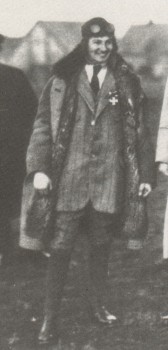
Antony Fokker was born on 6 April 1890 on the island of Java in the Dutch East Indies, but came with his family to the Netherlands four years later. In his youth, Fokker showed a greater disposition toward design and invention than toward formal schooling. During his adolescence he acquired a passion for cars, inventing a tire that could not be punctured, and then discovered aviation. His real desire was to learn to fly, but as his parents opposed this course most vehemently, the young Fokker contented himself initially with model planes built of wood and paper.
Anthony Fokker Article
Enrolling in an engineering school, after his military service had been cut short by an accident, the young Fokker finally obtained the structured educational basis which finally allowed him to construct his first plane, the Spin, in 1910.
After gaining his pilot’s license in 1911, Fokker moved to Germany, which he saw as a nation more likely than the Netherlands to take aviation to its bosom. Registered originally Fokker Aviatik GmbH, on 22 February 1912, Antony Fokker’s first company operated under Fokker Aeroplanbau GMBH at Berlin-Johannisthal then, moved to Schwerin, Mecklenberg, in 1913. Name changed later to Fokker Flugzeugwerke.
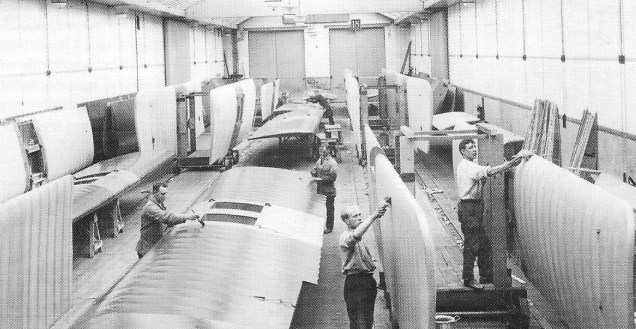
In 1912 Fokker sold his first plane to the German army, but the two years before the outbreak of the First World War were a distinct uphill struggle for the young Dutchman in financial terms. All this changed with the beginning of the war. Fokker accepted all commissions placed with him by the Imperial German air service, despite the fact that he might not be able to honour all of them. During the course of the war the Fokker company grew very considerably, producing for Germany many aircraft types both indifferent and good.
Indifferent types included the Eindecker series of armed monoplanes that nevertheless ushered in the concept of the true fighter, while good types included the classic Dr 1, DVII and D VIII fighters. The Fokker company was also notable for the development of the world’s first effective synchronizer gear to allow a fixed fuselage-mounted machine gun to fire directly forward without shooting off the propeller blades.
Some civil aeroplanes were built at Schwerin in 1918 under the supervision of Platz, but production soon ended, and the Fok¬ker Aeroplane Works, where some 3,350 aeroplanes had been built during the War, was liquidated. It became Schwerin Indus¬trial Works Ltd, producing yachts, motor¬boats, canoes and, later, bedsteads and scales.
The defeat of Germany and the revolutionary fever that swept the country toward the end of 1918 persuaded Fokker to beat a precipitate retreat to the Netherlands during November. The company was liquidated following Fokker’s return to Holland after the First World War. Here Fokker rebuilt his aviation empire, on 21 July 1919, founding the NV Koninklijke Nederlandse Vliegtuigenfabriek Fokker with factory at Veere, Zeeland, assembly at Amsterdam, with a series of important warplanes and a family of monoplane transports, including the classic F VII.
Fokker rented the Witteman-Lewis aircraft factory at Teterboro, together with the adjoining airfield at Hasbrouck Heights, New Jersey, USA, as the Netherlands Aircraft Manufacturing Company. In May 1924 a new company was formed, the Atlantic Corporation, with Lorillard Spencer as President and Robert B. C. Noorduyn as General Manager. Later named the Fokker Aircraft Corporation of America and, under the overall ownership of the General Motors Corporation in 1930, the General Aviation Corporation.
Often known as “The Flying Dutchman”, Fokker died on 23 December 1939 but his name survives as the manufacturer of some of the world’s most important short-haul airliners.
Production during Occupation included Arado Ar 196 floatplanes, Bucker Bu 181 Bestmann trainers and Dornier Do 24 flying-boats.
Postwar activity included conversion of military Dakotas and Skymasters for civil use, license-production of various types including 24 Hawker Sea Furies, 460 Hunter F.4, and F.6 fighters; final assembly and parts manufacture of 350 Lockheed F.104Gs; share in European manufacturing program for F-16 fighter; associate member of Airbus Industrie
On February 1st, 1947 an agreement was signed between Fokker, Aviolanda and De Schelde’s aviation department by which the long awaited merger was achieved. The name of the new conglomerate was “United Netherlands Aircraft Factories ¬Fokker”.
To commemorate Fokker’s thirty years of aircraft manufacture in the Netherlands, they were granted the title “Royal Dutch Aircraft Manufacturer Fokker” on 21 July 1949.
On April 1st, 1949 it became apparent that the merger between Fokker, Aviolanda and De Schelde had failed, and the con¬trolling body appointed Messrs. Vos, Beel¬ing, and During directors of the Fokker factory.
A new factory at Schiphol was opened in 1951.
On February 16th, 1954 Avio Diepen ¬became a subsidiary of Fokker.
The aircraft construction department of the Royal Company De Schelde, joined Fokker on May lst, 1954.
Around 1960 Fokker was looking for and American partner. Lockheed turned down the proposal because they thought it could not be profitable, but Northrop agreed to by a twenty-one percent share.
Formed a joint company with Vereinigte Flugzeugtechnische Werke in 1969.
VFW and Fokker joined in 1970 to form VFW-Fokker.
In the 1970s German interest in general aviation was maintained by one or two smaller companies, but there has also been quite a large R&D investment by Rhein Flugzeugbau, a subsidi¬ary of VFW Fokker, in ducted fan propulsion for a new generation of lightplanes represent¬ed by its revolutionary Fanliner.
By 1995 Fokker was a member of the Daimler-Benz Aerospace group.
In March 1996 company filed for bankruptcy, but Stork Group bought Fokker Aviation to continue as Fokker Aircraft BV for product support, electronic systems and components, aerostructures, and special products. Several attempts to purchase the aircraft manufacturing business by foreign companies came to little, leading to the end of all aircraft production in May 1997 (latterly under trustees).
Until production ended after Fokker collapsed due to financial problems on 15 March 1996, Fokker have developed and constructed over 100 different types of aircraft, both for military and civil aviation.
Focke-Wulf Flugzeugbau GmbH
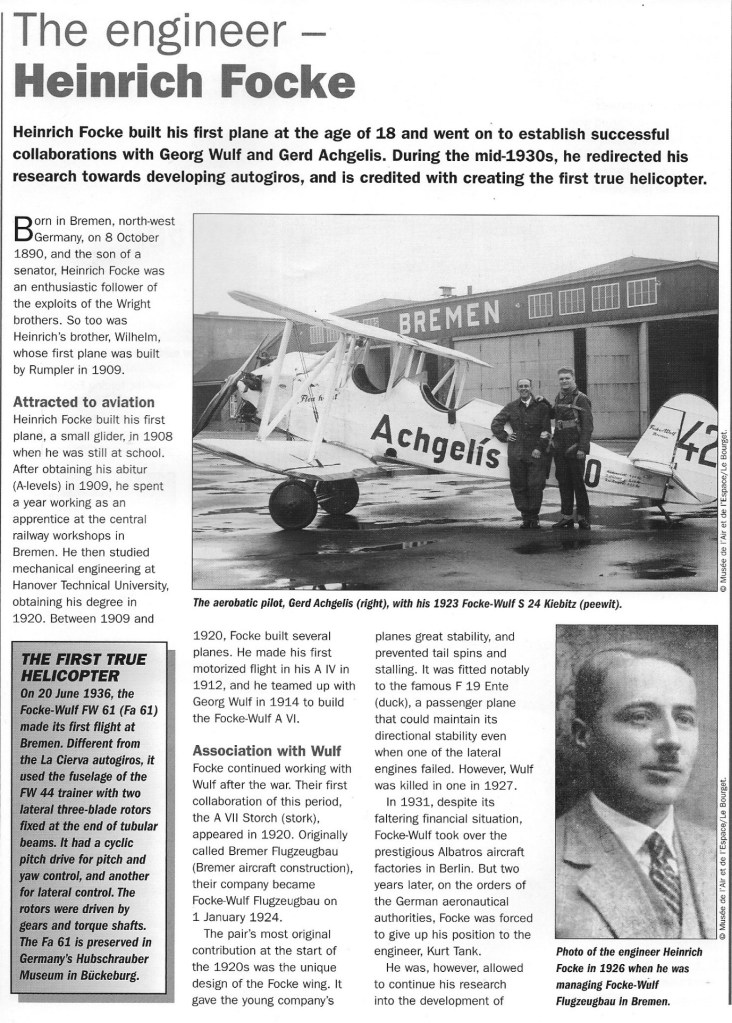
An association between Heinrich Focke and Georg Wulf was formalized January 1,1924 with formation of Focke-Wulf Flugzeugbau AG. at Bremen. Financial support followed success of A 7 Storch two-seater, flown November 1921.
First company design was A16 three/four-seat commercial transport, followed by the eight/nine-seat A17, the more powerful 650 hp BMW Vl-powered A 29 and the three-crew/ten-passenger A 38 airliners.
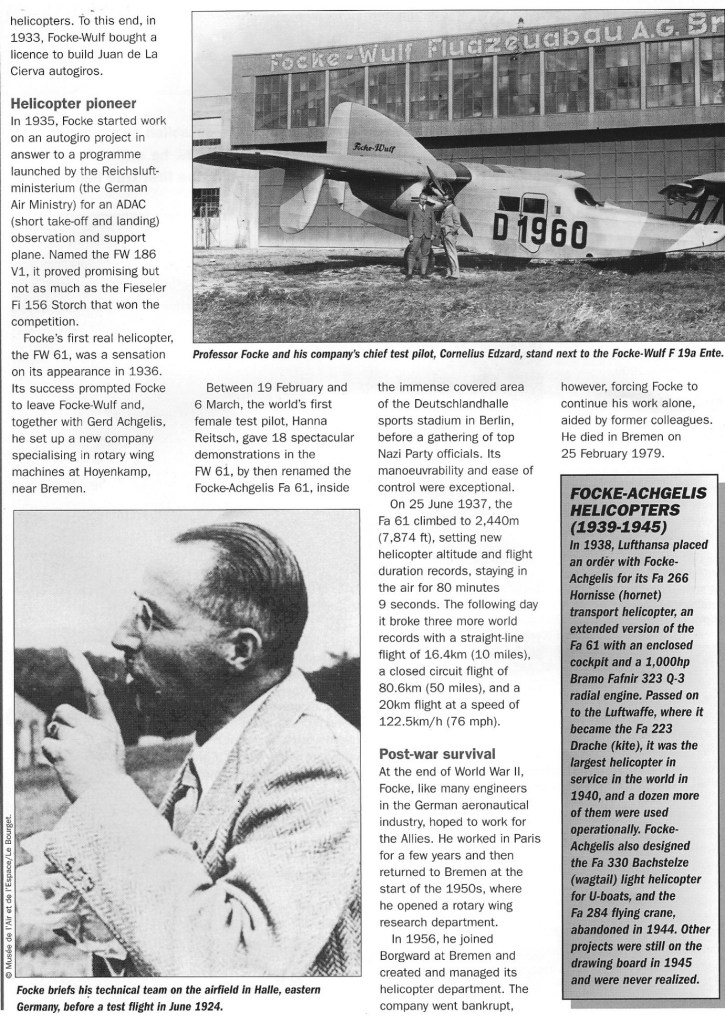
In 1931 acquired license to build Cierva C.19 Mk IV autogiro. Focke concentrated on rotary-wing activities, fixed-wing design was entrusted to Kurt Tank, formerly of BFW and of Rohrbach Metallflugzeug GmbH. Albatros Flugzeugwerke GmbH, Berlin, amalgamated with Focke- Wulf. On Focke’s resignation to form Focke-Achgelis, Tank appointed technical director. Reorganized June 1936 as GmbH under control of AEG. Ceased operations 1945, reformed 1951 and combined with Weser Flugzeugbau to form Vereinigte Flugzeugtechnische Werke.
S 24 Kiebitz two-seat trainer won 1931 German Aerobatic Championship flown by Gerd Achgelis, who conducted maiden flight of Fw 44 Stieglitz trainer late summer 1932, widely used by embryo Luftwaffe and in European and South American countries. First Tank design produced in any numbers (approximately 1,000) was Fw 56 Stosser fighter/dive-bomber advanced trainer, followed in 1935 by Fw 58 Weihe communications aircraft/crew trainer and in 1938 by Fw 189 reconnaissance aircraft. Fw 200 Condor airliner flown July 1937, developed into Fw 200C long-range reconnaissance aircraft. With production total of more than 19,000, Fw 190 fighter was the most notable of Focke-Wulf’s designs; after the first flight on June 1,1939, entered squadron service August 1941. High-altitude version, with revised high aspect ratio wing, designated Ta 152.
Focke-Wulf joined VFW in 1964.
Focke-Achgelis
Formed in 1933 by Heinrich Focke, formerly of Focke-Wulf, and aerobatic pilot Gerd Achgelis. Developed world’s first completely successful helicopter, Fw 61, flown as a prototype on June 26,1936. Also designed Fw 186 Argus As 10C-engined autogyro to similar requirement that had produced the Fieseler Storch. Twin-rotor Fa 223 Drache, first flown August 1940, ordered into production 1942 at Hoyenkamp factory, later at Laupheim; in 1945 a captured Drache became first helicopter to cross English Channel. Fa 330 Bachstelze rotor kite deployed operationally aboard U-boats from 1942.
Focke, Henrich
FMA / Fabrica Militar de Aviones / Aerotecnico / DINFIA / LMMASA
Originally founded in 1927 as the Fabrica Militar de Aviones SA (FMA), for aeronautical research and production at Cordoba.
The biggest aeronautical development and production center in Argentina was the Fábrica Militar de Aviones in Córdoba, an inland city 700 kilometers from Buenos Aires. The company first built airplaces (1929) and engines (1930) under license and later began building its own planes the Ae.C.1, a three-seated passenger plane with a covered cockpit.
Redesignated Institute Aerotecnico 20 October 1943.
As Industrias Aeronauticas y Mecanicas del Estado (IAME) formed March 28,1952 to take over State activities concerning military and civil aircraft, and incorporating the Institute Aerotecnico (formerly Fabrica Militar de Aviones). I.A.35 was twin-engined multipurpose monoplane; I.A.33 Pulqui II (first flown February 1951) a swept-wing jet fighter designed by Kurt Tank. Six Pulqui built 1955/56.
Nationalized 1957, with aircraft works at the Fabrica Militar de Aviones at Cordoba, under DINFIA (Direccion Nacional de Fabricaciones e Investigaciones Aeronauticas) name. Began with design and construction of IA 46 light aircraft, twin-engined transports IA 35, IA 45, the IA 38 four-engined tailless transport designed by Dr. Reimar Horten, and the IA 37, a small delta-wing aircraft. In 1966 began license construction of Cessna 182 and indigenous light turboprop and piston-engined transports.
Reverted to name FMA in 1968, becoming part of Area de Materiel Cordoba division of the Argentine Air Force.
December 1994 agreement between the Government of Argentina and Lockheed Aircraft Service Company to privatize FMA aircraft factory and maintenance depot at Cordoba, with Lockheed operating as the management organization from July 1995.
License-production 1927-1943 included Avro 504R, Dewoitine D.21 C, Bristol F.2B, Focke-Wulf Fw 44J, Curtiss Hawk 75. Indigenous designs included Ae.C-1 three-seat monoplane, Ae.C-2 trainer of 1932, Ae.T-1 fiveseater of 1933, Ae.C-3 light aircraft of 1934, and Ae.M- 01 built for Argentine Army. El Boyero two-seater built 1939-1940. Production of the IA.58 Pucara twin-turboprop COIN aircraft for Argentine Air Force ended in 1986. First flight of IA.63 Pampa advanced and weapon training jet trainer, and also for light attack, took place in October 1984.
In 1995 FMA was closed and privatized in 1995 to Lockheed Martin Corporation.
Fly Synthesis
Markets high-wing Storch two-seat cabin microlight in assembled and kit forms, plus low-wing Texan.
1998: Via Gorizia 63
I-33050 Gonars (Udine)
Italy
LSA builder
 All Aero