Franklin Aircraft

USA
The Franklin Aircraft Corporation of Franklin, Pennsylvania (1930-1933) built at least three models of aircraft: the Sport 65 (also known as the A), the Sport 70 (B), and the Sport 90.
In 1929 Jos P. Bauer designed the Model A tandem-seat biplane (55hp Velie). This led to Franklin Aircraft, at Franklin, PA. Nine Model A were followed by a Model B (70hp LeBlond) and six Sport 90s (90hp Lambert), ending in 1933.

Fournier

Rene Fournier

Rene Fournier was a ceramist by trade, and started off as a homebuilder with a design he called the RF 01 Avion Planeur (airplane glider). The RF.01 was a single-seat light aircraft/powered sailplane with modified Volkswagen engine, first flown July 6,1960. Government assistance for development of improved RF-2, with 34 hp Rectimo-VW engine, subsequently produced by Alpavia as RF-3, with slightly uprated engine, first flown March 1963. M. Fournier designed a series of light aircraft of similar configuration for Sportavia-Putzer and Indraero. Established subsequently Avions Fournier to develop revised version of his RF-6 Sportsman, designated RF-6B; first flown March 12, 1974. Produced RF-9 motorglider 1982.

Fouga

Fouga et Cie
Air Fouga
Potez Air Fouga

Fouga’s aircraft department formed 1936, subsequently building designs of M. Pierre Mauboussin who, with M. Castello, developed Castel-Mauboussin gliders and sailplanes. Operated postwar as Etablissements Fouga et Cie, becoming Air Fouga September 1956 when company was taken over, in equal shares, by Breguet, Dassault, Morane-Saulnier, Sud Est and Ouest Aviation.
Acquired by Henry Potez May 1958, renamed Potez Air Fouga. Early activities included production of Mauboussin 123 trainer, Castel C.25S, C.30S, and C.300S gliders. Castel- Mauboussin CM.10 transport glider built for French military forces, also CM.100 powered version with two Renault engines. In the latter CM-101R Renault engines augmented by two Turbomeca Pimene turbojets. Experience with CM.8-R.9 Cyclipe and with the Gemeaux led to development of the CM.170R Magister jet trainer, first flown 23 July 1952 and subsequently built in quantity for French Air Force and overseas customers.
The company operated as Potez Air Fouga until September 23,1961, when it was completely absorbed into Etablissements Henry Potez SARL. Continued development of CM.170 Magister and CM.175 Zephyr naval version, which were first flown as production aircraft on May 30,1959.

Foster-Wickner

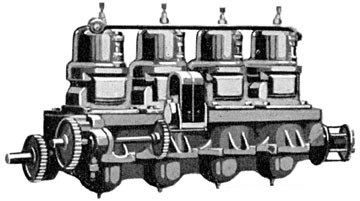
Established in 1934 by G. N. Wickner, V. Foster and J. F. Lusty, initially at the latter’s furniture factory at Bromleyby-Bow, London. Mr. Wickner’s earlier designs, built in Australia, included Wicko Sports Monoplane and Wicko Lion, both high-wing monoplanes on which the prototype Wicko F.W.1 was based. Of wooden construction, the F.W.1 was powered by a Ford V-8 engine, and became F.W.2 with Cirrus Minor and F.W.3 with Cirrus Major. Nine production aircraft built 1938-1939 at Southampton were designated G.M.1 with Gipsy Major engine.
The company ceased production at the outbreak of war.

Fornaire Aircraft Co

USA
Forney Manufacturing Company acquired production rights for Engineering and Research Corporation’s Ercoupe 415 two-seat light aircraft in April 1955. First production F-1 Aircoupe flew on September 1956. Offered later as Fornaire Execta, Explorer, and Expediter. Rights sold in 1960 to the city of Carlsbad, New Mexico.

Forlanini / Società Leonardo da Vinci Forlanini

Enrico Forlanini was born to Francesco Forlanini, a physician and director of the Ospedale Fatebenefratelli in Milan. After elementary school he attended one of the three Milan Regie Scuole Tecniche, in 1863 he entered the Military College of Turin.

In 1866 he enrolled at the Military Academy of Turin, and become a Lieutenant of Engineers. Enrico enrolled in the Scuola di Applicazione Artiglieria e Genio (Application School of Artillery and Engineers) in Turin in 1868.

Upon graduation in 1870, he was assigned to Casale Monferrato, where he was able to work in the police station’s workshop. He began working on a systematic testing of propellers. He subsequently studied at Politecnico di Milano and graduated in Industrial Engineering.

In 1877, he developed an early helicopter powered by a steam engine. It was the first of its type that rose to a height of 13 meters, where it remained for some 20 seconds, after a vertical take-off from a park in Milan.
Later he designed and built a series of dirigibles, notably, designed in 1901 and launched in 1909, the Leonardo da Vinci that he dedicated to the Renaissance inventor and, in 1912, the Città di Milano, dedicated to his beloved home town. The latter showed exceptionally good characteristics of stability and controllability that won Forlanini international renown. A further four airships were constructed: F3, F4, F5 and F6. A seventh, named Omnia Dir was only completed after his death in 1930.
Ford-Van Auken

Edsel Ford was born in 1893, the son of automobile pioneer Henry Ford. Edsel worked part time in the Ford factory where, in 1909, he met a Ford employee, Charles Van Auken, who had bought construction drawings for a Bleriot XI monoplane. Knowing that Edsel was deeply interested in aviation, his father asked several Ford employees to help Van Auken build the airplane.