Manlio Ginocchio was an Italian aviation pioneer, and an officer in the Italian Navy. After earlier experiences with flying and designing of machines, he designed and built his “Idro-canotto”
Manufacturer
Gilmore, Lyman Wiswell, Jr.
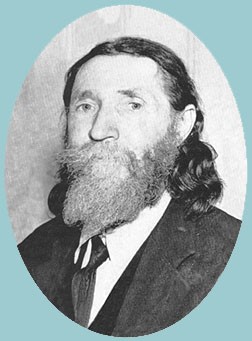
Lyman Wiswell Gilmore, Jr., was born on June 11, 1874, at Beaver Creek, Thurston County, in Washington, USA. He had three sisters and seven brothers. Gilmore’s first attempt at flight apparently occurred at Red Bluff, California, during July of 1894, when he reportedly built a glider (whether biplane or monoplane is not known) with a wing span of 18 feet and went aloft under tow by a horse. The source of this story, as with many of the assertions surrounding Lyman’s efforts, seems to have been Lyman Wiswell Gilmore, Jr., himself.
In addition to aeronautics, Gilmore had an active interest in gold mining, an aspect of his story which runs parallel to his aviation experiments. He wrote in 1898 that he was an “aerial Fulton,” someone who would open up the skies in the same way that Robert Fulton’s steam-powered ship had opened the waters. He also foresaw, in 1898, the use of dynamite dropped from aerial machines to sink enemy ships.
Copies exist of patent drawings of an aeroplane designed by Gilmore, although the April 27, 1898, date ascribed to them (and written on them in a hand other than the patent artist’s) is unsubstantiated, as far as can be determined.
The design is of a pusher/tractor monoplane, featuring an enclosed fuselage, with supplementary surfaces above the main planes. A vertical rudder surface is attached much as on a boat hull. The design also features a tricycle landing gear. If the design actually dates from 1898, it is a rather forward-looking conception. One of a number of significant impediments to flight would have been the fact that the lifting surfaces were flat and were not set at a positive angle of inclination.
During 1902, while living at Red Bluff, California, Gilmore was apparently awarded a U. S. patent for a steam engine meant for use in aerial vehicles. At a much later time, Gilmore claimed that he had built and flown a monoplane with a 32 foot wing span during May of 1902 powered by his patented steam engine, although no supporting evidence has come forth.
In 1903, Gilmore wrote to Samuel P. Langley with an offer to “balance” the Large Aerodrome which had recently plunged into the Potomac River. Langley declined Gilmore’s offer. During the 1910’s Gilmore’s efforts picked up ‘steam’ and he built a large monoplane, apparently patterned to a degree after Louis Bleriot’s Bleriot XII (not Bleriot XI) monoplane of 1909. Gilmore seems to have claimed that he built that machine in 1908, but that assertion, as with so much of Gilmore’s story, seems to be lacking corroboration. During August and September of 1909, Gilmore was experimenting with what seems to have been a clockwork-powered large model aeroplane, which was apparently successfully demonstrated to a small number of people.
Like three other of his brothers, Lyman never married. Late in his life he was set upon in his small cold cabin by murderous thieves who had come to relieve him of his supposed cache of gold. He was very ill at the time and managed to convince them that he was, in fact, without any funds of any sort, gold or currency. In much of his aeronautical work, Gilmore was ably assisted by his brother, Charles. He continued to work on drawing of aeroplanes until his death in the Nevada County (California) Hospital on February 18, 1951.
According to his grandniece, Caroline Boudreaux Sullivan, and his niece, Lyman Gilmore, Jr., thought of himself as an engineer rather than an aviator. Caroline Boudreaux Sullivan’s Mother (Lyman Gilmore, Jr.’s, niece) recalls that he neither shaved nor cut his hair nor bathed, for he believed if he did so, he would “diminish his strength and vitality.”
Gillis Aircraft Corp
Incorporated in 1927 at Battle Creek, Michigan, Gillis made its debut at the 1928 Detroit Air Show with the Crusader four-seat commercial cabin biplane, powered by a 125 hp Ryan Siemens engine.
Gilbert, Eugene
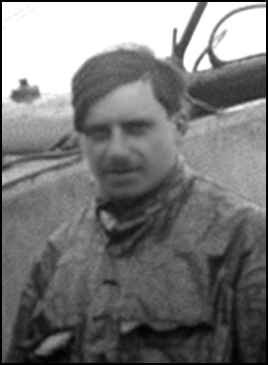
Eugene Gilbert (19 July 1889-1918) became interested in flight in his teens and attempted to build his own version of a flying machine in 1906. The effort appears to have been unsuccessful.
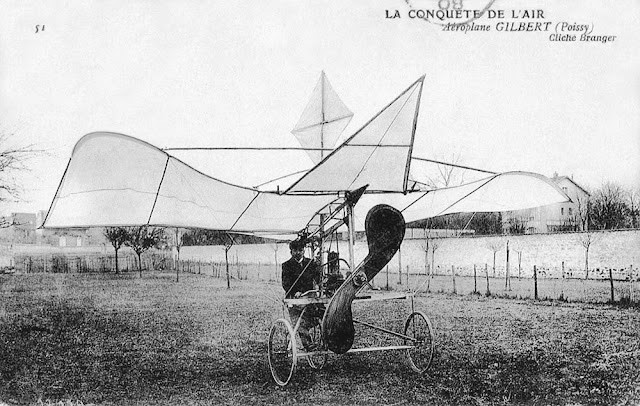
That same year he entered the Bleriot flight school in Étampes, gaining his pilot’s license on 24 September 1910
Gilbert was in the 1911 Paris-to-Madrid race, (won by Jules Vedrines), held a little earlier that year. And was flying over the ‘Pyrenees’ Mountains when attacked by that giant eagle.
During World War One Gilbert had attained at least five victories as a fighter pilot
Eugene Gilbert died May 17 1918.
Gigax
1983: Hans Gigax, Merkurstrasse 10, CH 4142 Miffichenstein, Switzerland.
Ultralight builder
Giffard, Jules Henri

1825 – 1882
Airship builder
Gidroplan Ltd / Redan
Russia
Redan was founded 1992 but known as Gidroplan since 1995.
Producing Che- 22 three-seat amphibious flying-boat (first flown 1992), developed from the single example of the Boris Chernov Che-20 two-seat homebuilt prototype that was tested 1989-1992. Che-25 four-seat derivative of Che-22 first flown 1996 but not selected for further production. Has also developed the Tsykada twin-engined very light agricultural monoplane.
Gevers Aircraft Inc
USA
Established 1988 to develop the unique Genesis six-seat twin piston-engined monoplane, featuring telescopic wings and a multi-configurational undercarriage to permit operations from land, water, or snow. Construction of prototype began 1998.
Motorluftfahrzeug Gesellschaft
DFG / Deutsche Flugmaschinenbau Gesellschaft
Austria
Established in Vienna, was one of the early builders of heavier-than-air craft. Produced both the Etrich Dove and the Loehner Arrow.
Geronimo Conversions Corp
USA
Successor to Vecto Instrument Corp and Vecto Aircraft Engineering Division, having acquired the assets of both companies on their owner’s death in 1965. Based at San Antonio, Texas, Geronimo carried out Vecto-designed conversions on the Piper Apache, fitting bigger engines and improving the aircraft’s internal and external appearance. Company name changed to Seguin Aviation in late 1960s.
 All Aero