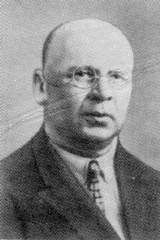
Dmitry Pavlovich Grigorovich was born on February 6 (January 25, old style) in 1883 in Kiev. His father, Pavel Dmitrievich, a great-nephew of the famous Russian writer Dmitry Vasilievich Grigorovich, first served in a sugar factory, later – in the quartermaster of the military department. Mother, Yadviga Konstantinovna, was the daughter of a rural doctor. The parents sent their son to the Kiev real school. Quite a lot of lessons were devoted to practical training in workshops and laboratories.
Graduates of a real school had the right to enrol in polytechnic institutes and, after graduating from a real school in 1902, Dmitry Grigorovich chose for his further education the mechanical department of the Kiev Polytechnic Institute of Emperor Alexander II.
Dmitry Grigorovich actively participated in the Aeronautical Circle KPI, founded in 1905. It was supervised by Nikolai Borisovich Delone, a student of Nikolai Yegorovich Zhukovsky, a professor of mechanics. Members of the circle listened to N.Delone’s lectures on the basics of aeronautics and were actively engaged in the design and manufacture of their own aircraft.
Before the end of the KPI, Dmitry went to the Belgian city of Liege, where he attended two semesters at one of the institutes, studying aerodynamics and engine theory. “Since 1909,” wrote N. Suknevich, the wife of Dmitry Pavlovich, “when Dmitry graduated from the Kiev Polytechnic Institute, we were both passionate about aviation. Our room was littered with mechanical parts, engine components, various parts. Not far from the Polytechnic Institute on the Kurenevsky airfield, he removes the shed and adapts it to the hangar. Next hangar another polytechnic – Igor Sikorsky. Dmitry made the first lightweight sports biplane G-1 with the Anzani engine with a capacity of 25 horsepower from bamboo, which he tested on January 10, 1910. “
The next work of D. Grigorovich was an airplane built according to the design of the French Bleriot XI aircraft, also with the Anzani engine, but with its own control system and chassis design. It was built by Grigorovich together with the Kiev motor sport amateur Ilnitsky. Financial assistance Ilnitsky was enough to complete work on a new airplane and demonstrate it at the Kiev exhibition of aeronautics. The aircraft attracted the general attention of aviation specialists and amateurs. The magazine “Automobile and aeronautics” called it the best design of the exhibition.
Fedor Tereshchenko, a descendant of a wealthy merchant family, became interested in the development of Dmitry Grigorovich. Tereshchenko also studied at the Kiev Polytechnic Institute and in his estate in the village of Chervonoye, Berdichevsky district, he equipped an aircraft workshop and airfield. Fyodor Tereshchenko proposed to Grigorovich to cooperate. Soon two of their sport airplanes appeared – the G-2 and the G-3. The designer and the main performer of all the works was Dmitry Grigorovich, the patron of the arts was Fyodor Tereshchenko.
In 1911 Dmitry Grigorovich went to St. Petersburg and got a job as a journalist in the science journal “Bulletin of the ballooning”. It was in 1911 that the famous work of Konstantin Tsiolkovsky’s Study of World Spaces with Jet Instruments was published in this journal.
Grigorovich flew one of his planes from Kiev to St. Petersburg and carried out several successful flights there at the Commandant airfield. They were witnessed by Sergei Schetinin, the founder of the first in the Russian Empire aircraft building plant called “The First Russian Aeronautical Partnership of the SS Shchetinin and Co.”. Over time, Schetinin invited Grigorovich to the position of manager and technical director of the plant.
Grigorovich proposed to create new aircraft designs, which at that time were very necessary for the military industry of the empire.
The head of the naval aviation of the Baltic Fleet requested repair the Donne-Levek military seaplane damaged in training flights. At Schetinin Grigorovich, together with the head of the drawing bureau Sedelnikov, suggested repairing the plane and at the same time making its drawings and setting up production at the factory.
During this work, the idea was born to create a hydroplane, but with the introduction of fundamental changes in its design as compared with Donne-Leveque. Grigorovich proposed to install the aircraft not on the float, necessary for take-off and landing on water, but to design a “flying boat”. The new design, called M-1 (“Sea-first”).
In parallel with the work at the plant of S. Shchetinin, on June 1, 1917, Grigorovich founded his own research aircraft building plant called “DP Grigorovich”.
On June 1, 1917 Grigorovich ended his working relationship with SS Schetinin. His personal relations by that time had been damaged and Schetinin, who had grown considerably rich from the war, considered that he no longer needed his engineer. Quite quickly Grigorovich received bank loans with low interest rates that allowed him to lease some facilities to organize an experimental factory and an empty building belonging to the Ismailovski regiment, at 12 Rota, Building 26. As an aid to be able to make the loan payment, the new facility received an order for the construction of 40 M-5 flying boats (later M-20), which was signed on July 28, 1917 with deliveries scheduled for the period between September 1, 1917 and January 1, 1918. The price of each unit was set at 16,000 rubles. In parallel Grigorovich received requests for the development of several experimental models.
At this enterprise, Dmitry Pavlovich designs, tests and prepares several more machine designs for serial production. These were flying boats M-18, M-19, M-20 and M-21.
The revolutionary events of 1917-1918 interrupted Dmitry Grigorovich’s quick pace in the aircraft industry. In March 1918, his plant was nationalized and redeveloped to produce agricultural equipment. According to some reports, in those days he received an invitation to go abroad, but remained in his homeland. The enterprise of S. Shchetinin was also reorganized into the State Aviation Plant “Red Pilot”.
Trying to survive and save his loved ones, D. Grigorovich began to work in the Main Committee of the United Aviation Plants (Golovkoavia) – the leading body of aircraft engineering. However, he did not work there for long: during the famine in Petrograd, Grigorovich and his family moved to Kiev, then to Odessa, then went to Taganrog. In Taganrog, he worked at an aviation factory, whose main profile was the repair of aircraft and engines. On the initiative of Grigorovich, outside of all sorts of orders and plans, the MK-1 sea float fighter (Rybka) was built there. Dmitry Pavlovich took direct participation in its design and production. Soon the order for “Rybka” was transferred to the plant “Red Pilot”, and Grigorovich was able to return to Petrograd.
In addition to introducing the new aircraft into production, Grigorovich completed work on the GASN sea torpedo bomber, which had been half forgotten in the factory yard since 1917. The hydroplane was repaired, some changes were made to its structure, and in the summer of 1920 test flights began.
In connection with the receipt of an order for the design of a new naval reconnaissance aircraft in mid-1922, Grigorovich moved to Moscow, where he was appointed Technical Director and Head of the Design Bureau of the State Aviation Plant No. 1 (GAZ 1), the former Dux Aircraft Factory. In this position, Grigorovich replaced another well-known aviation specialist, Nikolai Polikarpov, who was transferred to the Golovkoavia design department.
The company built a new Soviet R-1 reconnaissance aircraft for a 400 hp engine. The aircraft was designed on the basis of the captured English DH-9. Grigorovich accelerated the revival of production and ensured the operational solution of dozens of large and small tasks. On June 29, 1923, after the successful tests of the Air Force, the first two R-1 aircraft were handed over. And after a while, the plant produced 38 such machines every month.
In addition, the design team of the company worked hard on another order – the creation of a domestic fighter. It became a biplane I-2 with an M-5 engine, developed under Grigorovich and put into service in early 1925.
At the beginning of 1925 Grigorovich was again transferred to the Krasny Pilot plant (later – State Aviation Plant No. 23), where Aviatrest created the country’s first Department of Marine Research Aeronautical Engineering.
Under the leadership of Grigorovich, a number of projects and research samples of naval reconnaissance aircraft were prepared: MRL-1 (“Marine reconnaissance with Liberty engine”), its subsequent modifications – MR-2, MP-3, training aircraft MUR-1, MU -2 (“Marine Training with the engine” Ron “and” Marine Training “); ROM-1, ROM-2, ROM-2bis (“Scout of the open sea”), two-float, two-tail naval destroyer under two MM-1 tandem engines (“Marine minononset”), MT-1 (“Sea torpedo carrier”).
Unfortunately, due to some design flaws, incomplete compliance with customer requirements, and sometimes because of overt intrigues in the aviation industry, most of these machines did not reach mass production.
The chain of certain failures coincided in time with the start of the campaign launched against the old specialists. Special commissions “on the elimination of sabotage” were created at each defensive enterprise.
The first lawsuits against the “bourgeois experts” were the Shakhty affair and the Industrial Party affair. On September 1, 1928, they reached Grigorovich. He was arrested in his office, accused of sabotage and sent to Butyrka prison. Following him, he was arrested by his comrades – A. Sedelnikov, E. Maioranov, V. Corvin-Kerber, who worked with him in the “First Russian Aeronautical Partnership of S.S. Shchetinin and K”. Soon, a wave of arrests of aviation specialists swept through other defense industry enterprises.
In the spring of 1928, the USSR government adopted the “Plan for the construction of armed forces for the future five-year plan”. The leadership of the OGPU decided to use the imprisoned specialists in their direct specialties. The Deputy Chairman of the OGPU, Heinrich Yagoda, defended this idea, and was entrusted with the task of overseeing the first prison design bureau.
They established a design bureau in December 1929 directly in the Butyrskaya prison,. Dmitry Grigorovich was appointed Chief Designer of the Special Design Bureau, Nikolai Polikarpov, who was arrested on charges of participating in a counter-revolutionary organization, was appointed his deputy. Prisoners who were enrolled in the OKB were improved in conditions of detention — they increased their nutritional standards, more often they were taken to the bathhouse and were allowed to see their relatives. Immediately after the formation of the design bureau, he was visited by the Deputy Chief of the Air Force, Y. Alksnis, and set the task: by the spring of 1930, to design a fighter, the characteristics of which would be no worse than those of the best foreign aircraft.
Over time, the group of Grigorovich was transferred to aviation plant Menzhinsky (GAZ number 39), located near the Central airport. In his memoirs, Alexander Yakovlev, wrote: “They lived and worked in the mysterious” Seventh Hangar “, adapted to the internal prison.” The guards divided this hangar into two parts: in one there was a living area, in the other – working premises.
In just three months, the prisoners, designers and engineers have developed a model of the future fighter. They spent even less time on the construction of his research sample – a month, and on April 29, 1930, it was first tested in the air.
The success of the I-5 fighter inspired the leadership of the OGPU to expand the network of Special Design Bureaus, and the OKB D. Grigorovich received the orderto develop a whole range of combat aircraft.
Soon the staff of the OKB Grigorovich was expanded to 300 people at the expense of freelance specialists, and under the new name of the Central Design Bureau (Central Design Bureau) it was introduced into the technical department of the OGPU Economic Department. The mode of detention of prisoners of the Central Clinical Hospital was relaxed. And on July 10, 1931, Dmitry Grigorovich received freedom. In those days, Pravda newspaper published the Resolution of the USSR Central Executive Committee: “… Amnesty … Grigorovich Dmitry Pavlovich, Chief Designer for Research Aircraft Building, who repented of his previous actions and hard work, proved in practice his repentance. To award him with a diploma of the CEC of the USSR and a cash premium of 10,000 rubles.”
After his release, Dmitry Grigorovich remained to work in his Central Design Bureau. At that time, there were carried out searches and research of the best schemes of light and heavy attack aircraft, developed cannon fighter monoplanes I-Z and PI (factory code DG-52), armed with recoilless cannons and machine guns, which were produced in large series.
Dmitry Pavlovich combined his work with the Central Clinical Hospital with teaching and research at the Moscow Aviation Institute, where he headed the Department of Aircraft Design and Design.
In the spring of 1938, Grigorovich was given a new position – the head of the newly organized design bureau in Novosibirsk. But he could not go to Siberia – he became seriously ill and on July 26 of the same year, at the age of 56, died of blood cancer. He was buried at the Novodevichy cemetery in Moscow.
The result of D. Grigorovich’s life was 80 types of designed airplanes, of which almost four dozen were placed in production.
 All Aero