France
Gyroplane produced the G-20 two-seat light observation and liaison helicopter immediately following Second World War.
Manufacturer
Gyro-Kopp-Ters
2009-10: Gyro-Kopp-Ters
9392 US 90 West
Lake City, FL 32055-8045
Gyro copter builder
Gyroflight Ltd
UK
Formed in 1969 to develop gyroplanes designed by Ernest Brooks, who was killed when his ultralight Mosquito gyroplane crashed. Gyroflight produced a small number of Hornet single-seat gyroplanes and gyrogliders in the early 1970s.
Gyrodyne Co of America Inc
Known originally as P. C. Helicopter Corporation, the Gyrodyne Company was incorporated in New York in August 1946 for the development of advanced rotary-wing aircraft. Bought a five-seat coaxial design from defunct Helicopters Inc., and developed it into the G.C.A.2. Projected G.C.A.7 Helidyne with stub wings and two engines with pusher propellers mounted above wings. One-man portable helicopter, XRON-1 Rotocycle, developed for U.S. Navy Bureau of Aeronautics in mid-1950s, plus some ground-cushion vehicles.
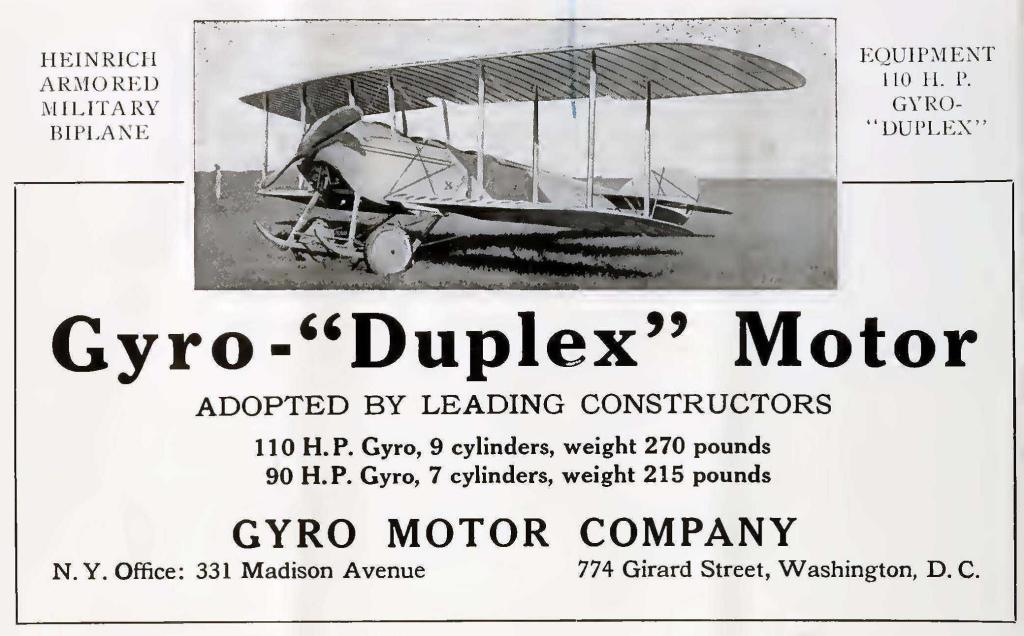
Gyro Motor Co
fdr: Emile Berliner
774 Girard St
Washington DC.
USA
Gypa-Aile
Xavier Demoury and Jean-Louis Darlet went their own ways in 1997. Demoury bought Gypa-Aile in 1997.
1998: Z.I Point Sud, F-65260 Soulom, France
1998: After ownership by Est Pyrerees, Gypa-Aile is now owned by Xavier Demouury.
Paraglider builder
Gwinn
Formed at Buffalo in 1935 by Joseph M. Gwinn Jr., a former chief engineer with Consolidated Aircraft Corporation. First product, in 1937, was Gwinn Aircar, a two-seat cabin biplane with tricycle landing gear, claimed to be stall- and spin-proof.
Guyot et Verdier
Ludovic Georges Louis Verdier was born on November 19, 1882 in Frenelles, Boisemont, Eure, France. Louis was discharged from military service in 1903. He took an interest in the emerging aviation and, in Roncherolles studies several prototypes. He began in 1903 to build his first helicopter but was stopped by a lack suitable engine, although he himself made an attempt by grouping two motorcycle engines together.
In 1904, Louis moved to Paris, he rented an office and workshop in rue Vercingétorix to build his first monoplane. He was authorized to use the Issy-les-Moulineaux training ground in the Hauts-de-Seine, provided it takes place on Sundays and public holidays.
In 1905, he resumed the study of a helicopter with a traction propeller and a lift propeller, then the study of a monoplane.
Faced with the futility of his efforts, Louis leaves his Parisian studio to get along with an industrialist at La Souterraine in the Creuse, Henri Guyot who has already filed a patent for a helicopter.
The Guyot-Verdier tandem is studying a propeller-driven tractor biplane, “Antoinette” type with adjustable pitch with 50 horsepower, quadrangular fuselage, aft fixed plane with angle variable and adjustable incidence. Front and rear stabilizers combined, rear rudder, wingspan of the aircraft 12 meters, length 10 meters, cell mounted on a landing gear metal, with shock absorbers and steerable wheels for landing and ground towing.
The tests of this “creusois” aircraft are carried out in Haute-Vienne, on the Dorat aerodrome, installed by Henri Guyot and Louis Verdier, on the racecourse made available to airmen by Mr. de La Guériviére.
The same pair built another propeller-driven biplane with a 60 horsepower engine. A biplane with the span of the upper planes 15 meters, span of the lower planes 12 meters, the cell front and rear stabilizer were joined by V-shaped ash beams and to reduce resistance to forward movement by flight in the atmosphere, the guying masts, the levers of controls were streamlined, the front cell mounted on landing pads and shock-absorbing wheels with skids braking on the ground under the fixed rear plane, the incidence of the rear plane being adjustable without touching the rear skids, the rudder steering being fixed at the rear of the rear stabilizer, the ailerons manually controlled by a joystick, the spacing of the pads landing area of 3.50 meters, 4 shock absorbers per skid mounted on dual wheels, constructed with drop-base rims for the fitting of balloon tires.
In 1913, Louis Verdier wrote:
“Despite all these facts and qualities as well as many steps taken by our gentlemen, Deputies and Senators of Creuse and Haute-Vienne, the La Souterraine aviation factory has never obtained any order of a military service from the French State, nor any financial aid, all this aviation equipment has been studied, built and developed to no avail, for it was not the few parties and exhibitions that were able to cover all these study and construction costs for these aircraft prototypes. I give up building and flying these planes, I leave the provinces and return to the Paris region”
Louis entered the Sanchez-Beza Establishments as a pilot, then as a test pilot and engine developer at the Salmson aviation factories in Billancourt and, with mechanics, replaces engines on seaplanes in Saint-Raphaël (Var), Bizerte (Tunisia), Marseille (Bouches-du-Rhône), Toulon (Var).
1914, the war breaks out, Louis helps Caudron to move his aviation factory and he returned to Farman as a pilot and instructor.
In 1940, the Farman and Louis factory moved to Angoulême in Charente. When they return to Billancourt, a month later,the enemy planes had done a sad job, the factory was bombed from all sides, everything had to be rebuilt. In March and September 1943, the home of Louis and his wife was partially destroyed by bombing.
In 1950, at the age of 68, Louis decided to give up aviation.
Louis Verdier, domiciled at 18 rue de Clamart in Boulogne-Billancourt, died at the age of 74, on January 29, 1957 at the hospital in Paris in the 15th arrondissement. He rests in the cemetery of the commune of Boulogne-Billancourt.
Gulfstream Aerospace
The company that evolved into Gulfstream Aerospace Corp. started in the late 1950s when Grumman Aircraft Engineering Co., a company known for military aircraft production, developed a marketable business aircraft at its manufacturing facilities in Bethpage, N.Y.
At the start of the GII program in the 1960’s, Grumman officials separated the company’s civil and military aircraft production to improve efficiency. In 1966, they relocated the civilian component to Savannah, Ga. There they found the needed supply of skilled labour, an established airfield adjacent to the plant site and sufficient acreage for expansion. Transportation facilities suitable for heavy equipment and machinery and weather favorable to year-round flight-testing and flight-training operations further enhanced Savannah’s appeal. The new building in Chatham County opened in June 1967 and was officially dedicated on Sept. 29, 1967. It housed production and flight testing for the GII. The 100-person work force that built the GII was 90 percent local and grew to more than 1,700 within a few years.
In 1972, Grumman merged with light-aircraft manufacturer American Aviation Corp.
The 256th and final GII delivery took place in 1977. One year later, the Gulfstream line and the Savannah plant were sold to American Jet Industries, which was headed by little-known aviation entrepreneur Allen Paulson.
Paulson became the president and CEO of the company, renaming it Gulfstream America.
Under Paulson’s leadership, the Savannah work force grew to 2,500 employees by the spring of 1982. Also in this year, the company’s name changed to Gulfstream Aerospace Corp. to reflect its worldwide scope, and a new plane, the Gulfstream IV, was conceived. The following year, Gulfstream offered a total of 8.8 million shares of its stock to the public. In 1985, Chrysler Corp. acquired Gulfstream as a part of the automaker’s plan to diversify and move into high-tech industries. This was also the year that Gulfstream first appeared on the Fortune 500 list, at No. 417. Two years later, the 200th and last Gulfstream III produced was delivered, and the first delivery of a Gulfstream IV took place. The GIV was the first jet in business aviation to have an all-glass cockpit. In 1989, when Chrysler decided to sell Gulfstream, Paulson teamed up with Forstmann Little & Co. – a private equity firm specializing in leveraged buyouts – and bought Gulfstream back.
The opening of a $16 million Savannah service center with 136,000 square feet of hangar space was in 1996.
At the end of the 1990s, General Dynamics, a giant in the defense industry, purchased Gulfstream. The company focused on enhancing product performance and lowering costs. It opened a $5.5 million aircraft refurbishment and completions support facility in Savannah in 2000. In 2001, it acquired Galaxy Aerospace and with it, the mid-size Astra SPX and super mid-size Galaxy, which were later rebranded the G100 and G200, respectively. Also in 2001, Gulfstream purchased four U.S. maintenance facilities in Dallas; Las Vegas; Minneapolis; and West Palm Beach, Fla. Those service centers, along with a Gulfstream facility in Westfield, Mass., formed General Dynamics Aviation Services, which maintains and repairs Gulfstream and other business-jet aircraft.
In 2002, Gulfstream renamed its products, using Arabic numerals instead of Roman numerals to differentiate its aircraft. At the time, the company’s lineup included the ultra long-range G550 and G500, the long-range G400, the mid-range G300 and G200, and the high-speed G100. 2002 was also the year that Gulfstream introduced its Airborne Product Support aircraft, a specially equipped G100. It is used to deliver parts and provide any-time service to Gulfstream customers in North America and the Caribbean who are operating aircraft under warranty. In 2003, Gulfstream acquired a service center at the London-Luton Airport, the first Gulfstream-owned service center to be operated outside the United States.
In 2006, Gulfstream announced plans to expand its manufacturing and service facilities in Savannah. The seven-year, $400 million Long-Range Facilities Master Plan included the creation of a new 624,588-square-foot service center, an independent fuel farm, a 42,600-square-foot, state-of-the-art paint hangar and the addition of a new Sales and Design Center. As a result of the expansion, employment at the facility was expected to grow by some 1,100 jobs. To meet the immediate need for engineering office space, Gulfstream opened a Research and Development Center (RDC). The RDC accommodates approximately 750 technical and engineering employees.
The year 2007 also saw its share of major breakthroughs. In April, Gulfstream broke ground for a new business-jet manufacturing building at its headquarters in Savannah. The following month, the company signed a nine-year lease with North Point Real Estate for a second Research and Development Center. The RDC II consists of an office building, which can accommodate some 550 employees, and a Laboratory Building, which is designed for 150 employees and test equipment used in Gulfstream’s research and development efforts. Gulfstream completed the new Sales and Design Center addition in June and officially opened the first phase of the new Savannah Service Center in August.
Gulfstream Aerospace Oklahoma Operations
Founded by Gulfstream American chairman Allen Paulson after purchase of former Rockwell Commander aircraft series. Program ended 1985.
 All Aero