De Bothezat who, after abandoning his first helicopter in 1923, had created a firm for the design and manufacturing of industrial fans, returned in 1937 to the helicopter: he created then the Helicopter Corporation of America and built a coaxial helicopter whose testing was entrusted to a Russian ace of World War I Captain Sergievsky.
Manufacturer
Helicopteros Do Brasil sa
Helicopteros Do Brasil sa was founded 1978, with partial Aerospatiale of France shareholding, to assemble Aerospatiale SA 315B Lama and AS 350B Ecureuil helicopters, known locally as HB 315B Gaviao and HB 350B Esquilo respectively. Programs encompassed assembly of Esquilo plus the military AS 550 Fennec version, and AS 365 Dauphin and military AS 565 Panther (all Eurocopter types).
Helicop-Jet
Canada
Based in Canada for project management, but with French connections in helicopter development; first flew in France in 1976 and 1984 two prototypes of a four-seat helicopter with rotor driven by cold-air tip jets. Program halted.
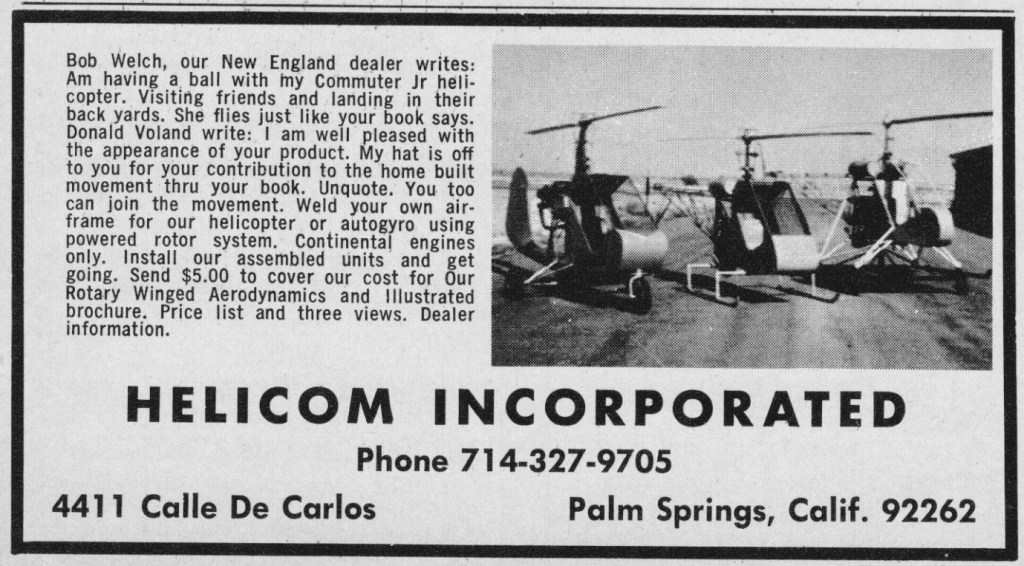
Helicom Inc
The Helicopter Research Company was founded by Harold E. Emigh in the early 1950s to build a single-seat, ultra-light conventional helicopter for amateur construction using either plans of kit – the H-1 Commuter Junior.
By 1963 the company had been renamed Helicom Inc and was based at Long Beach, California.
Harold Emigh Sr, a 15,000 hr fixed-wing pilot, taught himself to fly helicopters in the H-1 Commuter Junior.
Heldeberg Designs / Blue Heron Powered Parachutes
Founded in 1996, Heldeberg Designs was an American aircraft manufacturer, headquartered in Altamont, New York. The company specialized in powered parachutes.
Heldenberg Designs, 260 Benninger Rd. Delanson NY 12053
Originally marketing under its own name, the company marketed its aircraft under the brand name Blue Heron Powered Parachutes.

The company ceased manufacturing the Blue Heron line of powered parachutes in 2010. By early 2013 the company website stated: “After over 17 years of serving the aviation community, Heldeberg Designs LLC is wrapping up it’s operations and will no longer be manufacturing Blue Heron Powered Parachutes nor parts.”
Heitmann, Heinrich
Heinrich Heitmann started gliding experiments in Bresleu, Germany, before moving back to Hamburg-Altona. His company built eight different types between 1909 and 1912
Heinrich, Albert & Arthur
Brothers Albert & Arthur Heinrich from Baldwin, New York, were previously active in the boat business and both taught themselves to fly in their own Model A.
Heinkel
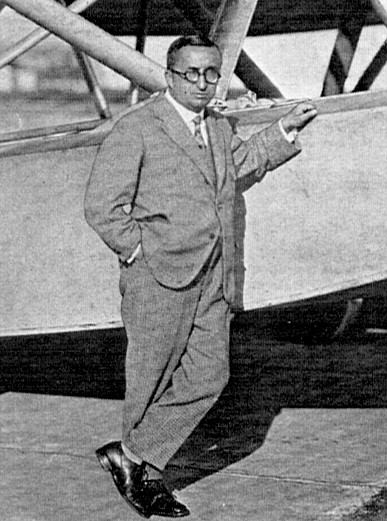
Ernst Heinkel was born in Grunbach, Germany, today a part of Remshalden. As a young man he became an apprentice machinist at a foundry. Heinkel studied at the Technical Academy of Stuttgart, where he initially became interested in aviation through a fascination with Zeppelins. In 1909, after he attended an international airshow in Frankfurt am Main, he determined flight was the future of transportation, and the following year, he built his first aircraft.
Ernst Heinkel established his own company shortly after the liquidation of Hansa Brandenburg, building a series of single-engined seaplanes (He 1 to He 8) in Sweden to circumvent the ban on the construction of military aircraft in Germany.
Heinkel, created in 1922, dealt with design, building of prototypes and small series. Large-scale production was not available, since all its production areas were limited to old aviation hangar in Varnemyunde.
The general practice was using HD designations for Heinkel Doppeldeckers (biplanes) and HE designations for Heinkel Eindeckers (monoplanes) was dropped in favour of He designations.
The He 51 biplane fighter went into production for the Luftwaffe in the 1930s and served with the Condor Legion in Spain. When the Heinkel He 70 passenger/mailplane appeared in 1932, ostensibly for Deutsche Lufthansa, it was the most advanced aerodynamic design then seen in Europe. A natural outgrowth of this design was the Heinkel He 111 twin-engined bomber which served with the Luftwaffe throughout the Second World War. A Rolls-Royce Merlin-engined version of the He 111 was built by CASA in Spain, and served with the Spanish Air Force until the late 1960s. Heinkel also produced late in the war the He 162 Volksjager (People’s Fighter), a lightweight turbojet fighter constructed almost entirely of wood. Heinkel had designed, built and flown the world’s first jet aircraft, the He 178, in 1939. Other significant Heinkel projects included the He 177 Greif heavy bomber and the He 219 Uhu nightfighter.
Heinkel joined VFW in 1965.
Heath Aircraft Co

Edward Bayard Heath was born on November 17, 1888 in Brooklyn, New York to Clark Heath and Ada M. Johnson.
Heath designed and built a series of aircraft starting in 1909 with a Bleriot-inspired monoplane. His first flight was on 10 October 1909 in Amsterdam, New York resulting in a broken landing gear. On July 4, 1910 Heath made $500 in appearance fees and $200 in photograph revenues from his aircraft that flew 3 feet above the ground.
In 1911 Heath went to work for Glen Curtiss in Hammondsport, New York as a motorcycle mechanic, next to the Curtiss aircraft factory where he built a second aircraft with Walter Eales making short aerial runs. After purchasing the Chicago-based Bates Aeroplane Company in 1912, Heath founded the E.B. Heath Aerial Vehicle Co., later becoming the Heath Airplane Company.
His company produced the Heath Feather and Heath Favorite after World War I, and later the Heath Parasol series of aircraft powered with Henderson Motorcycle engines.
The 1928 Heath Baby Bullet mid-wing monoplane racer exceeded 100mph (160kmh) on only 32 hp. Heath Super Soarer biplane glider, built 1930, was first unpowered aircraft to loop-the-loop. Heath Parasol of 1931, designed to be powered by a converted motorcycle engine, sold in large numbers to amateur builders.
Married to Berna Heath, Heath died on February 1, 1931 (aged 42) in Maine Township, Cook County, Illinois. He was in an aircraft accident while testing a new low-wing aircraft design.
Heath’s company was eventually purchased and after World War II, changed its product to kit electronics. Heathkit filed for bankruptcy and closed in 2012. As of 2019, the company has a live website at http://www.heathkit.com.
HCI Aviation Inc
1998-2007: Jack Hereford, 3461 Dissen Rd, New Haven, MO 63068, USA
LSA engine builder
 All Aero