Australia
Markets completed examples or kits of the Australian Light Wing PR tandem two-seat cabin monoplane and Australian Light Wing GR-912 side-by-side two-seat cabin monoplane LSA.
1998:
Southern Cross Drive
PO Box 89
Ballina
NSW 2478
Australia
Australia
Markets completed examples or kits of the Australian Light Wing PR tandem two-seat cabin monoplane and Australian Light Wing GR-912 side-by-side two-seat cabin monoplane LSA.
1998:
Southern Cross Drive
PO Box 89
Ballina
NSW 2478
Australia
In 1947, Howard formed Howard Aero to provide maintenance and service for business aircraft. One of his customers, a wealthy Mex¬ican businessman, requested that he develop an aircraft suitable for executive transport between Mexico City and New York. The result, in 1955, was a slick and speedy conversion of the Lockheed PV 1 Ventura that would cruise at 261 knots with its pair of 2,000 hp Pratt & Whitney R 2800s. Several large corporations, including Na¬tional Distillers, purchased the aircraft, and it won fame as the Flagship of the Fleet at the Reading Air Show in the late 1950s. But the Super Ventura, as Howard’s conversion was known, was neither pressurized nor new.
In 1963 Howard combined with Alamo Aero Service, specializing in the conversion of ex-military Lockheed PV-1 Venturas and civilian Lockheed Lodestars to high-speed executive transports known as Howard 250s, 350s and 500s, according to configuration and powerplant. A three-engined version of the Beech Travel Air twin was also flown experimentally.
Howard Aero was succeeded by Business AirCraft Corp by 1964.
Benjamin Howard built his first airplane, the DGA-1 (“Damn Good Airplane”), in 1923, while working for the Curtiss company. His DGA-3 Pete racer, built for the 1930 U.S. National Air Races, was succeeded by DGA-4 Ike and DGS- 5 Mike.
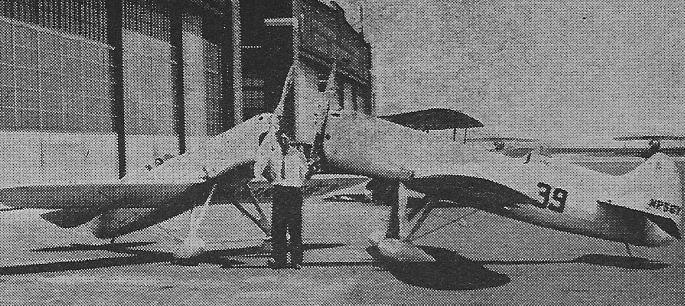
With DGA-6 Mister Mulligan Howard won all three major American racing titles in 1935, and this design was developed through several models into the Howard DGA- 15 five-seat cabin monoplane which served with the U.S. Navy in transport, instrument trainer and ambulance roles during the Second World War. The Howard DGA-18K two-seat primary trainer was produced in quantity during 1940- 1942 for the U.S. Government’s Civilian Pilot Training Program.
1980: R.W.Hovey, Box 1074, Canyon County, CA 91351, USA.
LSA builder
San Diego CA. USA
Built the Hotz Tiger LSA
Walter and Reimar Horten conducted flying-wing experiments prewar, building a series of tailless high-performance gliders. The Horten Ho V and Ho VI were both powered aircraft, leading to the turbojet-powered Ho IX flown in the summer of 1944. Before being destroyed in a landing accident after only a few hours flight, it had been flown at a speed of 800km/h. This was developed by Gothaer Waggonfabrik as the Gotha Go 229 V3 single-seat fighter, but the Gothaer works were captured by advancing U.S. forces before this prototype was completed.
Horton Aircraft was organized in 1952 for the purpose of engaging in the business of manufacturing and selling a so-called “Horton Wingless Airplane.” Its only asset was said to be a patent issued to William E. Horton, its president, with respect to the wingless plane and assigned by him to the company. Horton had agreed to assign the patent rights to the company for 500,000 shares of its stock, and to build and sell a model of the plane to the company for an additional 200,000 shares. The company’s entire personnel consisted of three directors, including Horton; and it had more than 800 stockholders. The first registration statement filed April 26, 1955, proposed the public offering of 400,000 shares by the company and 100,000 shares held by Horton, at $1 per share or the market price, whichever was higher. The second, filed October 18, 1956, proposed the public offering of 100,000 shares held by Horton at $25 per share.
The aircraft was designed and built by Bill Horton in a three way partnership with Howard Hughes and Harlow Curtice of General Motors. Horton had a falling out with Hughes.
The Securities and Exchange Commission announced the issuance of a “stop order” decision suspending the effectiveness of two registration statements filed by Horton Aircraft Corporation, of Las Vegas, Nevada, because of false and misleading representations contained in the registration statements, which proposed the public offering of 500,000 and 100,000 shares, respectively, of Horton Aircraft stock.
According to the Commission’s decision, Horton “had no patent rights or patent he could validly assign” to the company and it was at least doubtful whether he could legally sell a model of the wingless plane to the company because of a June, 1954 court decision upholding the validity of an earlier assignment to another company of Horton’s interest in his “invention” of the wingless plane. Furthermore, the Commission ruled that false and misleading statements were made in the registration statement with respect to the nature and performance of the wingless plane. The plane was represented as having no wings and it was stated that a model constructed by Horton in 1954 had been test-flown continuously and its performance had equalled Horton’s expectations.
The Commission found that the wingless plane in fact had wings which extended about 8 feet from the fuselage and had a depth of 5 to 6 feet, and that these wings, although retractable had never been retracted in flight. “The registration statements should have disclosed,” the Commission stated, “that the Horton plane, which was remodelled from a standard airplane, has in general performed in a manner inferior to that of a conventional plane Horton has used as a basis for comparison, that his plane admittedly was not built to fly any distance and the test flights were short, the longest flight being about 150 miles, that the maximum speed of the plane was about one-half that of another plane using the same motors, and that it had never been tested for range or load-carrying capacity. The second registration statement should have further disclosed that the prototype has not been test flown since it crashed in landing in June, 1955.
Moreover, the statement that the plane’s performance has equalled Horton’s expectations is misleading in view of statements made in brochures and form letters which Horton caused to be prepared and circulated by registrant in connection with previous sales of unregistered stock. Those statements, which were false and misleading, were to the effect that Horton’s development of the Horton Wingless Plane is comparable to the achievements of the Wright brothers, Leonardo da Vinci, Sikorsky, Billy Mitchell, and Charles Lindbergh; that his plane is one of the greatest aeronautical engineering achievements of all ages and the greatest advance in aviation since the advent of flying; that it can carry 100% greater payload over 100% greater range and is faster and easier to control than any other plane, and can carry twice the load at half the cost of any other plane; and that the Horton Wingless Jumbo Transport plane will carry 4,000 persons a distance of 25,000 miles non-stop) at 60,000 feet altitude, at speeds of over 400 miles per hour.”
The Commission also found false and misleading the disclosures in the registration statements with respect to past stock sales without prior registration, the selling costs of the proposed offerings, and the proposed use of the proceeds of the financing, as well as the implications that the $25 per share price of the second offering was based upon and related to some reasonable valuation of the stock.
Horton Aircraft and Horton were permanently enjoined by the United States District Court in Los Angeles in September, 1954 from making false and misleading statements in the sale of Horton Aircraft stock. Horton was convicted on March 8, 1957, of fraud in the sale of Horton Aircraft stock and sentenced to 3 years’ imprisonment followed by 5 years’ probation.
1983: Templeward Ltd t/a Hornet Microlights, Bankfoot Mills, Wibsey Bank, Bankfoot, Bradford, West Yorkshire BD63JU, Great Britain.
LSA and Trike builder
Levin, New Zealand.
LSA builder
Horizontec is a Mexican company dedicated to the design and development of aircraft supported by the National Center for Aeronautical Technologies (Centa).
 All Aero