International Aero Engines / IAE

IAE International Aero Engines AG is a Zürich-registered joint venture manufacturing company founded in 1983 to develop an engine to address the 150-seat single aisle market.

The original collaboration involved Pratt & Whitney of the United States, Rolls-Royce plc of the United Kingdom, Japanese Aero Engine Corporation of Japan and MTU Aero Engines of Germany. FiatAvio withdrew as a shareholder of the program early on, but the now-renamed Avio S.p.A. remainede as a supplier. The “V” product nomenclature remains as a legacy of the five original shareholders.

The collaboration produced the V2500 – the second most successful commercial jet engine program in production in terms of volume, and the third most successful commercial jet engine program in aviation history.

In October 2011, Rolls-Royce agreed to sell its 32.5% stake in the company to Pratt & Whitney’s parent company, United Technologies (UTC), giving UTC a combined equity ownership share of 49.5% (which is different from UTC’s total program share in the IAE collaboration, which stands at 61%). The transaction was completed on 29 June 2012.

Rolls-Royce remains a major supplier to IAE.

IAE had developed the abortive Superfan for the Airbus A340. IAE’s purpose became the development, production and aftermarket services of the IAE V2500 aero engine family.

By 2012, more than 5,700 engines had been delivered and approximately 1,600 more were on backlog, which is equivalent to nearly five full years production. Over the previous five years, production had doubled with over an engine a day being delivered.

In 2011, the IAE Executive Board of Directors announced the extension of its collaboration agreement to 2045. After receiving regulatory approvals and partner consent, Pratt & Whitney closed on the purchase of Rolls-Royce’s equity and program share in IAE on June 29, 2012. Rolls-Royce were to continue to support IAE as a strategic supplier for the V2500 engine and continue to perform its key responsibilities for IAE, including the manufacture of parts and engines, as well as supply MRO services for IAE’s fleet.

Shareholders in 2012 were:
Pratt & Whitney, USA: 25.00%
Pratt & Whitney Aero Engines International GmbH, Switzerland: 24.50%
MTU Aero Engines, Germany: 25.25%
The Japanese Aero Engine Corporation: 25.25%

The Japanese Aero Engine Corporation consisted of:
Kawasaki Heavy Industries
Ishikawajima-Harima Heavy Industries
Mitsubishi Heavy Industries
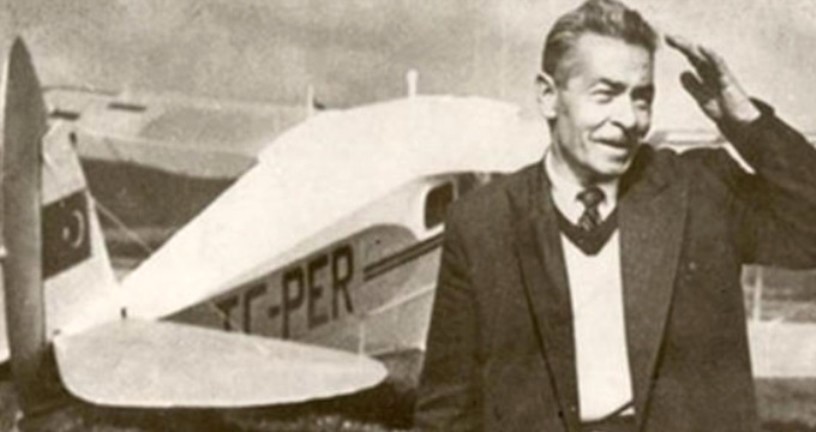
Hürkus, Vecihi

Born in Istanbul, Ottoman Empire, on 6 January 1896. Vecihi Hürkus father was customs inspector Feham Bey, his mother was Zeliha Niyir, born in Vidin. His father died when he was 3 years old. He went to elementary school in Bebek, Füyuzati Osmaniye Rüştiye (middle school) in Uskudar and Paşakapısı İdadi (high school). Then he finished Tophane Art School.

When Balkan War started, he joined as volunteer. Upon his return, he was assigned as the commander of a POW camp in Beykoz. Then during World War I, in early 1916, he was sent to, Bagdat, during Mesopotamia Campaign as a mechanic. He was sent back to Istanbul after he was injured. He subsequently joined Tayyare Mektebi, the Ottoman aviation school in Yeşilköy. His first solo flight was on May 21, 1916. Soon after receiving his pilot certificate he joined 7th airplane company (Tayyare Bölüğü) and commenced bombing and reconnaissance missions against the Russians on the Caucasus front. In one of these sorties, he shot down a Russian airplane, becoming the first Turkish pilot to bring down an enemy aircraft.

He was subsequently taken prisoner by the Russians but managed to escape from Nargin island to Iran by swimming with Azeri help and walking for over two months. Following his escape, he returned to Istanbul and joined the 9th combat aircraft squadron in 1918, assigned to protection of Istanbul from aerial attacks by Allies. He designed a fighter airplane but could not finish the project due to the terms contained within the Montreux Ceasefire Agreement. During the Turkish War of Independence, in which he flew as a “civilian pilot”, he held the equivalent rank of Captain. During this time he shot down a Greek airplane, and made the first and last flights of the war. In the last flight, he landed at İzmir Seydiköy Airfield, occupying it single-handedly.

In 1917, Hürkuş became the first Turkish aviator to fly a twin-engine aircraft, a Russian Caudron G.4 captured at the Caucasian Front. In 1918 he manufactured a propeller from scratch in Istanbul, for a Nieuport 17 also captured from the Russians. During the Turkish War of Independence he produced adhesive from gelatin to glue fabric to aircraft wings.

During the War of Independence, Vecihi married Hadiye, the daughter of the chief of police in Akşehir. They had two daughters, Gönül (Hürkuş Şarman) and Sevim (Hürkus Maxson). In 1925, he divorced Hadiye and married his childhood sweetheart İhsan. Another daughter, Perran (Ülgen-Hürkuş), was born in 1927.
Legacy

After the war, he designed and built his first airplane and a few other aircraft inside a converted saw mill which he had rented for that purpose. He used aircraft engines he had acquired during World War I to power the planes he manufactured. In 1924 he built a military aircraft from scratch in Izmir, Vecihi K-VI, which made its first flight on 28 January 1925. Vecihi seems to have begun by designing aircraft from salvage parts. In 1930 he constructed a speedboat (Vecihi-SK-X) and a civilian aircraft (Vecihi K-XIV) in Kadıköy, Istanbul, followed by a seaplane in 1933.

Designs are designated with Roman numerals … sometimes shown with prefixes — ‘K’ and ‘SK’ — and prefixes ‘STM’ and ‘D’. The ‘D’, for Deniz/Sea, was applied to floatplanes.

In 1923, in Edirne, Hürkuş flew an abandoned Italian Caproni Ca.5 aka Ca.57 or Breda M-1 with nine passengers, the first Turkish pilot to fly a passenger aircraft. He constructed the country’s first gliders (US–4 ve PS–2), and played a role in the establishment of the Turkish Bird (Turkish Aviation Society) from 1935 to 1936 in Etimesgut, Ankara.

On 21 April 1932, he established a civilian flying school, Vecihi Sivil Tayyare Mektebi, in Kadıköy. The following year he trained the first Turkish female aviator, Bedriye Bacı (Gökmen). He adopted the surname Hürkuş (“Freebird”) after the Surname Law of 1934. On 27 February 1939 he received a diploma in aircraft engineering from the Weimar Engineering School in Germany.

In 1948 he established a privately-funded aviation publication entitled Kanatlılar Dergisi. On 29 November 1954 he founded Hürkuş Havayollari (Freebird Airlines), the first private airline in Turkey. From 1961 to 1966 he conducted aerial surveys for the Mining Research Institute.

During his flying career, which spanned a period of 52 years (1916–1967), Vecihi Hürkuş flew a total of 102 different models of aircraft and spent 30,000 hours (3.4 years) in the cockpit.

Vecihi Hürkuş died on 16 July 1969, in Ankara, Turkey.

In 1994, Hürkuş was honored posthumously with the International Civil Aviation Organization’s (ICAO) 50th Anniversary Award for his contributions to civil aviation in Turkey.

The TAI Hürkuş turboprop trainer to be built by Turkish Aerospace Industries is named after Vecihi Hürkuş.

Hurel-Dubois

France
Formed to develop Maurice Hurel’s theories on high aspect- ratio wings. His first design, the Hurel-Dubois HD- 10 single-engined research aircraft, flew in 1948 and led to a twin-engined derivative, the HD-31. Production versions included the HD-32 transport, HD-33 freighter and HD-34 photo-survey aircraft for the Institut Geographique National. While still active in the French aviation industry, the company is no longer an aircraft constructor.