2002: From the Phil Kavanagh factory in the Hunter Valley, Australia.
Balloon builder
2002: From the Phil Kavanagh factory in the Hunter Valley, Australia.
Balloon builder
USA
Glider builder in the 1960s.
Lithuania
The Lithuanian Army’s aircraft factory, responsible for the construction of the Anbo 41, a two-seat day/night observation aircraft, and the Anbo 51 two-seat trainer, both monoplanes.
USA
Formed in June 1928, in Sioux City, Iowa, as a subsidiary of Kari-Keen Manufacturing Company Inc., which made automobile accessories. Built Kari-Keen 90 high-wing side-by-side two-seat light cabin monoplane.
Kari-Keen’s automotive product line included the Kari-Keen Kairrier automotive trunks and beds designed by Paul Lier and patented in 1925. Production started in Leeds, Iowa. In 1937, the automotive division ceased operations.
Kari-Keen also operated a flight school to operate their aircraft, the Kari-Keen School of Aviation. In 1930 C.F. Lytlebought the assets of the aviation branch and formed Sioux aircraft, changing the name of the Kari-Keen 90 into the Sioux Coupe 90. Only three prototype new models were built and retained the Kari-Keen logo on the tail.
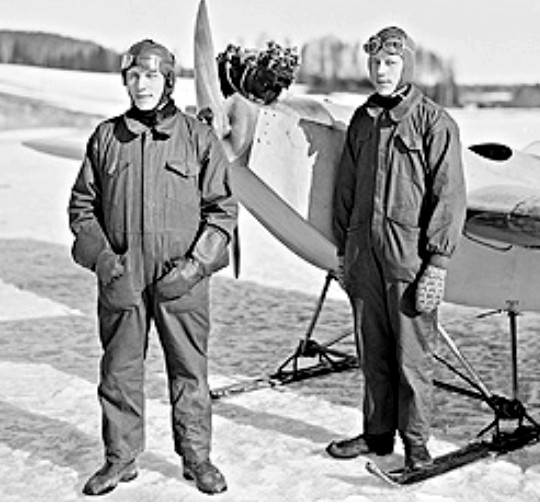
Niilo and Valto Karhumäki, also known as the Karhumäki brothers (Finnish: Veljekset Karhumäki), were Finnish aviation pioneers, aircraft manufacturers and airline founders.
Born in Multia, Niilo and Valto Karhumäki moved to Jyväskylä, where they founded a company called Veljekset Karhumäki in late 1924, which dealt with pilot training, public displays, aircraft maintenance and aerial photography during the 1930s. Niilo Karhumäki had completed in early Air Force reserve pilot course in Vyborg and received a pilot’s license.
Niilo and Valto Karhumäki started in autumn 1924 the construction of an airplane at their home. The work also involved Emil Kankaanpää and Hope Hovinen. The machine was given the name Bear 1. The brothers built in the 1920s of four aircraft: Bear 1 Bear 2 Bear 3 and Tern. Construction was initially something of a hobby, but soon expanded into a versatile aviation business.
In order to start a co-operation with the Finnish Air Force, the headquarters of Veljekset Karhumäki was moved to Kuorevesi. During World War II the company was merged into the Valtion lentokonetehdas company, manufacturer of a number of military aircraft. In the 1930s the Viri single-seat light monoplane was built, design by Finnish Club of Aeronautical Engineers. In 1939-1941 a new factory was built, near Halli airfield, where trainers for Finnish Air Force were built. The Karhumäki brothers designed the Karhumäki Karhu 48B light airplane, of which a small number was produced during the 1950s.
In 1950, Karhumäki Airways was founded by Veljekset Karhumäki, an airline initially offering scheduled passenger flights on mostly domestic routes. In 1963, Aero O/Y (today’s Finnair) acquired the majority of its stake, and in 1996 Karair (as it was known by then) was fully absorbed into Finnair.
Successful air transport and repair activities were discontinued due to tougher competition in 1963. Aerial Photography and the Ministry of Agriculture and Forestry flights continued. The brothers have been honoured with a monument called Lentäjäveljestenaukio (which translates as “Pilot Brothers Square”) in Halli.
Kappa Ltd was established in 1991 in the Czech Republic.
Produces the KP-2U Sova two-seat low-wing lightplane, first flown May 1996.
1998:
Brtnica 21
CZ-586001 Jihlava
Czech Republic
Russia
Developed the Ratnik two-seat multipurpose light autogyro, flight tested from 1995.
Formed in 1945 by Charles H. Kaman as Kaman Aircraft Corporation to develop a special servo-flap control system for helicopter rotors and “synchropter” lntermeshing twin rotor system, with aim of eliminating anti-torque tail rotor. K-125A built in 1947; K-190 in 1948; K-225 built in small numbers as YH-22 from 1949. HOK-1 delivered in quantity to U.S. Navy and Marines during 1950s; HTK-1 to Navy as trainer/ambulance, and also adopted as remote-controlled drone. By late 1960s well over 200 H-43 Huskie turbine-powered rescue helicopters were serving with the USAF. H-2 Seasprite naval rescue and utility helicopter first flown July 1959, retaining servo-flap system, though on a conventional main rotor. Seasprite developed in many versions, early production models using a single turboshaft engine and later models with twin turboshafts; experiments included stub wings serving as sponsons and gunship version with Minigun chin turret among other weapons.
In the late 1960s much subcontracting undertaken, together with development of Rotorchute and allied devices. Became Kaman Group in 1965 with extended activities, with Aerospace subsidiary subsequently taking the present name Kaman Aerospace Corporation as part of Kaman Group. Current programs include producing upgraded SH-2Fs as SH-2G Super Seasprites for antisubmarine/ anti-shipping, over-the-horizon targeting, SAR, mine countermeasures, vertrep and other roles, for delivery to Royal Australian Navy, Royal New Zealand Navy, Egypt, and U.S. Navy Reserve; production of K-MAX “Aerial Truck” single-seat, turboshaft-powered and twin intermeshing rotor external-lift helicopter (first flown December 1991); and subcontract work on Boeing airliners and for various military aircraft including AH-1, C-17, Comanche, F-22, and V-22.
1995: Old Windsor Rd, PO Box 2, Bloomfield, Conneticut 06002, USA.
In 2000 Kaman Aerospace was se¬lected by MD Helicopters (MDHI) to be the sole supplier of fuselages for its line of single-engine helicop¬ters, including the MD600N, MD520N, MD530F and the MD500E. The agreement is worth a reported $100 million.
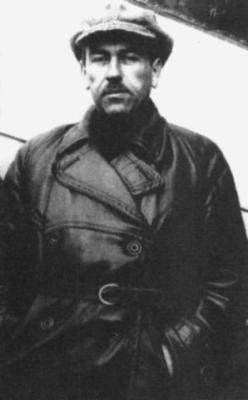
Konstantin Alexeyevich Kalinin (Russian: Константин Алексеевич Калинин) was born on December 29, 1899 in Warsaw. His father, a retired military man, died when he was only three years old. He completed his first studies at a local seminary.
During the 1905 disturbances in Russia, the young Kalinin was accused of distributing revolutionary bulletins, for which he was detained for four months. After being released he continued his teacher studies.
Between 1909 and 1912 Kalinin studied at the Odessa Higher Military Artillery School and after graduation was assigned to Vladivostok. A year later he would get married and have his first contact with aviation. Near the barracks where he was, was one of the first aviation units of the Russian Empire and these planes greatly impressed the young man, who requested to be transferred to a flight school, but was not allowed.
At the beginning of World War I Kalinin served as an artillery officer, but by February 1916 his dream of aviation came true when he was allowed to enter the Gatchina Military Flight School, graduating in December. The recently graduated pilot was assigned to the 26th Aviation Corps stationed on the Romanian front, where he flew reconnaissance missions in Farman and Voisin biplanes, receiving the Imperial Orders of Saint Stanislav, Saint Anne and Saint Vladimir.
After the October Revolution Kalinin joined the Red Army, serving as a pilot during the civil war and joining the ranks of the Communist Party in 1920. On June 1 of 1920, Kalinin entered the Moscow Aviation Technical School, created by Professor N. Ye. Zhukovski in 1919 and for the month of October, due to his excellent results, he validated the first year. By March 1921, Kalinin became head of the scientific-technical section of the school.
In 1922, his membership within the Communist Party was suspended on charges of sympathizing with the counterrevolutionary bands of the Ukrainian nationalist Petlyura and of party inactivity, but he was reinstated in June at the request of a member of the VS school party committee, Ilyushin, but in November he left the institution.
Kalinin moved to Kiev, where he started working at ” Remvozdux-6 ” aircraft repair factory as head of production. This factory, created in 1920, was dedicated to the repair of Red Army aircraft, mostly licensed model aircraft used during the First World War. Since his arrival, Kalinin grouped under his direction a design group made up of a technician (DL Tomashevich), two designers and two students linked to practical work: AT Rudenko and AN Gratsianski.
Determined to continue his studies at the end of 1922 Kalinin entered the Kiev Polytechnic Institute, where a year later he would be elected secretary of the Aviation Scientific Society. By 1923 he patented an elliptical wing of his own design, which would later be used on his civilian models. His graduation project in 1925 was the K-1 (RBZ-6) transport aircraft. Kalinin personally participated in the first flight of the K-1 and ended up graduating as a mechanical engineer. From that moment on he became one of the most renowned Soviet aircraft builders of the interwar period.
In 1926 Kalinin was transferred to Kharkov , where he was selected as chief designer of the UkrVozduxPut company, which was in charge of managing flights on local lines. Under his direction there were two designers, three specialists in wing configuration, fuselages and propellers, and two technicians.
The basis for his new KB was established in the aircraft repair shops of the UkrVozduxPut, which at that time was engaged in the repair of German Dornier aircraft used by Soviet-German airlines. This workshop had 25 workers and two German specialists on its payroll.
On September 17, 1926, these workshops, together with Kalinin’s team, would become the Kharkov Aviation Factory and would lay the foundations of the Kharkov Aviation Institute (JAI) , by creating classrooms for the preparation of workers. The Kharkiv Institute of Technology also created an aviation department for the preparation of engineers, which some time later would be transferred to the JHA.
Later, an aerodynamic laboratory was built where a 2-meter wind tunnel was installed in which Kalinin’s second model, the K-2, would be tested.
The work of the Soviet specialists in the UkrVozduxPut soon created problems with the Germans, which came to a head when the German model Dornier Mercur found a competitor in the domestic model K-2.
The leadership of the UkrVozduxPut was divided, with the supporters of the foreign model winning. As a result, Kalinin’s group was decremented, new specialists from Kiev were brought back, and development of the K-2 was halted.
In these circumstances, the Ukrainian government took action on the side of Kalinin. Soon the pro-German leadership of the UkrVozduxPut was removed from their posts, the Dornier Mercur was not bought and the K-2 was built and tested. Despite the fact that the K-2 did not show superiority in relation to the K-1 and was not produced, it served to prepare the mechanisms of the industry and was soon followed by more successful models such as the K-4 of 1928 (39 built) and the 1929 K-5(260 built), which managed to lay the foundations for national civil aviation, which meant the end of German dependence.
After some civilian models, Kalinin began the development of military models with the gigantic K-7 bomber, which would be destroyed during tests in 1933. Two improved models, one as a bomber and one as an airliner, began construction in Voronezh, but were abandoned in 1935. Later military aviation development was continued with the K-12 (VS-12) tailless bomber.
Kalinin ‘s KB was transferred to the Voronezh Aviation Factory (Factory No.18) where development of the K-12 continued. The new model had been ordered for production but the evaluation in the tests led to its configuration being considered as lacking in perspective and the development was abandoned (dragging with it other aircraft with a similar configuration such as the Moscaliov SAM-7).
In April 1938 he would be arrested on the charge of “enemy of the people” and shot in the Voronezh prison on October 22. His construction bureau was liquidated.
KA Kalinin’s career in aviation lasted only 13 years, in which he designed 16 models. Most of Kalinin’s designs were high-wing, elliptical-shaped, braced monoplanes with a tubular steel structure and wood and fabric covering, characteristic of his time.
rte de la Residence 2
1752 Villars-sur-Glâne
Switzerland
Hang glider builder
 All Aero