1983: Klub Siniaya Ptica, ul Vavishova, Rostoy Don 344064, USSR.
Trike builder
1983: Klub Siniaya Ptica, ul Vavishova, Rostoy Don 344064, USSR.
Trike builder
KLS became ACD / Advanced Composite Design Inc in 2005.
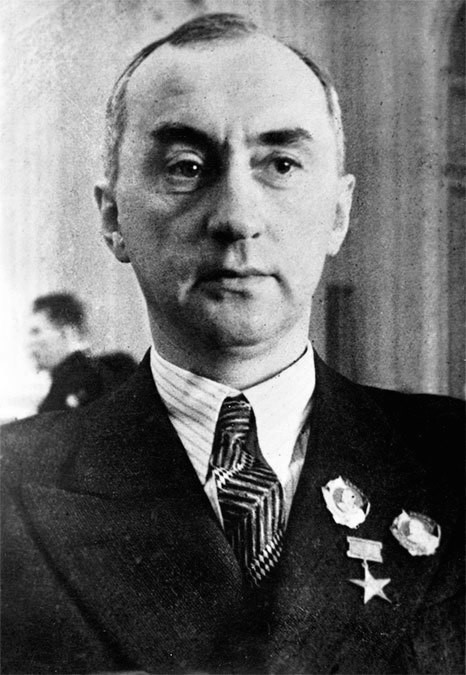
Vladimir Yakovlevich Klimov was born on 23 July 1892 in Moscow and studied at the Technical School Komissarovskom.
In 1918 he graduated from the Faculty of Mechanical Engineering of the Technical State University of Moscow NE Bauman and began his career in October of 1919 in Kolomna factory, an engineering company based in Moscow.
From July 1918 to 1931 he worked interchangeably as chief laboratory engineer, department head, assistant director of the automotive research laboratory of this factory which later became the Soviet Scientific Institute of Engines (NAMI).
After 1931 he became Head of the Department of Technical Control of gasoline engines of the Central Institute of Aviation Engines and at the same time, he worked as a professor at the Moscow Higher Technical School, the Lomonosov Institute and the Military Academy of the Force, Zhukovsky Aerial.
He was also head of the Engine Design Department at the Moscow Aviation Institute.
Vladimir Yakovlevich Klimov participated in the development of the first Soviet air-cooled star-shaped aircraft engines, the M-12, M-23, and others. In 1927 he created the first and most powerful engine of the time (approx. 650 kW (880 horsepower) the M-13 with liquid cooling for cylinders.
In the mid-1930s, it organizes the production of 12-cylinder M-100 engines, whose capacity was 30% more than that of similar foreign engines of the same size, at that time the M-103 series engine for bombers. “SB” designed by AA Tupolev and Arkhangelsk.
In 1935, Vladimir Klimov was appointed Chief Designer of the Rybinsk Engine Plant No. 26.
In August 1941, he worked designing high-power engines for Soviet aircraft destined to defend the USSR during World War II in a factory evacuated to Ufa.
The engines that Klimov had designed in the late 1930s and early 1940s (M-105, VC-105PF, EC-107, EC-108), were installed in Pe-2 dive bombers designed by VM Petlyakov and fighter jets designed by Yakovlev.
In the postwar period Klimov led the design and production of a wide series of jet engines.
During his work and research, Klimov developed and implemented a series of inventions and innovations in aircraft piston engines such as the closed liquid cooling system, the closed system with a special pressure air pump with two speed traction, advanced timing, mixed fuel feed systems in powerful and high-speed engines, and proposed a number of innovative solutions in the construction of the turbojet.
Klimov made a significant contribution to the development of lubrication theory, to the solution of balance piston engine problems, and other aircraft engine problems.
In 1947-1949 he created the first engines with internal centrifugal compressors for jet aircraft.
In 1951, on the basis of the English Nene engine, Klimov created the VK-1F – one of the world’s first turbojet engines equipped with an afterburner.
Vladimir Yakovlevich Klimov was a Deputy of the Supreme Soviet of the USSR from 1946 to 1950.
He reached the degrees of Major General in the USSR Air Engineering Service.
He was also an outstanding academic twice awarded as Hero of Socialist Labor (1940, 1957). Winner of four Stalin Awards (1941, 1943, 1946, 1949).
He died on September 9, 1962. He was buried in the Novodevichy Cemetery in Moscow.
In 2002, the name Klimov was given to a street in the Shevchenko district of Zaporozhye and a park called Academician Klimov already existed there.
Germany
Adlerwerke vorm Heinrich Kleyer AG. was formed at Frankfurt am Main in 1934 to take over Frankfurter Flugzeugbau Max Gerner GmbH. Made low-cost, low-powered all-metal light aircraft with Gerner engines.
The Kitty Hawk Flyer is just one flying vehicle being worked on by the Larry Page-backed startup. Page has reportedly invested more than $US100 million into Kitty Hawk and its other division, Zee Aero. Both organisations have registered to test a number of different aircraft, from gliders to sailplanes.
The goal of Kitty Hawk and Zee Aero is to one day reinvent personal transportation. Both divisions have roughly 100 employees combined. The CEO of Kitty Hawk is Sebastian Thrun, cofounder of Udacity and the father of Google’s self-driving car project.
The Kitty Hawk focus on over-water flights is intentional – it’s meant to reassure Federal Aviation Administration officials worried that unlicensed pilots will be flying over populated areas. The company wants to work with the FAA to enable more ambitious vehicles, but it would rather play it safe in the early stages.

Bob Kinney, designer/builder of the HRH, considers himself a practical “electro-mechanical applicationist.” Bob was born in a small town in Connecticut where, as a young boy, he and some friends would visit a nearby factory that was manufacturing curious rotary-wing machines. Looking back, Bob is convinced that the man with the distinctive Russian accent that continually chased him and his friends away from that factory was Igor Sikorsky—father of the modern helicopter—and only later understood that those curious machines were helicopters.
2002: 221 Fordney Rd, Lancaster, PA 17601, USA.
Karel Klenor – KLN, Choceň, Czech Republic.
LSA builder
Dr Ing Hanns Klemm (1885-1961) was an eminent pioneer in the development of light aircraft. During the First World War he worked with Zeppelin, Dornier and Hansa und Brandenburgische Flugzeugwerke, and later with Daimler, for whom he designed biplanes and monoplanes, including fighters. After the war he concentrated on light and economical aircraft, sometimes called Daimler-Klemm. L15 of 1919 was originally a glider, though later powered, but had high wing. True precursor of the classic Klemm low-powered two-seat line of low-wing monoplanes was L20 of 1924. In December 1926 Leichtflugzeugbau Klemm GmbH was formed (notably associated with Bb’blingen), and L 25 was produced from 1927 with many types of engine, consolidating Klemm’s reputation. K131 and K132 of early 1930s were cabin types. Part of Klemm became Halle in 1934. Company renamed Hans Klemm Flugzeugbau August 1938, and was then making K135 cranked-wing tourer/trainer series for Luftwaffe and export. In new type-number series built Kl 105-107. During Second World War contributed to military-aircraft production, afterwards Klemm revived Kl 107 three-seat cabin model. Klemm joined Siebel in 1940.
Production ended November 1957.
Lillestrømmen Aeroplanværksted (Lillestrøm Airplane Workshop)
Hærens Flyvemaskinfabrik (Army Flying Machine Factory)
This state-owned factory was established in 1914 at Kjeller airfield at Lillestrøm north of Kristiania (Oslo). The original name was Lillestrømmen Aeroplanværksted (Lillestrøm Airplane Workshop), in 1915 it become the Hærens Flyvemaskinfabrik (Army Flying Machine Factory) which had relocated from Sagene in Kristiania.
The name Kjeller Flyfabrikk didn’t appear until Aug 1927.
The Norwegian Army Aircraft Factory, located at Kjeller. Built under license during the 1930s Fokker C.V as the F.F.7 Hauk (Hawk) and de Havilland Gipsy Moth and Tiger Moth. Also did repair and overhaul of military-aircraft equipment, and experimental work.
France
Offers kits to build Helios-5-TR and Hermes side-by-side two-seat wood/composites monoplanes.
 All Aero