2415 O St
Lincoln NB.
USA
Circa 1931 airplane builder
2415 O St
Lincoln NB.
USA
Circa 1931 airplane builder
Ray A. Page established Nebraska Aircraft Corporation at Lincoln, Nebraska, during the First World War, and was a builder of the Lincoln Standard biplane, and also built aircraft under subcontract to the U.S. government.
Began construction, in 1922, of the five-seat Air Coach. Between 1923 and 1925 offered the Lincoln-Standard Tourabout, a three-seat rework of the Standard J.1 of 1916. Also produced the Sport Lightweight biplane. Page acquired the rights to the New Swallow and redesigned this as the three-seater Lincoln-Page LP-3 in 1928, an attempt to catch up with developments in light aircraft design. In 1929 produced a two-seat trainer known as the Lincoln-Page Trainer.
Lincoln Aircraft Company Inc was the official name of Lincoln-Page from 1929, but both names used indiscriminately.
The last design was the parasolwing Lincoln Playboy of 1931. Firm was by then the Lincoln Airplane and Flying School.
Limbach Flugmotoren (Limbach Flightmotors) is a German company that produces aircraft engines. The company is named after Peter Limbach who expanded his father’s engine repair business in the 1970s in Königswinter.

By May 2006, Limbach had produced more than 6000 engines for light aircraft, ultralight aircraft and airships. Many Limbach engines are based on the Volkswagen flat-4 boxer unit with displacement of up to 2.4 litres, and up to 160 BHP in the turbocharged model.
In a letter dated 25th August 2011, the company announced that it would be closing by late 2011, saying “Years of ever increasing regulations and requirements have been choking us. Our efforts to operate in that environment were not successful because we cannot provide the necessary resources. Additionally there are government activities that hinder our current business and we cannot make plans for the future.”
In late 2012 it was announced that the Limbach assets had been sold to Mr. Chen Shuide.
1998-2012: Kotthausener Str. 5, Konigswinter, Germany, D-53639
Limbach produce 2-stroke and 4-stroke engines from 15 to 125 kW for paragliders to cruising aircraft.
The engines have electronic engine management with electronic fuel injection, no mixture control, no choke, and no carburettor preheating. With an electrically adjustable propeller, you only need to preselect the speed and accelerate.
USSR
Formed 1975 and marketing hang gliders, motorgliders and the X-32 Bekas tandem two-seat ultralight suited to recreational, training and agricultural uses (first flown 1993).
The most significant pre-Wright brothers aeronautical experimenter was the German glider pioneer Otto Lilienthal. In Germany, Otto Lilienthal make an intensive study of bird anatomy and flying characteristics, inspired by the storks which he and his brother Gustav watched wheel¬ing over the rooftops of Potsdam, their home town. He sought to discover precisely how birds flew, altering the dihedral angle of their wings for lateral stability, and varying the camber of the surfaces for lift or drag. Lilienthal was quick to appreciate the importance of curved wing surfaces. In 1889 he published the results of his findings in his book Der Vogelflug als Grundlage der Fliegekunst (Bird Flight as the Basis of the Flying Art), and set about testing his theories.
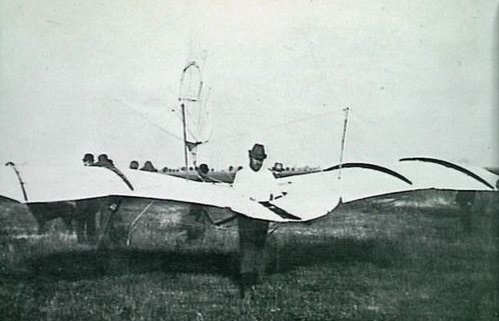
Between 1891 and 1896, he built and flew a series of highly successful full-size gliders. During this period, Lilienthal made close to 2,000 brief flights in 16 different designs based on aerodynamic research he conducted in the 1870s and 1880s. Most were monoplanes with stabilizing tail surfaces mounted at the rear. Control was achieved by shifting body weight fore-and-aft and from side-to-side.
Lilienthal began testing gliders in his backyard on a one metre platform and made hundreds of flights there before moving to a small hill, two and a half metres high.
By 1893 his gliders had cambred wings with radiated tip, fixed rear fin and tailplane, and could be folded to fit through an ordinary door.
On the evening of 9 August 1896, Otto was at Stöllen in the Rhinower Hills testing a new kind of head-movement control arrangement when a sudden gust upturned his No. 11 monoplane glider and he crashed heavily from 15 m (49 ft) breaking his spine. He died in a Berlin clinic the next day. His last words were ‘Opfer mussen gebracht werden’ (‘Sacrifices must be made’).
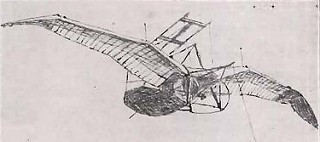
Gustav Lilienthal (1849-1933) was the younger brother of glider pioneer Otto Lilienthal. He spent the last 20 years of his life developing ornithopters, based on his studies of bird flight. The 1914 “Big Bird” spanned 17.5 metres and was tested at the research station of Altwarp, on the Stettiner Haff, but never left the ground. Lilienthal continued working at the Berlin Tempelhof and Adlershof airfields until his death.
1983: John Lee, Littleton Park Nursery, Laleham Road, Shepperton, Middlesex, Great Britain.
John Lee is one of Britain’s most prolific and individualistic homebuilders and since 1970 has built five aircraft, of which the two most recent (circa 1983), the Rooster 1 and Rooster 2 can be classified as microlights.
Taiwan
Established 1990, offers Ultrasport 254 single-seat ultralight kit-built helicopter, Ultrasport 331 Experimental category version, and Ultrasport 496 two-seater (Ultrasport 254 first flew July 1993). Subsidiary is American Sports- Copter Inc.
2009: Lightning West, Gregg Hobbs, 18750 West Avra Valley Rd, Marana, AZ 85635, USA.
Built the Lightning
1995: PO Drawer 40, Sheldon, SC 29941, USA.
Builder of the Lightning Bug
1995-7: 19695 NW 80Th Dr., Okeechobee, FL 34972, USA.
UL builder
 All Aero