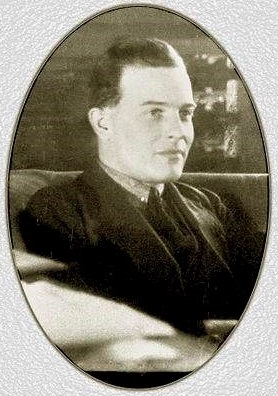
Nikolai Gustavovich Mijelson (in Russian: Николай Густавович Михельсон) was born in 1895 in Bielovostok, Grodnienski governor.
The first references to Mijelson appear after joining the construction bureau “Gamayún” in Saint Petersburg, directed by Schetinin and specialized in the design and construction of hydrofoils. Starting in 1912, after the incorporation of DP Grigorovich to the factory as technical director, Mijelson became his main collaborator, participating in the creation of all his designs during the pre-revolutionary period. Mijelson’s participation was decisive in the development of the famous M-5, M-9 and M-11 hydrofoils, participants in the First World War.
During the events of October 1917 Mijelson was in Krasnoyarsk where he met MM Shishmariov, Grigorovich’s former assistant. Together in 1920 and not without running into great dangers, he managed to move to Taganrog, as they had heard that the “Lieved” factory run by B. Levediev had been created there. The years of civil war ran and the friends were forced to avoid the white and red troops in combat.
The following year, together with Shishmariov and the engineer of the “Liebed” factory, formerly a naval pilot of the Denikin troops, VL Korvin-Kerber, he won a competition promoted by the VVS leadership for the project of a single-seater naval fighter with a Hispano-Suiza 200 hp engine. Construction of the prototype began in Taganrog. The new fighter, called MK-1 “Ribka” (Fish), was designed as a biplane with a monocoque structure that completely hid the engine. This structure used four plywood stringers and frames with holes to lighten the weight. The radiator was located in the center plane of the upper wing.
For the spring of 1922 the VVS made the decision to continue the construction of the experimental MK-1 “Ribka” in Petrograd, at the “Krasni Liotchik” factory. As a result, Mijelson headed there with the details and built components of the new fighter. The other co-authors were sent to Moscow to make themselves available to DP Grigorovich.
In Petrograd Mijelson completed the construction of the plane, but during the tests the prototype refused to take off from the water. The floats were too heavy for the low power of the engine. Measures to lighten the plane did not bring positive results either. Only when Mijelson removed the floats and replaced them with a train of wheels did pilot LI Giks manage to lift it up into the air. The aircraft proved to be well designed, but the low power of its engine did not allow it to go into series production. While waiting for a new engine, the plane was stored in a hangar at the small airfield on Kretovski Island where it was destroyed during a flood in 1924.
Mijelson continued to work at the “Krasni Liotchik” factory until the Department of Experimental Shipbuilding (OMOS) led by DP Grigorovich was transferred there from Moscow. From that moment on, Mijelson joined the group led by his former boss. During this period, he participated in the development of all OMOS works, including the SUVP passenger plane, the MRL-1 naval reconnaissance plane, the I-2bis fighter, the ROM-1 and ROM-2 open sea explorers. and the MUR-1 training scout. Many of these designs were unsuccessful, which was reflected in the collective’s psychological climate. For this reason, when it was decided to return Grigorovich with his collective to Moscow, Mijelson and another group of collaborators made the decision to remain in the “Krasni Liotchik” . Mijelson was in charge of the drawing department.
In 1929 Mijelson was arrested. This happened unexpectedly and was a continuation of the process that began with the arrest of DP Grigorovich and involved a significant number of OMOS workers. For a whole year Mijelson had been summoned to answer as a witness in the trials of DP Grigorovich, AN Sidielnikov, VL Korvin-Kerber and other colleagues, until his time finally came. Judged by article 58, Mijelson was sent to the first Sháraga TsKB-39 of the OGPU, where builders of the Grigorovich and Polikarpov collectives were already working. This collective in a very short time and under a strict supervision system managed to develop the I-5 fighter, the IZ gun fighter and the TB-5 bomber. In all these works Mijelson had an active participation.
In 1931 Mijelson was released and returned to Leningrad. Here at Factory No.23 (new designation of “Krasni Liotchik”) he began working as director of the construction department. In 1935 with the help of IV Chasovikov he created the PV-23 light seaplane and later devoted himself to improving the Polikarpov U-2 by creating the U-3 and U-4 trainers with improved aerodynamics.
Soon after, Mijelson would work on the MU-4, MU-5 and MU-6 training amphibians. The projects looked very promising, which was confirmed during testing of the second MU-4 prototype in Sevastopol. Almost parapelled Mijelson developed a lightweight torpedo boat named MP and was designed to be transported to the attack area under the wings of a TB-3 bomber. Once the torpedo was released, this aircraft was able to return by its own means to its base and land there.
These designs Mijelson could not finish. At the end of 1937 he was arrested again. Mijelson was charged under article 58 and on January 17, 1938, he was sentenced to the maximum penalty. The next 12 days were torture awaiting the announced end. Nikolai Mijelson was shot on January 29, 1938. His remains rest in an unidentified grave in Leningrad, presumably in the NKVD special cemetery “Levashovskaya Pustosh”.
The continuation of these projects was originally assigned to VL Korvin-Kerber and later to the young architect VV Nikitin, but soon they all ended up being closed. In the opinion of the NKVD an “enemy of the people” could not build anything good.

 All Aero