France
Formed by Mm. Millet and Lagarde to exploit Lagarde ‘s ML-10 twin-boom, heavily-staggered biplane four-seater, powered by 180 hp Regnier engine and first flown 1949.
Manufacturer
Miller, Richard
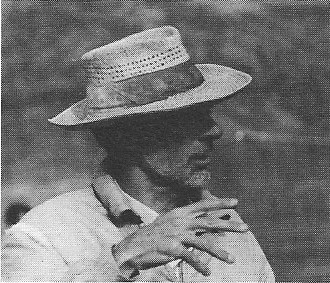
In 1964 Richard Miller was building his Bamboo Butterfly hang glider.
Later, Miller went on to be editor of ‘Soaring’ magazine.
Miller Aircraft Corporation
Mark Granville and “Pete” Miller found twenty people to invest $100 dollars each and formed the Miller Aircraft Corporation.
Formed 1937 at Springfield, Massachusetts, to market Zeta series of two-seat light aircraft; Z-1 with 95 hp Menasco B-4; Z-2 with 125 hp Menasco C-4; and Z-3 with 150 hp Menasco C-4S.
Miller / J.W. Miller Aviation
J.W. Miller Aviation Inc., Horseshoe Bay Airport, Box 757, Marble Falls, TX 78654, USA.
J.W. Miller Aviation, Marble Fails, Texas, makes modification kits for Apaches, Twin Comanches, Aztecs and Aero Commanders. Many of Miller’s airframe parts are made of honeycomb reinforced fiberglass. To research this, Miller returned to formula one racers, his JM 2.
Miles F.G. Ltd
UK
Miles F.G. Ltd was formed in 1951 at Redhill, Surrey, and transferred to Shoreham, Sussex, in 1952. Acquired by British Executive and General Aviation February 1961.
Developed M.75 derivative of Gemini with Cirrus Major engines; M.77 Sparrowjet conversion of M.5 Sparrowhawk prototype; M.100 Student jet trainer, first flown May 15,1957; H.D.M.105 aerodynamic test vehicle, which had Aerovan fuselage with Hurel-Dubois high-aspect ratio wing, flown March 31,1957.
Miles Aircraft Ltd
Phillips & Powis Aircraft was formed in 1935 to take over the aircraft manufacturing business operated by Phillips & Powis Aircraft (Reading) Ltd., which had produced the initial Miles Hawk series of light aircraft.
The name changed in October 1943 to Miles Aircraft, as successor to Phillips & Powis Aircraft Ltd. at Woodley, Reading.
Developed M.33 Monitor target tug. Manufacture included M.38 Messengers, some at Newtownards, Northern Ireland, M.57 Aerovan light freighters, M.65 Gemini light twins. Also developed M.68 Boxcar, with detachable freight container; M.71 Merchantman, which was enlarged four-engined Aerovan, and M.60 Marathon feederliner, later produced by Handley Page.
Miles met financial demise and went into liquidation in November 1947, and was acquired by Handley Page (Reading) Ltd in 1947.
Milan
Circa 1959, Milan operated out of Stuttgart-Echterdingen, airfield in Germany.
Built light aircraft
Mil

Mikhail Leontyevich Mil (died January 1970) began developing helicopters and autogyros in 1929. Mil was a contemporary of Nikolai Kamov at the TsAGI (Central Aero and Hydrodynamic Institute) during the 1930s, was given charge of his own design bureau in March 1947 and became responsible for the first Soviet helicopter to go into quantity production. The GM-1 / Mi-1.
Mi-1 first flown 1948, also manufactured by PZL-Swidnik in Poland 1956-1965. Mi-2 first flown in Soviet Union but production transferred to Poland. Enlarged Mi-4 introduced 1952, also built in China. Mi-6 with detachable wings to provide up to 20 percent of required lift in cruise flight first flown June 1957, then world’s largest helicopter, and 864 built at Rostov-on-Don (now Rostvertol) factory 1959-80, plus 50 at Moscow-Fili 1960-62. Mi-6 formed basis for Mi-22 airborne command post. Mi-8 first flown June 1961, becoming much produced medium civil and military helicopter (well over 7,000 built since 1965 and continuing), as turbine replacement for Mi-4; Mi-8 derivatives include Mi-9 tactical airborne command post (first flown 1977) and Mi-19 variant for use by commanders of tactical rocket units, Mi-17 (first flown August 1975) with change of engines and other modifications and Mi-171/Mi-172 export models, and lengthened Mi-173. Mi-10 flying crane development of Mi-6 first flown 1960, produced up to 1971. Two Mi-6 rotor/power packages used on giant Mi-12 with an overall rotors span of 67m, then the largest helicopter in world. Mi-14 became shorebased amphibious anti-submarine, SAR and mine-countermeasures helicopter (first flown August 1967).
Mi-26 first flown December 1977 as very heavy lift helicopter with two powerful turboshaft engines and single eightblade main rotor, with Mi-27 as airborne-command-post derivative. Series of helicopter gunships began with Mi-24 (first flown September 1969) and joining Soviet armed forces from 1970s, with Mi-25 as export version of Mi-24D tandem-cockpit variant and Mi-35 as second and improved export variant based on upgraded versions of Mi-24; most of over 2,500 built between 1970 and 1989, though smallscale production up to 1996. The Mi-28 attack helicopter was first flown November 1982. Mi-34 first flown November 1986 as piston-engined lightweight sporting and training fourseat helicopter. Proposed new types include Mi-40 eighttroop armoured and armed assault helicopter, Mi-46 heavy transport helicopter, Mi-52 three-seat light piston helicopter, Mi-54 utility helicopter, Mi-58 medium civil helicopter, and Mi-60MAI two-seat light training helicopter. Approximately 25,000 Mil helicopters have been built.
Became Mil Moscow Helicopter Plant. Has 25 percent shareholding in Euromil.
1995: (Moskovsky Vertolyotney Zavod), 2 Sokolnichyesky Val, Moscow 107113, Russia.
Mikoyan-Gurevich
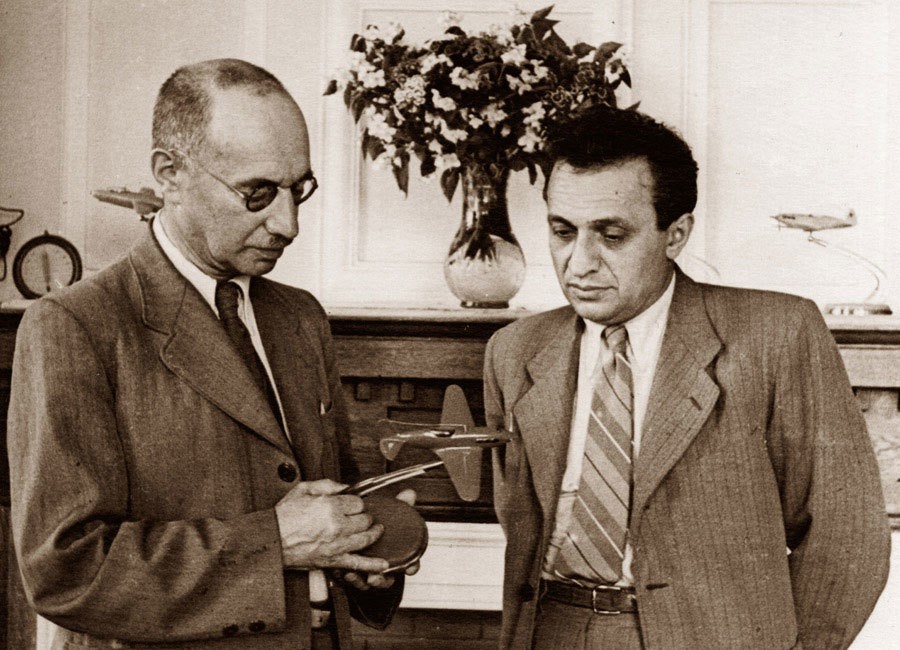
A. Mikoyan and G. Gurevich design bureau established December 1939; still operating in 1990 as MAPO “MiG” as part of MIG “MAPO-M” organization, although Gurevich retired in early 1960s and Mikoyan died December 9,1970.
MiG-1 fighters with AM-35 engine produced 1940-1941; developed MiG-3 produced until 1942. First jet aircraft built in quantity was MiG-9 with twin RD-20 (BMW 003A) engines, flown 24 April 1946. Swept-wing MiG-15 with Russian copy of Rolls-Royce Nene introduced 1947, built under license in Czechoslovakia and Poland. Followed by approximately 9,000 of derived MiG-17, with redesigned wing, manufactured 1950-1957. Twin Mikulin AM-5-powered MiG-19 flown September 1953, built under license in Czechoslovakia, Poland, and China. Superseded by delta-winged MiG-21, in service in the USSR from 1959 and, when built in India, was first Russian aircraft manufactured in non-communist country.
Col-Gen Mikoyan died in 1970.
As ANPK “MiG” named after A.I. Mikoyan Aviation Scientific- Production Complex, produced MiG-23 (4,278 constructed 1969-1985; also built in India) and MiG-27 (over 900 between 1973 and 1983) related variable-geometry fighter and ground-attack aircraft, MiG-25 Mach 2.8+ reconnaissance aircraft and interceptor (some 1,200 built up to 1985), and MiG-31 long-range interceptor (about 400, operational from 1983).
MAPO ‘MiG’ produced MiG-21 upgrade as MiG-21 -93, MiG-29 Fulcrum lightweight close-air-combat fighter (first flown October 1977 and over 1,500 built, serving since 1983), improved MiG-29M (first flown April 1986) and MiG-33 export version, MiG-29K shipborne fighter prototype (first flown July 1988, first landing on aircraft carrier Admiral KuznetsovNovember 1989, and development restarted in 1996 after earlier program halt), MiG-35 multirole fighter (first flight 1999?), MiG 1-44 uniquely configured newgeneration combat aircraft (first seen February 1999), and MiG-AT/UTS/AC series of advanced and combat trainers. MiG-301/321 are reported hypersonic reconnaissance aircraft, thought to be under development. Also developing MiG-110 light multipurpose transport and MiG-115 and MiG-125 transports.
Migavia – the first national aircraft manufacturer in Russia aircraft corporations. RAC “MiG” is integrated company in which all technologies of design, production and improvement of aircraft are collected together in one legal frame. Corporation Migavia holds the shares of other corporations which are included into the complex of firms developing and producing the aircraft engines.
Mike Adams Balloon Loft
1982: Mike Adams Balloon Loft, DeKalb Peachtree Airport, Atlanta, Georgia 30341, USA.
PO Box 12168
Atlanta
Georgia 30355
USA
Adams offers seven models of balloons, all of which can be fitted with options such as an additional fuel tank with vapor takeoff or an electric digital py¬rometer. Envelope volumes range from 27,000 .to 83,000 cubic feet. Price, quoted on request, includes complete leather trimmed basket and all FAA required instruments.
 All Aero