For the Maintenance Command Development Centre, Air-Vice Marshal Harjinder Singh of the Indian Air Force designed Kanpur I four-seat light aircraft, prototype built at MCDC in 132 days. Kanpur II with 250 hp Lycoming engine, first flown October 1961.
The origins of M. L. Aviation began during the mid 1930s with two separate companies, mainely Wrightson Aircraft Sales (formed May 34). The name was changed to Malcolm and Farquharson (formed May 36) and again changed to R. Malcolm Company (founded in Dec 36). Malcolm & Farquharson became a holding company in December 1939 with aircraft product work carried out by R. Malcolm. About this time, Marcel Lobelle, who had been Chief Designer of Fairey Aviation joined the company. He had designed many Fairey aircraft including the Swordfish.
At the beginning of WW2, both Malcolm & Farquharson and R. Malcolm suffered financial problems and turned to the Mobbs family for assistance. During 1940, control of both companies was taken over by the Mobbs through United Motor Finance Corporation.
Under Marcel Lobelle, a drawing office was opened on the Slough Trading Estate (owned by the Mobbs family) with rapidly expanding work for the Ministry of Aircraft Production. To allow for expansion the drawing office and experimental work was moved to White Waltham, leaving production on the Slough Trading Estate and still under the name of R. Malcolm. An additional firing site was also established on the airfield perimeter for development work.
In 1943, Malcolm & Farquharson’s services were dispensed with and control was taken over by Eric Mobbs as Managing Director and Marcel Lobelle as Chief Designer. The company continued to trade under the name of R. Malcolm. Finally in October 1946 the name was changed to M. L. Aviation for the White Waltham site and M. L. Engineering at Slough, the initials presumably being taken from the leading figure heads.
Spurred on by the advent of the Cold War the company expanded rapidly from the 1950s with a considerable work force of Design Engineers designing and manufacturing a large range of aviation products.
Expansion required further finance and in 1958 M. L. went public through the creation on M. L. Holdings. Subsequently the Holding Company diversified with non-aerospace business introducing further finance and therefore gradually reducing the influence of the Mobbs family
The 1980s saw the reducing aerospace industry having considerable impact on MLA with an ever diminishing workforce until in 1990 the Holdings Board, having recently brought Wallop Industries based in Andover, deciding to merge and sell the White Waltham site. The move was completed by early 1991, leaving the Airfield test site still operating. The White Waltham site was eventually sold in 1996.
In mid 1996, the Holding Board acquired the remains of arch rivals Fraser Nash and merged it with MLA producing a formidable aircraft equipment company which should have augured well for the future.
M. L. (Engineering) in Slough finally moved to Andover in early 1997 enabling design and production to join under one roof, thereby almost severing links with Berkshire.
Finally Cobham plc acquired M. L. Aviation & Marine for £37 million.
Produced the Mk.II two-seat helicopter in ultralight form, first flown 1996 and offered ready assembled. Ultralight since withdrawn, giving way to new and improved certificated version.
Mitsubishi Jukogyo Kabushiki Kaisha Mitsubishi Heavy Industries Ltd
After World War 1 several members of the former Sopwith Aviation Company’s technical staff had joined Mitsubishi and produced designs to meet the specifications of the Air Supply Section of the I.J.N. In this way, Herbert Smith became chief designer for Mitsubishi. W. L. Jordan, D.S.C., D.F.C., an ex RNAS and RAF fighter pilot, was appointed their chief test pilot.
Mitsubishi Heavy Industries Ltd. formed April 11,1934, through the merger of Mitsubishi Shipbuilding and Engineering Co Ltd. and Mitsubishi Aircraft Co Ltd. Long association with Japanese Navy, commencing with Type 10, operational 1922. Most notable aircraft were 1937 A5M4 “Claude”; 1942 J2M3 ‘Jack’; 1939 A6M3 ‘Zeke’ (Zero), which were all fighters; 1941 Ki-46 ‘Dinah’ reconnaissance aircraft; 1940 G3M1 “Nell” and 1941 G4M1 “Betty” medium bombers; 1940 Ki-21 “Sally” heavy bomber; and its replacement, 1944 Ki-67″Peggy.”
Mitsubishi built 80,000 aircraft between 1920 and 1945. After the pre¬dominant role Mitsubishi played in Japa¬nese aviation during the 25 years that preceded the termination of World War II, MHI was prohibited from engaging in aircraft manufacture until 1955.
Post-war built North American F-86F Sabres, Sikorsky S-55s, S-62As, and S-61s, and 177 Lockheed F-104J and 19 two-seat F-104D-Js Starfighters with Kawasaki, with which company it also manufactured McDonnell Douglas F-4EJ Phantoms. They will be fitted with arrester gear
Mitsubishi completed the assembly of 300 F-86F Sabres for the JASDF, but modifed 18 of these aircraft into RF-86F reconnaissance-fighters, each carrying two K-22 cameras in the forward fuselage and one K-17 camera under the centre fuselage.
Licence production of Sikorsky S-55 helicopters began in 1958, and was to be followed by manufacture of the HSS-2 Seadragon anti-submarine helicopter, of which Mitsubishi were to build 10 for the JMSDF by November 1966.
Shin Mitsubishi Jukogyo Kabushiki Kaisha 1962: Shin Mitsubishi Building, No 10, 2-Chome, Marunouchi, Chiyoda-ku, Tokyo
Produced 90 T-2 supersonic jet trainers, the first Japanesedeveloped supersonic aircraft (first flown 1971 and all delivered by 1988) and 77 F-1 single-seat close-air-support derivatives (all delivered by 1987). Developed MU-2 turboprop executive aircraft (first flown 1963), built in Japan and assembled and marketed in U.S.A. by subsidiary Mitsubishi Aircraft International, followed by the MU-300 Diamond (first flown 1978), which later became the Beech Model 400 Beechjet.
Produced 213 McDonnell Douglas F- 15J/DJ fighters for JASDF by 1998, and in October 1995 first flew new Japanese-developed F-2 fighter support aircraft, intended to replace F-1 and based on F-16 but incorporating new technologies. Currently modernizing F-4EJ fleet, is a partner in the Bombardier Global Express program, has a 20% share in the Kawasaki OH-1 helicopter program, constructs Sikorsky S-70B-3 helicopters for the JMSDF as SH-60JS (the first flew 1991) plus UH-60Js for SAR with JMSDF and JASDF and UH-60JAS for JGSDF, has developed the new MH2000 twin-turbine multipurpose helicopter (first flown July 1996), and constructs components forthe Dash 8, various Boeing airliners and Sikorsky S-92. Also has engine and space activities.
Its overhaul and repair organization handles all types of aircraft and aero-engines. In particular, it is responsible for component manufacture and repair of Pratt & Whitney engines in Japan.
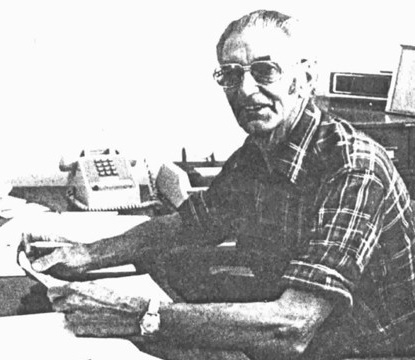
The Mitchell family of aircraft began in 1915, in Scotland, with the birth of Donald S. “Don” Mitchell. Hoping to create a better life for themselves, the family immigrated to the United States when the boy was only seven years old. He was still in school when he became fascinated with gliding. Indeed, Mitchell was a student at Alameda High School in Alameda when he built his first glider, under the tutelage of a pilot who had seen action during the First World War.
Intent on pursuing a career in aviation, Mitchell enlisted at the Boeing School of Aeronautics in Oakland.
In the 1930s, Mitchell worked for United Air Lines at Oakland and Fresno as a radio operator and station attendant. By now, however, he only dreamt of gliding. In spite of the Depression, Mitchell left his job in order to move south to San Fernando, near Los Angeles, where he visited glider pioneer William H. Bowlus – shop foreman at the factory which built Charles Lindbergh’ Spirit of St. Louis – and all but begged him to teach him how to design and build gliders.
Bowlus accepted and Mitchell trained under him for the next six years. All in all, Mitchell spent eleven years with Bowlus, working as his right-hand man on numerous projects during his last five years with his mentor. Along with another gentleman, the duo founded Bowlus Sailplane toward the end of 1936 and developed the BA-100 Baby Albatross glider, a very popular design with some structural problems, which was sold mainly if not exclusively in kits.
As the 1940s began, Mitchell designed and started to construct a large two-seat flying wing glider. To keep it under control without the usual tail, he developed a combination of aileron and elevator which he called a stabilator. All the while, Mitchell took part in demonstration flights for Bowlus Seaplane and was appointed soaring editor of Western Flying Magazine.
When he finally left Bowlus Sailplane, Mitchell went to teach aircraft welding at a technical institute located close by, at the Grand Central Air Terminal near Glendale. Leaving this position, he moved another short distance to the new Timm Aircraft factory in Van Nuys, where he helped with the molding of the fuselage of the S-160, a plastic-bonded wood basic trainer developed for use by the U.S. Navy and U.S. Army Air Corps. Mitchell later assisted the Civil Aeronautics Administration when the time came to perform the static tests of the aircraft. It passed with flying colours and later became, in April 1941, one of the first if not the very first ever plastic-bonded aircraft to receive an American Approved Type Certificate. The S-160 was later ordered by the U.S. Navy. Approximately 260 of these airplanes – now designated Timm N2T Tutors – were produced.
In early 1942, Timm Aircraft was awarded a U.S. Army Air Forces (USAAF) contract to build Waco CG-4 cargo gliders. Many other American companies received orders as well. Timm Aircraft eventually built close to 450 CG-4s. This aircraft turned out to be the most widely produced cargo glider in history.
His superiors at Timm Aircraft instructed Mitchell to organise construction of CG-4A wings in the factories of two furniture makers of the Los Angeles area. Weber Showcase, one of these manufacturers, soon hired him to take over control of their production. As all this was taking place, Mitchell nonetheless found the time to spend numerous evening and weekends with Bowlus to help with the design and construction of a pair of gliders – quite possibly two military transport gliders which proved eventually faulty under test and failed to win orders – as well as a half-size prototype of a large and rather unusual-looking transport glider designed as a private venture for the USAAF.
Confident that his design could help the war effort, Bowlus and an associate organised a company which finally became General Airborne Transport. Construction of a full-size prototype capable of carrying 42 soldiers or 10,000 pounds of freight, began. Mitchell left Weber Showcase in the spring of 1943 to work on this glider, all the while spending some time on his own flying wing design. Mitchell apparently became Director of Projects at General Airborne Transport. Sadly, the prototype of the CG-16 crashed in September 1943 during a test flight. Only Bowlus and one of the VIP passengers managed to parachute to safety. Still, the company managed to obtain permission to build a second prototype. An imposing-looking machine with good flying characteristics, the CG-16 nonetheless suffered from a number of design flaws. The program was cancelled in late 1944 and a third airplane was not built.
Following the end of the CG-16, Bowlus and a friend, Ted Nelson, started to work on a motorised version of the BA-100 Baby Albatross glider. The two of them formed Nelson Aircraft in San Fernando (California) to meet a perceived need for powered gliders now that the Second World War seemed about to end. Mitchell, who may helped with the design of the airplane, the Nelson Dragonfly, took part in the Civil Aeronautics Administration certification tests. Bowlus later appointed him supervisor of production.
In April 1946, after some years of work, Mitchell finally completed construction of his flying wing glider. After a number of successful test flights, Mitchell mounted a small engine on it and flew it as a powered airplane. In the meantime, the expected postwar light airplane boom was slowly turning into a bust and only a handful of Dragonflies left the factory. When the company closed its doors, Mitchell moved to San Leandro where he worked with Nelson and an associate on the design of new powered gliders. Their 1949 Nelson Hummingbird proved to be a better performer than the Dragonfly but its cost and relative lack of performance doomed it on the market. Only a handful were built.
As he worked on the Dragonfly, Mitchell set out on his own to build a new flying wing glider, which he called the Osprey, a single seat machine fitted with stabilators. Mitchell tested his flying wing several times near Oakland, in 1950. Unfortunately, the building in which the glider was stored burned to the ground and the flying wing was destroyed.
Faced with this, Mitchell threw himself into the design and construction of the Nimbus series of sailplanes. The Mitchell Nimbus III – which was developed around 1956 from the earlier Nimbus I and II – won the High Performance Sailplane Design Award at the 23rd National Soaring Contest held in Texas, as well as an award at the San Diego soaring meet.
During much of the 1960 and early 70s, Mitchell kept himself occupied by repairing and customising a number of aircraft. Around 1974, as interest in hang gliding was rapidly increasing, a Dr. Howard Long became intrigued by the idea of a flying wing hang glider. He asked Mitchell to build him such an aircraft. The first foot-launched Mitchell Wing hang glider, the first rigid-wing hang glider that could be controlled in roll, pitch and yaw, flew in 1976. Its flying characteristics and performance showed such promise that Mitchell received orders to build twelve after just one public demonstration flight.
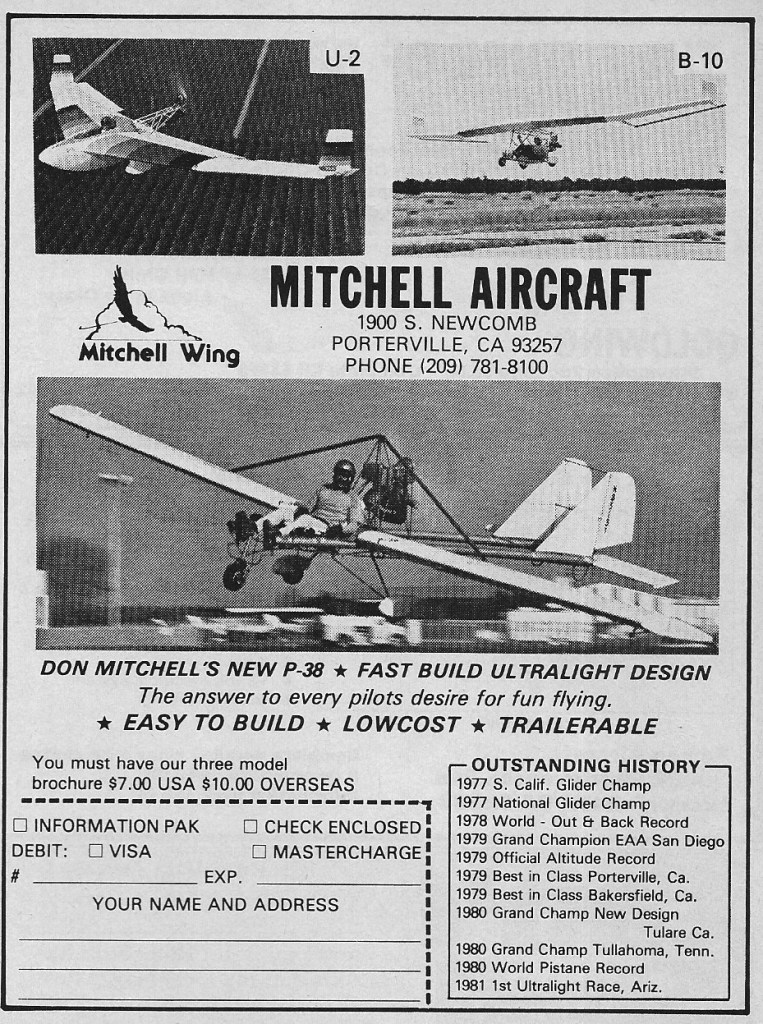
Fascinated by the idea of capturing all the official records for hang gliding newly recognised by the Fédération aéronautique internationale, American champion sailplane pilot George Worthington bought the third one built and went on to set half a dozen world records between 1976 and 1981. Interest among enthusiasts was such that Mitchell organised Mitchell Wing – later Mitchell Aircraft – at Porterville (California). Orders came in from all over North America, Europe and beyond.
In the mid 1970s, Mitchell added a tubular structure and a small engine on one of his wings, turning it into a powered glider or ultralight airplane. A prototype first flew in 1976. The new powered model gained fame as the Mitchell B-10. Mitchell took his flying wings to the world famous fly-ins at Oshkosh and was awarded top honors on numerous occasions.
Design and construction of the U-2, an ultralight fitted with an enclosed nacelle for the pilot followed in 1979. In 1983, a Mitchell U-2 set a new world altitude record for aircraft weighting less than 270 kg with a climb to about 26,000, as well as a sustained altitude record of slightly less than 26,000 ft. The Mitchell P-38 flew later on.
May 1981
1983: Mitchell Aircraft Corp, 1900 South Newcomb, Porterville, California 93257, USA. 1984: 11616 W. 59th Street South, Sand Springs, OK 74063, USA.
Over the years, Mitchell has sold hundreds of drawings and kits for the B-10, the U-2, the P-38 as well as the hang gliding version of the B-10. The designations Mitchell gave to his creations were those of great American aircraft, i.e. the very modern Martin B-10 bomber of the 1930s, the highly distinctive Lockheed P-38 Lightning fighter of the Second World War and the famous Lockheed U-2 spy plane of the Cold War era.
Canada Formed in Montreal by Bernard C. Maranda to develop and manufacture ultralight aircraft, acquiring worldwide license for Adam RA-14 and RA-17 high-wing monoplanes from French designer Roger Adam in 1957. These marketed as RA14BM1 and BM3. Also developed Hawk BM4, based on Beam Minicab, and Lark BM6 single-seat aerobatic biplane.
Made plans and some components available for the construction of the Celerity two-seat monoplane, originally designed by Larry Burton and first flown in 1985.
1996: 3936 Austin St, Klamath Falls, OR 97603, USA. 2009: Mirage Aircraft, Inc, 8702 N Silver Moon Way, Tucson, AZ 85743, USA
 All Aero