Phillipines
Until 1982 a subsidiary of the Philippines Aerospace Development Corporation, which began assembly and license-manufacture of MBB BO 105 helicopters in 1974. Later that year a contract was signed with Britten- Norman for the assembly and eventual manufacture of the BN-2A Islander, and for the development and marketing of an amphibious version. Assembly of Islanders began in 1976 from sets of parts from the UK. In 1978 a four-seat utility aircraft was developed in conjunction with the Philippine Government’s National Sciences Development Board.
1982 closure.
Manufacturer
Nash Aircraft Ltd
UK
Developed the Petrel two-seat touring, training and glider tug lightplane, first flown 1980.
Nardi
Nardi Sa Per Costruzioni Aeronautiche
Established in Milan in 1933 by three brothers. Nardi’s first aircraft was the F.N.305 tandem two-seat lightplane, which flew in 1935 and was intended as a fighter-trainer. A1938 successor, the F.N.315, was exported to six countries, and a light-attack version was flown experimentally.
The first postwar product was the F.N.333 amphibian, a three/four-seat twin-boom design later acquired by SIAI-Marchetti and marketed from 1962 as the Riviera, and in America as the North Star amphibian.
Narahara, Sanji
Around 1910, retired Japanese Navy engineer Sanji Narahara, who had studied munitions at the Imperial University, built an airframe for himself and on May 5, 1911, made a successful flight with a French-made engine installed.
Napier
By 1931, during the Great Depression, Bentley was having financial difficulties. When funds ran out in 1931, the receivers were negotiating with D.Napier & Sons Ltd for the sale of the remains of Bentley. However, Rolls-Royce put in a secret bid through a Liechtenstein company, and secured Bentley Motors for £125,256. For this, Rolls-Royce got the factory equipment, a number of incomplete car chassis, and the services of Walter Bentley for three years.
Ing. Nando Groppo / Nando Groppo Aergroup
1998:
C/O Aviosuperficie die Mennana Bigli
I-27030 Mezzana Bigli (PV)
Italy
LSA and trike builder
Nanchang Aircraft Manufacturing Company
Formed in 1951; produced a variant of the Soviet Yakovlev Yak-18 trainer known locally as the CJ-5, the improved CJ-6A still being built in the late 1990s in very low volume for the same radial piston-engined primary training role. Also co-produced (with Shenyang) a Soviet MiG-19 fighter variant known as the J-6, and license-built the Antonov An-2 general-purpose biplane as the Y5 before this was taken over by the Shijiazhuang Aircraft Manufacturing Corporation. Very important program to develop the Q-5 dedicated attack aircraft from J-6 technology was begun at Shenyang in 1958 but transferred to Nanchang.
June 1965 saw first flight of a Q-5 Fantan prototype, featuring an area ruled fuselage for minimum transonic drag, cockpit armour protection, a “solid” nose and a weapon bay (for early test and production aircraft, but omitted from improved production versions). Entered Chinese service in 1970 and also exported from 1983 as upgraded A-5. Also developed the N-5A agricultural aircraft (first flown December 1989) and partnered Pakistan Aeronautical Complex in development of the K-8 Karakorum jet trainer (first flown November 1990). Name changed to Hongdu Aviation Industry (Group) Corporation Ltd. in March 1998.
NAMC / Nihon Kokuki Seizo Kabushiki Kaisha
Following the decision made in 1956 to develop a medium sized passenger airliner in Japan, a Transport Aircraft Development Association was established in May 1957. This was succeeded in June 1959 by Nihon (with 53.8 per cent government ownership, remembered as NAMC), responsible for the development and manufacture of the NAMC YS-11 twin-turboprop airliner (first flown 1962). This was delivered to airlines in the U.S.A., Europe, and the Far East, and to the Japanese Air Self Defense Force; for the latter Nihon converted aircraft as electronic countermeasures (ECM) YS-11E.
1962:
Nihon Kokuk Seizo Kabushiki Kaisha (Nihon Aircraft Manufacturing Co Ltd)
Daido Building,
No 46,
1-Chome,
Minami-Sakumacho,
Shiba,
Minato-ku,
Tokyo
The pro¬gramme did not break even however, and NAMC had a deficit of some £14.6m after investment of £77.5m by the government and industry. The Japanese government decided to disband the Nihon Airplane Manufacturing Co (NAMC) within two years from 1981, in order to reduce its on going financial commit-ment to the company.
Nagler-Rolz Flugzeugbau
With the outbreak of war, Nagler joined with Franz Rolz to form the Nagler-Rolz Flugzeugbau.
The new company built a helicopter similar in configuration to the RI and RII. This ship had an empty weight of 700 pounds and though it was flown in hover, it could not be lifted out of ground effect. With the coming of World War II, the company received contacts from the German Government for the development of small single-seat helicopters.
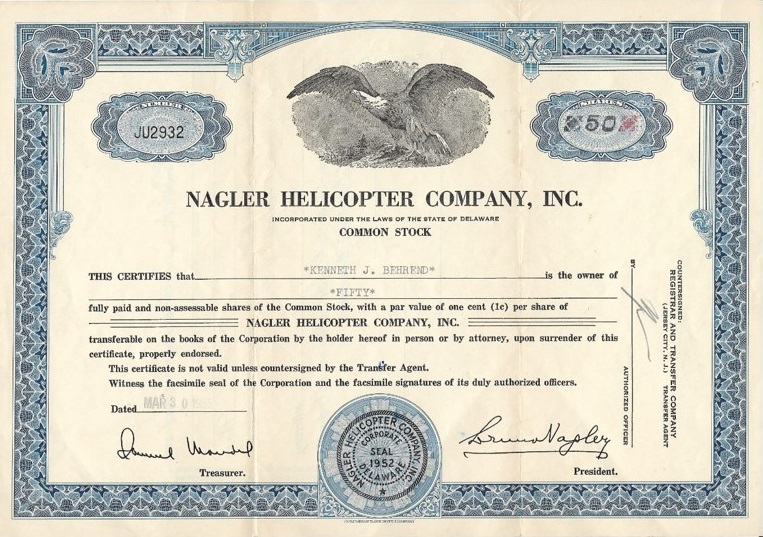
Nagler Helicopter Company Inc.
Bruno Nagler, whose earliest rotary wing experiments go back to 1929, emigrated to the United States in 1952.
There he has built various prototypes, all single-seat, like his former designs, but with a totally different concept of an anti-torque rotor in the extension of the main rotor.
Nagler’s Model NH-160 single-seat helicopter first flew in 1955. The VG-1 Vertigyro developed later comprised a Piper Colt aircraft fuselage with conventional engine. Its rotor system was driven by a turbine engine, enabling the craft to be flown as a gyroplane, a helicopter, or a combination of both.
1938-1945: (Bruno) Nagler-Rolz Flugzeugbau
Vienna
Austria.
1950:
Nagler Helicopter Company Inc
White Plains NY
1971
Nagler Aircraft Corp
Phoenix AZ
1974
Phoenix Heligyro Corp.
 All Aero