Norway
Formed in 1947 to produce the Finnmark 5A amphibian designed by Birger Honningstad, which did not progress beyond the prototype stage. Norsk also manufactured metal floats for a variety of aircraft.
Manufacturer
Norman Thompson Flight Company / White and Thompson
In 1909, Norman Arthur Thompson, an Electrical Engineer born in 1874 at Streatham, London, became interested in the science and practice of Aeronautics after reading two books on by the pioneer aerodynamacist Frederick W. Lanchester. Thompson, after securing finance from Dr Douglas White, a wealthy friend, approached Lanchester and persuaded him to collaborate on designing an aircraft. Lanchester designed a two-seat pusher configuration biplane powered by two 50 hp (37 kW) rotary engines, the Thompson-Lanchester No. 1 Biplane or Gray Angel. This was completed during 1910, but proved incapable of any more than brief hops, and was eventually scrapped.
Despite these setbacks, which used up most of White’s initial capital, Thompson and White set up a limited company, “White and Thompson” on 8 June 1912 to continue their aviation business at Bognor Regis. In early 1913 Thompson, working on his own without the involvement of Lanchester designed a second aircraft, the Norman Thompson No. 1 Biplane, another pusher, this time powered by a single 100 hp (75 kW) water-cooled ABC engine, which successfully flew. This was not progressed further, however, as White and Thompson was hired to maintain a Curtiss Model F flying boat, and was appointed the exclusive European agents for Curtiss in February 1914.
In the summer of 1914, White and Thompson designed and built two flying boats to compete in the Daily Mail £5,000 Circuit of Britain race for seaplanes, a single-engined flying boat, and a larger twin-engined aircraft. Although the race was cancelled owing to the outbreak of the First World War, the single-engined aircraft was successful, and a further eight were built for the RNAS as the White and Thompson No. 3, being delivered in 1915, as were 10 examples of the “Bognor Bloater”, a single-engined landplane.
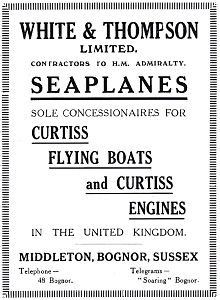
White left White and Thompson in 1915 to join the Royal Army Medical Corps, the company being re-organised as the Norman Thompson Flight Company, and expanding its factories to cope with increased demand for its aircraft, orders being placed for the N.T.4, a twin-engined patrol flying boat of similar size to the Curtiss H.4 Small America, and the N.T.2B, a single-engined flying boat trainer. One N.T.2B was shipped to Canada to make forestry patrols from Lake St John, Quebec. A change in RNAS requirements lead to the sudden cancellation of orders for the N.T.4, however, while engine problems caused delays to the delivery of N.T.2Bs.
These problems caused Norman Thompson to go into receivership on 19 April 1918, an attempt to sue Curtiss over breaking the 1914 agreement for White and Thompson to have exclusive sales rights in Europe getting nowhere. The Norman Thompson Flight Company went into Voluntary liquidation on 12 July 1919, the company’s factory and stock being purchased by Handley Page.
Aircraft
Thompson-Lanchester No. 1 Biplane / Gray Angel
White & Thompson No. 1 Seaplane
White and Thompson No. 3
White & Thompson Bognor Bloater
Norman Thompson N.1B
Norman Thompson N.T.2B
Norman Thompson N.T.4
Norman Aviation International Inc.
Markets kit for the Karatoo J-6 two-seat monoplane (version of Anglin Karatoo), kit and plans for the two-seat Nordic II cabin monoplane, kit for the Nordic VI-912 two-seater, and kit for single-seat Nordic VII cabin monoplane.
Norman Aviation, owned by Jacques Norman, sold models, such as Nordic II and VI, ready to fly for less than Can$55,000. All necessary instruments for flight are included in the equipment. Pre-sale final testing includes 15 hours of test flight and each motor is carefully examined and tested to ensure maximum reliability. Delivery was usually within four to five months.
1995-8: Caste Postale 61032 Levis, Quebec, G6V 8X3 Canada.
Norman Aeroplane Company Ltd.
UK
NDN Aircraft Ltd was renamed Norman Aeroplane Company Ltd after a 1985 move of factory to Wales. Continued development of Firecracker tandem two-seat turboprop trainer (first flown 1983) that had been proposed for the RAF by Hunting Firecracker Aircraft Ltd. Also continued development of Fieldmaster agricultural aircraft and Freelance.
Noordyun
In 1935 R.B.C.Noorduyn, experienced from the US Fokker company, went to Canada and organised the Noorduyn Aviation Company at Longue Pointe, Quebec.
Noorduyn designed and manufactured the Norseman eight/ten-seat cargo-transport aircraft, which first flew in 1935 and was delivered to the RCAF and the USAF; with the latter service it was designated C-64A. Norsemans were especially popular as bushplanes in the northern regions of Canada and with civilian operators in northern Europe.
The infant company’s elation over the initial acceptance of its new airplane was soon eclipsed by the emergencies of war. The Noorduyn factory became a natural for con¬version to production of North American Har¬vard (AT 6) trainers the Norseman and the Harvard both used the Pratt & Whitney R 1340. Although Norsemans converted into military airplanes continued in production, the emphasis was on the Harvards. From a staff of 150 employees, World War II changed the company almost traumati¬cally.
The Canadian Car & Foundry Company acquired Noorduyn’s assets in 1946 and produced an improved Norseman Mark V until 1950.
Nord / SNCAN
Societe Nationale De Constructions Aeronautiques Du Nord
Nord-Aviation
In France, the Socialist Government of the so called Popular Front brought all the companies building military aircraft, aero engines and ar¬mament under its control in 1936. The im¬mediate result was the socialized oblivion of such established companies as Marcel Bloch, Bleriot, Nieuport, Potez, Dewoitine, Hanriot and Farman within half a dozen nationalized groups or Societies Nationales, named ac¬cording to their geographical location (Nord, Ouest, Centre, Midi and so on). Les Mureaux, CAMS, and part of Breguet, Amoit and Potez formed SNCAN in 1938.
Dominant concern was production of Potez 630 series of twin-engined multipurpose aircraft. Peak output reached in May 1940. Development of basic type (e.g. Potez 671 specialized fighter with elliptical wing) was also SNCAN concern.
After World War II, although four of the nationalized groups continued operating un¬der state control, private companies were al¬lowed to resume the design and manufacture of both civil and military aircraft. Some of the pioneering names of French aviation, such as Breguet and Morane Saulnier, returned to prominence, and by 1950 a new one had been added Avions Marcel Dassault.
Caudron joined SNCAN in 1947.
Aerocentre / SNCAC went into liquidation during 1949, its plants and work being shared by SNCAN (Nord), SNCASO (Sud-Ouest) and engine form SNECMA.
In 1954, when company flew prototypes of trainers later built in quantity, amalgamated with Societe Frangaise d’Etudes et de Constructions de Materiels Aeronautiques Speciaux (SFECMAS, formerly Arsenal de I’Aeronautique).
From January 1958 called Nord-Aviation. Under new name continued development of Nord/SFECMAS Gerfaut delta-wing fighter; also Griffon, with fuselage forming outer casing of very large ramjet with turbojet in center for take-off and to ignite ramjet. Noratlas twin-boom transport, though first flown September 1949, continued in production and development under new name, achieving wide success. Nord name was emphasized in Noroit flying-boat and Noreclair shipboard aircraft.
Max Holste joined Nord in 1961.
On January 1st, 1970 three French nationalised aircraft companies – Sud-Aviation, Nord Aviation and the missile manufacturing company, SEREB – were merged into Aérospatiale.
Nord-Aviation produced a version of the Messerschmitt Bf 108 Taifun, known as the Nord 1002 Pingouin, for the French military service immediately after the Second World War. A tricycle landing gear variant, the Nord 1101 Noralpha, and a redesigned civilian four-seat derivative, the Nord 1203 Norecrin, were also produced in quantity, together with Nord NC-853/856 Norvigie liaison/trainer aircraft delivered to the French army and to aero clubs in the mid-1950s. A batch of N.1402 Noroit twin-engined amphibians were built for the French navy; and the N.2501 Noratlas twin-boom, twin-engined transport, first flown 1952, was subsequently produced in France and Germany. Nord took over the Max Holste Super Broussard twin-engined transport design and developed it as the Nord 262 airliner, delivered to European and U.S. airlines and to the French navy by Aerospatiale.
Nogrady
1983: Avions Nogrady, 24 impasse Alfred de Vigny, 30100 Ales, France.
UL builder
Noble Hardman Aviation
1983: Wales
UL builder
Nobile, Umberto
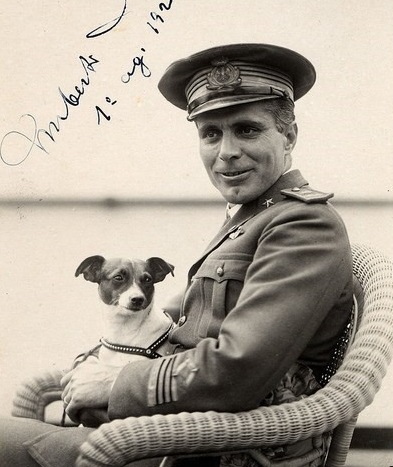
Italian engineer and airship designer. In 1931, Nobile left Italy to work for the next four years in the Soviet Union, where he helped with the Soviet semi-rigid airship programme. Details of the Soviet Airship Program remain obscure, but there is an obvious Nobile influence in the design of the airships USSR-V5, and SSSR-V6 OSOAVIAKhIM.
Nobile worked in the USSR from 1931 until 1935. He is believed to have been responsible for the design of nine semi-rigid airships.
Nirvana Paramotors
Nirvana Systems sro is a producer of motor paragliding equipment.
The first flights on the modified Parafoil began in 1987; take off using the tow rope behind the car. 1988 saw the beginning of parachute production – BIG type, and the discovery that flying from the hills is possible.
The first paramotor production began in 1989– the paramotor was not finished.
Sale and service of Edel parachutes began in 1992, later also the Wings.
In 1993 the Trike was completed with a Jawa 350 engine and later the Trabant. This was first flown in 1994. In 1995 the first own paramotor was completed with a Konig triple cylinder engine.
A light paramotor with a Hirth engine was completed in 1996.
1999 saw the foundation of the company – Nirvana paragliding – for the production of paramotors.
2000 brought the serial production of the Nirvana Electric model. First racing season – Czech Republic Championship.
Nirvana introduced the new PPG wings, Alix and Desire in 2005 and the Rodeo paramotor received DULV certification.
The new Flystyle collection was introduced in 2006.
Official entered the USA PPG market in 2009, WAG qualification, and official introduction of the Instinct to the domestic, German and UAE market.
 All Aero