Californian Professor Jerome S. Zerbe (1849-1921) built three multiplanes circa 1910.
Zerbe is somewhat of a mysterious figure whose real name was only recently determined to be James Slough Zerbe.
Fayetteville AR.
USA
Californian Professor Jerome S. Zerbe (1849-1921) built three multiplanes circa 1910.
Zerbe is somewhat of a mysterious figure whose real name was only recently determined to be James Slough Zerbe.
Fayetteville AR.
USA
Zeppelin-Werke Staaken GmbH
Zeppelin-Werke Lindau GmbH
This company was established under the patronage of Graf von Zeppelin, located formerly at Gotha, to design and construct aircraft with Claudius Dornier as chief designer, the Riesenflugzeug (giant aeroplane) “R” series bombers. The company’s first product, the Rs I multi-engined flying-boat, was wrecked before its first flight, but three differing examples were developed progressively, designated Rs II, Rs III, and Rs IV.
The Staaken design team evolved four-, five- and six-engined bombers, leading to the four-engined R.VI which was built by Automobil and Aviatik, Ostdeutsche Albatros Werke and Luftfahrzeugbau Schütte-Lanz and carried out successful raids against Allied territory, dropping bombs as large as 1,000kg. A floatplane version of the R.VI, the Staaken L, was wrecked during trials in 1918.
Other aircraft built by Zeppelin-Lindau included the C.I, C.II, D.I and VI biplanes, and Cs.I two-seat monoplane seaplane. Developed the Gs.I commercial flying-boat after the Armistice, which was broken up on the instructions of the Allied Control Commission. An advanced four-engined all-metal monoplane airliner, the E.4/20, flew successfully in 1920 but was then destroyed by order of the Allied Control Commission under the terms of the Armistice.
In 1922 the company was renamed Dornier GmbH.
Komatsu Zenoah CQ.
1998:
142-1 Sakuragaoka-2 Higashiyamato
JAP 189 Tokio
Japan
Zenoah Co. Inc
24144 Sumac Drive
Golden
CO 80401
USA
UL engine builder
Zenith Aircraft Corp
1927 founders Charles Rocheville & Albin Peterson; pres: Strerling Price
Santa Ana and Midway City CA
USA
1928:
Albatross Aircraft Co
Long Beach CA
USA
1929: Sold to Emsco.
Monte R Ruble, Charles L Semans, Clarence J Vogel
Uniontown PA
USA
Circa 1928 built the P-1 Sport
Formed 1974 and currently producing the Zenith CH 2000 certificated two-seat Iightpiane (first flown June 1993 and delivered in assembled form from 1994). Also markets the Zenith CH-100 single-seater, Aero CH-150 and CH-180 (aerobatic variants of CH-200), Zenith CH-200 two-seat Iightpiane and Zenith CH-250 long-range version, and Zenith CH-300 (Tri-Z) three/four-seat Iightpiane (as variant of CH 2000), all built from plans and/or kits.
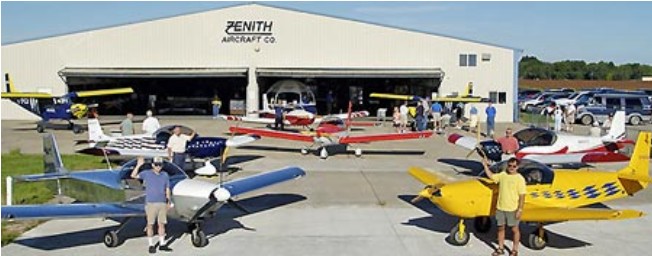
Zenith Aircraft Company is in the exclusive business of designing, developing and manufacturing kit aircraft. The independent, privately-owned company was formed in 1992 in Mexico, Missouri, centrally located in the United States, and is based in leased 20,000+ sq.ft. production facilities at Mexico Memorial Airport. Zenith Aircraft Company has acquired the exclusive rights to manufacture and market Zenair kit aircraft designs from designer Chris Heintz.

An aeronautical engineer, Chris Heintz is a graduate of the E.T.H Institute in Switzerland. After serving in the Air Force, Heintz worked for Aerospatiale on the supersonic Concorde jetliner, and later became chief engineer at Avions Robin (France) where he designed several fully-certified two and four seat all-metal production aircraft.
In his spare time, Heintz began to design and build his own aircraft, which he named the ZENITH, anagram of Heintz. His all-metal homebuilt aircraft incorporated simple construction methods throughout and after a little more than a year’s work, the two-place low-wing Zenith was rolled out and successfully flown in 1969. Soon after, detailed blueprints and construction manuals of the aircraft were drawn up and offered to the growing number of interested builders and flyers.
In 1973, Chris Heintz, his family and the Zenith moved to North America, where Heintz worked for de Havilland (in Toronto) as a stress engineer on the Dash 7 commuter. Chris decided to form his own aircraft company in 1974, and under the name of Zenair Ltd. started to manufacture Zenith kits himself from his two-car garage. Through the company, Heintz has introduced more than twelve successful kit aircraft designs over the years. In 1992, Heintz licensed the kit manufacturing and marketing rights to Zenith Aircraft Company for the STOL CH 701 and the ZODIAC CH 601 designs, and has developed the new STOL CH 801 and the new ZODIAC XL for Zenith Aircraft Company.
While Heintz officially retired in 2003, he is still very active as a designer, engineer and consultant.
1996: Huronia Airport, Midland, Ontario L4R 4K8, Canada.
PO Box 650, Mexico Memorial Airport, Mexico, MO 65265-0650.
By 1996, Zenair had a production facility in Mexico, Missouri, USA, headed by Sebastion Heintz (son of the designer, Chris Heintz)

After being denied an exit visa, Zdarsky decided to take matters into his own hands and build his own plane; a hang glider with a 2-cylinder engine. In August of 1984, he set off at 3 a.m. and made his escape to Vienna where he requested political asylum.
Zdarsky was able to sell his plane to a German museum that housed escape vehicles. Afterwards he moved to Los Angeles where he started his own company, called Ivoprop, which produced propellers of his own design. Ivoprop Corporation, founded in 1984 by Ivo Zdarsky, is an American manufacturer of composite propellers for homebuilt and ultralight aircraft, as well as airboats. The company’s headquarters are in Long Beach, California.
Zdarsky started the company after carving his own propeller for a homebuilt ultralight trike that he flew from Cold War Czechoslovakia, over the Iron Curtain to Vienna in 1984. Ivoprop has sold more than 20,000 propellers since then.
The company’s propellers are built from carbon-fiber-reinforced polymer and feature a stainless steel leading edge.
In 1997 Zdarsky decided to move somewhere close to a runway where he could develop his design for an aircraft that could function as both helicopter and airplane. He came across 400 acres in the Utah desert and purchased it for just $99,000.
Czechoslovakia
The Skoda company was the largest industrial organisation in Czechoslovakia in the 1920s, manufacturing engines of indigenous design alongside license-built Hispano-Suiza and Lorraine Dietrich aero engines, Dewoitine aircraft and Curtiss Reed propellers. Skodovy Zavody had a controlling interest in the Czech Avia company and in Ceskoslovenska Letecka Spolecnost, the Czech airline. Parent company has also made cars, firearms, etc.
Zanzottera Technologies
1998:
Zanzottera Motor
ZI Grandola ED UNITI (CO)
I-22017 Grandola Uniti
Italy
Zanzottera Technologies of Italy sold all of their two-stroke ultralight aircraft engine line to Compact Radial Engines of Surrey, British Columbia, Canada.
Charles A Zajicek
Berwyn IL.
USA
Circa 1934 airplane builder
 All Aero