První Brnenská Strojírna Velká Bíteš, a.s./ PBS is a manufacturer of:
Small aircraft turbojet engines and auxiliary power units,
Environmental control systems for aircraft and helicopters,
Ground power units,
Precise castings for automotive, aerospace and glass industries and healthcare,
Complex and completely machined parts of electromotors, alternators, mammographs and wind power plants,
Decanting centrifuges for sewage plants, i.e. programs closely related to ecology and environmental protection.
Manufacturer
Pazmany

Ladislao Pazmany is of Hungarian descent. His family moved to Argentina when he was three and he grew up and was educated there. After obtaining a degree in aero engineering, he worked wherever engineering jobs were available in the unstable economy that prevailed in Argentina at the time.
For nearly a decade he designed aircraft, pipelines, high tension power towers, suspenison bridges, chemical and hydroelectric plants, was an instructor at an aeronautics school.
In May of l956 Paz and his family moved to the U.S. and settled in San Diego where he went to work for Convair. The following month he attended his first EAA Chapter 14 meeting and has been involved in EAA activity ever since. At Convair, he worked on F-102, F-106 and other projects, and founded L. Pazmany & Associates at San Diego, California.
Concurrent with his full time employment he designed he PL-1, which flew for the first time on March 23, 1962, made plans available to homebuilders and wrote the book “Light Airplane Design”.
1980-95: Pazmany Aircraft, P.O. Box 80051, San Diego, CA 92138.
Paxman’s Northern Lite Aerocraft
1995-7: PO Box 1155, Glenwood, AB TOK 2R0 Canada.
Built the Viper LSA
Payne, V.W.
Vernon W. Payne, Rt. 2, Box 319M, Escondido, CA 92025, USA.
Designed and built a number of aircraft post-WW2
Payne, J.H.
Mr J,H.Payne designed two gliders in the 1930s.
The IC.1 single-seat Primary was built at the Imperial College, London, UK, in 1931.
The second, the Granta single-seat utility glider was commenced by the Cambridge University Gliding Club in 1931 but thought not finished.
Pawnee Aviation Pawnee Helicopter
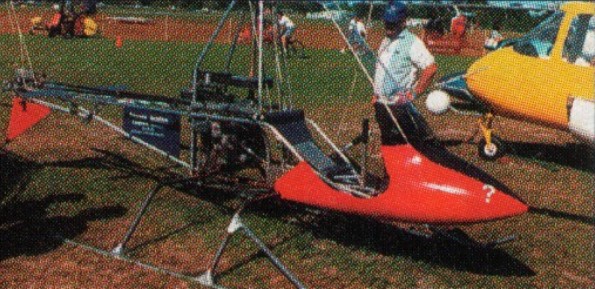
Max speed: 95 mph
Cruise: 80 mph
Range: 175 sm
Rate of climb: 1000 fpm
Service ceiling: 10,000 ft
Engine: Hirth, 65 hp
hp range: 65-110
Fuel capacity: 10 USG
Empty weight: 350 lb
Gross weight: 700 lb
Height: 7 ft
Length: 20 ft
Disk span: 21 ft
Seats: 1
Pawnee Aviation
1996: 400 Sumner St, Longmont, Colorada, USA.
1997: 505A Weaver Park Rd, Longmont, CO 80501, USA.
LSA helicopter builder
Pause, Rudolf
In 1929 Rudolf Pause caused a sensation with a muscle-powered swing plane developed in his company. From a hill on what is now Bodenseestrasse, Pause takes “incredible” leaps in the air, according to the archive authors, with a range of twelve meters.
According to the plans of designer Adalbert Schmid, who works for him, they build a swing-wing glider. On June 26, 1942, the muscular-strength aircraft will set out on a 900-meter flight on a meadow on Agnes-Bernauer-Strasse, where the Westbad is today. If you believe the pause experts from the Pasinger Archive, then it was the world’s first manned swing flight.
As a result, Schmid and Pause will of course equip the swing wing with motors, but the project comes to an abrupt end. The Nazi rulers believe that it is not important to the war effort.
Paup
1983: Paup Aircraft, Arthur Neu Airport, Carroll, Iowa 51401, USA.
UL builder
Companhia Aeronautica Paulista
Brazil
Companhia Aeronautica Paulista formed at Sao Paulo shortly after the Second World War to produce CAP 1 Planalto low-wing advanced trainer, CAP 4 Paulistinha high-wing cabin monoplane, and similar CAP 5 Carioca. The second was the most successful; improved version later built by Nieva. Company came under control of IPT in late 1940s.
 All Aero