Kestral was formed in 1991 by Oklahoma-based former Cessna Sales Manager Donald L. Stroud, to produce the KL-1 GA single.
Manufacturer
Columbia Aircraft Manufacturing Corporation
Lancair Certified was renamed Columbia Aircraft Manufacturing Corporation in 2005 to focus on the new design. Neibauer sold the kit-build portion of the company, Lancair International, to Joseph Bartels in March 2003.
The 300 was the fastest fixed-gear aircraft in the world when it was released, but held this title only for a short period until the turbocharged Columbia 400 (Model LC41-550FG) flew in June 2000. The 400 also featured a new glass cockpit developed under the AGATE program, which Columbia refers to as the “Highway in the Sky” (HITS). The 400 was certified on March 30, 2003.
The upgrades used in the Columbia 400 were then incorporated in the original 300 design to create the Model LC42-550FG, marketed as the Columbia 350. It appeared in April 2002 and was certified on April 8, 2004.
In January 2003, Composite Technology Research Malaysia (CTRM) bought a controlling interest in Columbia for over $50 million. CTRM is owned by the Malaysian government and was incorporated in November 1990 by Minister of Finance Malaysia Inc. CTRM’s CEO is Retired Col. Rosdi Mahmud. CTRM became interested in selling its share of the company in 2006.
All of the Columbia aircraft competed heavily with similar designs from Cirrus Design, which was also developed under AGATE and included many of the same features. First to market, the SR22 outsold the Columbia models by a wide margin.
On September 24, 2007 Columbia Aircraft announced that Textron would purchase the company, which would be merged with its Cessna division, including its line of high-performance single-engined aircraft. As part of the sale agreement Columbia Aircraft was to enter Chapter 11 bankruptcy protection. The arrangement would be subject to approval of the bankruptcy court and also to a final agreement with Cessna.
The fate of Columbia Aircraft was complicated on October 14, 2007 when three additional companies entered the bidding for Columbia Aircraft. These were Columbia’s competitor, Cirrus Design as well as Versa Capital Management and Park Electrochemical Corp. The two latter companies filed motions with the bankruptcy court stating that Cessna has been “getting preferential treatment in the process”. On 20 November 2007 Cirrus Design announced that they would not pursue purchasing Columbia, citing Columbia’s problems as being too serious and that resolving them would require excessive resources.
On November 27, 2007, Cessna’s parent company Textron announced that Cessna Aircraft was the successful bidder for Columbia Aircraft, that the Columbia 350 and 400 are renamed the Cessna 350 and Cessna 400 and that all existing Columbia aircraft will be supported by Cessna. Cessna paid USD$26.4M for the company and committed to investing in the current company location on the southeast corner of Bend Municipal Airport in Bend, Oregon.
On April 29, 2009, Cessna announced that it would close the former Columbia plant in Bend, Oregon facility where the Cessna 350 and 400 were built and move production to Kansas. The company laid-off all the remaining 150 employees at the Bend plant.
Aura Aero
Founded in 2018, Aura Aero has already made notable steps forward towards certification and commercialisation of its light aircraft family – becoming a certified aircraft manufacturer in October 2023 following receipt of EASA Part 21J approval.
Volk Brothers
Bert Volk started life as an engineer making cars in 1910.
A year later the first airplane landed in Brighton on the beach, a Bleriot monoplane. Volk became fascinated with aviation and he thought he would have a go.

In 1911, he started making parts for engines, wings, floats, and fabric bodies that would be fitted into planes, and two years later pleasure flights began being launched.
Bert Volk’s elder brother, Herman, invented a collapsible, portable hanger on the edge of the water from where pleasure flights started.
They were all built in bits and taken down to the seafront next to the Banjo Groyne, put together and launched into the sea.”
There was a ramp down into the water and planes were launched into the sea.
Seaplane pleasure flights began in Brighton in 1913
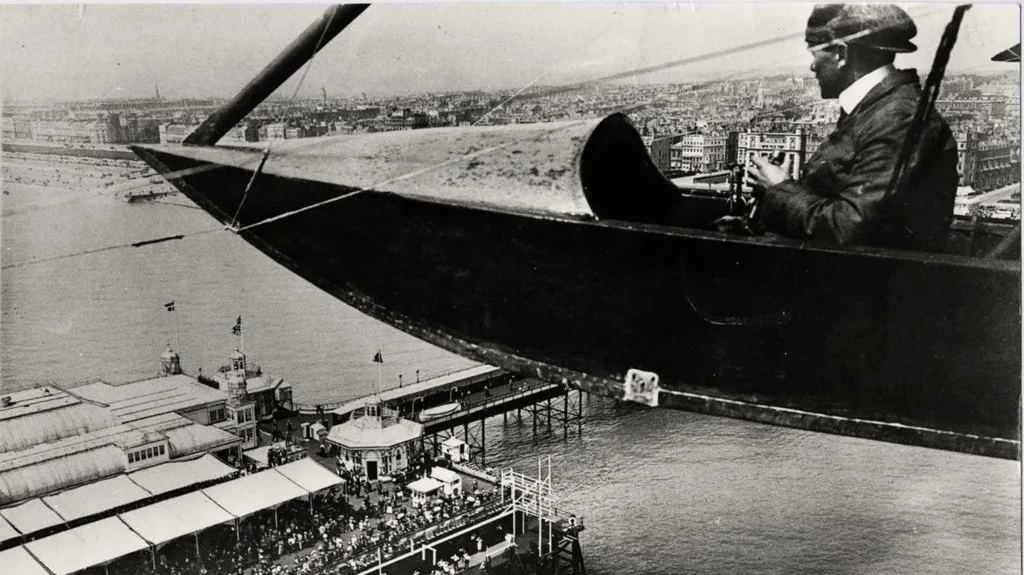
A year after flights started, the outbreak of World War One meant the hanger was requisitioned by the government and the project ended.
Herman Volk went off to manufacture planes for the war effort.
He also contributed to the development of Shoreham Airport – one of the first aerodromes in England.
After the war he took over the running of Volk’s Electric Railway on the seafront.
Bert went off to South Africa where he spent most of the rest of his life.
Daher
Daher took over Quest Aircraft in 2019.
Duigan, John
John Duigan (1882-1951) was born at Terang, Victoria, Australia, and later trained as a pilot and engineer in London.
Duigan designed and built the first Australian made aeroplane. He flew it on 16 July 1910, for a distance of 9m / 28 ft. He made 26 more flights in the aircraft, which was a biplane powered by a 20 hp engine built in Melbourne, Australia.
Wood, Cecil
Richard Pearce flew on 31 March 1903 near Temuka, New Zealand, after he had enlisted the help of Timaru engineer Cecil Wood to help with his lightweight motor. Wood had already been the first person in New Zealand to construct an aircraft motor that was three times lighter for its power output than similar car engines at the time.
Bentley
By 1931, during the Great Depression, Bentley was having financial difficulties. When funds ran out in 1931, the receivers were negotiating with D.Napier & Sons Ltd for the sale of the remains of Bentley. However, Rolls-Royce put in a secret bid through a Liechtenstein company, and secured Bentley Motors for £125,256. For this, Rolls-Royce got the factory equipment, a number of incomplete car chassis, and the services of Walter Bentley for three years.
Zuck-Whitaker
(Daniel R) Zuck-(Stanley D) Whitaker
Los Angeles CA.
USA
Circa 1947 airplane builder
Zornes, Charles
Charles A. Zornes seems to have started aircraft construction in Walla Walla, Washington, USA, in 1909. After they trained at the Benoist Aviation school in St. Louis, he and Johnny Ludwig together with some associates set up a company in 1912 in Pasco, Washington to manufacture aeroplanes. He also ran a flying school there, with the 1912 headless pusher and at least two others. Zornes crashed on April 19 1912, with injuries that did not seem to be life threatening. He appears in some lists of aviation casualties after the accident, but it appears he might have survived and lived until 1954.
 All Aero