In 1995 the owner of Pipistrel was Ivo Boscarol.
2009: GORIŠKA CESTA 50a, SI-5270 AJDOVŠČINA, SLOVENIA
LSA, power pack, trike and glider builder
In 1995 the owner of Pipistrel was Ivo Boscarol.
2009: GORIŠKA CESTA 50a, SI-5270 AJDOVŠČINA, SLOVENIA
LSA, power pack, trike and glider builder
1980: Piper Advanced Technology Inc
fdr: Howard “Pug” Piper, son of William T Piper Sr,
Wichita KS.
USA
Built the PAT-1 Pugmobile in 1981.
After being an investor in and later treasurer of that Bradford firm the Taylor Broth¬ers Aircraft Company a local oilman named William T. Piper bought the company at a bankruptcy sale for $761. It was 1930, and C. Gilbert Taylor, the former company’s designer and only surviving partner, was given half in¬terest in the new company, which he called the Taylor Aircraft Company.
About the time the J 2 rolled out, so did C.G. Taylor. There had been friction between Taylor and Piper for some time, so Taylor left and Jamouneau took over as chief engineer.
The company was beginning to see some improve¬ment in its always precarious financial situation, and then, in 1937, the plant burned down. By 1937 the company was producing 18 aircraft a week, but fire destroyed the facility on St.Patrick’s Day that year. It was a severe financial blow to the company and to William T. Piper. But instead of being an excuse to quit, the fire only in¬creased Piper’s determination to prove his point. Refi¬nancing was arranged, the name was changed to Piper Aircraft Company, and J 2 production was resumed in a vacant two storey Susquehanna silk mill conveniently located next to the Lock Haven, Pennsylvania airport. That same year, Piper assumed the presidency of the firm, making official a situation that had existed informally since the early 1930s.
In recog¬nition of Walter Jamouneau’s contribution to the E 2, subsequent models were called the J 2 and J 3.
The PA 11 followed next in the Cub line, and the PA 18 Super Cub with essentially the same structural and aerodynamic con¬figuration as the 1932 E 2 continued.
Initial production type was the Cub two-seat high-wing monoplane, of which 10,000 had been completed before the end of 1941.
Piper’s major contribution to the military in World War 2 was not, as often assumed, the Cub liaison and trainer, but steel radar masts.
In 1948 Piper took over the Stinson Division of Consolidated Vultee Aircraft Corporation and acquired the Stinson Voyager production rights, but production of this type was soon halted.
Piper’s first twin was the four-seat Apache, which entered production in 1954. The later four-seat single-engine Comanche first flew in 1956. A whole line of light aircraft has followed the original Cub, from the Pacer/Tri-Pacer/Colt series of high-wing monoplanes to their successors, the Cherokee low-wing series, first of which flew in 1960. Piper produced the specialized Pawnee agricultural monoplane in 1959.
William T. Piper died in 1970.
A series of twins developed from the Apache to Aztec, Twin Comanche, Seneca, and Navajo, plus other aircraft such as single-engined PA-38 Tomahawk. Company became subsidiary of Bangor Punta Corporation, then Lear Siegler Inc (1984), and later Romeo Charlie Inc (1987), finally with only Cheyenne and Malibu Mirage offered, but became insolvent early 1990s, though reduced-rate production continued while a buyer was sought.
The New Piper Aircraft Inc restarted production of Warrior, Archer, Arrow, Dakota, Saratoga and Seneca models at Vero Beach in June 1987 following the sale of the 50 year old aircraft company to Stuart Millar in May.
In 1981 Flight Designs Inc was incorporated into Pioneer International Corporation which has been well known for half a century in the aerospace industry as specialising in parachutes.
1984: Pioneer International Corp, Pioneer Industrial Park, PO Box 631, Manchester, CT 06040, USA.
A 1997 newcomer to the UK hang gliding community has appeared in the form of a Devon based company, Pioneer Aviation Ltd. Managing director Rupert Sweet-Escort.
pres: Storm Archer
175 Broadway
New York NY.
USA
Built the Pioneer BS-2 in 1929.
1984: 1313 Newton Ave, Evansville, IN 47715, USA.
UL builder
1998:
Route de Toissieu
F-07340 St Désirat
France
Paramotor builder
1931:
American Airplane & Engine Corp (Fairchild)
Farmingdale NY.
USA
1931: Acquired by General Aviation Mfg Corp.
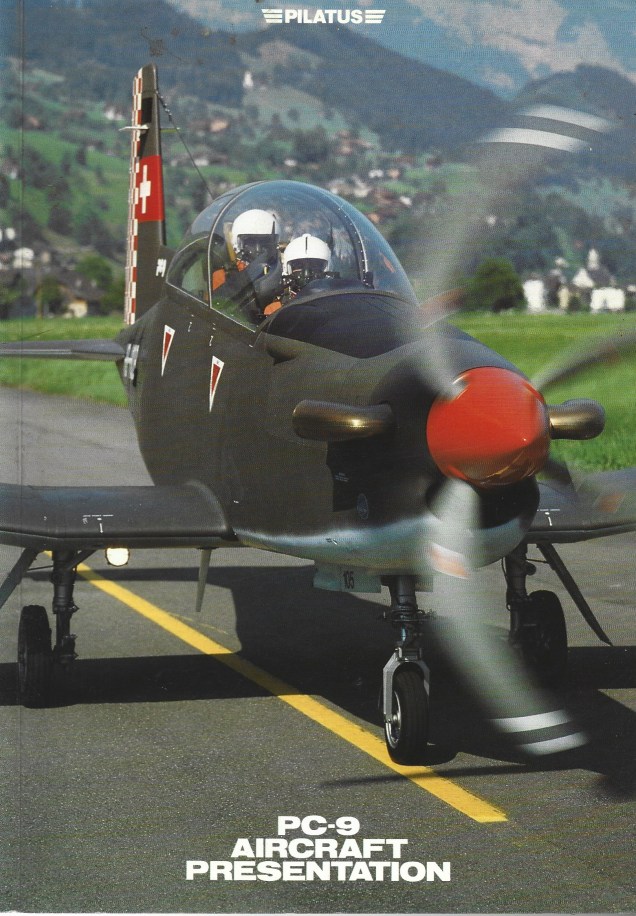
The prototype PC-9 flew on May 7, 1984, and was followed by a second aircraft, to production standard, on July 20, 1984. Although it bears a strong external resemblance to the PC-7, the PC-9 has only ten per cent commonality with the former. Major differences include a ventral airbrake, a reduced span wing with enlarged ailerons, a longer dorsal fin, and undercarriage doors. Compared with the PC-7, the PC-9 has an 857kW PT-6A-62 turboprop engine driving a four-blade propeller which, together with the structural changes, gives a significantly improved performance, including a maximum low-level speed of 496km/hr (268kt), an initial climb rate of 1,247m/min (4,000ft/min), and a time to 4,575m (15,00ft) of 4mm 30sec. Stepped tandem seating is fitted under a revised canopy, with Martin-Baker zero-zero ejection seats. Cleared for erect and inverted spinning.
Pilatus had completed the first PC-9 for Australia by June 1987. Two aircraft will be supplied complete, followed by six in kit form and components for 11 more. Hawker de Havilland and the GAF division of Aerospace Technologies of Australia assembled their first PC-9/A, of 67 PC-9/As for the RAAF, which first flew on 14 November 1987.
By late 1986 126 PC-9s had been sold to five customers.
Orders for more than 150 have been placed by 1990 by a number of air arms including those of Burma and Saudi Arabia. The PC-9 is fully acrobatic and has provision for underwing pylons for light stores.
Pilatus has continually upgraded the PC-9M to improve its operation, while maintaining low life-cycle and acquisition costs. Optimised power mapping and a trim aid device result in outstanding airborne handling. The introduction of large primary and secondary AMLCD flight displays has transformed the PC-9M into a true “glass cockpit” aircraft. The aircraft can also be equipped with a Head Up Display and Video Recording System, which enable the operator to expose students to today’s fighter technology at a very early stage of their training.
By 1993 a total of 140 aircraft were built.
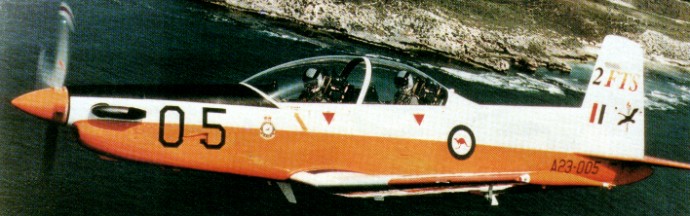
The Royal Australian Air Force’s Pilatus PC-9/A is the major basic training aircraft of the Australian Defence Force (ADF), introduced to the Air Force in 1987. Pilot training in the aircraft commenced in 1989. It was flown by the Central Flying School at RAAF Base East Sale, Victoria, where ADF fixed-wing flying instructors are trained, No 2 Flying Training School at RAAF Base Pearce, Western Australia, where ADF pilots are trained to ‘wings’ stage, and Forward Air Control Development Unit at RAAF Base Williamtown, near Newcastle, to train Joint Terminal Attack Controllers.
The PC-9/A is flown by the RAAF Roulettes in aerobatic displays at major events throughout Australia. Central Flying School pilots fly six aircraft that comprise the team as a secondary role to their instructional tasks. Central Flying School trains Navy and Air Force pilots to become flying instructors.
At RAAF Base Pearce, trainee ADF pilots, having successfully completed the Basic Flying Course at the ADF Basic Flying Training School at Tamworth, undertake the Advanced Flying Training Course with No 2 Flying Training School, during which they fly 130 hours in the PC-9/A. Upon successful completion, graduates are awarded their wings and posted to a flying squadron.
There are also four modified PC-9/A(F) aircraft in grey paintwork fitted with smoke grenade dispensers for target marking. These aircraft are based at RAAF Base Williamtown, near Newcastle, and are used to train ADF Joint Terminal Attack Controllers (JTACs, formerly forward air controllers), who coordinate air support to troops on the ground.
In 2020 eighteen retired RAAF PC-9A were placed up for auction at Avalon Airport, Victoria, Australia, with bids starting at $1 and no reserve.
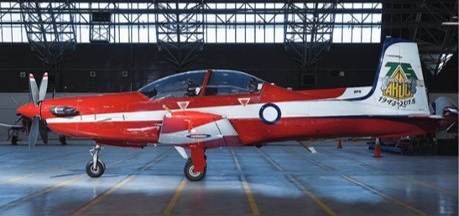
Variant: Raytheon Aircraft T-6 Texan II
PC-9
Crew: 2
Engine: 1 x Pratt & Whitney Canada PT6A-62 turboprop, 950 shp (708 kW)
Wingspan: 10.12 m / 33 ft 2 in
Length: 10.18 m / 33 ft 3 in
Height: 3.26 m / 11 ft 8 in
Wing area: 175.453 sq.ft / 16.3 sq.m
Max take-off weight: 3200 kg / 7055 lb
Empty weight: 1620 kg / 3572 lb
Fuel internal: 508 lt
Max. speed: 556 km/h / 345 mph
Landing speed: 79 kt / 147 km/h
Cruising speed: 270 kt / 500 km/h
Max operating speed: 320kts IAS
Initial climb rate: 3937.01 ft/min / 20.0 m/s
Ceiling: 11580 m / 38000 ft
Range w/max.fuel: 1642 km / 1020 miles
T/O run: 240 m
Ldg run: 260 m
Endurance: 2 hr
Crew: 2
Pilatus PC-9/A
Engine: Pratt and Whitney PT6A-62 turboprop, 950 shp / 710kW
Length: 10.18m / 33 ft 4 in
Height: 3.28m / 10 ft 8 in
Wingspan: 10.24m / 33 ft 2in
Wing area: 175.3 sq.ft
Basic weight: 2250kg
MTOW: 2710kg
Max speed: 320 kts
Cruise speed: 270 kts
ROC: 4100 fpm
Range (with two underwing tanks): 1,850km
Combat radius: 650km
Ceiling: 25,000 ft
Hardpoints: 2
Crew: 2
Pilatus PC-9/A (F)
Engine: Pratt and Whitney PT6A-62 turboprop, 950 shp / 710kW
Length: 10.18m / 33 ft 4 in
Height: 3.28m / 10 ft 8 in
Wingspan: 10.24m / 33 ft 2in
Wing area: 175.3 sq.ft
Basic weight: 2250kg
MTOW: 3210kg
Max speed: 320 kts
Cruise speed: 270 kts
ROC: 4100 fpm
Range (with two underwing tanks): 1,850km
Combat radius: 650km
Ceiling: 25,000 ft
Hardpoints: 2
Crew: 2
PC-9M
Basic empty weight (typical) 1,725 kg (3,803 lbs)
Maximum take-off weight 2,350 kg (5,181 lbs)
Maximum external load 1,040 kg (2,292 lbs)
Take-off ground roll 247m (810ft)
Landing ground roll 352m (1.155ft)
Rate of climb 3,880 ft/min
Maximum operating speed 320 KCAS
Maximum cruise speed 271 KTAS
Maximum cruise speed at 10,000 ft 298 KTAS
Stall speed – flaps and gear down 69 KCAS
Maximum positive g-load +7.0 g
Maximum negative g-load -3.5 g
Sustained g-load +3.7 g
Maximum range (clean) 860 nm
Underwing stores 6
 All Aero