1980: Charles H. Richard, 2561 W. Avenue K, Lancaster, CA 93534, USA.
Built the Commuter monoplane.
1980: Charles H. Richard, 2561 W. Avenue K, Lancaster, CA 93534, USA.
Built the Commuter monoplane.
Italy
A Shipbuilding company which began aircraft manufacture in First World War. Postwar, the R.6 single-seat and R.9 two-seat sports-triplanes were built around 1920, plus the large three-engine twin-hull R.I.B. flying-boat. Company closed down in about 1925.
1998:
H&M Minami Aoyama East 304 Minami Aoyama
5.11.14 Minato-ku
Tokyo 107
Japan
LSA helicopter builder
Germany
RWF was formed at Porz-Westhoven, near Cologne, in early 1950s to develop a new light aircraft, the RW-3 Multoplane, basically a powered sailplane with Porsche engine driving a propeller mounted between the fin and rudder, and under the tailplane. The production license was subsequently transferred to Rhein-Flugzeugbau GmbH.
1997: 179 Aviation Ave, PO Box 497, Walterboro, SC 29488, USA.
Sold White Lightning Aircraft WLAC-1 and Lightning Bug Aircraft Lightning Bug LSA
Reginald Foster Dagnall was born in Fulham, London on 11 April 1888 the son of Walter and Frances Dagnall, he was educated at Tiffin School, Kingston upon Thames. Dagnall started his career in the drawing office of the Thames Ironworks and Shipbuilding Company. He then joined Ernest Willows in developing Willows airships and during the 1914-18 war he was first works manager and then general manager of Airships Limited., a firm which made kite balloons and blimps.
After World War I Dagnall founded his own company, in a small factory at 17 Stoke Road, Guildford, Surrey Dagnall began the manufacture of equipment and gliders.
The RFD name is now synonymous with “Rapid Flotation Device” and the supply of marine and aviation safety equipment. He had researched flotation gear of various sorts, and in 1918 he built some of the earliest rubber dinghies.
RFD moved to Guildford in 1926 and expanded to Catteshall Lane, Godalming, in 1936 the Godalming factory burnt down and was rebuilt in 1954.
The R.F.D. Co Ltd built the prototype of the Dagling, a primary glider, in 1930 for the London Gliding Club using plans acquired through America. Dagnall was a keen glider pilot and chairman of the Surrey Gliding Club and its later incarnation the Southern Counties Soaring Club.
The non-rigid airship AD1 (registration G-FAAX) was designed by RFD and built by the Airship Development Company at the Stoke Road works in Guildford. It was taken to the old Cramlington Airship Station near Newcastle and erected in the 1918 airship hangar, with its first flight on 18 September 1929. In May 1930 it performed a number of aerial advertising flights with banners laced to the envelope sides. The original ABC Hornet engine was replaced by a 75 hp Rolls-Royce Hawk in July 1930 for work in Belgium. By mid-1931 it was dismantled and parts sold off by auction on 18 June 1931.
The Dagling was successful enough to go into production and the R.F.D. Co built at least 27 but in January 1932 announced the cessation of its glider making activities to concentrate on its Air Ministry contracts, and the name of R.F.D. was henceforth to become far better known for liferafts, dinghies, parachutes, air and sea rescue equipment and related products.
Reginald Foster Dagnall died on 16 November 1942 (aged 54) in Surrey, England, of heart failure.
In 1959 RFD merged with Perseverance Mill. In 1963 it took over Elliot Equipment and acquired GQ Parachute Company Ltd. Dagnall was also a director of G.Q. Parachute Co., Ltd., which leased space in the RFD works in Guildford. It purchased Mills Equipment Company in 1968. In 1970 the three companies merged to form RFD-GQ In 1975 RFD-GQ divided into: – RFD Inflatables Ltd – GQ Parachutes Ltd – RFD Systems Engineering Ltd – RFD Mills Equipment Ltd.
Founded in 1957, RFB obtained a license from Rhein-West Flug to build the RW-3 Multoplane in 1957, flying the first production aircraft in 1958 and following with a small batch.
Built and flew the RF1 six-seat STOL transport in 1960; with two Lycoming engines geared to drive single pusher propeller in a wide-chord duct.
In 1968, VFW-Fokker acquired 65% of shares in RFB, and in 1969 RFB acquired a percentage holding in Sportavia company. Company became busy with military contracts for overhaul, and target towing for some years.
Built in collaboration with Grumman-American the Fanliner two-seat light aircraft with Wankel rotary engine, first flown in 1973. It was re-engined in 1976 with a Dowty Rotol ducted propulsor. Based on the Fanliner’s promise, the Federal German Government awarded a contract for two Fantrainer prototypes with ducted fan engines, first flown in 1977 and 1978. In the 1970s German interest in general aviation was maintained by one or two smaller companies, but there has also been quite a large R&D investment by Rhein Flugzeugbau, in ducted fan propulsion for a new generation of lightplanes represent¬ed by its Fanliner.
Production Fantrainer 400s and 600s were ordered only by Thailand, the first (a 600) flying in 1984 and most assembled in Thailand from kits. Projected Fantrainer 800 did not enter production; neither did the proposed Tiro-Trainer with a turbofan engine. Company ceased trading in 1997.
The Reynard Glider Construction Co of Aylestone, Leicester, UK, built a few primary gliders, of an original design, in 1930. The company last advertised in the “Sailplane and Glider” dated 6 February 1931.
France
Built experimental R-1 twin-engine monoplane with variable- incidence wings, first flown with normal wings in 1949, and with articulated wings in 1951. Original patents taken out in 1938 and an aircraft built in 1940, but was destroyed during the war.
The founder of Rex Smith Aeroplane Company, Rex Smith (1862–1923), was an inventor and a patent attorney. He placed his offices in Washington D.C., and operations at College Park Airport, Maryland. The company was capitalized with $500,000 in 1910 with Victor J Evans as president and Rex Smith as Vice president.
(Rexford) Rex Smith Aeroplane Co,
College Park MD.
USA
In 1911, Rex Smith moved his hangar to line up with the Army Aviation School, and hired Frank Kastory from Anzani, and Abraham Whalomie Raygorodsky from Russia. He test flew Smith aircraft alongside Fox engine powered Curtiss aircraft. Rex also hired Tony Jannus, and Paul Peck as test pilots. In a stroke of coincidence, flying at the same airport at the same time was another military aviator, Paul W. Beck.
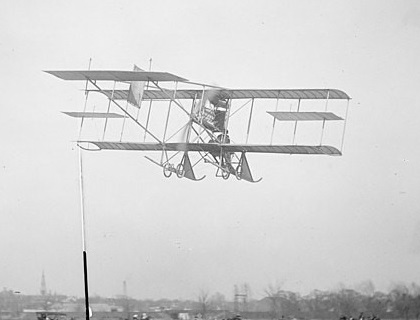
Two Rex Smith Biplane were built and used in the successful April 3, 1911 U.S. Army Signal Corps experiments in wireless communications. Potomac river pontoon experiments on April 5, were not as successful, with the aircraft plowing into the water headfirst nearly drowning the test pilot Jannus. Just two days later the machine was ready again. Janus took up actor Nat M. Wills, and later two female passengers at the same time. Marking the first time an aircraft flew with more than one passenger.
The Signal Corps did not buy any Smith Biplanes, they did however use them from time to time to train pilots to fly the Curtiss aircraft at the same field.
Operations continued until 1916 in building several other Curtiss-type biplanes.
 All Aero