Germany
Mainly sailplane manufacturer, but built Krahe single-seat powered sailplane in 1957, with 18 hp Zink-Brandl engine.
Manufacturer
Rockwell
Rockwell-Standard Corp
North American Rockwell Corp
Rockwell International Corp
In 1919, Colonel W.R. Rockwell reorganised a bankrupt axle company in Oshkosh, Wisconsin. Following the Colonel’s development of the first double reduction axles for heavy-duty vehicles, Timken-Detroit Axle company acquired his axle company in 1928.
In 1953, Timken-Detroit merged with Standard Steel Spring Company to form Rockwell Spring and Axle Company. In 1958, the name of the company was changed to Rockwell-Standard Corporation. Rockwell-Standard embarked on a plan of diversification in the late 1950s and 60s and by 1967, it was a major independent producer of a wide-range of automotive components.
In 1965 Rockwell-Standard acquired Snow Aeronautical, continuing to produce agricultural aircraft at Olney as Snow Commanders (as division of Aero Commander), and acquired Intermountain Manufacturing Company (IMCO) 1966. Single-engined Model 112 delivered to customers from 1972. Low-wing twin-engined Rockwell Commander 700 produced jointly with Fuji in Japan. Thrush Commander was very notable specially-designed agricultural aircraft. The entire Thrush Commander range sold to Ayres Corp and then became known by the Ayres name. Shrike Commander 500S terminated 1980 but Commander Jetprops continued by Gulfstream American Corporation.
In 1967, Rockwell-Standard Corporation and North American Aviation merged to create the North American Rockwell Corporation.
Following company reorganization, the former Aero Commander division of Rockwell became part of NAR, and its Shrike, Commander 685 and Turbo Hawk Commander twin-engined business aircraft were marketed under the new company name, together with Quail, Sparrow, Snipe and Thrush Commander agricultural aircraft, and the Darter and Lark Commander single-engined lightplanes.
The Model 112 Commander lightplane and B-1 swing-wing supersonic bomber projects were started before the company name was changed to Rockwell International in 1973.
In 1973 North American Rockwell and Rockwell Manufacturing Company merged to become Rockwell International Corporation. Aircraft production after the 1967 merger included the Aero Commander line of single and twin-engine aircraft, the turboprop OV-10 Bronco armed reconnaissance aircraft, T-2 Buckeye jet trainer, B-1B Lancer supersonic swing-wing bomber, and the Sabreliner executive and light jet transport. Company’s aerospace and defence units purchased by the Boeing Company on December 6,1996, becoming Boeing North American. Similarly, Rockwell Australia became Boeing Australia Ltd.
In 1977 Rockwell International sold its agricultural airplane operation to the Ayres Corporation of Albany, Georgia. The new owners will continue to manufacture the Models 600 and 800 Thrush Commanders. Fred Ayres, who developed the Turbo Thrush PT6 retrofit, plans to begin producing that airplane at his new plant.
1984: Sabreliner Corporation, a new company formed to acquire the former Sabreliner Division of Rockwell International.
Rocket Aircraft Corporation
USA
Formed in 1946 by take-over of Johnson Aircraft Inc. of Fort Worth, Texas. Johnson had designed the Rocket cabin monoplane in 1941, with molded plastic plywood construction and Lycoming engine. The Rocket 185 received its Approved Type Certificate in April 1946.
Roche Aviation
France
Company formed after Second World War, with M. Guerchais as chief engineer; connection with prewar Avions Guerchais not known. Guerchais Roche produced several two-seat light aircraft from about 1946, the Types 35 with Renault engine, the 39 with Mathis radial engine, and the 30 with Ford V-8 engine, as well as the type 107 single-seat glider.
Robinson Helicopters
After working for Bell, Kaman, Cessna and then Hughes, Frank Robinson formed Robinson Helicopters in 1971 to design and build a low-cost, piston engined, two-seat lightweight helicopter as the R22, which first flew in August 1975. Deliveries started 1979 and over 2,700 since sold in several versions, including improved R22 Alpha and Beta, Mariner with floats, IFR Trainer for instrument training, Law Enforcement and Agricultural versions. A four-seat development first flown March 1990 as the R44 Astro, with deliveries from 1993. Variants include IFR Trainer, Newscopter for media operations, and Police Helicopter.
1995: 24747 Crenshaw Blvd, Torrance, CA 90505, USA.
Robin Aviation / Centre Est Aeronautique / CEA / Avions Pierre Robin
The history of the Robin aircraft can be traced to the 1950s when Pierre Robin, then a young flying instructor, wanted to build an aircraft capable of carrying his wife and son. He found an unused Jodel D.10 glider wing lying in a hangar at a nearby airfield and built a fuselage, based on a scale-up version of the Jodel D.11, around this wing; resulting in the DR 10. After many refine¬ments, the final production version an aircraft powered by a Continental C-90 and able to carry three people rolled out as the DR100. This was the beginning of a successful aircraft business.
Centre Est Aeronautique formed at Dijon October 1957 by Pierre Robin and Jean Delemontez (ex-Jodel) , at Darois Vil¬lage, near Dijon, Burgundy, as a privately owned company, and began production with the DR 100 Ambassadeur, a three-seat version of the Jodel D.11, designed by Robin and first flown July 1958; built also by Societe Aeronautique Normande. The basic design was constantly refined through a number of variants.
Delivered 500th aircraft in June 1967.
Subsequent products also mainly two- to four-seat private-owner models. Name of company subsequently altered to Avions Pierre Robin (Centre Est Aeronautique); the latter part later dropped from marketing name.
Aircraft from Avions Robin include the Robin 200 two-seat lightplane and trainer (first flown 1971); DR 400 (first flown May 1972) that was offered in two-seat and 112 hp DR 400/100 Cadet form during 1980s later in 118 hp DR 400/120 Dauphin 2+2 two-plus-two seating form, 160 hp DR 400/140 B Dauphin 4 four-seat form, 160 hp DR 400/160 Major four-seat form with extra fuel capacity and increased wing area, 180 hp DR 400/180 Regent four-seat form, 180 hp 400/180 R Remo 180 four-seat form for glider towing and with reduced fuel, 200 hp DR 400/200 R Remo 200 four seat form for glider towing, and latest 200 hp DR 400/200i President four/five-seat form with larger fuselage to offer increased cabin space; Robin 2160 two-seat aerobatic lightplane (certificated 1978).
1983: Avions Pierre Robin SA, aerodrome de Dijon¬Val Suzon, 21121 Fontaine les Dijon, France.
Robin 3000 four-seat lightplane with T-tail (first flown 1988 in 3000/160 form). Robin 1180 Aiglon had first flown in 1976 as metal four-seater.
By 1998, Mudry had been bought out by the group which owns Robin Aircraft and as a result the Barouder became available through Bul Aéro.
Since its foundation it has continuously created light aircraft, producing over 3,500 in ten different aircraft ranges, and in 2001 the company was building about 60 aircraft a year, a third of which are for export.
Robey & Co. Ltd
UK
Engineering company in Lincoln, Lincolnshire, which built Sopwith Gunbus and Farman Longhorn biplanes and Short 184 seaplanes to Admiralty orders in First World War, and also designed and built its own single-seat scout and two prototypes of a “Fighting Machine” with two manned gun positions in upper wing.
Robertson
Created in 1921 by the late James L Robertson, who was one of the pioneers of the development of STOL Aircraft (short take off and landing), Robertson Aircraft specialises in flap and slat systems adaptable to numerous aircraft, both single and multi engine (Cessna, Piper Beechcraft and Learjet mainly). Robertson also earned a place in the history books by being the principal sponsor of Charles Lindberg’s transatlantic flight of the 20 May 1927, Lindberg himself later being the chief pilot for this company.
1983: Robertson Aircraft Corp, Snohomish County Airport C 72, Everett, Washington 98204, USA.
Roberts, Don
Don Roberts of Noblesville High School, Noblesville, Indiana.
Mr. Roberts built or rebuilt 10+ aircraft in the high school program he led, involving hundreds of boys in the process.
Mr. Don Roberts was a Navy man, serving on the aircraft carrier USS Essex as an aircraft maintenance technician.
He describes his ring-side seat at the Bay of Pigs invasion.
I was at Noblesville High School from 1972 to 1976 and worked on this plane. Mr. Roberts approached the school board several years before I became a high school student and convinced the board to allow him to put together an aviation program. The Dauntlas was the third plane the school built. Don was able to scratch together funds to allow us to build this plane and it was one of the greatest experiences I had. The program he put together was three years, the first was a ground school, the second you learned how to work on airplanes, (welding, riveting and general maintenance), and in the third year two students were selected to supervise the rest that worked on this plane. He took a group of us to Oshkosh two years in a row.
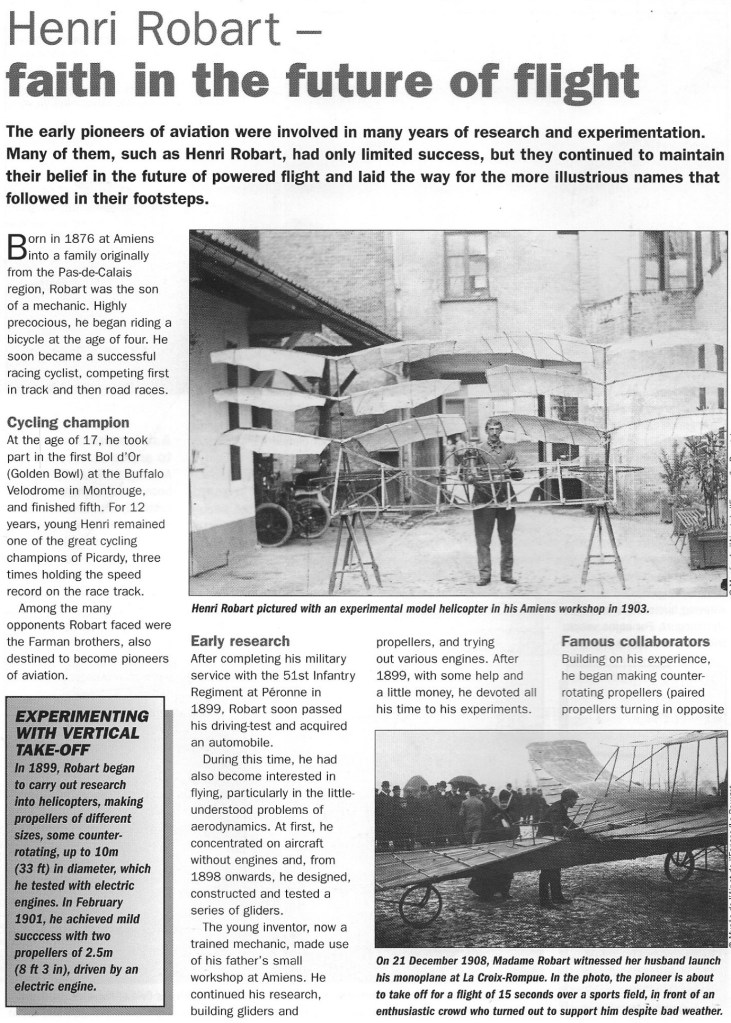
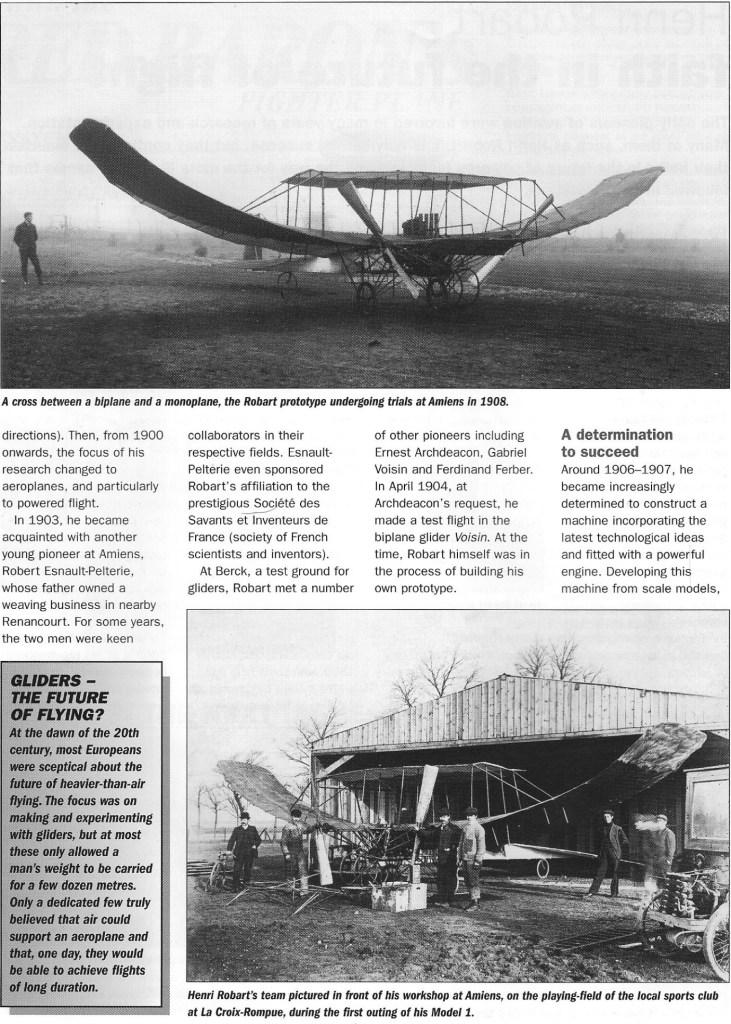
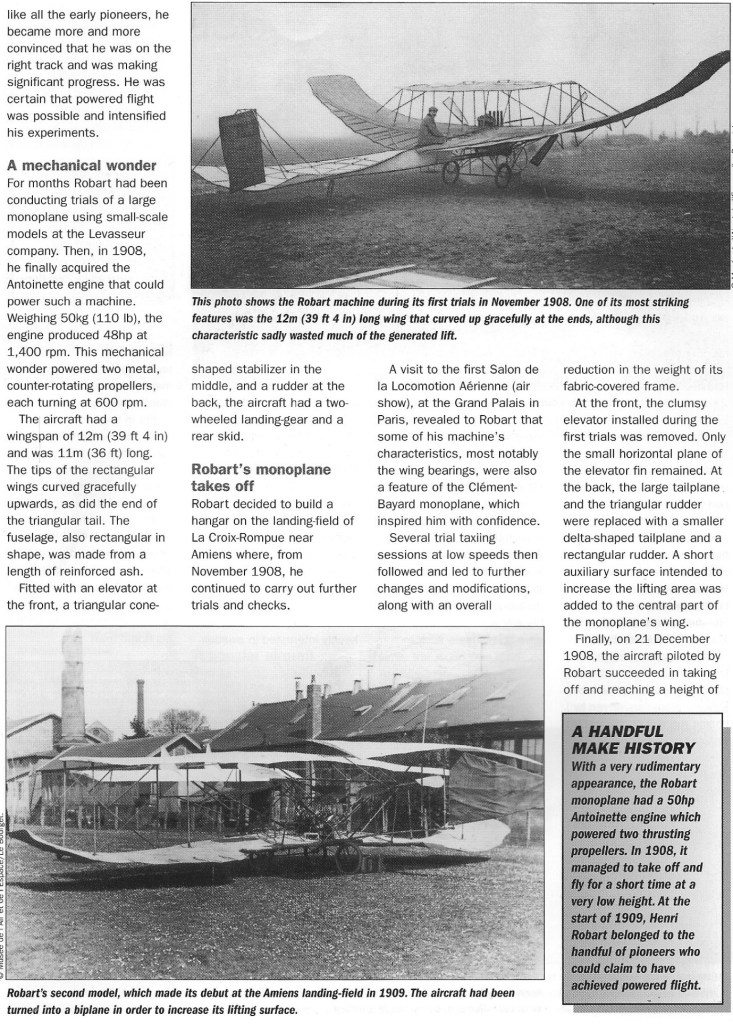
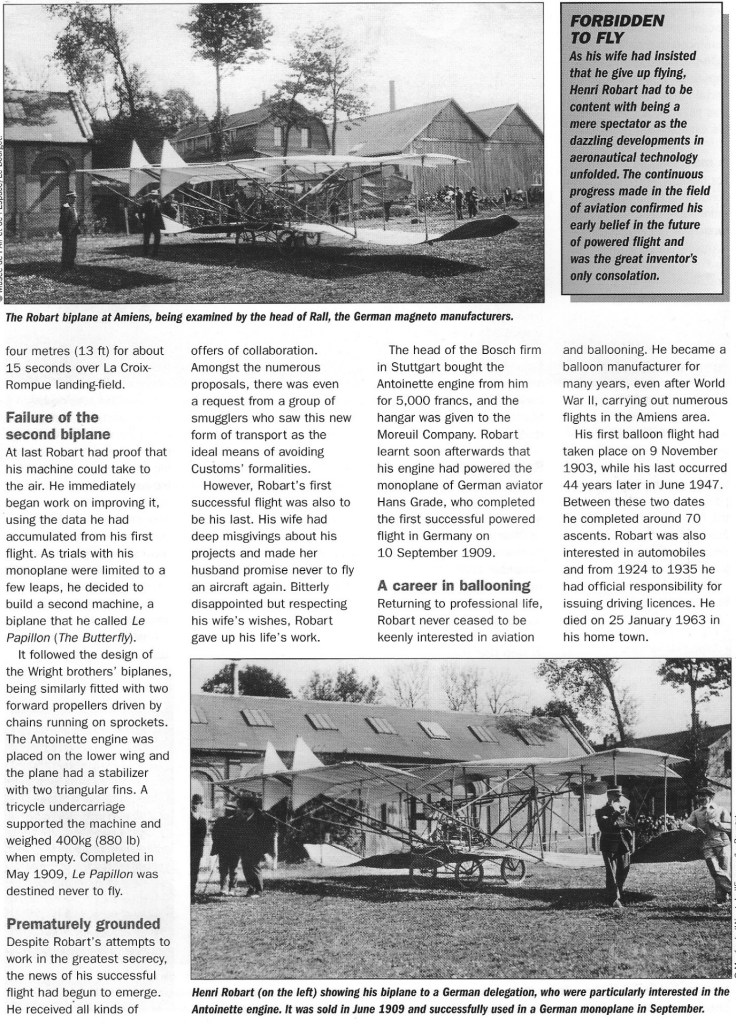
Robart, Henri
 All Aero