Hans Röver (1890-1917), the son of an organ builder, received his technical training from Hans Grade in Bork. There he also earned his flying licence (Nr.56 on February 3, 1911). Leaving with a Grade Monoplane he flew at a few competitions with the goal to earn enough money to build his own aircraft. This was realised in 1912 – the Röver Monoplane
In 1913 Hans Röver rented a shed at Johannisthal, built a second monoplane, and trained pilots until August 1, 1914. Afterwards he flew for the navy and did not return from a reconnaissance mission in 1917.
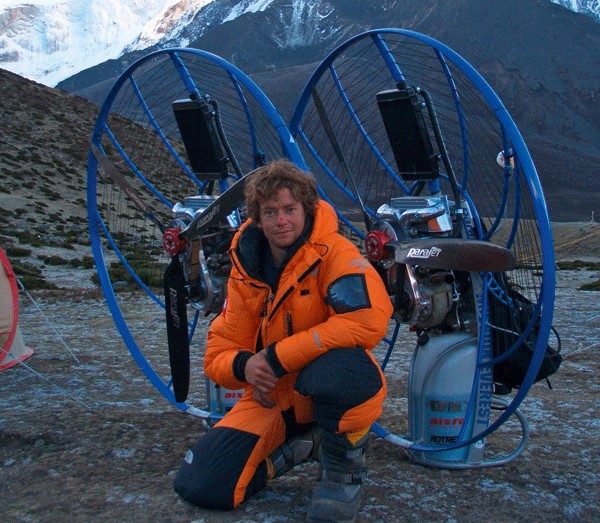
In early 2007 Rotron founder and chief technology officer, Gilo Cardozo, pursued a childhood dream: to fly a paramotor 30,000ft over the summit of Everest.
Having teamed up with friend and TV personality Bear Grylls, Cardozo had just seven months to build two paramotors. The most powerful paramotor engine available was barely producing 30hp and was far too heavy to launch at the desired altitude. So, he also set about building a four-stroke rotary engine that was more compact and 50 per cent lighter than a piston engine equivalent.
The basis of the Everest engine was a 294cc single rotor engine producing 40hp as a standard normally aspirated engine.
The engine included a miniature centrifugal supercharger fitted with a miniature intercooler to ensure the air was as cold and dense as possible when entering the combustion chamber. The supercharger was modified to be spun at up to 200,000rpm in order to simulate sea level atmospheric pressure of 1 bar at 30,000ft.
To eliminate the problem of icing, the supercharger was placed before the fuel delivery system. The heated and supercharged air was then sent through an intercooler before passing the injector at an average of 25 degrees Celsius.
After four months of design, development, testing and manufacturing, the engine was finally ready. With just two days before departure, the second engine was completed.
On 14 May 2007 the two pilots took off and in a flight that lasted four hours they achieved a paramotoring world record of 29,494 feet.
On completion of the expedition and building on its success, Cardozo continued to develop his rotary engine and looked for a commercial platform for the technology. Rotron Power was born.
B J Schramm’s association with flying began in 1958 when he founded Schramm Aircraft Company, and built and flew a Bensen Gyrocopter.
He studied at California Polytechnic State University and eventually was drafted into the military where he worked on missiles as an electronics technician at the White Sands Proving Ground. There he did design and drawings and began to formulate a plan for building a helicopter that the average pilot could afford. After his discharge in 1967, he immediately entered helicopter manufacturing and started his own company, Rotorway, with the goal of producing his own designs.
Schramm began building a horizontally opposed engine based on the VW design. Ultimately it was water cooled and used cylinders and crankshaft of his own design. After years of development it was a 180 lb engine that put out 150 hp. The engine had a 600 hour TBO, primarily due to valve wear.
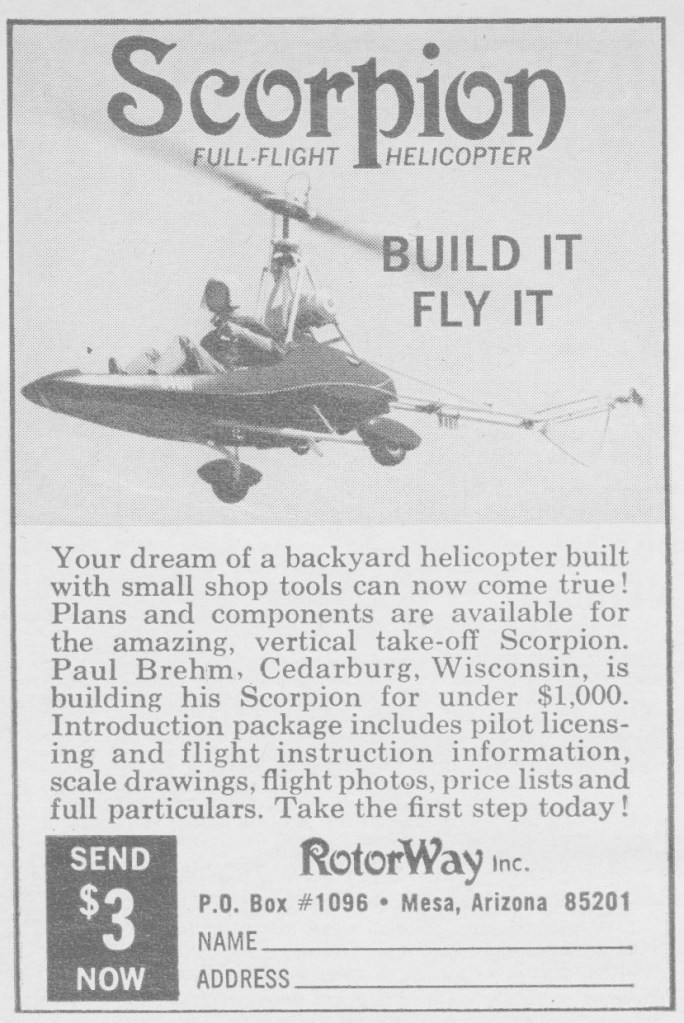
First established in 1961 in Chandler, Arizona, as RotorWay Aircraft, the company premiered its first kit helicopter model, the Scorpion, at the 1967 Oshkosh Fly-In.
November 1969
RotorWay Aircraft Inc founded 1970 to market in plans and kit forms the Scorpion single-seat helicopter, developed from the Schramm Javelin. Followed by the two-seat Scorpion Too, subsequently known as Scorpion 133 and using a RotorWay RW-145 piston engine.
1977-80: Rotorway Aircraft Inc. 14805 S. Interstate 10/Tempe, Arizona 85284, USA.
Exec two-seat helicopter appeared 1980 to supplement and eventually replace Scorpion 133, offered in its kit-built Exec 162F form (available since 1994) using a 150 hp RotorWay Rl 162F engine; over 500 Exec 90 and latest Exec 162F kits delivered since 1990, in which year company became RotorWay International.
The Executive model was soon born in 1980 and continued to be the company’s premier model until the assets of the company were sold in 1990.
In 1987 Schramm’s health began to fail and he went to the Mayo clinic for treatment. He made some poor business decisions and failed to put the right people in charge of operations during his absence. This resulted in the company declaring bankruptcy in 1990.
1998: 4141 West Chandler Blvd AZ 85226 Chandler USA
A group of British investors, led by John Netherwood, purchased the company. Then, he set about getting the newly christened RotorWay International on its feet with the help of many of the previous RotorWay Aircraft staff and their expertise. John Neatherwood, a British distributor, took over the business, paid off the creditors, and built a plant in Chandler, Arizona. Rotorway was selling approximately 60 units a year.
By late September of 1990, the company introduced a greatly improved helicopter, derived from the original Executive, and called it the Exec 90.
In 1994, RotorWay International moved to a new 37,000 sq. ft. facility, which would house the entire company versus the multiple locations they were previously distributed amongst. Along with the modern, streamlined factory, the company also introduced a new and improved helicopter, the model Exec 162F.
In 1996, when John Netherwood decided to sell the company, the employees negotiated an ESOP (Employee Stock Ownership Plan) arrangement to purchase RotorWay International. Rotorway remained employee owned until February of 2007 when the company was acquired by an ownership group led by Grant Norwitz, who first became acquainted with the company when he purchased one of its helicopters. He joined Rotorway in 2006 as CEO.
2009: RotorWay International 4140 W. Mercury Way Chandler, AZ 85226
RotorWay International was bought February 14, 2007 by a small group of investors comprising the company’s upper level management — Grant Norwitz, CEO, Bill Adams, COO, and Judy Craven, CFO. Of these, only Norwitz is still with the company as of mid-2008.
In February 2009, RotorWay purchased PMC Machining and Manufacturing, a Phoenix-based builder of helicopter parts. The CEO of PMC, Mark Porter, became president and COO of RotorWay as part of the acquisition. The company also announced plans to certify a two-seat turbine helicopter using the Rolls-Royce RR300 engine and said that acquiring PMC will make that possible.
Although it is the third largest helicopter manufacturer in the United States, RotorWay has established a factory in South Africa that manufactures ready-made helicopters in addition to kits. RotorWay has also begun the process of expanding into the certified helicopter market.
Awards and recognition 2005 Exec 162F is named Oshkosh AirVenture grand champion. 2004 Exec 162F is named Oshkosh AirVenture gold lindy grand champion, silver lindy reserve grand champion, and a model wins for outstanding workmanship. 2003 Exec 162F wins Oshkosh AirVenture grand champion and reserve grand champion. 2002 Exec 162F wins Oshkosh AirVenture reserve grand champion and for outstanding workmanship. 2001 Exec 162F wins Oshkosh AirVenture reserve grand champion, champion, and outstanding workmanship. 2000 HAI Aviation Repair Specialist Award for work done on the FADEC system. 1999 Finalist for the Flight International’s Aerospace Industry Awards, in the category of Corporate and General Aviation. RotorWay Exc 162 was featured on Discovery Channel show “A Chopper is Born”.
German investment group Lift Holding will combine the technical expertise of Flight Design with its other recently acquired aviation asset, gyrocopter producer Rotorvox. Both companies will be headquartered at the Kindel Airport near Eisenach.
Formed jointly by Mitchell Engineering Group and Servotec Ltd to develop the Grasshopper twin-engined light helicopter designed by Jacob Shapiro. Powered by two Walter Minor engines, this was first flown in 1962. A second example was built, but the type did not enter production.
James Weir became aware of the CR Twin development and in 1965 decided to give this development financial support. This combination of interests was cemented in a take over of Rotorcraft Ltd by the Cierva Autogiro Co, which was thereupon renamed the Cierva Rotorcraft Co.
USA Company engaged in helicopter development immediately after Second World War. Built two-seat helicopter for U.S. Army under designation XR-11. Little more heard until the mid-1950s, when the RH-1 Pinwheel ‘strap-on’ personal helicopter appeared in 1954.
 All Aero