Founded by Elbert (Burt) L Rutan in 1969, Rutan Aircraft Factory first flew the VariViggen two/four-seat canard monoplane for construction by amateur builders from plans in 1972. Other aircraft followed, including VariEze two-seater (first flown 1974), Defiant four-seater (first flown 1978), Grizzly joined-wing/canard STOL transport (first flown 1982), and Voyager.
Rutan opted for a basic canard configuration, and has succeeded in developing several canard lightplanes with first-class flight characteristics.
1984: Rutan Aircraft Factory, Building 13, Mojave Airport, Mojave, CA 93501, USA.
Russia The large Russian engineering company, Russo-Baltic Waggon Works, based at St Petersburg, was only partly concerned with aircraft production. It was responsible for the construction of the ll’ya Muromets series of four-engined bombers, designed by Igor Sikorsky, which equipped Russia’s Eskadra Vozdushnykh Korablei (Squadron of Flying Ships) in First World War. Largest of the series was the Type IMYe2, with a wingspan of 34.50m and a gross weight of 7,000kg. The Sikorsky S-16 reconnaissance biplane was also built.
In 1906 the Chief Engineer’s Office Russian Empire was specially seconded to France, with a delegation of engineers and professionals for the development of on-site experience of the most advanced airship.
In 1923, the Society for the Friends of the Air Fleet of the USSR was created special Vozduhtsentr with tasks which included the promotion of Russian airship in Russia. After a while Vozduhtsentr was renamed vozduhsektsiyu Osoaviahima USSR and in the autumn of 1924 completed the construction of another Myagenko airship under the title “Moscow chemist rezinschik” (MHR). This title pointed to the fact that it was made by means of chemical industry workers in and around Moscow. The designer of this project was N. Fomin.
At the end of 1931 at CAB CAF was created under the title “Dirizhablestroy.” This organization was to unite the efforts of various groups of professionals working in the field, as do the planned deployment of the work in designing and building the next Russian airships. Also, the organization should take the time to research on the topic of aeronautic and improve methods of exploitation airships.
Nobile worked in the USSR from 1931 until 1935. He is believed to have been responsible for the design of nine semi-rigid airships.
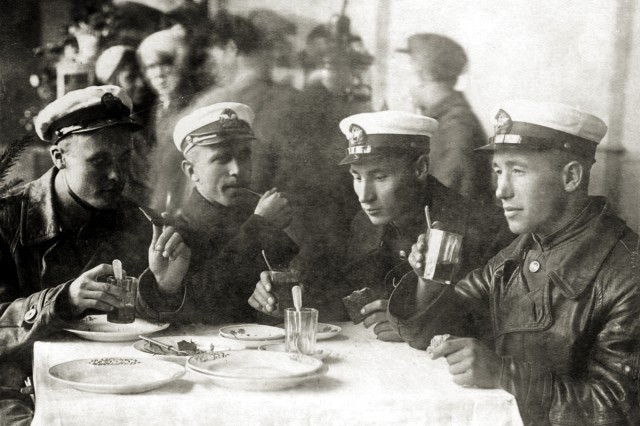
Russian airship crewmen (left to right) – Nikolai Gudovantsev, Ivan Obodzinsky, Ivan Pan’kov and Vladimir Ustinovich. 1933
The rationale for the Soviet program was to provide transport to distant rugged regions, notably Siberia, as well as such utility functions as surveying.
There were works at Leningrad, and Zagi near Moscow, the latter also the center of Tsiolkovski’s metalclad efforts. The plan was to make 92 ships but it is unknown how many were actually made.
There were also some non-rigids built in 1937 at Zagi.
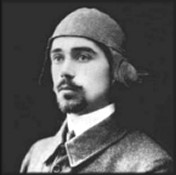
Edvard Rusjan was born in Trieste, Austro-Hungarian Empire, on July 6, 1886. While still a lad, his family moved to Gorizia where he spent his youth and attended public secondary school and an evening course in trade. During his school years, he was apprenticed barrel maker and was a successful racer.
In 1900, the Rusjan brothers made a model aircraft with a propeller drive on a spring. Edvard’s aviation career began in 1908 when he started designing and building model airplanes. One design, a helicopter that was strapped on like a backpack, was a portent of things to come decades later. With older brother Josiph’s help, he designed a glider that became a pattern for future airplanes.
They continued their self-education and in 1908, received his father’s support for the production of the first aircraft. In September 1909, Edvard Rusjan visited an international air meeting in Brescia (Italy), where he examined the construction of the most successful aircraft and got to know the French airman, Louis Blériot.
In the fall of 1909, the Rusjan brothers began work on a powered airplane using a 3-cylinder, 25-horse-power. Anzani-model engine. The airplane was a canard-type biplane with paper covered wings with the larger part of the horizontal stabilizer forward of the wings. Flight tests, however, fell short of expectations. By relocating the vertical stabilizer aft of the wings in what has evolved as the conventional configuration, they achieve success. On November 25, 1909, on the Mila Rojice Airfield in the neighborhood of Gorizia, Edvard made the first successful powered flight in Yugoslav Aviation history in his EDA 1 airplane.
From December 1909 to the end of June 1910, the Rusjan brothers built and flight tested five airplanes of entirely different designs.
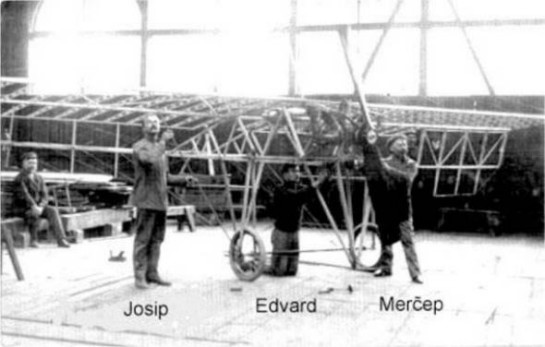
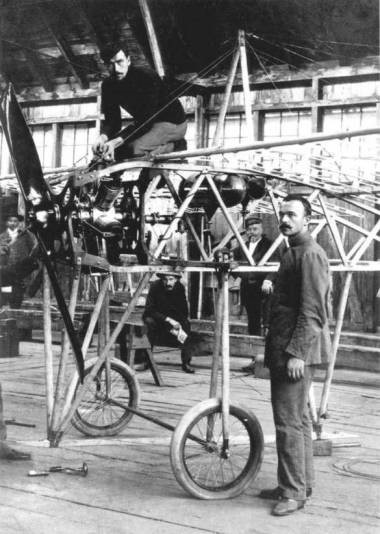
Zagreb, Eduardo and Giuseppe working
Since Rusjan could not realise the planned development of aircraft to commercial production in Slovene circumstances, in the middle of 1910 he concluded a partnership with the Serb, Mihailo Mercep, a well-known Zagreb photographer and cyclist, who planned the production of aircraft for the market. After the agreement with Merćep, they had no more financial problems and a large hangar is available for their planes. So the Mercep-Rusjan monoplane (a supplemented variant of EDA VI) was created in the first aircraft factory in Croatia.
After their successful flight demonstration with the Mercep-Rusjan, and in accord with the custom of the time, Edvard and Mercep organized a tour of European cities, the first stop being Belgrade. On January 9, 1911, despite strong gusty winds, the 24-year-old Edvard went ahead with a demonstration flight. His takeoff and flight over the town and a railway bridge over the Sava River were uneventful. However, while the airplane was returning for a landing, at an approximate height of 20 meters, a strong gust ripped off a wing and the airplane crashed against a tower wall located on the riverbank. Edvard was killed.
His work was successfully continued by his brother Joze, who built a further 3 aircraft after Edvard’s death.
Germany Established 1987, developed the R90 four-seat touring and IFR training monoplane of composites construction, first flown in 1991 and certificated 1992. Original R90- 230 RG version with 230 hp engine and retractable undercarriage is to be joined by the R90-180 RG with a 180 hp engine and retractable undercarriage, the R90-230 FG with 230 hp engine and fixed undercarriage, and R90- 300 T-RG with a supercharged 300 hp engine and retractable undercarriage. The R90-420 AT is a turboprop proof-of-concept model, first flown 1993 and used at present only as a factory aircraft.
Germany Founded before First World War as E. Rumpler Luftfahrzeugbau, with the company’s works and flying school based at Berlin/Johannisthal airfield, and with a military flying school at Monchelberg. Began production with license construction of Etrich Taube monoplane, but subsequently became famous for a series of armed biplane reconnaissance aircraft in First World War, including the C.I, CIV and C.VII. Went into liquidation about 1919 owing to lack of work.
UK Italian Felix Ruffy and Swiss Edouard Baumann founded flying school at Hendon in 1915 and subsequently built several training aircraft of their own design. Company became part of the Alliance Aeroplane Company Ltd when the latter expanded in 1918.
Shortly before the outbreak of the Great War, student Jerzy Rudlicki (who later become known aircraft designer), after building several successful gliders 1912-1913 designed an aircraft named R-I.
 All Aero