Sack, Arthur

Arthur Sack was a farmer who enjoyed constructing aero-models.
In June 1939 in Leipzig-Mockau he attended the First National Contest of Aero-models with Combustion Engines, where he hand-launched his first aero model with a circular wing, the AS-1. It possessed rather poor flying qualities. Arthur Sack’s aeromodel measured 125 cm and weighed just 4.5 kg, powered by a Kratmo-30 motor of 0.65 V and 4,500 RPM with a propeller measuring 600 mm in diameter. His circular aircraft was unable to lift off the ground by itself, and finally Sack had to throw it into the air in desperation. After this assisted takeoff, the model managed to perform 100 meters of stable flight, just barely reaching the finish line.

However, the odd-shaped model instantly caught the attention of Air Minister General Udet who was fascinated by the circular shape and gave Sack permission to proceed with his research with official backing. Sack immediately began construction of A.S. aero models of increasing size up to the A.S.5 which was by far the largest flying model. With a wingspan of 125 cm, length of 159 cm, and height of 65.3 cm the two-bladed propeller model took to the air and proved the soundness of the basic design.

From this point on Sack was determined to build a manned machine that would become the Arthur Sack A.S.6V-1.

Sablatnig

Sablatnig Flugzeugbau GmbH

Austrian Josef Sablatnig experimented and flew before First World War. Moved to Germany and in 1913 became a director of Union Flugzeugwerke GmbH, where he did technical work and flying. When Union company went into liquidation (1915) he founded Sablatnig Flugzeugbau GmbH in Berlin, famous for seaplanes used by German Navy but built other types also. SF1 floatplane (1915) developed into very successful SF2 (license-built by LFG and LVG); SF4 was single-seat fighter floatplane, built both as biplane and triplane; SF5 was widely used SF2 replacement; SF8 was last Sablatnig floatplane built in numbers (trainer of 1918). Landplanes included trainers, single engined night bombers, and a monoplane. N1 was two-seat land fighter used at Kiel. After war developed civil types, including P1 four-passenger biplane and P3 six passenger high-wing monoplane. One light sports type built, but aircraft work ceased 1921.

SABCA / Societe Anonyme Belge de Constructions Aeronautiques

Belgium
Formed December 1920, SABCA had a close SABENA association and that airline used SABCA’s only S.2 single-engined monoplane transport. Built Handley Page 3-engined airliners for SABENA Belgian Congo service; also other private-owner prototypes.

At the end of 1920 the Société Anonyme Belge de Constructions Aéronautiques (SABCA) was created to ensure the construction, testing and overhaul of aeronautical equipment for the development of civil aviation and air transport (SABENA will be founded three years later). It will begin with the overhaul and overhaul of Belgian Military Aeronautics aircraft, before starting, in 1922, to build foreign aircraft under license.
The first designs and new realizations will be due to members of the staff of SABCA, encouraged and supported by the company. Among others, the moto-aviette Jullien SJ-1 (in 1923), of Henri JULLIEN, engineer director of the design office of the SABCA, and the “Limousine” Demonty-Poncelet of Mathieu DEMONTY (technical director) and Paul PONCELET (head of the wood section) (in 1924).

On his own, but with the support of SABCA, Paul PONCELET designed and built the “Castar” in 1922-1923, then in 1923 the “Vivette”.

SABCA’s first project was a small aeroplane called the Sabca J1, which was powered by the engine of a FN motorcycle. The company also constructed “Sabca” 1500 with a 200 HP engine and some gliders. It later assembled the Handley-Page, Fokker F VII, and the Savoia-Marchetti used by Sabena. Held Breguet and Avia licences, and from 1927 directed attention to metal construction. Outcome was S-XI 20- passenger monoplane with three 500 hp engines, as well as similar S-XII 4-passenger monoplane with three 120 hp engines. Built under license Renard R.31 reconnaissance monoplane and Savoia-Marchetti S.73 transport.

In October 1937, the Belgian aircraft manufacturer Société Anonyme Belge de Constructions Aéronautiques (SABCA) made a marketing agreement with the Italian company Caproni, with SABCA selling some of Caproni’s military aircraft in certain markets, including the Caproni Ca.135, Ca.310 and the Ca.312, which were to be designated SABCA S.45bis, S.46 and S.48 respectively. As part of this agreement, Caproni were to develop a replacement for the Belgium Air Force’s Fairey Fox biplanes, which were used as two-seat fighters and reconnaissance aircraft, but were obsolete.

Built S.47 2-seat low-wing monoplane fighter of 1937 in collaboration with Caproni. Company revived in 1950s. In 1960s assembled, maintained, and repaired Republic F-84; also collaborated with Avions Fairey on Hawker Hunter and made Vautour components for Sud- Aviation. Much work of various kinds on Lockheed Starfighter, Dassault Mirage, and Breguet Atlantic; also missile and space activities. Dassault Aviation took 53 percent shareholding, while in 1998 Fokker’s shareholding was then reportedly being sold. Recent work has included weapon system integration, development of the cockpit front panel, final assembly, and flight testing of Belgian ArmyA-109 helicopters; update of F-5s; production and upgrading of F-16s; upgrade of Mirage 5s and F1s; production of servo actuators; and construction of subassemblies for Dassault, Boeing, Airbus, and Fokker aircraft.

SAAB

Svenska Aero
AB Svenska Järnvägsverkstäderna (ASJA)
Svenska Aeroplan Aktiebogalet (SAAB)

Svenska Aero, as a subsidiary of Heinkel, was taken over by AB Svenska Järnvägsverkstäderna (ASJA) in 1932.

The Bofors Company at Trollhattan formed in 1937 Svenska Aeroplan Aktiebogalet (SAAB). Following its merger in 1939 with the AB Svenska Jarnvagsverkstadernas Aeroplanavdelning (AJSA). In 1939 amalgamated with Aircraft Division of Svenska Jarnvagsverkstaderna and moved main establishment to Linkoping. From 1950 acquired other important facilities, including underground factory at Linkoping.

Built 82 Tiger Moth, 43 Hawker Hart, 11 NA-16-4M, FW-44, and Northrop 8A-5 under licence.

In 1945, in the hope of a lasting peace, the Company decided to scale down its production of military aircraft and to develop its civilian operations – a change in policy signified by the ap¬pearance of the Saab 90 Scandia airliner and the Saab 92 car.

Name changed to Saab Aktiebolag May 1965; Malmo Flygindustri became a subsidiary in 1967; in 1968 merged with Scania-Vabis group to became Saab-Scania. Current name Saab Group, comprising five main divisions: Saab AB, Saab Dynamics AB for guided weapons and electronics, Saab Training Systems AB, Saab Aircraft AB for marketing and supporting commercial aircraft, and Saab Combitech AB. Saab AB parent division established January 1997 to combine activities of previous Saab Military Aircraft, Saab Aircraft and Saab Service Partner, and develops and manufactures military and commercial aircraft within business units known as Gripen, General Military Aircraft, Future Products and Technology, Operations Commercial Aircraft, and Collaborative Programs.

First airplanes were license-built Junkers Ju 86K twin-engined bombers, Northrop-Douglas dive-bombers (Douglas 8A-1, similar to the US Army Air Corps’ A-17) and North American NA-16 trainers. First own-design production aircraft was Saab 17 dive-bomber of 1940, used widely and 60 delivered to Ethiopia from 1947. Saab 18 was twin-engined bomber of 1942, some late examples of which had ejection seats. Saab 21A of 1943 was piston-engined single-seat fighter, and 21-R was jet development of the same aircraft. Saab 29 was the so-called “flying barrel” swept-wing jet fighter, in production until 1956, while Saab 32 Lansen of 1952 was swept-wing fighter/attack/reconnaissance two-seater. Saab 35 Draken “double-delta” fighter appeared in 1955, and a squadron remained active as interceptors until 1999. Saab 105 of 1963, a twin-jet light side-by-side two-seater armed multipurpose aircraft, still in use as a trainer in 1999; Swedish Air Force aircraft have just undergone an upgrade with new engines and thus redesignated Sk 60W. Saab 37 Viggen multirole combat aircraft, first flown February 1967, has foreplane and delta wings, and with its STOL capability remains a very potent weapon system. Produced for service between 1971 and 1990, it has been continuously upgraded; redelivered in latest upgraded form 1998 for continued service in JA 37 interceptor and AJS 37 attack/interceptor/maritime-reconnaissance variants. Latest combat aircraft is Saab AB Gripen JAS 39 Gripen, first flown December 1988 and taken into Swedish Air Force service from 1996. Grippen is the world’s first combat aircraft of the new-generation type and the first to combine the roles of interceptor, attack, and reconnaissance in a single aircraft (all as primary roles) by the adoption of push-button control to select the required function in the computer programs of the totally integrated avionics suite.

Civil types have included Saab 90 Scandia twin-engined 32-passenger transport (first flown November 1946); Saab 91 Safir all-metal 3/4-seater (first flown November 1945); two/three-seat high-wing Safari (first flown in July 1969) and its military Supporter development (first flown 1972). In production until 1999 has been the Saab 340 turboprop regional transport (first flown January 1983, and finally produced in 340B and BPIus variants with accommodation for up to 37 passengers) and the Saab 2000 50/58-seat turboprop regional airliner (first flown March 1992). Saab has also developed an airborne early warning and control variant of the 340B airliner as the S100B Argus (first flight of AEW&C prototype with overfuselage radar July 1994), plus a search-and-rescue variant for the Japanese Maritime Safety Agency as the SAR-200 (delivered 1997).
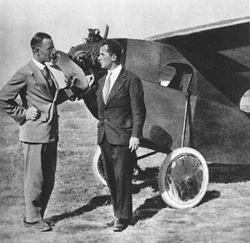
Ryan / Mahoney-Ryan Aircraft Corporation

Mahoney-Ryan Aircraft Corporation
Ryan Aeronautical Corporation

Founded 1928 at St Louis, Missouri, as Mahoney-Ryan Aircraft Corporation, deriving from Ryan Airlines, which began operations on U.S. West Coast in 1922.

Ryan was in partnership with B.F. Mahoney. Conflict between the two led Ryan to sell out of the company that bore his name, only to see it become world famous less than a year later as the builder of Lindbergh’s Spirit of St. Louis, a larger descendant of the M 1.

In 1926 began manufacture of Ryan M-1 mailplane from which Charles Lindbergh’s transatlantic Ryan NYP Spirit of St Louis was developed in 1927. Commercial version of the latter, Ryan Brougham, was built in quantity.

Ryan merged with Detroit Aircraft Corporation in 1929, but DAC did not survive the slump in 1930-1931.

T. Claude Ryan formed Ryan Aeronautical Company in 1933-1934 and produced the S-T training monoplane, forerunner of a series of successful Ryan trainers. The S T became the Army’s basic trainer; his school won contracts to train thousands of Army pilots, and his subsidiary bases multiplied. During the war, his business grew from $1 million to $55 million.

The YO-51 Dragonfly of 1940 was observation monoplane built for the USAAC. A new fighter for the U.S. Navy in 1943 reflected a “belt and braces” outlook on the new gas turbine engine, having a mixed powerplant comprising a conventional piston engine and rear-fuselage jet. Known as the FR-1 Fireball, it was too late to see operational service in Second World War.

The end of the war came as a blow to Ryan, as it did to all airframe manu¬facturers whose lucrative contracts were abruptly cancelled. For a while, the company went into the lugubrious business of building metal coffins; then it took over the Navion from North American in 1947 and built the plane until the Korean War.

Ryan developed to a mid-1950s USAF contract the X-13 Vertijet, a delta-wing vertical-take-off jet with Rolls-Royce Avon engine. A flex-wing research aircraft was built in 1961, and the XV-5A lift-fan research aircraft followed in 1964. Development of the “fan-in-wing” VTOL principle continued with two prototype aircraft, later restyled XV-5B.

RWD

RWD was a Polish aircraft construction bureau active between 1928 and 1939. It started as a team of three young designers, Stanisław Rogalski, Stanisław Wigura and Jerzy Drzewiecki, whose names formed the RWD acronym.

Jerzy Drzewiecki and Jerzy Wedrychowski by the RWD-7

They started work while studying at Warsaw University of Technology. In December 1925, with some other student constructors, they set up workshops at the Aviation Section of Mechanics Students’ Club (Sekcja Lotnicza Koła Mechaników Studentów), where they manufactured their first designs. From 1926 they designed several aircraft alone (Drzewiecki JD-2 and WR-1), in 1928 they joined forces as one team, starting with RWD-1 sportsplane. Apart from building planes, J. Drzewiecki was a test pilot of their designs, while S. Wigura flew as a mechanic in competitions. In 1930 the team was moved to new workshops at Okęcie district in Warsaw, near the Okęcie aerodrome, today’s Warsaw International Airport, founded by the LOPP paramilitary organization. On 11 September 1932, Stanisław Wigura died in an air crash in the RWD-6 during a storm, but the RWD name continued to be used for new designs (according to a popular story, the letter W now de facto stood for engineer Jerzy Wędrychowski, but he was not a designer). In 1933, Rogalski, Drzewiecki and Wędrychowski founded the company Doświadczalne Warsztaty Lotnicze (DWL, Experimental Aeronautical Works) in Warsaw, which became a manufacturer of further RWD aircraft. Apart from Rogalski and Drzewiecki, in a construction bureau worked designers Tadeusz Chyliński, Bronisław Żurakowski, Leszek Dulęba and Andrzej Anczutin and several engineers, including Henryk Millicer.

At first, the RWD team designed and built light sportsplanes. Early designs RWD-2 and RWD-4 were built in small series and used in Polish sports aviation, including their debut at the Challenge 1930 international contest. Their next designs performed particularly well in competitions – the RWD-6 won the Challenge 1932 and RWD-9s won the Challenge 1934 international contest. The sportsplane RWD-5 was the lightest plane to fly across the Atlantic in 1933. Three types saw mass production: the RWD-8, which became the Polish Air Force basic trainer, the RWD-13 touring plane and the RWD-14 Czapla reconnaissance plane (1938).

Other important designs were the RWD-10 aerobatic plane (1933), RWD-17 aerobatic-trainer plane (1937) and RWD-21 light sport plane (1939). World War II prevented further development and serial production of later RWD designs, and put an end to the RWD construction bureau and the DWL workshops.