1983: Mahe, Flugplatz Schachtlder, D 2370 Rend¬sburg, West Germany.
Built the Pfadfinder UL
1983: Mahe, Flugplatz Schachtlder, D 2370 Rend¬sburg, West Germany.
Built the Pfadfinder UL
An all metal, low wing, fixed taildragger. The S-21 was designed to be easy to build and fly with good economy. Construction is all metal using pop riveting. Prototype designated S-20, plans built versions the S-21.
Gross Wt. 720 lb
Empty Wt. 456 lb
Wingspan 25’
Length 18’6”
Engine 1500cc Volkswagen.
Vmax 110 mph
Cruise 90 mph
Climb rate 850 fpm
Range 250 miles
The S-20 utilizes all-metal construction but keeps it simple by the extensive use of pop rivets. It features open-cockpit seating for one, low wings and conventional tail-wheel landing gear. The fuselage is of steel-tube truss construction with a light alloy skin. The constant-chord wings are also covered with the same light alloy skin.
First flight was made on March 9, 1972 by N106AB. S-21 was the designation for plan-built aircraft by home-builders.
Engine Volkswagen 1500cc, 53-hp
Wingspan 25 ft 0 in
Length 18 ft 6 in
Gross Wt. 720 lb
Empty Wt. 456 lb
Fuel capacity 10 USG
Top speed 162 mph
Cruise 90 mph.
Stall 38 mph.
Climb rate 850 fpm
Takeoff run 300 ft
Landing roll 300 ft
Range 250 miles
Seats: 1
1980: MacDonald Aircraft Co, 1282 Fowler Creek Rd, Sonoma, CA 95476, USA.
LSA builder
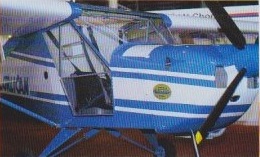
The Orlikan has a welded spaceframe fuselage with Dacron covered wooden wings.
Engine: Walter M-202, 65 hp
Wing span: 10.42 m
Wing area: 13.55 sq.m
MAUW: 450 kg
Empty weight: 250 kg
Max speed: 160 kph
Cruise speed: 135 kph
Minimum speed: 55 kph
Climb rate: 3.5 m/s
Seats: 2
Fuel consumption: 13.25 lt/hr
Price (1998): 50 000 DM
1998:
CZ-56537 Chocen
Czeah Republic
M7 was a subcontractor to the Schemp-Hirth glider company.
LSA builder
single-seat military versions UL
ultralight

Single engined high wing mono¬plane with conventional three axis control. Wing has swept back leading and trailing edges and tapering chord; no tail, canard wing. Pitch control by fully flying canard; yaw control by under wing rudders at half span; roll control by differential canard. Wing braced from below by struts; wing profile; 100% double surface. Undercarriage has three wheels in tricycle formation; no suspension on any wheels. Push right go right nosewheel steering. No brakes. Fuselage, totally enclosed. Engine mounted below wing driving pusher propeller.
The Vitality was first announced in mid 1982, using differential canard for roll control and under¬wing rudders at half span for yaw control. In August 1982 Flightlline magazine was told that three Vitalitys had been built and 36 ordered, that production would be concentrated on the two seat version, and that an all new three cylinder 1000 cc radial four stroke was being developed for the aircraft.
A few weeks later came the announcement that Luscombe Aircraft was to move into a new factory in November and that the company hoped to have an aircraft produced by the end of February 1983. These aircraft never materialised, however, as the company announced later in 1982 that it had shelved the design, at least until the UK microlight airworthiness regulations were finalised.
Although that happened in March 1983, the design rights of Vitality were for sale, along with three prototypes one two seater and two single seaters. The design was first conceived some 11 years before and dusted off in response to the microlight boom.
Engine: Robin EC44, 60 hp.
Power per unit area 0.47 hp/sq.ft, 5.0hp/sq.m.
Empty weight 236 lb, 107 kg.
Length overall 11.7 ft, 3.56 m.
Height overall 4.8ft, 1.47m.
Wing span 34.0ft, 10.36m.
Mean main wing chord 3.8 ft, 1.15 m.
Canard span 14.0ft, 4.27m.
Mean canard chord 0.95ft, 0.29m.
Total wing area 141 sq.ft, 13.1 sq.m.
Main wing area 128sq.ft, 11.9sq.m.
Canard area 13 sq.ft, 1.2 sq.m.
Wing aspect ratio 9.0/1.
1983: Luscombe Aircraft Ltd, Terminal Building, Ashford Airport, Lympne, Kent CT21 4LR, Great Britain.
Produced designs for light recreational aircraft with rear mounted wings and engines, starting with Vitality of 1971, from which Valiant ultralight and Rattler single-seat military versions developed. Other types included Viper and Ranger, Super Ranger and Twin Ranger, latter three types later further developed by United Aerospace Technologies.
 All Aero