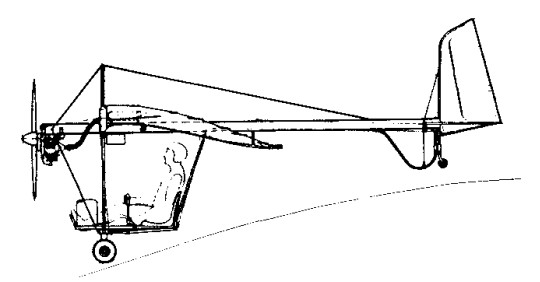
Mason Christavia

Christavia Mk.1

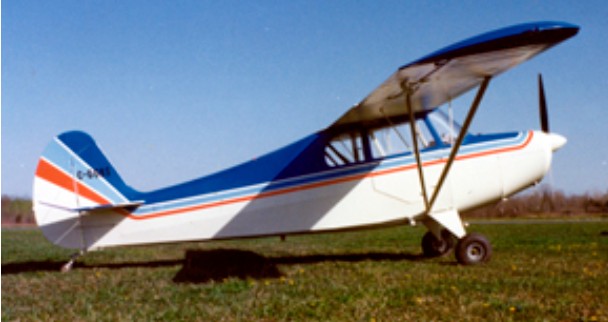
Christavia was designed by Ron Mason around the classic lightplane lines of yesteryear, but with updated performance. It was specifically designed with missionary flying in mind. Mason describes it as a con-ventional, high-wing, strut-braced monoplane easily converted from wheels to floats or skis. All materials are standard off-the-shelf or easily obtainable. Industrial mild steel tubing in the fuselage keeps costs at a minimum; all parts can be made in a small workshop with just hand tools and a welder. No machining is required.

The Christavia was designed in 1982 as a mission field workhorse. Design requirements were short take-off and landing, small engine (low fuel consumption), low stall speed, good cruise speed and rate of climb, large cabin area, low maintenance and high safety factor. The Christavia is easy to fly, and the Iarge cabin makes long flights very comfortable.

Christavia Mk.2

Over 1000 sets of the plans have been sold for the MK1 (two place tandem), MK2 (two place side-by-side), and Christavia MK4 (four place).

For the MK-2 side by side seating version of the MK-1, increase all crossmembers in the fuselage by 35% for approximate materials requirements. No separate materials list is available for the MK-2.

Christavia Mk.4

Aircraft Spruce & Specialty Co. has acquired the design rights to the popular Christavia MK1, Christavia MK2, and Christavia MK4 homebuilt aircraft from the designer, Ron Mason of Elmwood Aviation in Canada.

Mk.1
Engine: Continental, 65 hp
HP range: 65-100
Height: 7 ft
Length: 21 ft
Wing span: 32.5 ft
Wing area: 146.2 sq.ft
Weight empty: 720 lbs
Gross: 1500 lbs
Fuel cap: 19 Imp.G
Speed max: 118 mph
Cruise: 105 mph
Range: 315 sm
Stall: 40 mph
ROC: 900 fpm
Take-off dist: 300 ft
Landing dist: 600 ft
Service ceiling: 14,000 ft
Seats: 2 tandem
Landing gear: tail wheel.

Mk.2
Seats: 2 Side by Side

Mk.4
Engine: Lycoming, 150 hp
Height: 7 ft
Length: 22 ft
Wing span: 35.5 ft
Wing area: 177.5 sq.ft
Weight empty: 1100 lbs
Gross: 2150 lbs
Fuel cap: 37 Imp.G
Speed max: 128 mph
Cruise: 118 mph
Range: 400 sm
Stall: 40 mph
ROC: 800 fpm
Take-off dist: 450 ft
Landing dist: 800 ft
Service ceiling: 19,000 ft
Seats: 4
Landing gear: tail wheel.

Marsden Skylark

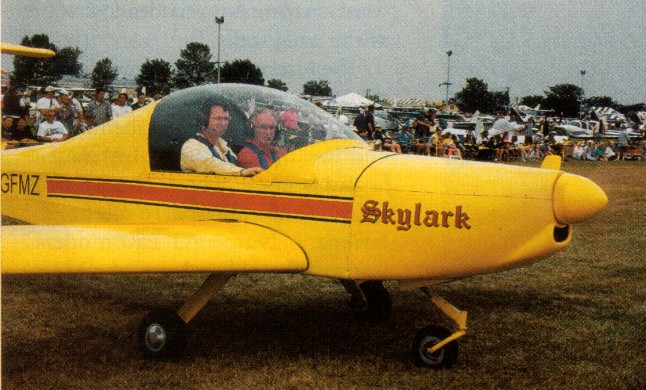
Design of the all metal, T tail, side by side two place Skylark began in January 1999, with the first flight on 10 March 2000. After the first flight, all that was required was a change to the incidence on the horizontal tail.

The Skylark is basically a 6061-T6 aluminium structure aircraft with 0.016 2024-T3 Alclad in the control surfaces. Winglets, engine cowling, tips and main landing gear legs are composite. The wing is tapered with the same wing section across the entire span. A channel type spar, located at 38% chord, is 9 in high and reinforced at the root. It tapers to 7 in at the tip. Each wing panel is fitted with six ribs stamped from 0.025 in 6061 sheet and has three full span skins. Wings are bolted to the fuselage carry-through spar.

Seven foot span, 7.25 in flaperons actuate the flap function mechanically by a handle below the centered throttle quadrant. They reflex (move up) 10 degrees for cruise.

The wing employs an IARV 419 airfoil that was designed by Stephen Marsden. It is a high lift, laminar flow profile specifically designed not to be sensitve to surface roughness due to ice, rain, and snow.

The fuselage is a semi-monocoque structure with three formers aft of the cockpit, which is 43 in wide and has dual controls. A 4.25 cu.ft baggage area is behind the seats. The stabiliser and elevator have a 9 ft span each. A 48 in electrically operated trim tab is installed on the left side of the elevator. The fin is reinforced at the root. Rudder height is 50 in. All of the tail control surfaces are D-cell structures with ribs but no spars. The elevator has six ribs, and the rudder has three.

Main gear legs carry Cleveland wheels and brakes, with 5.00×5 McClreary tires. The nosegear castors, employing a 4130 square steel leg with a spring shock absorber and a 5.00×4 Lamb tire. Main gear tread is 79 in, and wheelbase is 48 in.

Two 14.5 USG welded aluminium fuel tanks are located behind the wing spar, starting at the root and extending 35 in.

Skylark has double tip winglets. As part of the development program, a single winglet was added after the first flight, positioned at the front of the tip. It did assist tip airflow and split the vortices in two parts. Marsden deduced that dual winglets would work better. He added a second winglet, canted out at 45 degrees, that splits the vortices into three parts. This increased effectiveness about 50% over the single winglet.

For takeoff, flaps are set 10 degrees down. On approach, 20 degrees flap are set for landing for better visiblity. The aileron differential is 10 degrees up and 15 degrees down from whatever the flap angle is set.
Downwind approach is at 80 mph, reducing to 70 on base and final, with a touchdown speed of 54 mph.

Engine: Rotax 912, 80 hp
Prop: CSC wood, ground adjustable 68 in
hp range: 85-150
Wingspan: 22 ft
Wing chord: 48 in
Wing area; 92 sq.ft
Empty weight; 655 lb
MAUW: 1200 lb
Fuel capacity: 2 x 14.5 USG
Max level speed; 130 mph
Stall 20 deg flap: 50 mph
Cruise 75%: 120 mph
Fuel burn at 75%: 4 USGph
Econ cruise: 90 mph
Fuel burn at econ cruise: 2.5 USGph
Stress: +6 / -4
Takeoff run; 500 ft
Takeoff speed: 52 mph
Climb rate: 650 fpm at 75-80 mph
Vne: 210 mph
Range at 120 mph: 700 mile
Landing distance: 500 ft

Mariner Aircraft Mariner

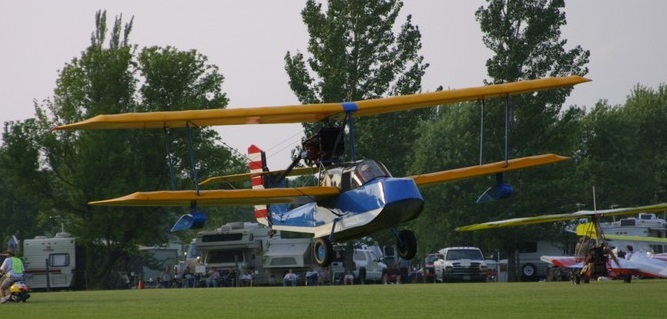
In 1989 designer and manufacturer Larry Seifert introduced the Mariner. The Mariner is a two-place tandem seating amphibious bi-plane. It was being offered in kit form, which would take the average builder between 300 and 600 hours to build, and required no special tools, or jigging. It was also offered as a ready to fly plane under the new Light Sport Aircraft category.

The Mariner is set up to take a number of different engines, from the Rotax 503 and 582 on up to the Subaru auto conversion. Depending on engine power cruise comes in between 55 and 75 mph, top speed 95 mph, climb rate 1,000 feet per minute and stall 28 mph. Take off from land or water requires 150 to 200 feet.

Horsepower: 40 hp
Wingspan: 28.5 ft / 8.69 m
Length: 18.75 ft / 5.72 m
Height: 8 ft / 2.44 m
Empty Weight: 304 lb / 138 kg
Gross Weight: 950 lb / 431 kg
Useful Load: 646 lb / 293 kg
Fuel Capacity: 5 USgal / 19 L
Cruise: 48 kts / 89 kmh / 55 mph
Stall: 26 kts / 48 kmh / 30 mph
Range: 65 nm / 120 km / 75 mi
ROC: 800 ft/min / 4.1 m/sec
Ceiling: 12,000 ft / 3,658 m
Takeoff Distance: 150 ft / 46 m
Landing Distance: 225 ft / 69 m

Manta Foxbat / FX-3

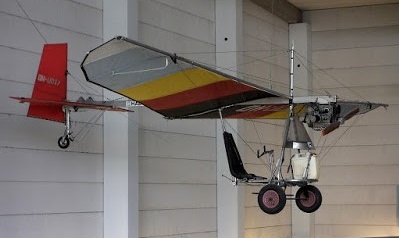
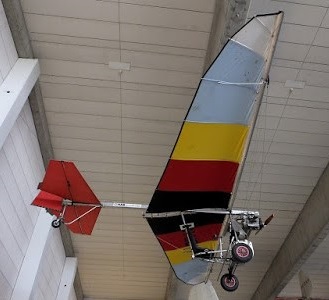
The Foxbat/FIedge III was a single seat single engined high wing monoplane with hybrid control. An American ultralight aircraft that was designed by Bill Armour and produced by Manta Products Inc of Oakland, California. The aircraft was supplied as a kit for amateur construction.

Manta Foxbat Article

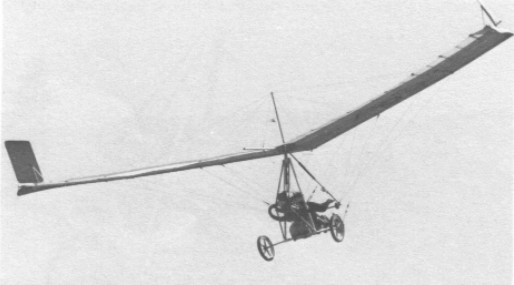
The Foxbat was designed to comply with the US FAR 103 Ultralight Vehicles rules, including the category’s maximum empty weight of 254 lb (115 kg). The aircraft has a standard empty weight of 200 lb (91 kg). It features a cable-braced high-wing, a single-seat, open cockpit, tricycle landing gear and a single engine in pusher configuration. Undercarriage has three wheels in tricycle formation; steel spring suspension on nosewheel and glass fibre suspension on main wheels. Push right go left (push right go right optional) nosewheel steering independent from yaw control. Brakes on main wheels. Wing has swept back leading and trailing edges, and tapering chord; no tail. Wing braced from above by kingpost and cables, from below by cables; 90% double surface.

The aircraft is made from bolted-together 6061T6 aluminum tubing, with the wing covered in Dacron sailcloth. Its 32.5 ft (9.9 m) span wing is supported by cables strung from an inverted V style kingpost. The wing is derived from the Manta Fledge hang glider wing. The control system is unconventional and uses a hang glider style control bar for weight shift control of pitch and roll, augmented with wing tip rudders for yaw, activated by hand controls on the control bar. The fuselage is an open frame structure that is attached to the wing via a flexible single point mount, to allow weight shift control. The pilot is accommodated on a sling seat in trike unit, using bar to control pitch and roll by altering relative positions of trike unit and wing. Yaw control by tip rudders operated by control bar sliders. The landing gear is of tricycle configuration, with a steerable nose wheel.

Strictly speaking, this machine is not a trike, since it does not use a Rogallo wing, but in essence it is the same concept: a combination of a hang glider with a power pack/seating/undercarriage unit. In this case, the hang glider is Manta’s own rigid wing hybrid control Fledge III rather than a Rogallo, combined with the purpose designed Foxbat ‘trike unit’. A feature of the Foxbat is its geared down nosewheel steering, which allows the pilot to keep the nosewheel firmly on course during rough field take offs and landings.

Manta Products announced in January 1983 the adoption for the Foxbat of the Kawasaki TA440A 38.5 hp engine. Previously these aircraft had been equipped in standard form with the Cuyuna 430D or on option a 430R or Zenoah G25B (22 hp) engine with a reduction drive of 2.25/1.

The pilot is comfortably installed in a bucket seat and the four semi rigid tie in points of the trike unit to the sail act as a shock absorber. The options include electric start, a three blade variable pitch propeller, a wider body with larger seat, floats and a strobe light. Price complete is $5360 in 1982.
No longer in production.

The Foxbat wing can be folded for ground transport and storage.

Engine: Kawasaki TA440A, 38.5 hp at 6000 rpm.
Toothed belt reduction, ratio 2.0/1.
Power per unit area 0.24hp/sq.ft, 2.6hp/sq.m.
Fuel capacity 5.0 US gal, 4.2 Imp gal, 18.9 litre.
Length overall 10.0 ft, 3.05 m.
Height overall 6.0ft, 1.83m.
Wing span 33.5ft, 10.21m.
Chord at root 5.8ft, 1.75 m.
Chord at tip 4.6 ft, 1.40 m.
Sweepback 16 deg.
Total wing area 157 sq.ft, 14.6sq.m.
Wing aspect ratio 6.7/1.
Wheel track 5.2 ft, 1.57 m.
Wheelbase 6.0ft, 1.83 m.
Main wheels diameter overall 20 inch, 51 cm.
Empty weight 215 lb, 98kg.
Max take off weight 549 lb, 249kg.
Payload 334 lb, 151kg.
Max wing loading 3.50 lb/sq.ft, 17.1 kg/sq.m.
Max power loading 14.3 lb/hp, 6.5 kg/hp.
Max level speed 55 mph, 88 kph.
Never exceed speed 55 mph, 88 kph.
Max cruising speed 45 mph, 72 kph.
Economic cruising speed 35 mph, 56 kph.
Stalling speed 22 mph, 35 kph.
Max climb rate at sea level 425 ft/min, 2.2 m/s.
Min sink rate 300ft/min, 1.5m/s.
Best glide ratio with power off 9/1.
Take off distance 75 ft, 23 m.
Landing distance 50 ft, 15 m.
Range at average cruising speed 130 mile, 209km.

FX-3
Engine: 1 × Cuyuna 430, 30 hp (22 kW)
Propellers: 2-bladed wooden
Length: 8 ft (2.4 m)
Wingspan: 32 ft 6 in (9.91 m)
Wing area: 157 sq ft (14.6 sq.m)
Empty weight: 190 lb (86 kg)
Gross weight: 425 lb (193 kg)
Wing loading: 2.7 lb/sq ft (13 kg/m²)
Fuel capacity: 5 U.S. gallons (19 lt / 4.2 imp gal)
Cruise speed: 35 mph (30 kt / 56 km/h)
Stall speed: 22 mph (19 kt / 35 km/h)
Range: 100 mi (87 nmi / 161 km)
Endurance: 2.75
Maximum glide ratio: 12:1
Rate of climb: 400 ft/min (2.0 m/s)
Crew: one
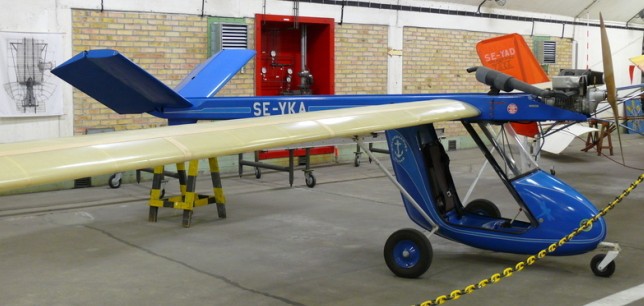
MFI BA-12 Sländan

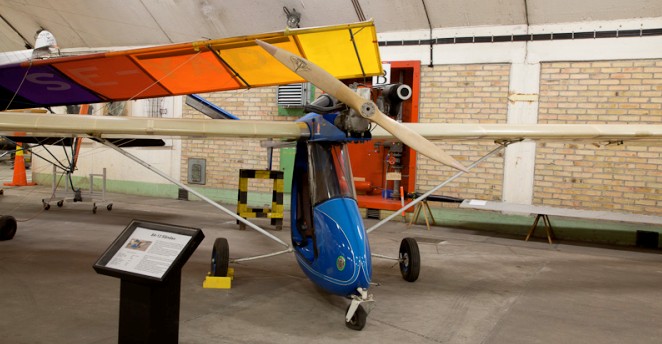
Designed and constructed by Bjorn Andreasson and Rudolf Abelin, the Malmö Flygindustri (MFI) BA-12 Sländan is a single seat ultralight of pod and high boom configuration and with a butterfly tail. Designed and built in Sweden in the 1980s, the Sländan (English: Dragonfly) was the first Swedish microlight apart from glider based types. It is built from composite materials, with a square section beam formed in two halves supporting the engine well ahead of the wing leading edge and extending aft continuously to the tail. The wings, rectangular in plan and with a high aspect ratio (10:1), are attached to the beam with dihedral of 1.5 degrees. Ailerons cover 30% of the trailing edge. The wing has two pressed spars, foam filled glass fibre ribs and Kevlar filled glass fibre sandwich skins. The butterfly tail surfaces are also rectangular and assisted by a short ventral fin with the same chord as the tailplane.

The round nosed, single seat cabin is formed from six bonded pieces and mounted on the boom with its windscreen at the wing leading edge, placing the pilot below the wing at about one quarter chord. The sides are normally open though complete enclosure is an option. On each side a forward leaning bracing strut runs from the lower rear cabin to the front wing spar. The Sländan has a short, fixed, tricycle undercarriage with a steerable nosewheel; the mainwheels, fitted with brakes, are mounted on straight steel cantilever legs from the lower fuselage. There is a protective tailskid on the tip of the underfin.

The prototype Sländan was initially powered by a (21 kW) (28 hp) König SD 570 4-cylinder two-stroke engine though there were plans to replace this with a Lotus Magnum 2.25 when this type became available. At least three examples have been fitted with Rotax engines.

The Sländan first flew in 1984 and by February 1985 MFI were assembling five more. It was agreed that later aircraft should be produced by the Royal Swedish Aero Club using MFI’s moulds and tools. It was intended to market the Sländan in both flyaway and kit form. At about the same time, in a collaboration between MFI and FFK Aerotech, Andreasson was developing a slightly larger, two seat version called the FFV Aerotech BA-14 Starling.

Three Rotax powered, Swedish registered Sländans appeared on the mid-2010 civil aircraft registers of Europe.

BA-12 Sländan
Engine: 1 × König SD 570, 21 kW (28 hp) at 4,200 rpm
Reduction: 1.7:1 toothed belt
Propeller: 3-bladed
Length: 5.20 m (17 ft 1 in)
Wingspan: 10.00 m (32 ft 10 in)
Height: 2.0 m (6 ft 7 in)
Wing area: 10.0 sq.m (108 sq ft)
Aspect ratio: 10.0
Airfoil: laminar type, 15% thickness to chord ratio
Empty weight: 135 kg (298 lb)
Max takeoff weight: 250 kg (551 lb)
Fuel capacity: 20.0 L (5.3 US gal, 4.4 Imp gal)
Maximum speed: 110 km/h (68 mph; 59 kn)
Cruising speed: 100 km/h (62 mph; 54 kn) maximum
Stall speed: 40 km/h (25 mph; 22 kn)
Never exceed speed: 118 km/h (73 mph; 64 kn)
Service ceiling: 1,220 m (4,003 ft) service
g limits: +4.4/-2.2 recommended
Rate of climb: 4.1 m/s (810 ft/min) maximum at sea level
Wing loading: 25.0 kg/m2 (5.1 lb/sq ft)
Power/mass: 8.4 W/kg (0.051 hp/lb)
Take-off distance: 50 m
Landing distance: 50 m
Crew: 1

Mahe Pfadfinder

OH-UO17

Single seat single engined high wing monoplane with two axis control. Wing has unswept leading edge, swept forward trailing edge, and tapering chord; conventional tail. Pitch control by fully flying tail; yaw control by fully flying rudder; no separate roll control; control inputs through stick for pitch/yaw. Wing braced from above by kingpost and cables, from below by cables; wing profile single surface. Undercarriage has three wheels in tail dragger formation, with suspension on tailwheel and steel spring suspension on main wheels. No ground steering. An aluminium tube framework, without pod. Engine mounted below wing driving tractor propeller.

The Pfadfinder is in fact a version of the Australian Scout built under licence in West Germany by Mahe.

The Pfadfinder uses a noticeably different wing from the original Scout and is fitted with the Konig SC430 engine. Used at 4400 rpm, this gives 27 hp with a three blade ground adjustable propeller. Options include floats, instruments, and a document and map case.

Length overall 17.1 ft, 5.22 m.
Height overall 6.9 ft, 2.09 m.
Wing span 28.4 ft, 8.67 m.
Chord at root 5.7ft, 1.75m.
Chord at tip 1.3 ft, 0.41 m.
Sweepback: 0 degs.
Tailplane span 10.7ft, 3.25m.
Fin height 4.9 ft, 1.50m.
Total wing area 125 sq.ft, 11.6 sq.m.
Rudder area 8.3 sq.ft, 0.77 sq.m.
Total elevator area 17.0 sq.ft, 1.58 sq.m.
Wing aspect ratio 6.5/1.
Wheel track 4.8 ft, 1.47 m.
Wheelbase 12.5 ft, 3.78 m.
Tailwheel diameter overall 11 inch, 27 cm.
Main wheels diameter overall 11 inch, 27 cm.
Engine: Konig SC430, 27 hp at 4400 rpm.
Propeller diameter 51 inch, 1.30 m.
Belt reduction, ratio 1.511.
Max static thrust 155 lb, 70 kg.
Power per unit area 0.22 hp/sq.ft, 2.3 hp/sq.m.
Fuel capacity 2.6 US gal, 2.2 Imp gal, 10.0 litre.
Empty weight 132 lb, 60 kg.
Max take off weight 375 lb, 170kg.
Payload 243 lb, 110kg.
Max wing loading 3.00 lb/sq.ft, 14.7 kg/sq.m.
Max power loading 13.9 lb/hp, 6.3kg/hp.
Load factors; +6.0, NC ultimate.
Max level speed 56 mph, 90 kph.
Never exceed speed 65 mph, 105 kph.
Max cruising speed 56 mph, 90 kph.
Economic cruising speed 47mph, 75kph.
Stalling speed 28 mph, 45 kph.
Max climb rate at sea level 500 ft/min, 2.5 m/s.
Best glide ratio with power off 7/1.
Take off distance 130 ft, 40 m.
Landing distance 82 ft, 25 m.
Range at average cruising speed 112 mile, 180 km.