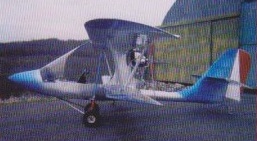
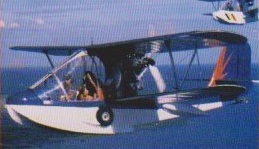
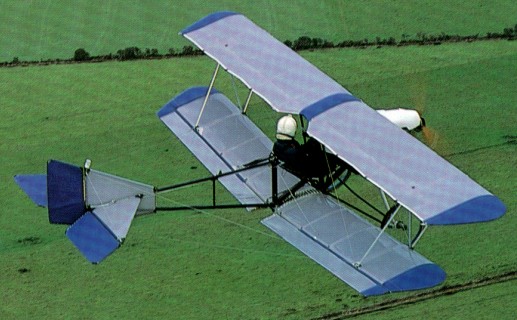
The tandem, two seat MD 03 amphibious pusher biplane has a fuselage of spaceframe and composites, while the wings are the same as on other Delpech models.
Engine: Rotax 582, 64 hp Wing span: 8.60 m Wing area: 18 sq.m MAUW: 450 kg Empty weight: 198 kg Fuel capacity: 45-60 lt Max speed: 160 kph Cruise speed: 130 kph Minimum speed: 60 kph Climb rate: 5 m/s Seats: 2 Fuel consumption: 9-14 lt/hr Kit price (1998): 110 000 Fttc
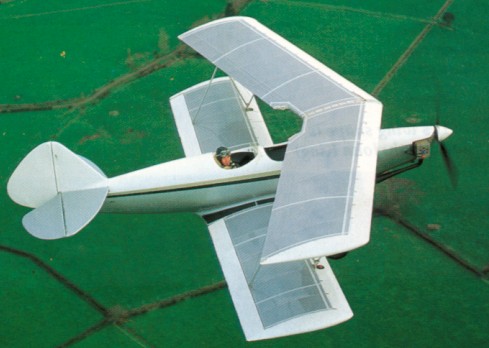
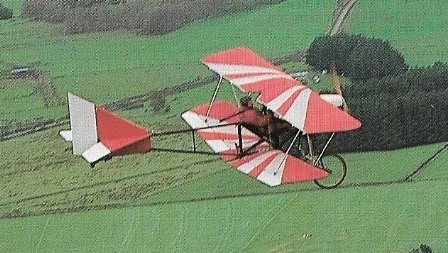
Wallace and Robert McNair started the Mynah II design in Septem¬ber 1988, intended right from the start for series production, a two seater at the top end of the microlight performance range. This aircraft had no commonality with the earlier single seat Mynah aircraft, although both were designed by Wallace and Robert McNair of Auckland, New Zealand.
The fuselage is a one piece moulded fibreglass unit, with integral verti¬cal fin and bottom wing fairings. Moulded in at construction time are wooden longerons, to which the engine mount is bolted at the firewall, and strength is added by the compound curves everywhere, the only straight surface being on the bottom be¬tween the wings. Bulkheads are located around the cockpits and form the structural unit on which the wings, struts, wires and fibreglass landing gear legs are mounted.
The wings, of Clark Y aerofoil, have folded aluminium channel extrusions for the spars, pressed aluminium ribs and Mylar covering, an aluminium leading edge, laced along the lead¬ing edge and each end, with the lacing covered by tips and leading edges, applied after covering. They have marked forward stagger, the bottom wing rear spar passing behind the rear seat and the top wings with a large amount of sweepback to keep the centre section well forward, clear of the front cockpit. Fuel tanks with a total capac¬ity of 50 litres are incorporated in the in¬board ends of the bottom wing leading edges.
Everything is designed around the 390 kg microlight category and standard 4G loading. Empty weight is 170 kg, allowing a pay¬load total of 220 kg, plenty for two occu¬pants, full fuel and a bit more. The Mynah II has a safe endurance of two and a half hours. Motive power is a two cylinder horizon¬tally opposed two stroke Arrow engine from Italy, pulling 65 hp at 6800 rpm, with the three blade carbon fibre propeller of 66 in diameter geared down at 2.77/1.
It was designed with an eye to production but this never eventuated.
ZK-FWT (c/n 001/MAANZ/450) was built by the McNairs and also by Alan Stewart of Tuatapere, to whom the aircraft was first registered on 25/10/90. It flew well with a cruise of around 70 mph. Empty weight was around 220 Kg and MAUW was 449 Kg.
It was sold to RA Hansen of Huntly on 30/8/93. It is still registered and it is kept in a hangar at Glen Murray, although I believe it hasn’t flown for several years.
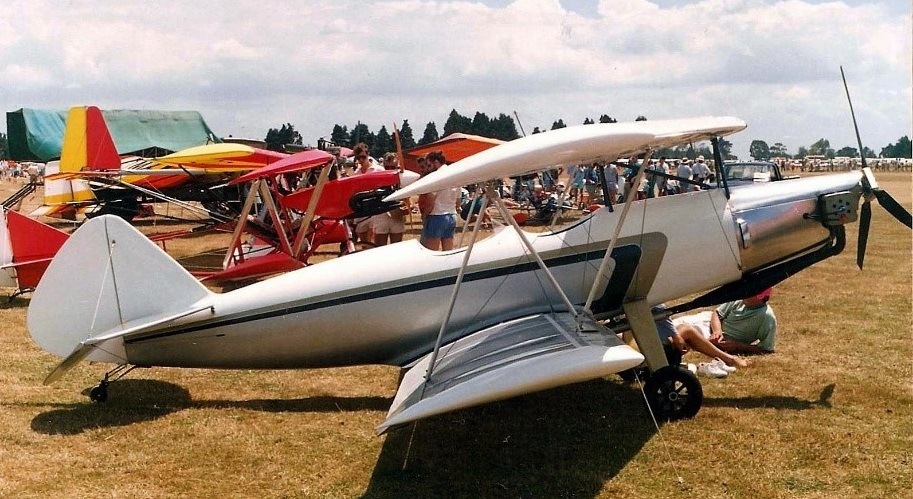
Designed and built by Wallace McNair, Auckland, NZ, and owing much to the Lincoln Sports design, the Mynah has a unique folding fuselage for transportation by trailer. The wings are therefore able to be permanently rigged while the wire bracing from the wing struts to the rear fuselage takes only a matter of minutes to rig. The engine is a two-cylinder “half-a-VW”.
Hi I currently own the mcnair mynah pictured and one partialy built, mine has a rotax 447 engine although i have seen one with a 503 rotax. There were about 6 built and 3 in flying condition that i know of. Michael Jones 13 December 1013
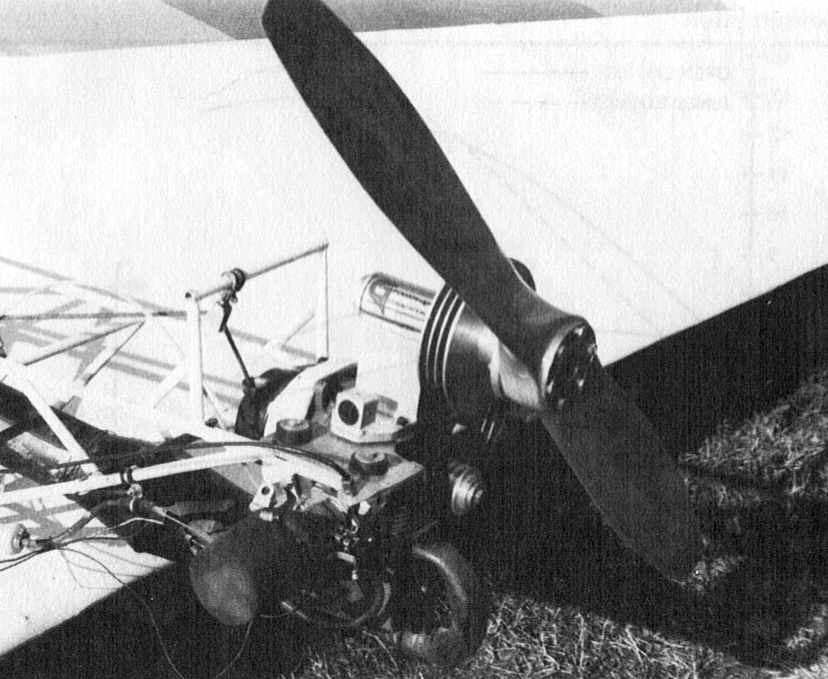
The McCulloch MAC-101, also called the MC-101 and MC101, is a two-stroke, single cylinder engine that was designed and produced by McCulloch Motors Corporation for kart racing use, being introduced in 1967. It was also used in the late 1970s and early 1980s as an ultralight aircraft engine.
All models in the MC-101 series have a bore of 2.280 in (5.791 cm), a stroke of 1.835 in (4.661 cm) and a displacement of 7.5 cu in (122.90 cc).
Variants: MC-101 Introduced in 1967
MC-101A Introduced in 1969
MC-101AA Introduced in 1971
MC-101B Introduced in 1974
MC-101C Introduced in 1969
MC-101D Introduced in 1971
MC-101M/C Introduced in 1973
Applications: AmEagle American Eaglet Aviastroitel AC-4 Russia Birdman TL-1 Eipper Quicksilver Farner HF Colibri 1 SL Hovey Whing Ding II Skyhigh Skybaby UFM Easy Riser
Specifications:
MC-101B Type: single cylinder, two-stroke engine Bore: 2.280 in (5.791 cm) Stroke: 1.835 in (4.661 cm) Displacement: 7.5 cu in (122.90 cc) Fuel system: carburetor Oil system: pre-mixed Cooling system: air-cooled Power output: 12.5 hp (9 kW) at 9000 rpm
Designed to capture the spirit of the Santos Dumont Demoiselle, in developing this aircraft over 19 years, designer Kevin McLeod set out to produce a simple, rugged ‘back to basics’ machine that he hoped would be fun to fly.
The Terrafly is an original design ultralight aircraft built under the provisions of Australian ANO 95-10. Work started on the project in 1984.
The Terrafly is a single engine, high-wing, tail-dragging monoplane with conventional three axis controls. As with the Demoiselle, the pilot sits under the wing with the propeller wash in his face. The open cockpit has an airspeed indicator, altimeter, a dual CHT/EGT gauge, compass, clock, a G-meter, a Hobbs Hour Meter and fuel sight gauge.
The only example of the Terrafly built, registered 10-0571, was not test-flown and so information on its performance has never been established. The aircraft was donated to the South Australia Aviation Museum in October 2006 by the owner/designer.
Engine: Rotax 377 35 hp Cruising Speed: 55 kt (100 kph) estimated Maximum take-off weight: 225 kg Length: 5.54 m Wingspan: 7.62 m Height: 2.6 m Capacity: 1 pilot
Single seat single engined high wing monoplane with conventional three axis control. Wing has unswept leading and trailing edges, and constant chord; conventional tail. Pitch control by elevator on tail; yaw control by fin mounted rudder; roll control by full span ailerons; control inputs through stick for pitch/roll and pedals for yaw. Wing braced from above by kingpost and cables, from below by cables; wing profile; double surface. Undercarriage has three wheels in tail dragger formation; suspension on all wheels (type NC). Push right go right tailwheel steering connected to yaw control. Optional brakes on main wheels. Aluminium tube framework, without pod. Engine mounted at wing height driving pusher propeller. Dacron wing covering.
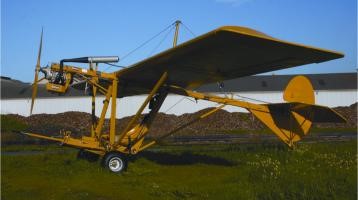
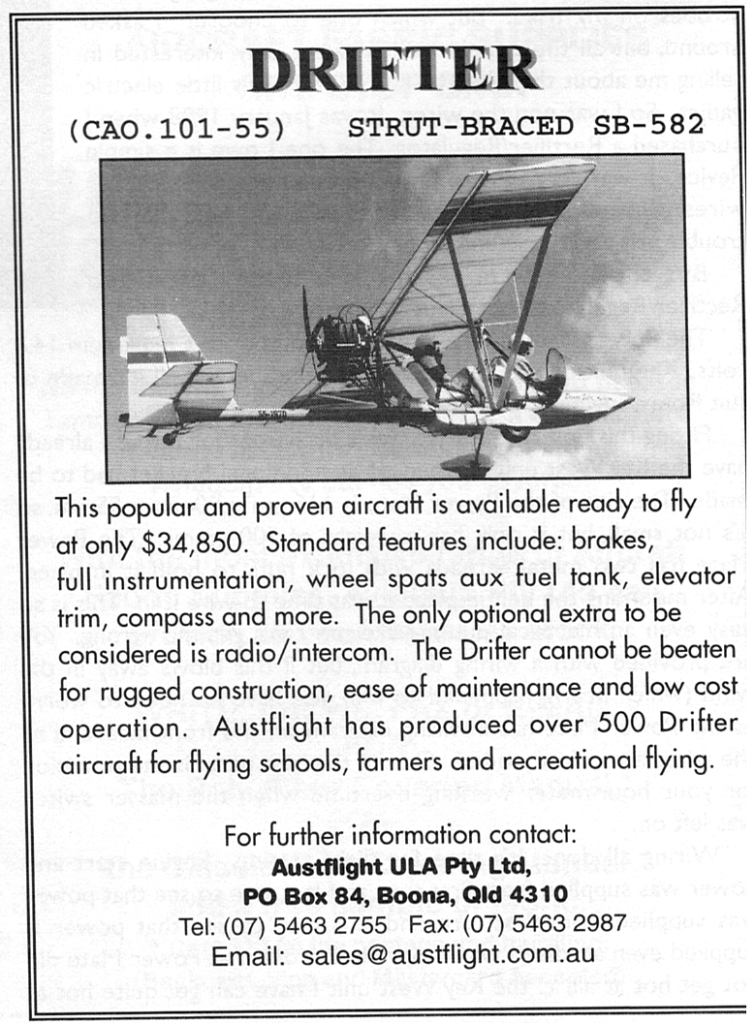
The Drifter started life as a modified Hummer, the brainchild of the late Klaus Hill. Maxair Sports dealer Roy Pinner built the first Drifter from a Hummer kit, with some notable design changes. On the Drifter, in place of the V-tail empennage, Pinner built a conventional cruciform tail, sporting a regular set of stabilizing surfaces — vertical and horizontal. Along with the stabilizing surfaces Pinner constructed a rudder and elevator. Maxair also added bent sheet aluminum to strengthen the fuselage boom. New landing gear built of springy 4130 chrome-moly steel replaced Hummer’s complex aluminum-tube gear. The wing utilizes a flatter profile, sporting a batten-braced lower surface with some curvature, enabling the craft to slice through the air with less effort. And less effort required means that the Drifter flies faster on the same power as Hummer, even though both sport approximately the same wing area, despite Drifter’s higher empty weight.
The Duralumin and Dacron Drifter made its first public appearance as a prototype at Oshkosh in 1982, where it was on static display only, since the aircraft had not at that time completed its flight test programme. The design is by Roy Pinner, marketing director of Maxair Sports, who conceived the Drifter as an improved version of the Hummer from the same company, with a remodelled structure and a conventional tail in place of the characteristic V tail, as designed by Klaus Hill.
The Drifter has been on sale since May 1983, Maxair Sports differentiating the new model from the Hummer, which is still in production, by emphasising its sprung suspension on the main undercarriage and its increased track, which allows more rough¬terrain use. It also points out that the tail has become conventional, with large control surfaces, and that the ailerons are now full span. The improved control authority of the Drifter gives better cross wind capabilities and its performance has been increased by the 38.5 hp delivered by its twin cylinder in line Kawasaki TA440A engine. Priced in 1983 at US$5500.
The XP 503 was first introduced at Oshkosh in 1983. A two-seat high wing microlight powered by a pusher 48 hp Rotax 503. Max speed is 63 mph.
By 1984 600 Drifters had flown.
Its cable-braced wing and aluminum fuselage tube resulted in a rigid design that was soon expanded to include a two-seat trainer version and a short-wing, overpowered single-seat hot rod that was well outside ultralight limits. Some Drifters were equipped with monohull or dual floats.
March 1999
Maxair declared bankruptcy in 1991, and the Drifter project was picked up by Phil Lockwood, who had worked for Maxair. Lockwood Aviation has reintroduced the design. When powered by the 582 Rotax engine the craft will climb out at 900 feet a minute cruise a 70 m.p.h. and stall in the 38/40 m.p.h. range.
Leza Lockwood Drifter
Drifter Engine: Kawasaki TA440A, 38.5 hp at 6000 rpm. Propeller diameter and pitch 58 x 36 inch, 1.47 x 0.91 m. V belt reduction, ratio 2.25/1. Max static thrust 230 lb, 104kg. Power per unit area 3.94 hp/sq.ft, 2.7 hp/sq.m. Fuel capacity 5.0 US gal, 4.2 Imp gal, 18.9 litre. Length overall 19.0 ft, 5.79 m. Height overall 7.6ft, 2.32m. Wing span 30.0ft, 9.14m. Constant chord 5.0ft, 1.52m. Dihedral 4 deg Sweepback 0 deg Tailplane span 7.4 ft, 2.23 m. Fin height 6.0ft, 1.83m. Total wing area 152 sq.ft, 14.1 sq.m. Fin area 15.0 sq.ft, 1.39 sq.m. Tailplane area 26.0 sq.ft, 2.41 sq.m. Wing aspect ratio 5.9/1. Wheel track 6.0 ft, 1.83 m. Wheel¬base 15.6 ft, 4.72 m. Tailwheel diameter over¬all 4 inch, 10 cm. Main wheels diameter overall 12 inch, 30cm. Empty weight 233 lb, 106kg. Max take off weight 505 lb 229 kg. Payload 272 lb, 123kg. Max wing loading 3.32 lb/sq.ft, 16.2 kg/sq.m. Max power loading 13.1 lb/hp, 5.9kg/hp. Load factors +6.0, 3.0 design. Max level speed 63 mph, 101 kph. Never exceed speed 63 mph, 101 kph. Max cruising speed 60 mph, 97 kph. Economic cruising speed 50mph, 80kph. Stalling speed 25 mph, 40 kph. Max climb rate at sea level 1100 ft/min, 5.6 m/s. Min sink rate 300 ft/min at 40 mph, 1.5 m/s at 64 kph. Best glide ratio with power off 9/1 at 42 mph, 68kph. Take off distance 100ft, 30 m. Land¬ing distance 100 ft, 30 m. Range at average cruising speed 150 mile, 241 km.
Single seat single engined high wing mono¬plane with two axis control (unconventional three axis control optional). Wing has un¬swept leading and trailing edges, and constant chord; V tail. Pitch/yaw control by elevon; no separate roll control (roll control by spoilers optional). Control inputs through stick for pitch/yaw (and pedals for roll optional). Wing braced from above by kingpost and cables, from below by cables; wing profile; double surface. Undercarriage has three wheels in tail dragger formation; steel spring suspension on all wheels. Tailwheel steering connected to yaw control. Optional brakes on main wheels. Aluminium tube framework, with optional pod. Engine mounted below wing driving pusher propeller. Main boom made from 6061T6 aluminium. Wing covering is Dacron.
A high-wing monoplane with upright V-tail and spoilers (no ailerons), it was designed as an ultralight and not as a hang glider, with the engine as an afterthought. It features a non-welded, pop-riveted, bolted-together, wire-braced airframe of aluminum tubing. The wire-braced wings are built from aluminum tubing and covered with presewn Dacron, so no dope, glue or rib stitching is necessary. The V-tail is equipped with movable ruddervators acting as rudder and elevator. The main fuselage boom is 5’-diameter 6061 -T6, aluminum, to which the wing and engine support structures are attached. The pilot is seated forward of the wing and controls flight with conventional stick and foot pedals.
In August 1977 Klaus Hill had begun design studies for the Hummer and started work on a prototype in October. Thirty hours of labour and $2000 later in November of the same year, the first prototype was complete. The first production models appeared on 17 March 1978, but the machine did not seem an immediate success as only a dozen were flying by the beginning of the 1980 season. Maxair has since 1982 offered as an option a nose fairing, made of glass fibre with a windscreen, and a fairing for the main undercarriage legs. Originally a two axis design, a new innova¬tion presented on the Hummer at Sun ‘n’ Fun in March 1983, was a wing covering with spoilers sewn in place on the upper surface. Operated by pedals (absent on the two axis machine), these spoilers can also be used together as air brakes to obtain a high sink rate for steep approaches and short field landings. Also available as an option are main wheel brakes, a reduction drive for the Zenoah G25B engine and floats. Price is $4395 in 1982. Worthy of note are two developments of the Hummer, a tandem two seat produced in Switzerland by ULAC and in the USA Maxair’s own Hummer B single seater. In¬tended for heavier pilots, this had its payload increased from 170 to 210 lb (77 to 95 kg) and its maximum gross similarly increased, but the standard 1983 Hummer shows such an improved performance over earlier versions that the type B is no longer required.
Engine: Chaparral snowmobile, 20-hp Top speed: 45 mph ROC: 400 fpm Takeoff dist: 150 ft Ldg dist: 100 ft
Engine: Zenoah 925B, 22 hp at 6000 rpm Propeller diameter and pitch 52 x 32 inch, 1.32 x 0.81 m V belt reduction, ratio 2.2/1 Max static thrust 160 lb, 73 kg Power per unit area 0.16 hp/sq.ft, 1.7hp/sq.m Fuel capacity 5.0 US gal, 4.2 Imp gal, 18.9 litre Length overall 18.0 ft, 5.48 m Height overall 8.3ft, 2.54m Wing span 34.0ft, 10.36m Constant chord 4.4ft, 1.32 m Sweepback 0 degs Tailplane span 8.2 ft, 2.50 m Total wing area 138 sq.ft, 12.8sq.m Wing aspect ratio 8.3/1 Wheel track 3.6 ft, 1.08 m Tailwheel diameter overall 6 inch, 15 cm Main wheels diameter overall 10 inch, 25 cm Empty weight 185 lb, 84kg Max take off weight 440 lb, 199 kg Payload 255 lb, 171 kg Max wing loading 3.18 lb/sq.ft, 15.5 kg/sq.m Max power loading 20.0 lb/hp, 9.0kg/hp Load factors +4.0, 3.0 design Max level speed 60 mph, 97 kph Never exceed speed 97 mph, 101 kph Max cruising speed 45 mph, 72 kph Economic cruising speed 30mph, 48kph Stalling speed 22 mph, 35 kph Max climb rate at sea level 400 ft/min, 2.0 m/s Min sink rate 300ft/min, 1.5m/s Best glide ratio with power off 9/1 at 28mph, 45kph Take off distance 60ft, 18m Landing dis¬tance 100ft, 30m Service ceiling 10,000ft, 3050 m Range at average cruising speed 100 mile, 160 km
Franklin Manufacturing Corporation Maxair Sports Inc
Maxair Sports was founded in 1973 under the name of Franklin Manufacturing Corporation to make metal components for the hang gliding industry. By 1982 the name had changed to Maxair Sports Inc. 1982-4: Maxair Sports Inc, PO Box 95, 32 Water Street, Glen Rock, Pennsylvania 17327, USA. Maxair declared bankruptcy in 1991, and the Drifter project was picked up by Phil Lockwood, who had worked for Maxair.



 All Aero