Merlin E-Z Flyer

EZ Flyer

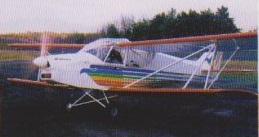
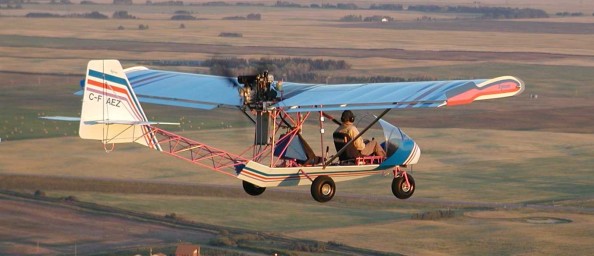
The two-place ultralight trainer EZ-Flyer was designed by Canadian Wayne Winters, using a lot of the Merlin’s wing and tail structure.

The LSA EZ-Flyer II has a chromoly steel tube fuselage structure. It is a predominantly triangulated structure. The engine is pusher mounted behind the wing and on top of the steel fuselage cage. It can handle all the bigger Rotax engines and Merlin indicates that the 80-hp Rotax 912 four-stroke engine.

It is a 4130 chromoly steel construct that is painted at the factory prior to shipping. The wing has an aluminum “D” cell, is Ceconite covered and strut braced, but sports a large wingtip “fence” at the end that was removed from factory ships for testing. The ailerons are not quite full-span but are hinged in a frise-type setup with no differential. There are no flaps, and the wing is a constant chord assembly.

The rudder tri-gear has a set of very heavy spring steel gear legs and 18 inch tundra tires. The EZ-Flyer II is 21 feet long, 6 feet high, and has a span of 30 feet. The wing has 165 sq. ft. of wing area, a 10 US gal fuel capacity, and is stressed to +4 and -2 Gs. With the standard Rotax 503, the 465-lb EZ-Flyer II has a max gross weight of 1000 lbs, leaving more than a 500 lbs payload.

The empty EZ-Flyer has a tendency to sit on its tail with the nose sticking skyward.

Dual controls come in the form of a long J-neck control stick, rudder pedals, and a single-lever braking system to the left of the pilot seat. The throttle is also on the left and is made prominent on the prototype by a small golf-ball-shaped handle that sits atop the lever. The front seat offers minimal protection from the elements with a small windscreen that does keep the worst of the breeze out of your face.

There is some notable down thrust evident in full-power operations that will require initiating a positive rotation until you get to a much higher than normal light-off speeds. Lift-off at about 35 mph and 350 feet.

Engine: Rotax 582, 65 hp
Max speed: 100mph
Cruise speed: 70 mph
Stall: 30 mph
ROC:700 fpm
Takeoff distance: 90 ft.
Landing dist: 150 ft
Fuel cap: 9 USG
Empty weight: 483 lb
Gross weight: 1050 lbs
Height: 6 ft
Length: 21 ft
Wing span: 26 ft
Wing area: 137 sq.ft.
Seats: 2
Undercarriage: tricycle

Blue Yonder EZ Flyer
Engine: Rotax 503, 52 hp
HP range: 50-74.
Speed max: 100 mph
Cruise: 65 mph.
Stall: 30 mph
ROC: 650 fpm.
Take-off dist: 90 ft
Landing dist: 150 ft.
Fuel cap: 9 USG
Weight empty: 469 lbs.
Gross: 1050 lbs
Height: 6 ft.
Length: 21 ft
Wing span: 26 ft.
Wing area: 137 sq.ft
Seats: 2 tandem.
Landing gear: nose wheel.

Blue Yonder EZ Flyer
Engine: Rotax 582, 65 hp
HP range: 50-130.
Cruise: 70 mph.
Stall: 35 mph
ROC: 700 fpm.
Take-off dist: 100 ft
Landing dist: 175 ft.
Fuel cap: 24 USG
Weight empty: 535 lbs.
Gross: 1300 lbs
Length: 21 ft
Wing span: 31 ft.
Wing area: 176 sq.ft
Seats: 2 tandem.
Landing gear: nose wheel.
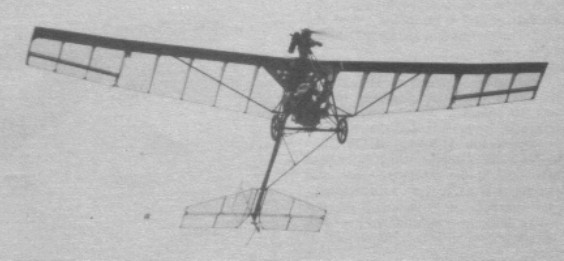
Merlin Aircraft Inc

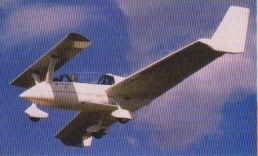
Made kits available to construct the Merlin GT-582 two-seat monoplane, originally developed in Canada as the Macair Merlin.

1996: 509 Airport Rd, Muskegon, MI 49441, USA.
The company closed due to financial difficulty.
The designs were being produced by Blue Yonder Aviation, Inc., and one is also available from AeroComp Inc.

Mecavia Onyx Biplace

Onyx bi 582

A tandem two-seat composites, built developed from single-seat Piel CP.150 Onyx and featuring rear-mounted wings and high canard. The fuselage is in wood and composites with the kit including all mouldings. The engine is limited to 55 kg for CoG reasons.

Onyx bi 582
Engine: Rotax 582 DCDI, 64 hp
Wing span: 9.20 m
Wing area: 16.07 sq.m
MAUW: 440 kg
Empty weight: 220 kg
Fuel capacity: 50 lt
Max speed: 185 kph
Cruise speed: 150 kph
Minimum speed: 64 kph
Climb rate: 5 m/s
Seats: 2
Fuel consumption: 13 lt/hr
Kit price (1998): 117 800 Fttc

Meadowlark Ultralight Meadowlark

Single seat single engined high wing mono¬plane with conventional three axis control. Wing has unswept leading edge, swept for¬ward trailing edge and tapering chord; cruci¬form tail. Pitch control by elevator on tail; yaw control by fin mounted rudder; roll control by one third span ailerons; control inputs through stick for pitch/roll and pedals for yaw. Wing braced from below by struts; wing profile; double surface. Undercarriage has three wheels in tricycle formation with additional tailskid; steel spring suspension on all main wheels. Push right go right nose¬wheel steering connected to yaw control. Brakes on main wheels. Aluminium tube framework, without pod. Engine mounted above wing driving tractor propeller. Cover¬ing is transparent Mylar; push pull tubes for flight controls.

The prototype of this single seater appeared at the end of 1982 and presented at the March 1983 Sun In’ Fun in Lakeland, Florida, where it enjoyed a certain success. It is certainly one of the better conventional three axis designs on the American market; for instance, the controls are operated by push rods and the wing is supported on struts rather than cables, features which allow one to rig the aircraft in around 20 min. The wings fold parallel to the fuselage allowing easy transport on a trailer without any other derigging.

The Meadowlark was fitted with a Cuyuna 430R engine with Arizona Air Sports reduc¬tion drive and was sold only in ready to fly form, at a price of $6575. Biam floats were available as an option for $975; other options include flight and engine instruments.

Engine: Cuyuna 430R, 30 hp at 5500 rpm
Propeller diameter and pitch 54 x 27 inch, 1.37 x 0.68 m
V belt reduction, ratio 2.0/1
Max static thrust 197 lb, 90 kg
Power per unit area 0.22 hp/sq.ft, 2.4 hp/sq.m
Fuel capacity 3.7 US gal, 3.1 Imp gal, 14.0 litre
Length overall 19.0 ft, 5.79 m
Height overall 7.3ft, 2.21m
Wing span 35.0ft, 10.66m
Chord at root 5.0ft, 1.52m
Chord at tip 3.0ft, 0.91m
Dihedral 3 deg
Sweepback 0 deg
Tailplane span 8.6 ft, 2.59 m
Fin height 3.4 ft, 1.01 m
Total wing area 136 sq.ft, 12.6 sq.m
Total aileron area 12.0 sq.ft, 1.11 sq.m
Fin area 7.5 sq.ft, 0.69 sq.m
Rudder area 5.0 sq.ft, 0.46 sq.m
Tail¬plane area 14.0 sq.ft, 1.30 sq.m
Total elevator area 7.0 sq.ft, 0.65 sq.m
Wing aspect ratio 9.0/1
Wheel track 5.0ft, 1.52 m
Wheelbase 5.0ft, 1.52 m
Nosewheel diameter overall 19 inch, 48 cm
Main wheels diameter overall 23 inch, 58 cm
Optional floats: 11.0 x 23.5ft, 3.35 x 7.13 m
Empty weight 251 lb, 114 kg
Max take off weight 550 lb, 249kg
Payload 299 lb, 136kg
Max wing loading 4.04 lb/sq.ft, 19.7kg/sq.m
Max power loading 18.3 lb/hp, 8.3kg/hp
Load factors +3.8, 1.5 design
Max level speed 55mph, 88kph
Never exceed speed 60mph, 97kph
Max cruising speed 55mph, 88kph
Economic cruising speed 35mph, 56kph
Stalling speed 22 mph, 35 kph
Max climb rate at sea level 1000 ft/min, 5.1 m/s
Min sink rate 400 ft/min at 27 mph, 2.0 m/s at 43 kph
Best glide ratio with power off 8/1 at 30 mph, 48 kph
Take off distance 75 ft, 23 m
Landing distance 100ft, 30m
Range at average cruising speed 90 mile, 145 km

Mead 100 Adventure

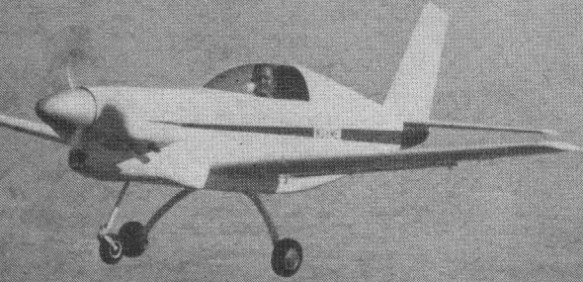
The Model 100 Adventure’s simplicity of operation is equaled only by its simplicity in construction. A modern, high performance, sandwich composite structure was used throughout. The materials and working techniques are descendants of Rutans VariEze technology. The Adventure has a combination of high speed cruise, low stall speeds and good climb performance.

The general configuration is a single-seat, low mid-wing tractor monoplane with fixed tricycle landing gear that may be powered by any of the Con¬tinental Motors A or C series engines of 65 to 85 hp driving a fixed-pitch wooden propeller. The wing is a two-piece assembly to minimize the space required to build and to facilitate its removal from the fuselage. The fuselage is built from flat sheets of half-inch-thick polystyrene foam and constructed from the inside out. The canopy is a single-piece, free-blown unit.

Aileron rolls and one turn spins are the only aerobatics that the Adventure has performed. It is intended to be a utility category aircraft with lots of structural beef and a conservative repertoire of aerobatic maneuvers.

Engine 65 to 100-hp Continen¬tal
Gross Wt. 800 lb
Empty Wt. 460 lb
Fuel capacity 20 USG
Wingspan 20’
Length 13’
Wing area: 40 sq.ft
Top speed 188 mph
Cruise 180 mph
Stall mph 57
Climb rate 1600 fpm
Takeoff run 800 ft
Landing roll 700 ft
Range 650 miles
Seats: 1.