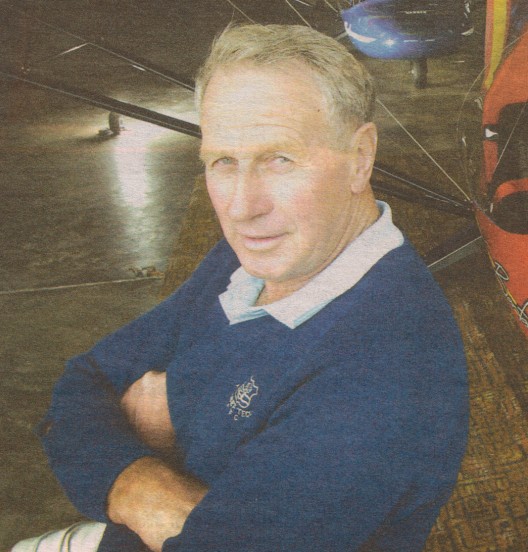
In 1983 Max Clear (Inventor, and founder of Micro Aviation) saw the need for a fun, stable, affordable aircraft, which could be mostly maintained by the owner, so he designed and built the first Bantam Mircolight. 1985: Micro Aviation (NZ) Ltd, C/- Post Office, Te Kowhai. In March 1993, Max Clear bought out his partners John Dick and John Smith.
Max Clear
2009: Limmer Rd, Te Kowhai, RD 8, Hamilton 3288, New Zealand.
Max Clear died in November 2010 and the entire manufacturing operation was made available for sale.
By 2013 almost half of the production was exported to seven countries. The Bantam Aircraft Manufacturing Plant was relocated to Mandeville, New Zealand, with Colin & Maeva Smith having spares available for all models.
The latest production Model Bantam – the B22UL, with a 4 cylinder, 4 stroke UL 260i engine, was undergoing its final Certification tests.
Of all metal construction, the Pulsar III’s use of an aerofoil section for the leading edge spar plus round-out improved its speed range and low-end performance.
Pulsar III Engine: Rotax 582, 64 hp Wing span: 9.2 m Wing area: 15 sq.m MAUW: 450 kg Empty weight: 146 kg Fuel capacity: 60 lt Max speed: 160 kph Cruise speed: 130 kph Minimum speed: 50 kph Climb rate: 6 m/s Fuel consumption: 10 lt/hr Certification: Espagnole Seats: 2 Price (1998): 135 000 Fttc Kit price (1998): 71 900 Fttc
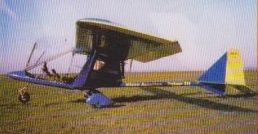
Side by side two seat single engined high-wing monoplane with conventional three axis control. Wing has swept back leading and trailing edges, and tapering chord; no tail. Pitch/roll control by stabilators; yaw control by tip rudders; control inputs through stick for pitch/roll and pedals for yaw. Cantilever wing; wing profile NACA 23015; double-surface. Undercarriage has three wheels in tricycle formation; suspension on all wheels. Push right go right nosewheel steering connected to yaw control. Brake on nosewheel. Aluminium tube/wood/steel tube framework, partially enclosed. Engine mounted below wing driving pusher propeller. Seeing the need for training aircraft, Micro Aviation decided at the end of 1981 to launch some two seater microlights. To this end, the firm asked Don Mitchell to give it the benefit of his experience in this matter and a prototype called the Two Seat Trainer was duly shown at Oshkosh in August 1982. By 1983 it has not gone into serious production. The aircraft shown was a direct development of the B10 Mitchell Wing, enlarged and strengthened. It was intended that the two-seater should use a Konig SD570 four cylinder two stroke engine.
Engine: Konig SD570, 28 bhp at 4200 rpm. Power per unit area 0.16hp/sq.ft, 1.7 hp/sq.m. Wing span 38.0 ft, 11.58 m. Mean chord 4.8 ft, 1.45 m. Total wing area 181 sq.ft, 16.8 sq.m. Wing aspect ratio 8.0/1. Empty weight 240 lb, 109kg. Max take off weight 640 lb, 290 kg. Payload 400 lb, 181 kg. Max wing loading 3.55 lb/sq.ft, 17.3 kg/sq.m. Max power loading 22.9 lb/hp, 10.4kg/hp. Load factors +6.0, 6.0 design. Stalling speed 24 mph, 38 kph. Max climb rate at sea level 400ft/min, 2.0m/s. Take off distance 350ft, 107m.
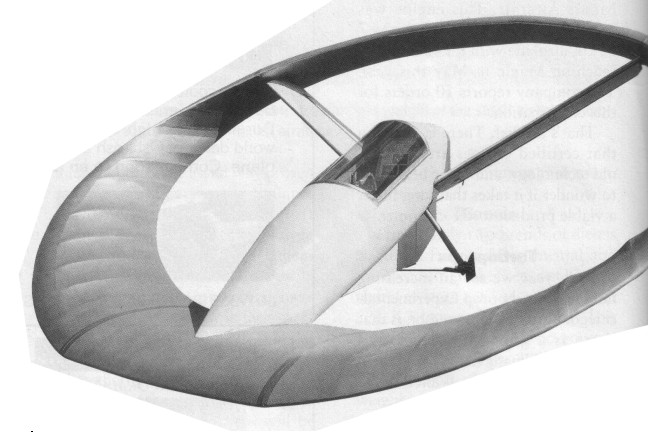
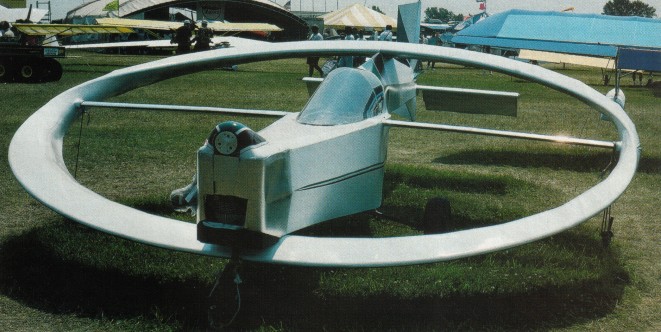
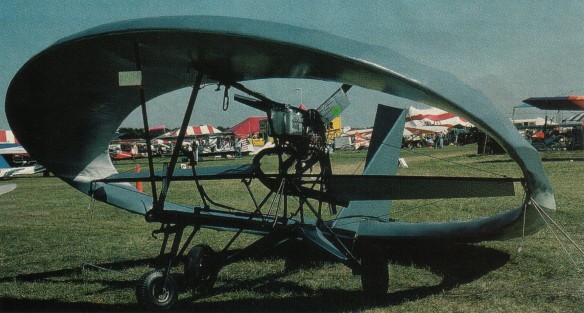
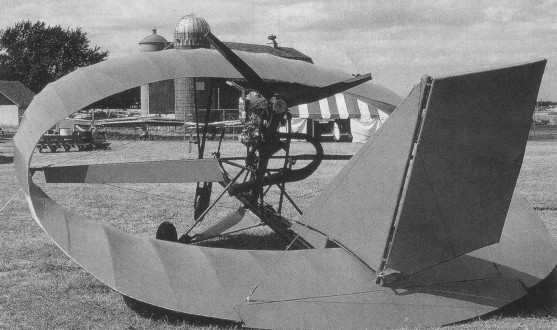
David Meyers began development of a single seat ring design called Orbit Air in 1988 and obtained a patent for it in 1991. Orbit Air began as an unpowered craft in 1990 as it was tested by being towed down the runway to evaluate the wing’s stability and lift. Various follow-on testing programs have resulted in five configuration changes.
Changes included fitting a 40 hp Kawasaki 440 engine with a three blade, 62 inch propeller in both tractor and pusher positions. The down angled ring wing has also been moved to an up-tilt position, the cockpit area was reworked, and the tail surfaces and landing gear were redesigned.
1994
The primary structure is a 6061-T6 aluminium structure, but the wing and control surfaces are Stits PolyFiber covered wood. The wing employs leading and trailing edge spars that are 1.125 inch in diameter with 30 built-up quarter inch fir and mahogany plywood ribs. It is canted upward 15 degrees with a 12 foot span and a maximum chord of four foot 5 inches (in the 1995 configuration). Wing area is 100 sq.ft. Ailerons of five foot span and 9 inch chord are fitted within the wing just forward of the propeller.
Version 5
An elevator is installed in the trailing edge of the wing under a 4.5 foot rudder. The seat is a weight shift type.
Version 5
Orbit Air is 21 feet long and 7 feet high. Flight tests were only short hops to 100 ft altitude down a 3100 ft runway. Meyers claims that the airplane will take-off at 40 mph, cruise at a maximum 55 mph, and stall at 30-35 mph. Development and testing were continuing.
George W. Meyer was already a well known craftsman and model airplane builder prior to his full size project. He started the Little Toot by drawing it in ½ inch to the foot scaled drawings and proceeded to build a metal, 1/24 scale model of his dreams. The model duplicated what he wanted in the full size airplane including a scale metal engine. Many of the building processes were refined in the small model, prior to starting the full size project in 1952.
The full size airplane performed perfectly on the first flight with only a slight adjustment to the rudder trim tab. The first flight was flown on February 2, 1957 in Corpus Christi, Texas. The pilot for the test flight was a great lady pilot by the name of Pauline Glasson.
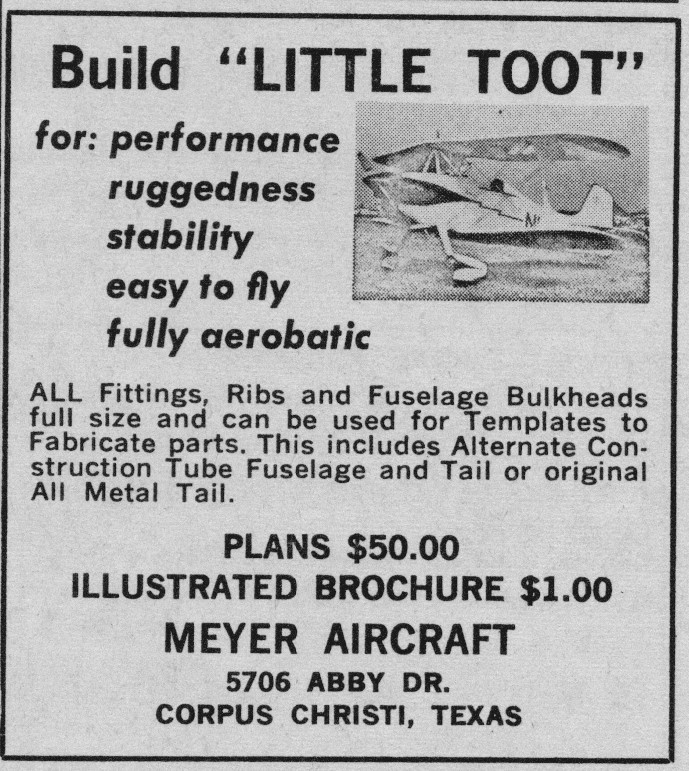
All the test hours were flown off and the plane came through with flying colours. The plane was fully aerobatic, and had no bad habits in stall or spin type maneuvers. George originally intended for the Toot to be a one of a kind airplane, but the requests for plans soon overwhelmed that decision so he began to produce plans with all of the modifications incorporated into them that he had made during the project.
The Little Toot took the top award from Mechanic Illustrated for “Outstanding Achievement in a Homebuilt Aircraft” at the 1957 EAA convention in Milwaukee. “Little Toot” also won the Paul H. Poberezny Award two years in a row. Year 1999 and 2000.
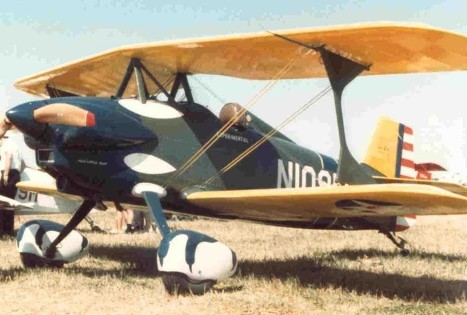
The single seat fuselage is an all-metal structure with metal-covered steel tube construction from rear of cockpit forward, and metal monocoque rear of tubular fuselage cockpit forward section. Plans also provide you with an alternate full Tube and Fabric fuselage construction.
It features all wood wings, two 1″ thick spar structure with fabric covering, and NACA 2212 wing section, 8 degrees sweepback on the top wing, and 2.5 degrees of dihedral on lower wing. There is 2 degrees incidence on both upper and lower wings. Braced biplane type with Cabane and I-struts. Fabric covered all metal full-length ailerons on lower wings only. No Flaps. Little Toot has a structure stressed to 10- and 10+ G’s
The original was fitted with a Continental 90-hp engine, but power plant options include 4-cylinder engines of up to 200 hp, or six cylinders up to 250 hp. The Little Toot has an eight-degree sweepback on the upper wing. The straight lower wing carries fabric covered, metal, almost full-span ailerons that give the ship an unusually high roll rate. Fiberglass engine cowlings are now available. A baggage compartment is located behind the pilot seat.
There are two tail type options. A cantilever all aluminum structure, or a tubular 4130 chrome-moly steel, fabric covered. Both have a trim tab in the port elevator. The main gear is fixed cantilever spring steel from Cessna 140/120, or new aluminum gear with integrated brake line, and a steerable tailwheel.
Jan 65
Wing span (both): 19 ft in Fuselage length: 16 ft 6 in Total height: 7 ft Weight empty: 914 lb Gross weight: 1320 lb Max wing loading: 10 lb/sq foot Max power loading: 13.7 lb/sq foot Fuselage fuel tank: 19 USG Opt. wing fuel tanks: 18 USG Total fuel capacity: 37 USG Roll rate: 120 deg/sec Vne: 200 Mph V2min (min takeoff speed): 65 mph VFTO (Final takeoff speed): 70 mph VC (most efficient cruising speed): 125 mph VD (design diving speed): 200 mph VDF (demonstrated flight diving speed): 160 to 180 mph in aerobatic configuration VFC (Max speed for stability characteristics): 90 mph VH (Max speed in level flight at max power): 138 mph VLOF (Lift-off speed): 55-60 mph VMC (Minimum control speed in flight): 48 mph Vmcg (Minimum control speed on the ground): 40 mph VMO (Maximum operating limit speed): 180 mph VNO (Maximum structural cruising speed): 138 mph VR (Rotation speed): 60 mph VRef (Landing reference speed): 70 mph VSO (Power off stall speed): 48 mph VY (Best rate of climb): 100 mph Max speed at sea level 125 hp: 135 mph Max speed at sea level 150 hp: 150 mph Max speed at sea level 180 hp: 165 mph Normal cruising speed 125 hp: 125 mph Normal cruising speed 150 hp: 135 mph Normal cruising speed 180 hp: 145 mph Max rate of climb 125 hp: 1600 fpm Max rate of climb 150 hp: 2000 fpm Max rate of climb 180 hp: 2150 fpm Range (Standard with wing tanks)125 hp: 260 sm Range (Standard with wing tanks)150 hp: 240 sm Range (Standard with wing tanks)180 hp: 220 sm
George W. Meyer was already a well known craftsman and model airplane builder prior to his full size project. He started the Little Toot by drawing it in ½ inch to the foot scaled drawings and proceeded to build a metal, 1/24 scale model of his dreams. The model duplicated what he wanted in the full size airplane including a scale metal engine. Many of the building processes were refined in the small model, prior to starting the full size project in 1952.
The full size airplane performed perfectly on the first flight with only a slight adjustment to the rudder trim tab. The first flight was flown on February 2, 1957 in Corpus Christi, Texas. The pilot for the test flight was a great lady pilot by the name of Pauline Glasson, who is now in her 90’s and still a flight instructor in Corpus Christi. All the test hours were flown off and the plane came through with flying colors. The plane was fully aerobatic, and had no bad habits in stall or spin type maneuvers. George originally intended for the Toot to be a one of a kind airplane, but the requests for plans soon overwhelmed that decision so he began to produce plans with all of the modifications incorporated into them that he had made during the project.
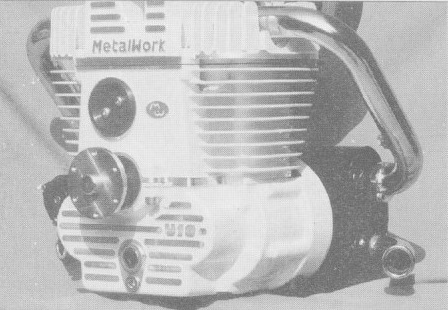
Cycle: 4 stroke No cylinders: 2 Bore: 90 mm Stroke: 78 mm Compression: 10 Displacement: 992 cc Cooling: Air/oil Ignition: Electronic Reduction: Mechanical Engrenages 1.9-4.2:1 Dimension: 486 x 400 x 477 mm Weight: 49 kg Max pwr: 68 hp at 5800 rpm Max torque: 75 Nm at 5800 rpm Fuel consumption: 8 lt/hr Price 1998: 14 000 DM
The Merlin was designed in 1986 by John Burch. The Merlin’s fuselage is all pre-welded at the factory and consists almost entirely of 5/8″ x .035 4130 chromoly steel tubing, versus 1/2″ tubing found in most tube and fabric kits. This framework provides the foundation for the Merlin’s ruggedness. The entire steel structure and all pieces are sandblasted and epoxy-primed, ensuring no worry of rust.
Fiberglass cowlings are custom designed and manufactured for each of the standard Merlin GT engine packages. These easy-to-install two- piece cowlings enable the builder to enclose his powerplant simply and efficiently.
The Merlin cockpit is a 41″ wide, and leg and headroom are sufficient to handle a pilot up to 6’6″ tall, plus passenger. For storage, a standard-equipment 10 cubic foot cargo pod is normally installed inside the cockpit, behind the seats. A skylight in the roof is available as an option.
The landing gear is a chromoly steel tube and bungee shock cord arrangement. Each Merlin GT is supplied with standard 8.00 x 6 tundra tires (approx. 19″ high x 8″ wide). Independent hydraulic toe brakes are also standard on every Merlin GT.
The Merlin is an aircraft designed to fly out of short unimproved strips. The plane is fairly tail-heavy on the ground, ensuring no tendency to nose over and damage the prop. This feature also makes the Merlin easier to handle on landing, with ample positive control of the fully steerable tailwheel.
Wing construction on the Merlin has a leading edge built of 2024T6 aircraft aluminum. The 9″ aluminum “I”-beam main spars (0.080″ laminated) and wing leading edges (“D-cells”) are completely pre-built by the Merlin Aircraft factory. The wing ribs are constructed by the builder, using high-density foam for lightweight and strength. These easily assembled ribs are capped with heavy-duty 0.040″ aluminum “U” channels. These “U” channel rib caps are joined from top to bottom of the rib by 1 ” straps of aluminum. There is no structural wood in the aircraft. Foam has been chosen because of its durability. Fewer ribs are required due to the rigidity they provide, simplifying construction and installation. The foam ribs can be repaired, if necessary, much more easily and affordably than either wood or aluminum stamping. Slotted full span ailerons have been incorporated into the design, for slow flight control and a responsive roll rate. The aileron horns are made of heavy aluminum and have never experienced any cracking or in-flight failures. The ailerons are controlled by push rods inside the cockpit, not by cables in the wing. This system eliminates high maintenance pulleys, hardware, bell cranks and control cables. The aileron control rods are easily accessible for routine inspection. Combined with the pre- fabricated “D” cells and aluminum capped foam ribs, these simple wings are the key to the Merlin GT’s established 350 hour quick build time. Each Merlin GT also comes with simple “folding-wing” capability, to facilitate trailering and road transport.
Typical take off distances with the 65 HP Rotax 582 is 150 to 200 feet dual, and about 100 feet solo. With a power-off stall as low as 34 mph, with low inertia and plenty of induced drag during landing (from the simple high-lift wing), landing rolls at full gross weight are often only 250 ft, and a true cruise speed of 85 mph.
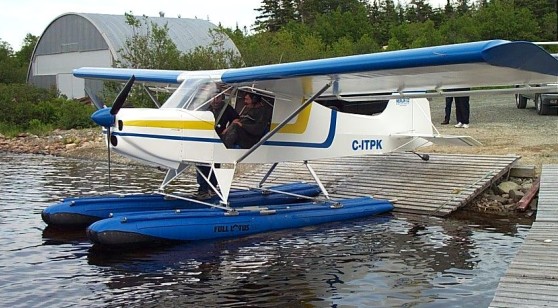
Being designed in Ontario, Canada, operation on floats and skis were a prime concern from day one. The first Merlin off the production line was fitted with Full Lotus amphibious floats. Each kit since has float-mounting plates welded to the airframe, making every aircraft easily adaptable to floats. In winter, the floats can easily be replaced by skis. These fit directly onto the existing axle tubes. Cruise speeds observed on skis are the same as on wheels-85 mph with the standard 68″ ground adjustable two-blade prop.
Blue Yonder Merlin GT / EZ
The Merlin GT is built using tried and proven building techniques, materials and aircraft hardware. Component kits were also available.
Aerocomp Merlin GT 582
First flown in January 1985, the Merlin GT-582 operates on wheels, floats or skis. One option is the Rotax 618 engine.
The AirComp Merlin GT-Rotax 912 features a wing folding option, and a 100 hp Continental option. First flown in January 1993.
Aerocomp inc Merlin Stall: 30 kt / 35 mph / 56 kmh Cruise: 78 kt / 90 mph / 145 kmh VNE: 104 kt / 120 mph / 193 kmh Empty Weight: 261 kg / 575 lbs MTOW Weight: 590 kg / 1300 lbs Climb Ratio: 1500 ft/min / 8 m/s Take-off distance (50ft obstacle): 400 ft / 122 m Landing distance (50ft obstacle): 400 ft / 122 m
Aerocomp Merlin GT-582 Empty weight: 220 kg Wing span: 9.1 m Wing area: 15.3 sq.m Fuel capacity: 49 lt Engine: Rotax 582, 64 hp MAUW: 520 kg Seats: 2 Max speed: 190 kph Cruise speed: 135 kph Minimum speed: 65 kph Climb rate: 7.5 m/s Fuel consumption: 15 lt/hr
Merlin GT-582 Speed max: 120 mph Cruise: 85 mph Range: 333 sm Stall: 34 mph ROC: 1100 fpm Take-off dist: 105 ft Landing dist: 150 ft Service ceiling: 18,000 ft Engine: Rotax 582, 65 hp Fuel cap: 16 USG Weight empty: 480 lb Gross: 1300 lb Height: 6.5 ft Length: 20 ft Wing span: 30 ft Wing area: 167 sq.ft Seats: 2 Landing gear: tail wheel
AirComp Merlin GT-Formula 110 Speed max: 120 mph Cruise: 98 mph Range: 379 sm Stall: 40 mph ROC: 1600 fpm Take-off dist: 120 ft Landing dist: 175 ft Service ceiling: 18,000 ft Engine: Subaru, 110 hp HP range: 65-120 Fuel cap: 16 USG Weight empty: 615 lb Gross: 1300 lb Height: 6.5 ft Length: 20 ft Wing span: 30 ft Wing area: 167 sq.ft Seats: 2 Landing gear: tail wheel
AirComp Merlin GT-Rotax 912 Speed max: 120 mph Cruise: 93 mph Range: 350 sm Stall: 38 mph ROC: 1500 fpm Take-off dist: 100 ft Landing dist: 150 ft Service ceiling: 18,000 ft Engine: Rotax 912, 120 hp HP range: 65-120 Fuel cap: 16 USG Weight empty: 615 lb Gross: 1300 lb Height: 6.5 ft Length: 20 ft Wing span: 30 ft Wing area: 167 sq.ft Seats: 2 Landing gear: tail wheel
Blue Yonder Merlin GT/EZ Cruise: 92 mph Range: 810 sm Stall: 32 mph ROC: 1500 fpm Take-off dist: 100 ft Landing dist: 200 ft Engine: Rotax 912S, 100 hp HP range: 65-130 Fuel cap: 24 USG Weight empty: 796 lb Gross: 1450 lb Length: 21 ft Wing span: 33 ft Wing area: 186 sq.ft Seats: 2 Cockpit width: 41 in Landing gear: floats
Blue Yonder Merlin Top Speed: 100 mph. Cruise Speed: 70 mph. Stall Speed: 35 mph. Fuel Capacity: 32 gal. Range: 350 n.m. Takeoff Distance: 50 ft. Landing Distance: 175 ft. Service Ceiling: 15,000 ft. Empty Weight: 789 lbs. Gross Weight: 1400 lbs. Height: 7 ft. Length: 23 ft. Wingspan: 35.5 ft. Wing Area: 235 sq. ft. Number of Seats: 2
Engines: 2 Rotax Top Speed: 100 mph. Cruise Speed: 70 mph. Stall Speed: 35 mph. Fuel Capacity: 32 USgal Range: 350 nm Takeoff Distance: 50 ft. Landing Distance: 175 ft Service Ceiling: 15,000 ft Empty Weight: 789 lb Gross Weight: 1400 lb Height: 7 ft Length: 23 ft Wingspan: 35.5 ft Wing Area: 235 sq. ft Number of Seats: 2
Blue Yonder win EZ Flyer Engines: 2 Rotax 503, 52 hp Hp range: 52-13 each Cruise Speed: 70 mph. Stall Speed: 38 mph. Range: 400 sm Takeoff Distance: 50 ft. Landing Distance: 175 ft Fuel Capacity: 33 USgal Empty Weight: 789 lb Gross Weight: 1450 lb Length: 23 ft Wingspan: 35.5 ft Wing Area: 235 sq. ft Number of Seats: 2


 All Aero