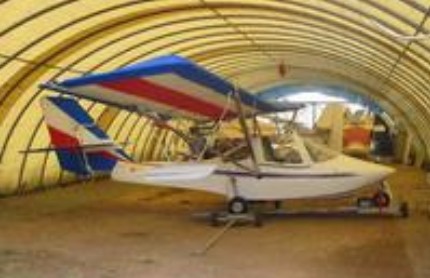
Midwest Microlights Tomcat Two-place

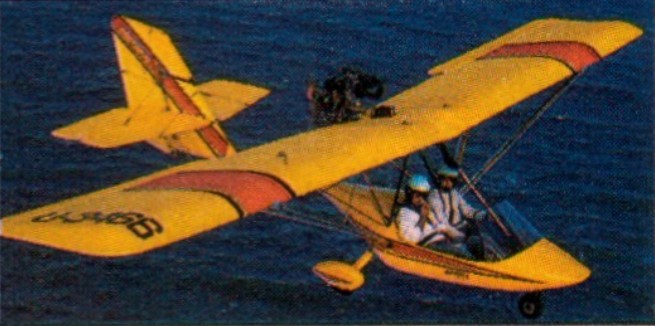
This side by side two¬-seater version of the HM 81 Tomcat was announced at the finish of the 1981 and appeared early in 1982.

Engine: Cuyuna 430R, 30 hp at 5500 rpm.
Propeller diameter and pitch 54 x 36 inch, 1.37 x 0. 91 m.
V belt reduction, ratio 2.0/1.
Max static thrust 250 lb, 113 kg.
Power per unit area 0.17 hp/sq.ft, 1.8hp/sq.m.
Fuel capacity 5.0 US gal, 4.2 Imp gal, 18.9 litre.
Length overall 12.0 ft, 3.66 m.
Height overall 10.0ft, 3.05m.
Wing span 30.0ft, 9.14m.
Chord at root 4.0ft, 1.22 m.
Chord at tip 3.0 ft, 0.91 m.
Main wing dihedral 0 deg.
Main¬ wing sweep back 0 deg.
Canard span 8.0ft, 2.43m.
Canard chord 3.0ft, 0.91m.
Total wing area 175 sq.ft, 16.3sq.m.
Main wing area 125 sq.ft, 11.6 sq.m.
Canard area 25 sq.ft, 2.3 sq.m.
Total dihedral wing area 25 sq.ft, 2.3 sq.m.
Main wing aspect ratio 7.2/1.
Wheelbase 7.0ft, 2.13 m.
Nosewheel diameter overall 10 inch, 25 cm.
Main wheels diameter overall 10 inch, 25 cm.
Empty weight 245 lb, 111 kg.
Max take off weight 605 lb, 274kg.
Payload 360 lb, 163 kg.
Max wing loading 3.46 lb/sq.ft, 16.8kg/sq.m.
Max power loading 20.2 lb/hp, 9.1 kg/hp.
Load factors +5.0, 3.0 design.
Max level speed 60 mph, 97 kph.
Cruising speed 45mph, 72kph.
Stalling speed 24mph, 38kph.
Max climb rate at sea level 350 ft/min, 1.8 m/s.
Best glide ratio with power off 7/1.
Take off distance 180 ft, 55 m.

Midwest Microlights HM-81 Tomcat Tourer / The Baron / Waspair Tomcat

Single seat single engined high wing mono¬plane with additional dihedral wings; unconventional three axis control. main wing has unswept leading and trailing edges, and constant chord; no tall, canard wing. Pitch control by fully flying canard; yaw/roll control by control surfaces on dihedral wings; control inputs through stick for pitch/yaw/roll. Main wing braced from below by dihedral wings. Wing profile; double surface. Undercarriage has three wheels in tricycle formation; rubber suspension on main wheels. Push right go-right nosewheel steering independent from yaw control. No brakes. Aluminium tube framework, without pod. Engine mounted below main wing driving pusher propeller. Tubing in 6061T6 aluminium, anodized. Stainless steel cables. Dacron wing covering.

Waspair Tomcat Article

Robin Haynes, founder and president of the Waspair Corporation which originally produced the Tomcat, de¬signed this unique machine at the end of 1979. It only became the Tomcat after a succession of names, the first production models having been sold under the name The Baron.

At Oshkosh in 1981 the HM 81 won the EAA prize for the most outstanding new design. The aerodynamic configuration of this machine is very unusual and warrants some supplementary explanation. The Tomcat is made up of three lifting elements: the main wing (67% of the total lift), the two inclined structural wings angled at 45O and with 15O sweepback, (18% of the lift) and the canard (15% of the total lift). The main wing is fixed and devoid of control surfaces, while the inclined wings, Which he called dihedral wings, are two fixed surfaces carrying elevons, like a V tail. The canard angle of attack can be altered to control pitch, all control being by a single stick which acts as a mixer on the elevons and the canard.

At the beginning of 1982, Waspair Cor¬poration offered the standard version of the Tomcat fitted with the twin cylinder 430D 30hp engine and direct drive; with the 430R and 2/1 reduction drive, the machine was called the Tomcat Sport. However, by the end of 1982, the latter had become the standard version. Also appearing at the beginning of 1982 was a Tourer version for the heavier pilot with a heavy duty airframe and the Cuyuna 430R. It is this model on which the company is now concentrating and at the Sun ‘n’ Fun in Lakeland, in March 1983, the maker was marketing it as the standard version. In kit form it costs $4695 and pre built it costs an extra $1150.

Engine: Cuyuna 430R, 30 hp at 5500 rpm.
Propeller diameter and pitch 54 x 36 inch, 1.37 x 0. 91 m.
V belt reduction, ratio 2.0/1.
Max static thrust 250 lb, 113 kg.
Power per unit area 0.17 hp/sq.ft, 1.8hp/sq.m.
Fuel capacity 5.0 US gal, 4.2 Imp gal, 18.9 litre.
Length overall 12.0 ft, 3.66 m.
Height overall 10.0ft, 3.05m.
Wing span 30.0ft, 9.14m.
Chord at root 4.0ft, 1.22 m.
Chord at tip 3.0 ft, 0.91 m.
Main wing dihedral 0 deg.
Main¬ wing sweepback 0 deg.
Canard span 8.0ft, 2.43m.
Canard chord 3.0ft, 0.91m.
Total wing area 175 sq.ft, 16.3sq.m.
Main wing area 125 sq.ft, 11.6 sq.m.
Canard area 25 sq.ft, 2.3 sq.m.
Total dihedral wing area 25 sq.ft, 2.3 sq.m.
Main wing aspect ratio 7.2/1.
Wheelbase 7.0ft, 2.13 m.
Nosewheel diameter overall 10 inch, 25 cm.
Main wheels diameter overall 10 inch, 25 cm.
Optional floats, length 11.0 sq.ft, 3.35 m.
Optional skis, length 3.0 ft, 0.91 m.
Empty weight 235 lb, 107 kg.
Max take off weight 595 lb, 270 kg.
Payload 360 lb, 163 kg .
Max wing loading 3.40 lb/sq.ft, 16.6 kg/sq.m.
Max power loading 19.8 lb/hp, 9.0kg/hp.
Load factors +6.0, 4.0 design; +8.0, 6.0 ulti¬mate.
Max level speed 60 mph, 97 kph.
Never exceed speed 65 mph, 105 kph.
Max cruising speed 45 mph, 72 kph.
Economic cruising speed 40mph, 64kph.
Stalling speed 27 mph, 43 kph.
Max climb rate at sea level 800 ft/min, 4.1 m/s.
Min sink rate 250 ft/min at 30 mph, 1.3 m/s at 48 kph.
Best glide ratio with power off 8/1 at 30 mph, 48 kph.
Take off distance 90 ft, 27 m.
Landing distance 125 ft, 38 m.
Service ceiling 15,000 ft, 4570 m.
Range at average cruising speed 125 mile, 201 km.
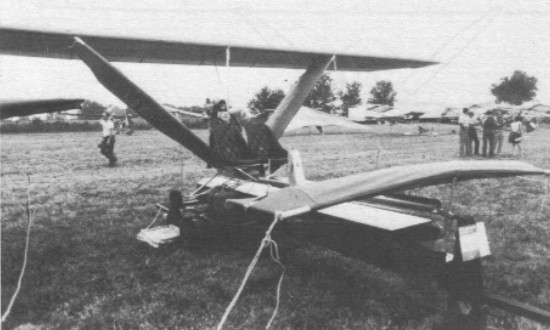
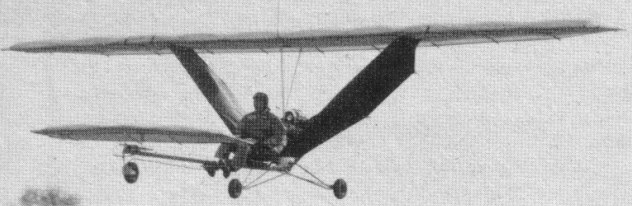
Microwings Cubby / Tri-Cubby

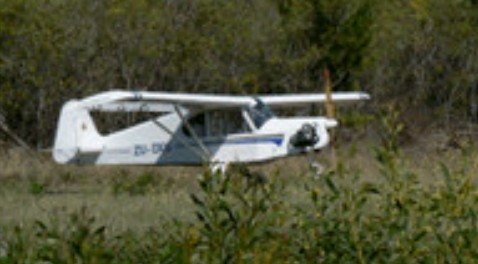
The Cubby is 75% of the original J-3 Piper cub. With modern materials and technology the performance has been improved, and the Cubby uses automotive fuel as opposed to AVGAS.

The Cubby can be registered as a three axis micro-light or a non type certified light aircraft. The Cubby was available in tri-gear or tail dragger. The 2009 Price was dependable on the choice of engine. The option to have the Cubby interchangeable between tri-gear and tail dragger was also available on request as an option.

The factory is up to CAA standards. All upgrade and changes requested by CAA has been done and communicated to all Cubby owners. All correspondence of changes and upgrades are posted to Cubby owners with a newsletter.

Tri-Cubby

There were 26 flying in South Africa and 3 on order. The Cubby was available in kit form, fast built and basic kit, or as ready to fly or fully built but without engine, radio and instruments.

Cubby
Stall: 40 kt / 46 mph / 74 kmh
Cruise: 74 kt / 85 mph / 137 kmh
VNE: 113 kt / 130 mph / 209 kmh
Empty Weight: 260 kg / 573 lbs
MTOW Weight: 500 kg / 1102 lbs
Climb Ratio: 1200 ft/min / 6 m/s
Take-off distance (50ft obstacle): 660 ft / 200 m
Landing distance (50ft obstacle): 820 ft / 250 m

Tri-cubby
Stall: 45 kt / 52 mph / 83 kmh
Cruise: 100 kt / 115 mph / 185 kmh
VNE: 130 kt / 150 mph / 241 kmh
Empty Weight: 260 kg / 573 lbs
MTOW Weight: 500 kg / 1102 lbs
Climb Ratio: 1200 ft/min / 6 m/s
Glide Ratio: 10:1
Take-off distance (50ft obstacle): 330 ft / 100 m
Landing distance (50ft obstacle): 490 ft / 150 m

Microleve ML500

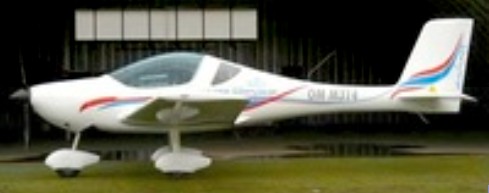
Basic ultralight, tricycle landing gear, with rigid wing. Now with a full closed cabin.

Stall: 26 kt / 30 mph / 48 kmh
Cruise: 78 kt / 90 mph / 145 kmh
VNE: 96 kt / 110 mph / 177 kmh
Empty Weight: 220 kg / 485 lbs
MTOW Weight: 500 kg / 1102 lbs
Climb Ratio: 1000 ft/min / 5 m/s
Glide Ratio: 12:1
Take-off distance (50ft obstacle): 330 ft / 100 m
Landing distance (50ft obstacle): 330 ft / 100 m

Microleve ML450

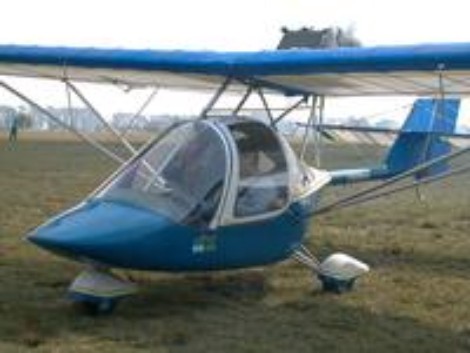
A two place, side by side with trigear or tail wheel. First flown in 1989.

Engine: Rotax 582, 65 hp
HP range: 55-74
Height: 6.9 ft
Length: 22.4 ft
Wing span: 33.8 ft
Wing area: 177.4 sq.ft
Empty weight: 484 lb
Gross weight: 980 lb
Fuel capacity: 17 USG
Top speed: 100 mph
Cruise: 70 mph
Stall: 20 mph
Range: 289 sm
Rate of climb: 1000 fpm
Takeoff dist: 200 ft
Landing dist: 100 ft
Service ceiling: 10,000 ft
Seats: 2
Landing gear: nose or tail

Microleve Corsario

Mk.V

A two place, side by side LSA amphibian with retractable trigear or tail wheel. First flown in 1989.

Mk.III
Engine: Rotax, 74 hp
HP range: 66-80
Height: 6.9 ft
Length: 22.4 ft
Wing span: 33.8 ft
Wing area: 177.4 sq.ft
Empty weight: 540 lb
Gross weight: 1100 lb
Fuel capacity: 17 USG
Top speed: 100 mph
Cruise: 75 mph
Range: 289 sm
Rate of climb: 800 fpm
Takeoff dist land: 260 ft
Takeoff dist water: 330 ft
Landing dist land: 220 ft
Landing dist water: 250 ft
Service ceiling: 10,000 ft
Seats: 2
Landing gear: nose or tail wheel

Mk.5
Engine: Rotax 912, 80 hp
HP range: 80-100
Length: 22.6 ft
Wing span: 33 ft
Wing area: 175 sq.ft
Empty weight: 685 lb
Gross weight: 600 kg / 1320 lb
Cruise: 85 mph
Stall: 42 mph
Fuel capacity: 20 USG
VNE: 120 kt / 138 mph / 222 kmh
Range: 460 sm
Rate of climb: 900 fpm
Glide Ratio: 10:1
Seats: 2
Cockpit width: 44 in
Landing gear: nose or tail wheel
2009 Price: US$17000