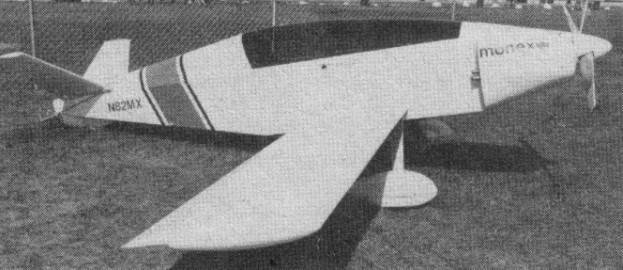
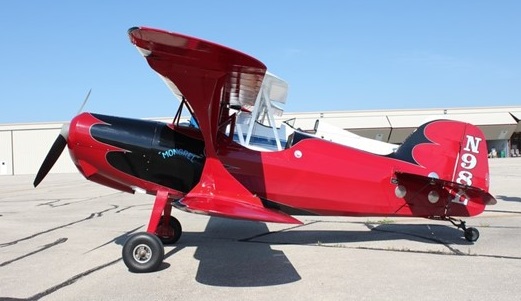
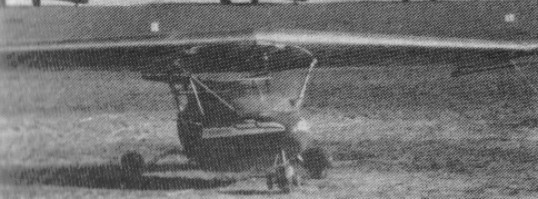
The Monex made its maiden flight on September 30, 1980. It is a high-performance, single-place, conventionally geared aircraft, and was used primarily as a research and development airplane for the Moni. The construction technique used in Monex is reflected in the Moni series of aircraft available in kit form.
After enjoying success with his original VW-powered Sonerai, John Monnett decided to develop the Sonerai II, a tandem-seated version. Both pilot and passenger sit under a bubble canopy which is hinged on the right side. The Sonerai II differs mainly by being slightly larger, making use of a more powerful engine, and by being stressed for aerobatics when flown by the pilot alone.
Sonerai IIL
The II-L is the same aircraft but with a “low-wing”. The low-wing version is especially popular with 6 foot plus pilots, as the pilot legs go over the main spar carry through structure.
The Sonari II was also available as a low-wing nose gear two place, or the Sonerai II-Stretch: A low-wing model 18″ longer than the original, as a low-wing taildragger and a low-wing tri-gear. The Sonerai II-LT is the steerable nose wheel version.
The Sonerai II series will accept VW power plants from 1700cc – 2276cc.
All models of the Sonerai II use a minimum of different sizes of materials to reduce the cost, without hampering the integrity of the design. The wing is all aluminum and is composed of two panels that easily fold along side the fuselage enabling the Sonerai II, II-L and II-LT to be towed tail first on its own gear. Stainless steel cherry rivets are used to skin the wing. The fuselage and tail surfaces are constructed of standard sizes of 4130 steel tubing that are fabric covered. All aluminum sheet used is 2024-T3 .025″ except for the spars which are .040″.
The fiberglass cowling removes easily to allow complete access to the engine, magneto, tank and instruments. The landing gear is a formed aluminum spring with 5″ wheels and 3/4″ axles. A tapered tailspring rod is used for the tailwheel (II and II-L) All Sonerai II’s feature a l0 US gallon main tank with the option of a 6 gallon auxiliary tank carried on the passengers floor board (without passenger).
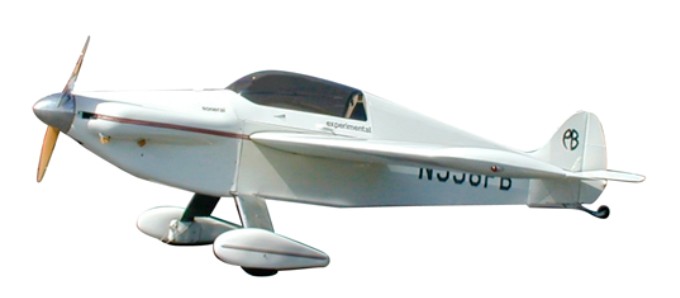
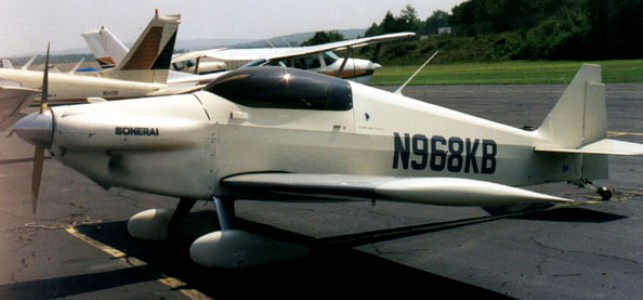
The Sonerai I is a mid-wing sport plane, racer, designed and first built in 1971to meet all Professional Race Pilots Association (PRPA) and Formula Vee Racing requirements for 1600cc Volkswagen powered aircraft. Its wings are 2024-T3 aluminum.025″ except for the spars which are .040″. The wing is composed of two panels that fold along side the fuselage, enabling the Sonerai I to be towed tail first on it’s own gear. Stainless steel cherry rivets are used to skin the wing. The fuselage and tail are of standard 4130 chrome moly tubing.
The Sonerai I uses a minimum of different sizes of tubing to reduce the cost. Cowling is fiberglass, and fuselage and tail surfaces are fabric covered. The fiberglass cowling removes easily to allow complete access to the engine, magneto, tank and instruments. The landing gear is manufactured from 1/2″ x 5″ 2024T-351 aluminum. The Sonerai I will accept engine displacements from 1600cc through 2180cc.
The Sonerai was also marketed as the Great Plains Aircraft Sonerai (1998). The Sonerai I can handle +/- 6 G’s with the “S” wing and will do 170 mph flat out with a Great Plains 2180cc engine.
John T Monnett founded his company to sell plans and some compo¬nents for his Formula V Racer, the Sonerai, which was awarded the prize at the 1971 EAA convention at Oshkosh for the best single seat, Volkswagen engined aircraft.
1980: Monnett Experimental Aircraft, 955 Grace, Elgin, Il 60120, USA. 1982-3: Monnet Experimental Aircraft Inc, 895 W 20th Avenue, PO Box 2984, Oshkosh, Wiscon¬sin 54903, USA.
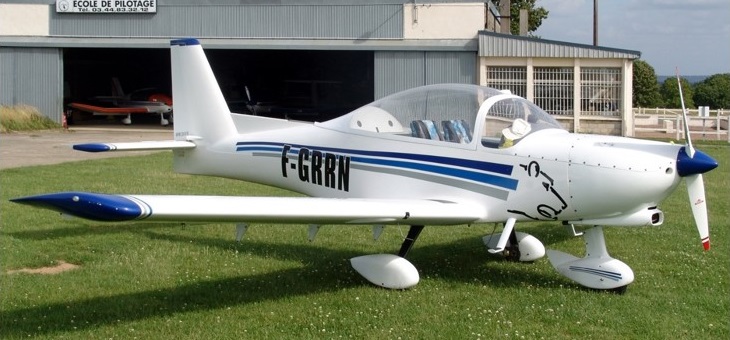
The APM 20 Lionceau began as the Moniot APM-20 in 1992, by Les Industries de Composites d’Auvergne Reunites (ICAR).
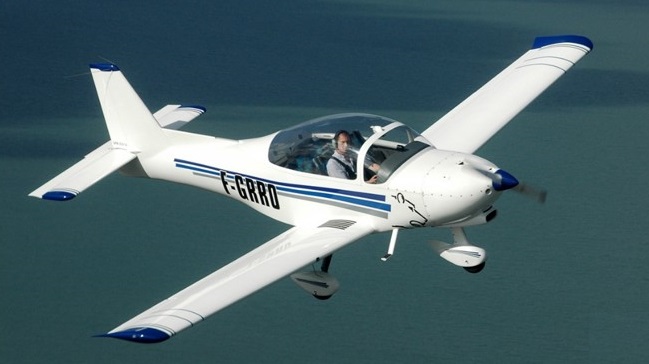
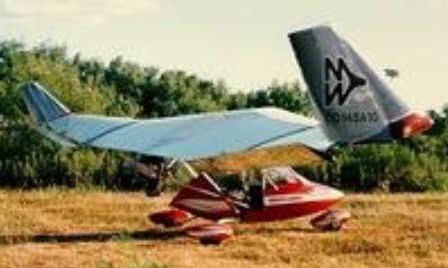
Designed by Philippe Moniot at Rex Composites and certified in 1999 EASA CS-VLA, the APM 20 Lionceau is a very light (400 kg empty, 634 kg loaded) and economical 73.5 kW (98.6 hp) Rotax 912 ULS powered aircraft is primarily intended to be used to learn to fly, but also to travel with a relatively high cruise speed (113 knots).
Manufactured by the French manufacturer Issoire Aviation, it is entirely built from composite materials, especially carbon fibers. Design (as Moniot APM-20) was started 1992 by Les Industries de Composites d’Auvergne Reunites (ICAR).
Issoire APM 20 Lionceau
The design features a low wing, NACA 63618 aerofoil, thickness/chord ratio 18 per cent, dihedral 3o, incidence 2o, twist 1o. The structure is Carbon fibre/epoxy. Flying controls are conventional and manual. Spring elevator tab for pitch trim. Electrically operated slotted flaps to about two-thirds span. A refuelling point is on the port side of fuselage.
The landing gear is fixed tricycle type with spats; oleo-sprung steerable nose leg, composites main legs. Mainwheels and nosewheel diameter 330 mm; maximum pressure 2.35 bar (34 lb/sq in).
Two, side by side seats are under rearward-sliding tinted canopy. Dual controls standard. Baggage compartment at rear of seats. Fixed step forward of wing leading-edge on each side.
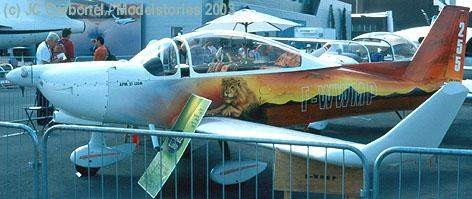
The prototype (F-WWMP) exhibited at Paris Air Show 1995 before first flight on 21 November 1995; third (second flying) aircraft (F-WWXX) exhibited statically at Paris Air Show, June 1997, fitted with JPX flat-four engine, which is not offered on production aircraft.
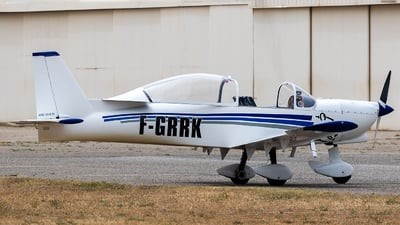
No.4 (also registered F-WWXX) was exhibited at Paris in June 1999 and No.5 (F-GRRE) in 2001.
They were certified to JAR-VLA on 17 May 1999 and to JAR-21 in 2000. The first all-carbon fibre, single-engine aircraft to gain JAR-VLA certification.
Development cost around FFr10 million. Unit cost FFr620,000, minimally equipped or FFr700,000 with standard equipment (2001). Operating cost FFr350 per hour (1998).
First flying in December 1995, the Issoire Aviation APM 20 Lionceau is entirely built from composite materials, especially carbon fibers. Production is carried out by Issoire Aviation.
The APM-22 Liondo was the prototype APM-21 F-WWMP equipped with large winglets and exhibited at Paris, 15-22 June 2003, as representative of this UAV proposal, with 24-hour endurance and 556 kg (1,225 lb) MTOW.
APM-22 Liondo
A three-seat version, the APM 30 Lion, was presented at the 2005 Paris Air Show.
Issoire APM-20 lionceau Engine: Rotax 912A, 59.6 kW (80 hp) Propeller: Evra AL1 two-blade, fixed-pitch wooden Wingspan: 8.66 m (28 ft 5 in) Wing area: 9.5 m2 (102 sq ft) Aspect ratio: 7.9 Airfoil: NACA 63-418 Length: 6.6 m (21 ft 8 in) Height: 2.4 m (7 ft 10 in) Empty weight: 380 kg (838 lb) Max takeoff weight: 620 kg (1,367 lb) Fuel capacity: 68 litres (18.0 US gallons; 15.0 Imp gallons) Usable fuel: 65 litres (17.2 US gallons; 14.3 Imp gallons) Cruise speed: 230 km/h (140 mph, 120 kn) Stall speed: 80 km/h (50 mph, 43 kn) Never exceed speed: 250 km/h (160 mph, 130 kn) Endurance: 4–5 hours Rate of climb: 3.4 m/s (670 ft/min) Seats: 2
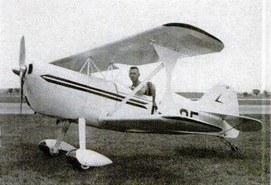
The first Mong Sport was built as a personal aircraft by the designer Ralph Mong, Jr, first flown on May 1, 1953 and plans for homebuilding were provided afterward, due to demand.
Mong Sport
The original Mong MS1 Sport biplane was built around a Continental A65 65 hp (48 kW) engine. The biplane has an A frame shaped centre wing support. The biplane did not require expensive, drag producing support wires, using steel tubing instead. All Mong models use lift struts connected to the outer sections of the wings instead of flying and landing wires. Some builders installed the centre pylon support as an alteration to the design. But this alteration is not supported, recommended or condoned by Mong Aircraft. The fuselage is steel tube with aircraft fabric covering.
Costing approximately $1750 to build in 1971, original plans were still available for $100.00, plus shipping, out of the USA. Over 400 sets of plans for the aircraft had been sold.
Ed Fisher of Raceair Designs purchased the design rights in 1993 and designed a new set of wings that have 12 square feet more wing area, aimed at lower stall speeds. A new MS-3 airframe puts the control column under the longerons, which lowers the seat about 2″.
By 2019 Michael Stewart was owner of Mong Aircraft.
A Mong is a loop/roll/spin positive maneuver sport Biplane. For a sportplane Mong, recommended is the O-200 Continental for power.
In the mid-1960s, a biplane class was added to the Reno Air Races. The Mong Sport met the basic qualifications, and has been extensively modified over the years by builders to be used as a biplane racer. In 1965, Bill Boland won with his “Boland Mong” at 148 mph and again in 1967 and 1970 with speeds of 151 mph and 177 mph respectively. The Mongster won the 1968 Biplane class of the Reno National Championship. Long Gone Mong won in 1987 and 1989.
A highly modified Mong Phantom of Andrew Buehler and Tom Aberle with carbon fibre wings won in 2005 piloted by Andrew Buehler with 230,8 mph ( a 10 mph lead to the second place), and in 2006 with a speed of 251.958 mph, and has since raised the record to 284.454mph.
The Mong is the basis of the Micro Mong that Ed Fisher designed.
Mong MS1 Sport Engine: 1 × Continental A65, 65 hp (48 kW) Length: 14 ft 1 in (4.29 m) Wingspan: 16 ft 10 in (5.13 m) Height: 5 ft 6 in (1.68 m) Wing area: 80 sq ft (7.4 m2) Empty weight: 550 lb (249 kg) Gross weight: 970 lb (440 kg) Fuel capacity: 16 US gallons (61 litres) Maximum speed: 100 kn; 185 km/h (115 mph) Cruise speed: 96 kn; 177 km/h (110 mph) Stall speed: 43 kn; 80 km/h (50 mph) Service ceiling: 13,000 ft (4,000 m) Rate of climb: 1,000 ft/min (5.1 m/s) Crew: 1
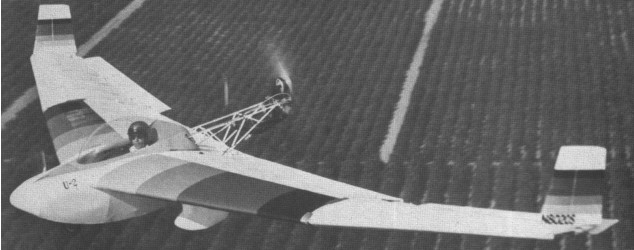
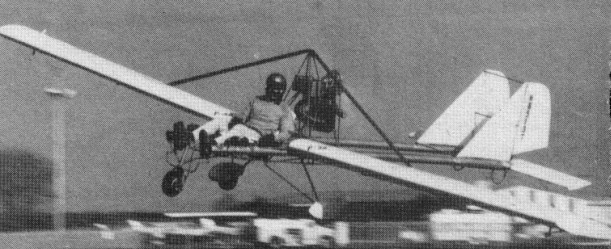
With the Zenoah engine and a considerable evolution in the wing itself Mitchell produced the self-launching U-2 with a fuselage of welded steel tube, and wing of composite structure. The spar is wood, with foam nose ribs and a plywood skin forming a D- tube. Tip rudders provide yaw control. Single seat single engined mid wing monoplane with conventional three axis control. Wing has swept back leading and trailing edges, and tapering chord; no tail. Pitch/roll control by stabilators; yaw control by tip rudders; control inputs through stick for pitch/roll and pedals for yaw. Cantilever wing; wing profile modified Worthmann; double ¬surface. Undercarriage has three wheels in tricycle formation; suspension on main wheels. Push right go right nosewheel steering connected to yaw control. Brake on nosewheel. Wood/steel tube fuselage totally enclosed. Engine mounted above wing driving pusher propeller.
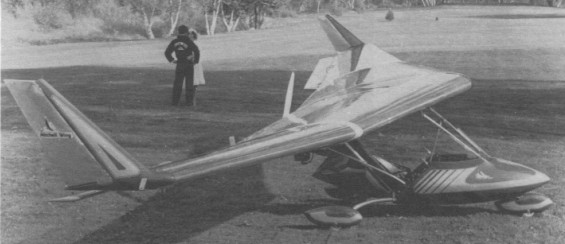
The Super U-2 is a flying wing with three-axis controls featuring winglet-type hinged rudders for yaw control and stabilators for pitch and roll control. Control surfaces are operated separately, and rudders can be simultaneously deflected. Construction is of chromomoly tubing with Douglas fir and birch plywood. Foam is used for the leading edge ribs and nose cone. Wings are covered with 1 mm birch plywood and ceconite. Tail surfaces and fuselage are covered with ceconite. POWERPLANT: Zenoah G25B-1 in a pusher position above the wing. A 2.25:1 reduction unit turns a two blade wooden propeller made by Woody’s Prop Shop. Fuel is carried in a polypropylene tank installed in the wing. LANDING GEAR: Solid tricycle gear with a steerable nosewheel and a nosewheel friction brake. Main and nose wheels are 10½-inch. OPTIONS: Cuyuna 430R Power Pack, Blueprint plans.
The prototype of the U 2 Super Wing made its first flight in the Spring of 1980 and was presented more as a powered glider with soaring capability than as an ultralight. Initially this flying wing was even envisaged as having a retractable tricycle undercarriage, although this was dropped in favour of having com¬pletely faired in main gear.
With a glide angle of 20/1 at 45 mph (72 kph) the U 2 is perfectly happy with a low powered engine like the single cylinder McCulloch Mc101 derated to 10hp, however, the aircraft was designed to be powered by engines up to 30 hp and Mitchell Aircraft have offered a kit since 1981 with, as an option, either Zenoah G25B 20hp or Cuyuna 430R 30 hp engines. The design philosophy remains very close to that of the B 10 Mitchell Wing but is applied to a more complex machine, so the amount of time for assembly is considerably more, around 250 h for the major fabrication and 100 h for finishing off. It is classified as an experimental home¬built and not an ultralight in the USA, requiring the pilot to have at least a private pilot’s licence.
Prototype Engine: McCulloch 125cc, 10 hp Gross wt: 450 lbs Empty wt: 225 lbs Max pilot wt: 250 lbs First year built: 1979
Super U-2 Engine: Zenoah G25B, 20 hp at 6300rpm Propeller diameter and pitch 52 x 27 inch, 1.32×0.69m Belt reduction, ratio 10/1 Power per unit area 0.14hp/sq.ft, 1.6 hp/sq.m Fuel capacity 3.0 US gal, 2.5 Imp gal, 11.4 litre Length overall 9.0ft, 2.74m Height overall 3.0ft, 0.91m Wing span 34.0ft, 10.36m Chord at root 6.2ft, 1.87m Chord at tip 2.0ft, 0.61m Dihedral 6 deg Sweepback 12 deg Total wing area 136 sq.ft, 12.6 sq.m Wing aspect ratio 8.5/1 Nosewheel diameter overall 10 inch, 25 cm Main wheels diameter overall 10 inch, 25 cm Empty weight 240 lb, 109 kg Max take off weight 550 lb, 249 kg Payload 310 lb, 141 kg Max wing loading 4.04 lb/sq.ft, 19.7 kg/sq.m Max power loading 27.5 lb/hp, 12.5 kg/hp Max cruising speed 60 mph, 97 kph Stalling speed 26 mph, 42 kph Max climb rate at sea level 400 ft/min, 2.0 m/s Take off distance 200ft, 61m Landing distance 200ft, 61m Range at average cruising speed 180 mile, 290 km
Super U-2 Engine: Cuyuna 430R, 30 hp Belt reduction Power per unit area 0.22hp/sq.ft, 2.4 hp/sq.m Fuel capacity 3.0 US gal, 2.5 Imp gal, 11.4 litre Length overall 9.0ft, 2.74m Height overall 3.0ft, 0.91m Wing span 34.0ft, 10.36m Chord at root 6.2ft, 1.87m Chord at tip 2.0ft, 0.61m Dihedral 6 deg Sweepback 12 deg Total wing area 136 sq.ft, 12.6 sq.m Wing aspect ratio 8.5/1 Nosewheel diameter overall 10 inch, 25 cm Main wheels diameter overall 10 inch, 25 cm Empty weight 300 lb, 136 kg Max take off weight 550 lb, 249 kg Payload 250 lb, 113 kg Max wing loading 4.04 lb/sq.ft, 19.7 kg/sq.m Max power loading 18.3 lb/hp, 8.3 kg/hp Load factors; +7.8, 7.8 ultimate Max level speed 100mph, 161kph Max cruising speed 70 mph, 113 kph Stalling speed 37 mph, 60 kph Max climb rate at sea level 750 ft/min, 3.8 m/s Min sink rate 180ft/min at 45mph, 0.9 m/s at 72 kph Best glide ratio with power off 23/1 at 49mph, 79kph Take off distance 210ft, 64m Landing distance 250ft, 76m Service ceiling 12,000ft, 3660 m Range at average cruising speed 80 mile, 129 km
Single seat single engined mid wing monoplane with conventional three axis control. Wing has unswept leading and trailing edges, and constant chord; two fin tail. Pitch control by fully flying tail; yaw control by fin mounted rudders; roll control by full span ailerons also usable as flaps; control inputs through stick for pitch/roll and pedals for yaw. Wing braced from above by struts, wing profile NACA 23015; double surface. Undercarriage has three wheels in tricycle formation, with addi¬tional tailskids; steel spring suspension on nosewheel and glass fibre suspension on main wheels. Push right go right nosewheel steering connected to yaw control. Brake on nosewheel. Aluminium tube/wood/steel tube framework, with optional pod. Engine mounted above wing driving pusher propeller.
The P 38 was designed by Jim Meade and christened Lightning after the famous twin boom fighter of the Second World War. The prototype appeared at the end of 1980 and the first P 38 was sold during the second quarter of 1981. The prototype was fitted with a 26.0ft (7.92m) span wing having a 4.0ft (1.22m) chord, giving 104sq.ft (9.7 sq.m) of wing area using the same NACA 23015 profile as the B 10. With 200 lb (91 kg) empty weight and 450 lb (204 kg) maximum gross weight, this machine carried 250 lb (113 kg) useful load with a wing loading of 4.32 lb/sq.ft (21.1 kg/sq.m).
On the production models, the wing span was increased to 28.0ft (8.53m) and the chord also increased. Initially fitted with a Honda Odyssey engine of 250 cc giving 20 hp, or as an option a Zenoah G25B also of 20 hp, the P 38 was in 1983 powered by the twin cylinder Cuyuna 430RR 30 hp engine. Its characteristics and performance figures do not allow its classification as an ultralight, so it is therefore necessary to hold at least a private pilot’s licence to fly the Lightning in the US.
The complete kit, requiring 80 h for assembly, has less than 200 pieces, the principal components being prefabricated and partly assembled. The wing ribs are wood, bonded with epoxy to the tubular Duralumin spar, while the leading edges are of polyurethane foam shaped and then covered with birch plywood. On the P 38, the ‘flaperons’ a combination of flap and aileron are made with ribs every 6 inch (15 cm). Like the other Mitchell models, this one is also available as an economy kit or as plans only.
Units delivered by June 1981 35 kits and plans.
The AG 38 is the crop spraying version of the P 38 Lightning, to which it is very similar except a pod is fitted. The prototype AG 38 was shown to the public during the EAA Convention at Oshkosh in August 1982. This aircraft is fitted with Micron X15 100 variable speed rotating nozzles, which are said to control droplet size and so reduce the amounts of chemical and water required. They are supplied from a shaped tank which carries 14.0 US gal (11.7 Imp gal, 53.0litre) of spray chemical. The tank is fitted under the seat and central wing section, between the legs of the main landing gear. An electric pump feeds the spray booms which are fitted with 19 fan nozzles across the full wing span. For a better spread, the two spray bars are placed at not the trailing edge as is usual, but 9.5 inch (24 cm) below the level of the wing.
At 50mph (80kph) the AG 38 spray swath varies from 20ft (6m) wide at 6ft (2m) altitude to 45 ft (14 m) wide at 15 ft (5 m) altitude. With the equipment set for maximum delivery, the AG 38 can deliver 48oz/acre (3.4 litre/hectare) and can treat 37 acre (15 hectare) per load. Reloading is required every 30 min, allowing an average coverage of 60 acre/h (24 hectare/h). At the other end of the scale, the machine can be set up for maximum acreage, when it will deliver 6oz/acre (0.42 litre/hectare) and treat 300 acre (120 hectare) per load. Reloading is required approximately every 2h, giving an average coverage of 140 acre/h (56 hectare/h).
P-38 Engine: Cuyuna 430RR, 35 hp at 5500 rpm Power per unit area 0.29 hp/sq.ft, 3.1 hp/sq.m Length overall 17.0ft, 5.18 m Height overall 5.0ft, 1.52m Wing span 28.0ft, 8.53m Constant chord 4.3 ft, 1.29 m Sweep forward 5 deg Total wing area 120 sq.ft, 11.2 sq.m Wing aspect ratio 6.5/1 Wheel track 5.0 ft, 1.52 m Nosewheel diameter overall 10 inch, 25 cm Main wheels diameter overall 10 inch, 25 cm Empty weight 305 lb, 138kg Max take off weight 700 lb, 317kg Payload 395 lb, 179kg Max wing loading 5.83 lb/sq.ft, 28.4 kg/sq.m Max power loading 20.0 lb/hp, 9.lkg/hp Load factors; +4.0, 4.0 ultimate Max level speed 65 mph, 105 kph Max cruising speed 55 mph, 88 kph Stalling speed 32 mph, 51 kph Max climb rate at sea level 500 ft/min, 2.5 m/s Min sink rate 400 ft/min, 2.0 m/s Best Wide ratio with power off 7/1 Take off distance 210ft, 64m Landing distance 250ft, 76m Service ceiling 12,000ft, 3660m Range at average cruising speed 110 mile, 177 km
AG-38 Engine: Cuyuna 430RR, 35 hp at 5500 rpm Power per unit area 0.29 hp/sq.ft, 3.1 hp/sq.m Length overall 17.0ft, 5.18 m Height overall 5.0ft, 1.52m Wing span 28.0ft, 8.53m Constant chord 4.3 ft, 1.29 m Sweep forward 5 deg Total wing area 120 sq.ft, 11.2 sq.m Wing aspect ratio 6.5/1 Wheel track 5.0 ft, 1.52 m Nosewheel diameter overall 10 inch, 25 cm Main wheels diameter overall 10 inch, 25 cm Empty weight 325 lb, 147kg Max take off weight 700 lb, 317kg Payload 375 lb, 170kg Max wing loading 5.83 lb/sq.ft, 28.4 kg/sq.m Max power loading 20.0 lb/hp, 9.lkg/hp Load factors; +4.0, 4.0 ultimate Max level speed 65mph, 105kph Stalling speed 35mph, 56kph Max climb rate at sea level 500ft/min, 2.5 m/s Take off distance 275 ft, 85 m Landing distance 325 ft, 100 m
Single seat single engined high wing monoplane with conventional three axis control. Wing has swept back leading and trailing edges, and tapering chord; no tail. Pitch/roll control by stabilators; yaw control by tip rudders; control inputs through stick for pitch/roll and pedals for yaw. Cantilever wing; wing profile; double surface. Undercarriage has three wheels in tricycle formation. Push right go right nosewheel steering connected to yaw control. Aluminium tube framework, with pod. Engine mounted below wing driving pusher propeller.
Shown in December 1982, the A 10 Silver Eagle is an updated version of the B 10 Mitchell Wing, not only as regards detail improvements, but in the technology and type of manufacture. Don Mitchell has abandoned the overhead stick, which comes down from the high wing on the B 10, to replace it with a conventional stick between the pilot’s knees. Materials (wood and fabric) used for the B 10 wing have been superseded by aluminium and a foam developed by NASA called honeyfoam and designated SR 502B, the final B indicating the use of boron.
The A 10 Silver Eagle was sold ready to fly and includes a fairing for the cockpit, wheel fairings on the main wheels, an upholstered seat with shoulder harness and an instrument panel. The price in April 1983 was $5995.
Mitchell Wing A-10
Ameriplanes Inc sold the Mitchell Wing A-10 described as a unique, ultralight motorglder for intermediate and advanced pilots based on Don Mitchell’s Mitchell Wing B-10 hang glider. It is a flying wing design from aluminium. It utilzes a Rotax 277/28 hp engine and was available in kit form for $9400 (does not include engine). Price completed in 2009: 11700 USD
The A-10 was available with a 2SI, A-20 engine and when equiped with same it comes in at 254lbs (the 103 UL limit). Other engines, like the Zenoah G25B-1 were also available.
The Higher Planes A-10 is stressed to +6 and –5.5 G, and the wings fold for transport. The kit price in 1997, without engine, was US$7900.
Engine: Rotax 277, 26 hp Speed max: 70 mph Cruise: 55 mph Range: 200 sm Stall: 28 mph ROC: 800 fpm Take-off dist: 200 ft Landing dist: 200 ft Service ceiling: 12,000 ft Fuel cap: 2.5 USG Weight empty: 280 lbs Gross: 553 lbs Height: 7.33 ft Length: 9.33 ft Wing span: 34.33 ft Wing area: 134 sq.ft Seats: 1 Landing gear: nose wheel
A-10 Silver Eagle Engine: Zenoah G2SB 1, 20 hp at 6500 rpm Toothed belt reduction Max static thrust 165 lb, 75 kg Power per unit area 0.14 hp/sq.ft, 1.58 hp/sq.m Fuel capacity 3.0 US gal, 2.5 Imp gal, 11.4 litre Length overall 8.0ft, 2.43m Height overall 5.6 ft, 1.67m Wing span 34.4ft, 10.46m Chord at root 6.0ft, 1.83m Chord at tip 2.0ft, 0.61m Dihedral 6 deg at tip Sweepback 12 deg Total wing area 136 sq.ft, 12.6sq.m Wing aspect ratio 8.6/1 Nosewheel diameter overall 10 inch, 25 cm Main wheels diameter overall 10 inch, 25 cm Empty weight 250 lb, 113kg Max take off weight 553 lb, 251 kg Payload 303 lb, 138 kg Max wing loading 4.06 lb/sq.ft, 19.8 kg/sq.m Max power loading 27.6 lb/hp, 12.5 kg/hp Load factors +6.0, 6.0 design Max level speed 63 mph, 101 kph Max cruising speed 58 mph, 93 kph Stalling speed 26 mph, 42 kph Max climb rate at sea level 650 ft/min, 3.3 m/s Best glide ratio with power off 18/1 Take off distance 200ft, 60m Landing dis¬tance 200 ft, 60 m


 All Aero