The two-seat Joey series of light sporting monoplanes was designed, developed and built by Garry Morgan of Miranda Investments of Riverwood, NSW, Australia. The first of his designs, the Joey, was designed for the amateur builder and was provided in kit form.
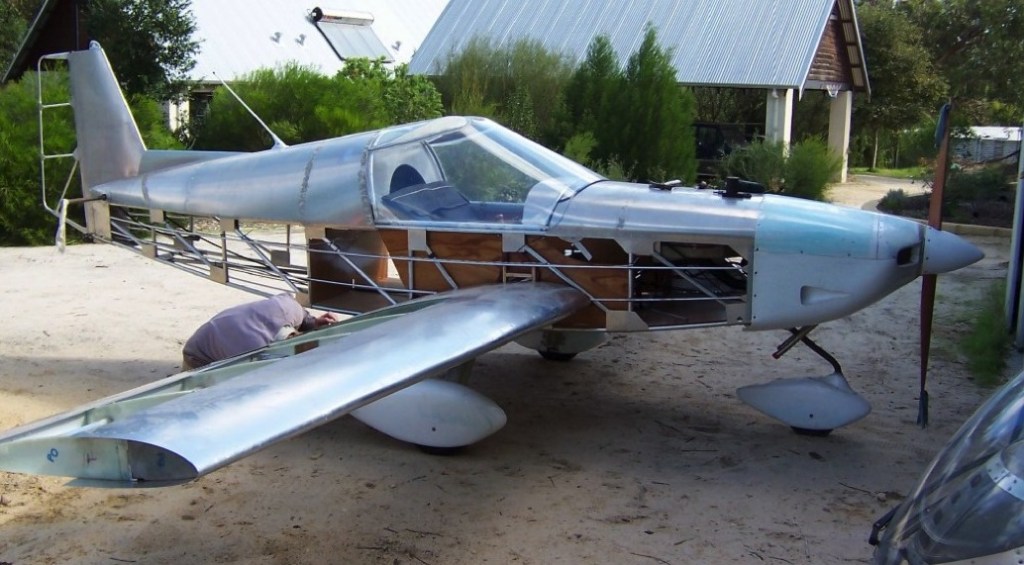
The kit provided the fuselage partly built, brakes, seat-belts, metal parts cut and bent, bolt kit, control cables and all welding carried out. The wing had wooden spars. The fuselage had fibreglass moulded skins on top of the fuselage deck, these being bonded with resin and cotton flock, the ply on the bottom half being 2.5 mm (0.98 in) Birch. The wing skins were pre-moulded, the tail, rudder and fin being supplied. Fuel was carried in integral wings in the wing.
The Joey can be de-rigged for carriage by trailer and to save on hangarage.
The prototype (19-3377) was completed in 2003, was fitted with a converted Volkswagen engine driving a two-blade propeller, and the cockpit width was 104 cm (41 in).
A number have been built and have been fitted with a range of engines, including Volkswagen conversions, Rotax and Jabiru units. Engines in the 45 kw to 75 kw (60 hp to 100 hp) range may be installed.
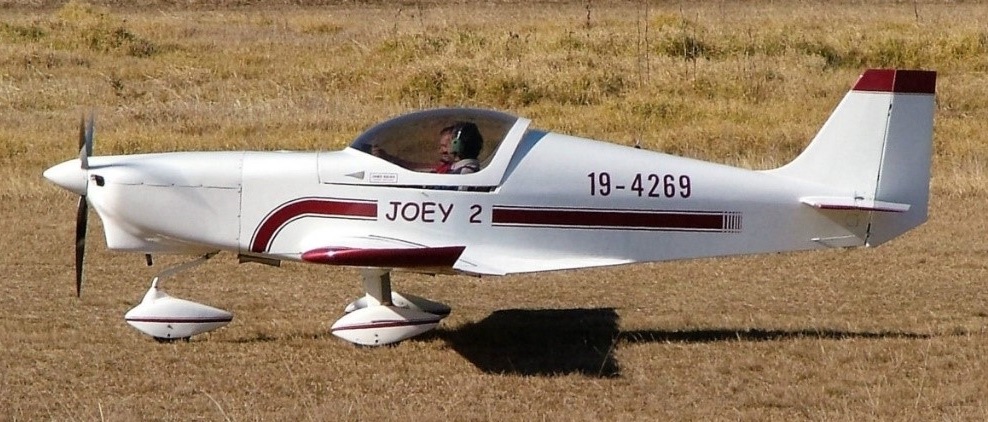
Development of the series continued and in late 2005 a new variant was released, known as the Joey 2, with a 114 cm (45 in) wide cockpit, powered by a Rotax 912 engine. Fuel capacity was a total of 150 litres (33 Imp gals) comprising 70 litres (15 Imp gals) in a header tank and 40 litres (8.8 Imp gals) in each wing tank. A further example became 19-7913.
Joey Mk II Engine: Rotax 912, 60 kw (80 hp) Wingspan: 8.3 m (27 ft 2 in) Length: 5.5 m (18 ft 0½) Height: 1.82 m (5 ft 10 in) Empty weight: 300 kg (661 lb) Loaded weight: 544 kg (1,199 lb) Fuel capacity: 150 litres (33 Imp gals) Max speed: 322 km/h (200 mph) Max cruising speed: 222 km/h (138 mph) Max manoeuvring speed: 222 km/h (138 mph) Max rough air speed: 259 km/h (161 mph) Stalling speed: 74 km/h (46 mph) Takeoff and landing run: 200 m (656 ft) Cockpit width: 114 cm (45 in)
Morgan Aero Works produced the single seat Diamond. The Super Diamond is a fabric-covered, pop-riveted aluminum tubing design with premolded fiberglass wing ribs, cowlings, fairings, etc.
The Super Diamond four-stroke single-seater can take many engines in the 60-80 hp range and they have a Super Diamond Twister model that is approved for aerobatics.
The complete kits less motor, instruments, paint and upholstery ran about $14-18k for the single-seater.
New Zealander Garry Morgan’s first design was the Cheetah and this was further developed into the Cheetah Sierra 100.
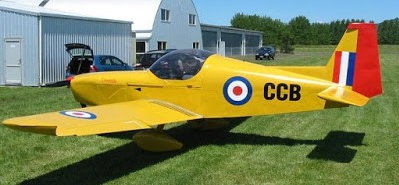
Morgan Aero Works Cheetah ZK-CCB (c/n MA 17)
The aircraft are built from kits and are of aluminium tube and sheet construction using pop rivets with a welded steel frame for the cockpit, undercarriage and engine mounts. The fairings and engine cowling are fibreglass. The wings are easily detachable for trailering and storage.
Morgan Aero Works Cheetah ZK-CCB (c/n MA 17)
Garry Morgan sold Morgan Aero Works in 2016 to Wedgetail Aircraft Pty Ltd. Wedgetail Aircraft offer the Cheetah Sierra 200.
Cheetah Sierra 100 ZK-TJD (c/n 23-S-5)
Cheetah Sierra 100 Engine: Jabiru 2200, 80 HP Wingspan: 26 feet Length: 19 feet Empty weight: 313 Kg MAUW: 544 Kg Cruise speed: 130 knots Stall speed: 37 knots
New Zealander Garry Morgan formed Morgan Aero Works in Australia in 2002, having come from a background of model aircraft building. His first design was the Cheetah and this was further developed into the Cheetah Sierra 100. Further designs followed including the single seat Diamond, the two seater Cheetah Sierra 200 and the Joey Mk II, and the 4 seater Cougar.
Garry Morgan sold Morgan Aero Works in 2016 to Wedgetail Aircraft Pty Ltd which was formed by Ray Tolhurst and which is based at Camden Airport in NSW. Wedgetail Aircraft offer the Cheetah Sierra 200 and the Cougar, as well as the single seat Vampire.
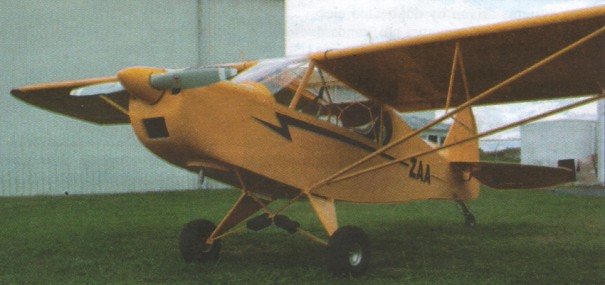
Designed in Italy by Pasquale Russo with some help from Bonaldo, Franchini and Vizzini in 1997, and manufactured in the Czech Republic by the Morava Zlin Aero, at their Otrokovice factory, is a J3 Cub lookalike. The Savage is a single-engine, high-wing, two-seater tandem microlight aircraft.
With a Rotax 912S 100 hp performance is lively. There is ample baggage space behind the front seat, the one piece door hinges up and fastens on and the aircraft can be flown with the door open. There are features such as sight glasses in the wing root to view the tank contents, an effective flap to 35 degrees, disk brakes and electric start. With a comfortable 95 kts cruise, the large balloon tyre undercarriage and fully castoring tailwheel allows for some off runway outlandings.
Available as a basic kitset through to a fully assembled option, the type is powered by the 100 hp Rotax 912S and turns a 183 cm propeller. An interesting feature of the Zlin tube framed aircraft is the option to pressurise the frame with an inert gas. Should the frame crack and the gas leak out, a drop in pressure will be detected through a gauge on the instrument panel. The two spar (foldable) wing, with flaps, is fabric covered and contains two 34 litre fuel tanks.
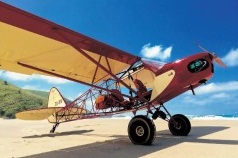
Zlin Savage Bobber
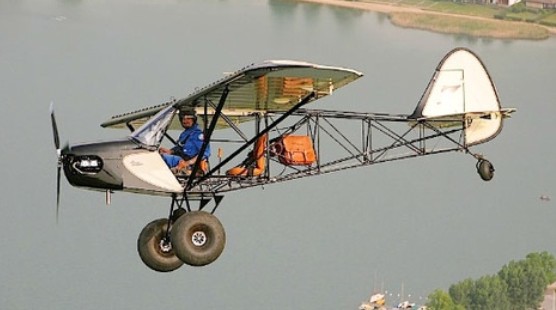
The Zlin Savage Cub fleet includes the iCub (with docked Apple iPad) and its Bobber open-frame, totally customizable variant.
Zlin Bobber
Savage Engine: Rotax 912S 100 hp Stall: 31 kt / 36 mph / 58 kmh Cruise: 92 kt / 106 mph / 170 kmh VNE: 111 kt / 127 mph / 205 kmh Empty Weight: 288 kg / 635 lbs MTOW Weight: 560 kg / 1235 lbs Climb Ratio: 800 ft/min / 4,8 m/s Take-off distance (50ft obstacle): 660 ft / 200 m Landing distance (50ft obstacle): 520 ft / 160 m
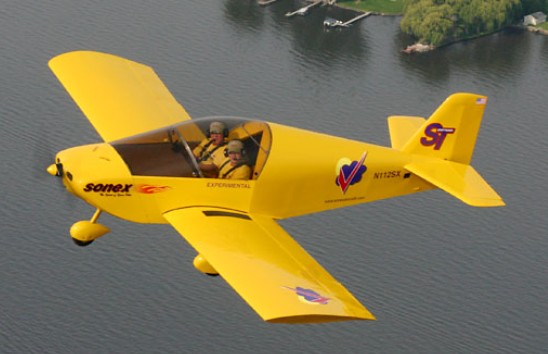
Sonex, Ltd. is a kit manufacturer in Oshkosh, Wisconsin. Their original design, the all-metal, two-seat Sonex single engine monoplane morphed into the V-tailed Waiex. Add a 45′ wingspan to that airplane, and a motorglider, the Xenos, is born. The company boasts the talents of John Monnett, creator of the Monerai sailplane and the Moni motorglider.
Designed by John Monnett as a simple airframe and power plant to create a fun VFR machine. A basic and economical all metal, two place monoplane with a hp range of 80-120. With all the metal except the main spar, pop-riveted, options include nose or tail wheel.
Designed to meet the needs of the European and Domestic sport aircraft markets, it can incorporate various light weight engines of 80 to 120 hp (engine package weight of less than 200 lbs.), and is perfectly suited to the new US Sport Pilot/LSA regulations. The three recommended powerplants include the 2180cc Volkswagon, 2200 Jabiru, and 3300 Jabiru.
Performance is achieved through its clean aerodynamic shape and simple, light weight construction. The Sonex plans contain many options, including a tailwheel or tricycle landing gear along with a center or dual stick. Motor mount drawings are supplied for all three recommended powerplants.
The Sonex features easily removable wings for transport and storage.
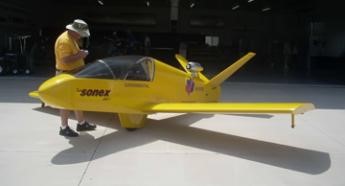
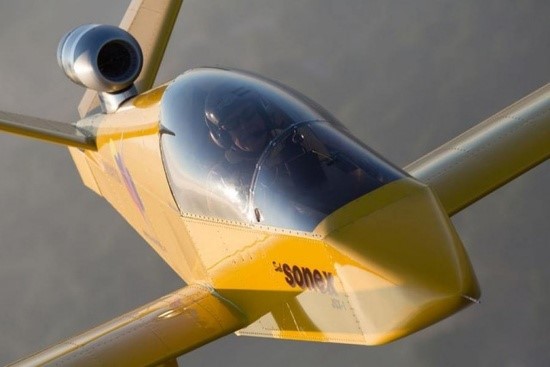
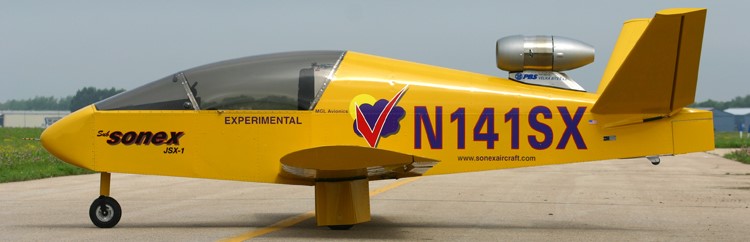
The SubSonex jet aircraft prototype, JSX-1, made its first flight on August 10, 2011 at Wittman Airport in Oshkosh, Wisconsin. Piloted by Bob Carlton, the flight lasted approximately 14 minutes and focused on low-end speed, including stalls and low approaches in the landing configuration. The engine selected for the SubSonex is the Czech-built PBS TJ-100 turbojet.
Through the course of a series of high-speed taxi tests, Sonex design team has identified some issues with controllability of the aircraft in the transition phase approaching takeoff speeds, and has decided to enter a thorough design review process aimed at making the aircraft easier to handle for the average recreational pilot.
The Subsonex originally sported a tandem landing gear with outrigger gear on each wing tip. Due to the increased power offered by the new PBS TJ-100 engine selected for the SubSonex, it was determined that a tricycle gear configuration would be needed to increase yaw stability on the ground in the transition phase approaching takeoff speeds.
SubSonex personal Jet aircraft
During Air Venture 2010, it was presented with the new fixed tricycle landing gear and the PBS TJ-100 turboJet engine.
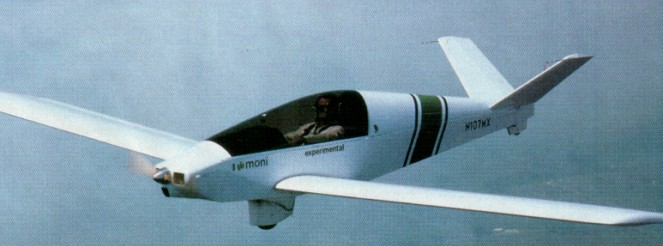
Single seat single engined low wing mono¬plane with conventional three axis control. Wing has unswept leading and trailing edges, and constant chord; V tail. Pitch/yaw control by elevon; roll control by full span ailerons; control inputs through stick for pitch/roll and pedals for yaw. Cantilever wing; wing profile; double surface. Undercarriage has two wheels in tandem with wing tip wheels; no suspension on either wheel. No ground steer¬ing. Aluminium tube/glass fibre fuselage totally enclosed. Engine mounted at wing height driving tractor propeller.
Shown for the first time at the 1981 homebuilders’ convention at Oshkosh, the Moni is defined by its creator as an aerial leisure vehicle, ARV standing for Air Recreational Vehicle. A maximum speed of 120mph (193kph), together with a remarkably well thought out set of aerodynamics classify it as a very light aircraft rather than as a single seater ultra¬light for home building. Following from the single seat Sonerai of 1970 and the two seater Sonerai II of 1973, the Moni benefits from this experience and particularly from that of the 1980 Monex, from which it takes its aerodyna¬mic configuration (basically rectangular wing, V tail set at 110O and a canopy which does not deviate from the fuselage line) and its construction method and with 200mph (322 kph) straight and level on 65 hp, there is clearly not much wrong with the Monex’s configuration.
Whereas the Monex uses a two stroke twin cylinder Zenoah engine of 440 cc, the Moni has KFM 107. It delivers 22 hp at 6000 rpm which, with direct drive to a 38 inch (96 cm) diameter twin blade propeller, gives a tip speed of some 300 m/s. The wing has an I-shaped extruded alumi¬nium spar together with a false spar on which is hinged the full span ailerons which also serve as flaps, hinging upwards as much as 8 degrees to reduce the drag in cruise by altering the camber. The skinning is made from a single¬sheet rolled around the leading edge, bonded to the ribs and riveted to the false spar. Each wing weighs only 50 lb (23 kg) and is de¬mountable for ease of garaging and trailer transport.
In 1983 this aircraft was only sold as a kit, for $6000, and no assembly time was quoted.
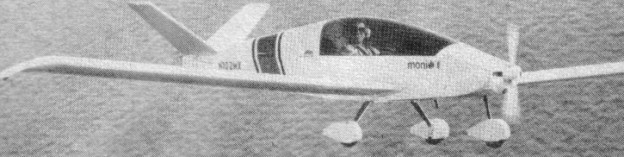
Moni Tri-Gear
The Moni Tri-Gear is designed for the low-time pilot. Nosewheel is direct steering. A belly flap provides glidepath control. Wings are removable for trailering.
Moni Engine: KFM 107, 22 hp at 6300 rpm Propeller diameter 37 inch, 0.96m No reduction Power per unit area 0.29hp/sq.ft, 3.2 hp/sq.m Fuel capacity 4.0 US gal, 3.3 Imp gal, 15.1 litre Length overall 15.0 ft, 4.57 m Height overall 3.3ft, 0.99m Wing span 27.6ft, 8.38m Constant chord 2.9 ft, 0.88 m Sweepback 0 deg Total wing area 75 sq.ft, 7.0 sq.m Wing aspect ratio 10/1 Empty weight 260 lb, 118kg Max take off weight 500 lb, 227kg Payload 240 lb, 109kg Max wing loading 6.66 lb/sq.ft, 32.4kg/sq.m Max power loading 22.7 lb/hp, 10.3kg/hp Load factors +6.0, 4.0 design Max level speed 120 mph, 193 kph Max cruising speed 110mph, 177kph Economic cruising speed 80mph, 129kph Stalling speed 38mph. 61 kph Max climb rate at sea level 500 ft/min. 2.5 m/s Best glide ratio with power off 20/1 at 50 mph, 80 kph Take off distance 400 ft. 122 m Range at average cruising speed 320 mile, 515km
Moni Tri-Gear Engine KFM 107, 2 cylinder, 22 hp electric start. Wingspan: 27’6” Length: 15’ Gross Wt: 560lbs Empty wt: 280 lbs Fuel cap: 4 US Gal




 All Aero