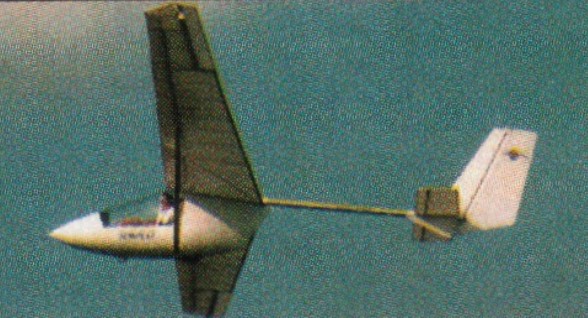
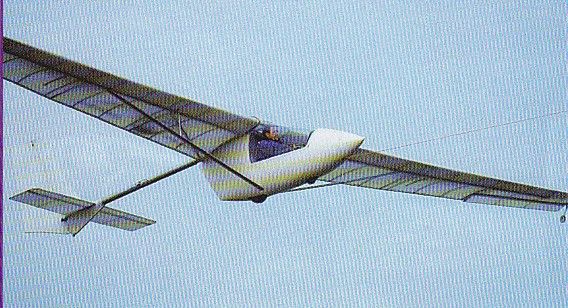
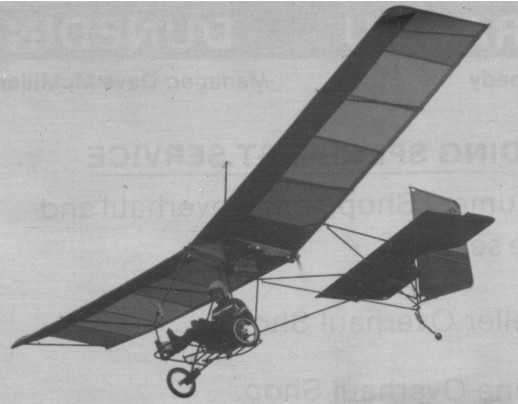
Designed by Bobby Bailey, the Tempest is an FAI Class 4 light sailplane circa 1998, using tube and fabric construction, and composite cockpit. It can be dismantled into three parts for transport. The semi-enclosed fiberglass cockpit has a canopy that hinges to one side.
Launchable by towing from an UL, it was availablein the US as a kit for $10,000 or as a completed sailplane for $12,500, through Quest Air Soaring Canter, 6548 Groveland Airport Road, Groveland, Florida 34736.
Tempest Wing span: 13 m / 42 feet Wing area: 14 sq.m / 150 square feet Height: 5 ft Length: 21 ft Aspect ratio: 12:1 MTOW: 400 lb Empty weight: 100 kg / 220 lb Vzmin: 0.8 ẚ 40 m/sec Stalls: 29 km/h Speed max: 80 mph Glide Ratio: 25 @ 60 kph L/D: 24 @ 68 km/h L/D ratio: 5:1 Min sink: 170 fpm Seats: 1 Landing gear: single wheel Price (1998) $ 10500 (kit)
The main product from the LiteFlite stable is the Dragonfly. The Dragonfly is a three axis ultra light aircraft which takes off in a reasonably small area and lands in a reasonably small area. It has dual seating and dual controls.
Due to the slow flying speed, the Dragonfly is a favoured hang gliding towing aircraft and has been sold to 12 different countries. The Dragonfly provides a low cost form of aviation which can be flown almost anywhere and is really easy to learn.
The Dragonfly has been in production since 1990 and during this period, in excess of 100 aircraft have been manufactured.
The Dragonfly is constructed from 6061 grade aluminium tubing, is structurally supported by stainless steel wire and has fabric covered wings. It is powered by either a two stroke or four stroke engine. It has a range of options available depending upon your requirements and financial constraints.
Engine: Rotax 582, 65 hp Overall Length: 5.974 m / 19 ft 6 in Maximum Height: 2.316 m / 7 ft 6 in Wing Span: 10.363 m / 34 ft Wing Area: 15.8 sq.m / 170 sq.ft MTOW: 385 kg Gross Weight: 800 lb Empty Weight: 150 kg / 330 lb Fuel cap: 6 USG / 20 lt VNE: 57 knots / 100 kph VC at 5200rpm: 40 knots / 60 kph Stall: 14-17 kt Normal Landing Approach Speed: 26 kt ROC: 1400 fpm /16 m/s Take-off dist: 50 ft Take-Off Distance (To 50ft): 195 feet Landing dist: 100 ft Landing Distance (From 50ft): 363 feet Range: 100 sm Fuel consumption: 16 lt/hr Service ceiling: 16,000 ft Seats: 2 Kit price (1998): US$15,700 Landing gear: tail wheel
Started in 1967, Moyes Delta Gliders was a Company solely dedicated to hang gliding. 1995: 2-4 Taylor St, Waverly, 2024 NSW, Australia.
1998: 1144 Bottany Road, NSW 2019 Botany, AUSTRALIA
2001: 200 Hillcrest Dr, Auburn, CA 95603, USA. LiteFlite is owned and operated by Bill Moyes. Bill is based in Sydney at the Liteflite factory and frequently travels the world to sell and support his products. Bill has been flying and manufacturing aircraft since 1966 and has a long list of accolades to show for his efforts.
Bill Bennett and his partner Bill Moyes worked improvents into the Rogallo tow kites and Moyes towed to 1000 feet in 1967. After the towboat ran into a sand bar one day and the kite gently glided down, they began to deliberatelycut loose and experiment with untethered flight. This led the skiers up mountain sides where they made ski launches, sometimes gliding as far as five miles.
Bennett went to the USA in 1969 and began a tou of exhabitions which included flying over the Golden Gate Bridge to land on Alkatraz, and, on July 4th, circling the Statue of Liberty. American fliers were still using the Lilienthal-type parallel bars and hanging by their armpits but Bennett brought with him a trapeze style control bar and swinging seat.
After the success of his tour he settled down in LA and began to manufacture and promote hang gliders to the growing market in Southern California.
LiteFlite is a manufacturer of ultra light aircraft and hang gliding accessories. The main product from the LiteFlite stable is the Dragonfly, an ultra light aircraft most commonly used for towing hang gliders into the air. The Dragonfly has been in production since 1990 with approximately 100 aircraft being made, and is internationally recognised for its slow flying speed and great manoeuvrability.
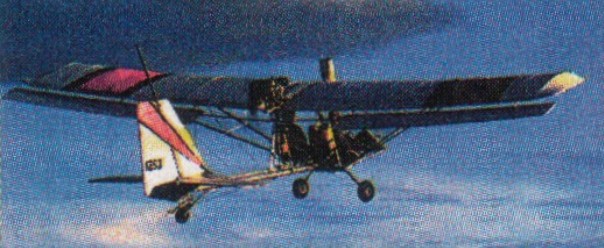
The Teratorn was a single seat single engined high wing monoplane with hybrid control. Wing has unswept leading and trailing edges, and constant chord; cruciform tail. Pitch control by weightshift; yaw control by fully flying rudder; roll control by one third span spollerons; control inputs through weight shift for pitch/yaw/roll. Wing braced from above by kingpost and cables, from below by cables; wing profile; 33% double surface. Undercarriage has three wheels in tail dragger formation; suspension on tailwheel and bungee suspension on main wheels. No ground steering. No brakes. Aluminium tube framework, without pod. Engine mounted above wing driving pusher propeller. Leading edges stiffened with Mylar.
The Teratorn which we are concerned with is itself a venerable design, having appeared at the birth of microlight aviation around the same time as the first powered version of the famous Quicksilver, with which it has a certain similarity. The Teratorn was powered, up till 1982, by the single cylinder Yamaha KT100S giving 15 hp through a reduction drive of 5/1, with initially the option and later the standard replacement by a twin cylinder Rotax of 28 hp with a 2.5/1 reduction drive.
On an original note, the company chose black anodising for the tubes on this hybrid control machine and the wires too were covered in black vinyl. The Teratorn is delivered as a kit requiring 20 to 25 h assembly according to the maker, and costs $3895 with the Rotax motor in 1983. Options include an instrument panel, skis, Kevlar floats and the choice of the Yamaha KT100S, which drops the price by $400. The machine is trailer transportable or on a roof rack and folds to around 16 x 5 x 1 ft (4.9 x 1.5 x 0.3 m). A kit allowing the Teratorn to be converted to the Teratorn TA with three axis control is also available.
The Teratorn TA was a single seat single engined high wing mono¬plane with conventional three axis control. Wing has unswept leading and trailing edges, and constant chord; cruciform tall. Pitch control by elevator on tail; yaw control by fully flying rudder; roll control by one third span spoilerons; control inputs through stick for pitch/roll and pedals for yaw. Wing braced from above by kingpost and cables, from below by cables; wing profile; 33% double surface. Undercarriage has three wheels in tail dragger formation; steel spring suspension on tailwheel and bungee suspension on main wheels. No ground steering. No brakes. Aluminium tube framework, without pod. Engine mounted below wing driving pusher propeller.
This is the three axis version of the hybrid control Teratorn. The TA appeared in 1982 with the Yamaha KT100S 15 hp engine, though today that has become just an option, the machine being fitted in standard form with the Rotax 300 of 28 hp or the Rotax 377 with 34 hp. Rigging time for the earlier model is 25 min, while this model requires 25 min to rig with two people. The Teratorn TA is sold so that it requires only 20h to complete, according to the maker, and for a price of $4295 with Rotax 300 or $4595 with Rotax 377. The options include the Yamaha engine for a reduction of $300, floats of Kevlar, skis and instrument panel. Production was phased out in favour of the more advanced Tierra.
Teratorn Engine: Rotax 300, 28hp at 6200rpm Propeller diameter and pitch 60 x 24 inch, 1.52 x 0.61 m Reduction ratio 2.5/1 Power per unit area 0.18 hp/sq.ft, 1.9 hp/sq.m Fuel capacity 3.3 US gal, 2.8 Imp gal, 12.5 litre Length overall 18.0 ft, 5.49 m Height overall 9.0 ft, 2.74m Wing span 32.0ft, 9.75m Constant chord 5.0 ft, 1.52 m Sweepback 0 deg Total wing area 160 sq.ft, 14.9 sq.m Wing aspect ratio 6.4/1 Tailwheel diameter overall 3 inch, 7 cm Main wheels diameter overall 16 inch, 41 cm Empty weight 212 lb, 96 kg Max take off weight 474 lb, 215kg Payload 262 lb, 119kg Max wing loading 2.96 lb/sq.ft, 14.4 kg/sq.m Max power loading 16.9 lb/hp, 7.7kg/hp Load factors; +3.0, 3.0 ultimate Max level speed 50 mph, 80 kph Never exceed speed 55 mph, 88 kph Economic cruising speed 35 mph, 56 kph Stalling speed 15 mph, 24 kph Max climb rate at sea level 600 ft/min, 3.1 m/s Min sink rate 250 ft/min at 25 mph, 1.3 m/s at 40 kph Best glide ratio with power off 8/1 at 25 mph, 40 kph Take off distance 50 ft, 15 m Landing distance 75 ft, 23 m Service ceiling 10,000 ft, 3050 m Range at average cruising speed 70 mile, 113 km
Teratorn TA Engine: Rotax 300, 28 hp at 6200 rpm Propeller diameter and pitch 60×24 inch, 1.52×0.61m Reduction ratio 2.5/1 Power per unit area 0.18hp/sq.ft, 1.9 hp/sq.m Fuel capacity 3.3 US gal, 2.8 Imp gal, 12.5 litre Length overall 18.0 ft, 5.49 m Height overall 9.0ft, 2.74m Wing span 32.0ft, 9.75m Constant chord 5.0 ft, 1.52 m Sweepback 0 deg Total wing area 160 sq.ft, 14.9 sq.m Wing aspect ratio 6.4/1 Tailwheel diameter overall 3 inch, 7 cm Main wheels diameter overall 16 inch, 41 cm Empty weight 227 lb, 103kg Max take-off weight 489 lb, 222kg Payload 262 lb, 119 kg Max wing loading 3.06 lb/sq.ft, 14.9kg/sq.m Max power loading 17.5 lb/hp, 7.9 kg/hp Load factors; +4.0, 3.0 ultimate Max level speed 50 mph, 80 kph Never exceed speed 55 mph, 88 kph Max cruising speed 45 mph, 72 kph Economic cruising speed 35 mph, 56 kph Stalling speed 17 mph, 27 kph Max climb rate at sea level 600 ft/min, 3.1 m/s Min sink rate 270 ft/min at 28 mph, 45 m/s at 45 kph Best glide ratio with power off 8/1 at 28mph, 45kph Take off distance 50ft, 15m Landing distance 75ft, 23m Service ceiling 10,000ft, 3050 m Range at average cruising speed 70 mile, 113km
Engine: Rotax 377, 34 hp at 6400 rpm Propeller diameter and pitch 60×36 inch, 1.52×0.91m Toothed belt reduction, ratio 2.6/1 Max static thrust 240 lb, 109kg Power per unit area 0.21hp/sq.ft, 2.3 hp/sq.m Fuel capacity 4.4 US gal, 3.7 Imp gal, 16.7 litre Length overall 18.0 ft, 5.49 m Height overall 9.0ft, 2.74m Wing span 32.0ft, 9.75m Constant chord 5.0 ft, 1.52 m Sweepback 0 deg Total wing area 160 sq.ft, 14.9 sq.m Wing aspect ratio 6.4/1 Tailwheel diameter overall 3 inch, 7 cm Main wheels diameter overall 16 inch, 41 cm Empty weight 237 lb, 108kg Max take-off weight 499 lb, 226kg Payload 262 lb, 119 kg Max wing loading 3.12 lb/sq.ft, 15.2kg/sq.m Max power loading 14.7 lb/hp, 6.6 kg/hp Load factors; +4.0, 3.0 ultimate Max level speed 55 mph, 88 kph Never exceed speed 63 mph, 101 kph Stalling speed 23 mph, 37 kph Max climb rate at sea level 900 ft/min, 4.6 m/s
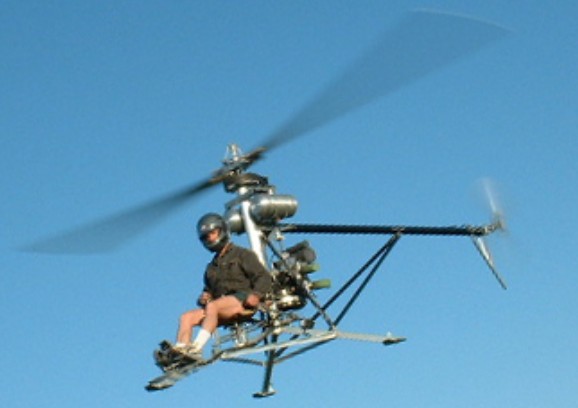
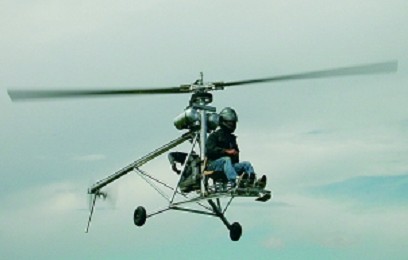
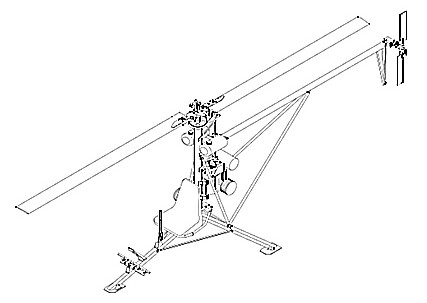
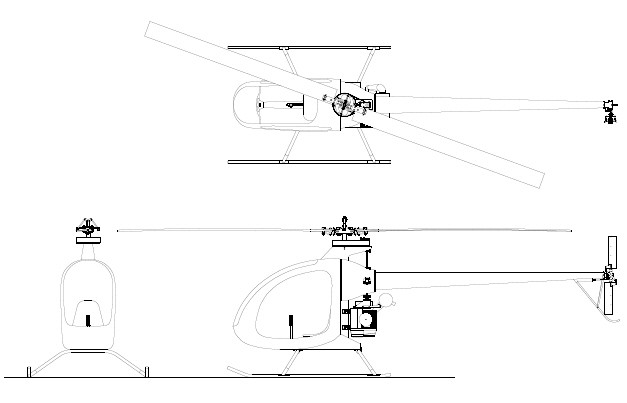
The ultralight Mosquito is one of the worlds lightest manned Helicopters that was designed and developed over 10 years to deliver performance, relability and easy of flight. The original prototype has been flying since 1994 and meets the ultralight Part 103 requirements.
The Mosquito frame is made up of Aircraft Grade 6061-T6 aluminum and utilises a simple triangulated structure with straight tubing throughout to maximize strength, reduce weight and simplify construction. The additional use of a Carbon Fibre tail boom and support struts adds to the Mosquito’s structural ridgidity. The Mosquito’s tripod legs are equiped with small skid pads to help reduce lateral movement during engine run-up to lift off stage. Ground handling wheels are also available to easy ground transport.
The Mosquito is powered by Compact Radial Engine’s – MZ202, 60-hp, a two cycle, two cylinder engine. This engine empolys Reed Induction which yields a very flat torque curve ensuring power is delivered constantly over the required operating range. The MZ202 also has a lower operating speed of 6000 rpm resulting in less stress on the engine and improving reliability. The complete engine package only weighs 69 pounds and comes with a 180-watt alternator that provides power to run the electrical system which also features and an electric start system.
Mosquito
The primary reduction is bolted directly to the engine. A centrifugal clutch on the engine crankshaft permits startup of the engine without the load of the rotor. Power is transmitted from the clutch to the driven pulley of the reduction through an HTD cog belt. The driven pulley houses the sprage clutch, which permits the rotor to overspeed the engine during autorotation.
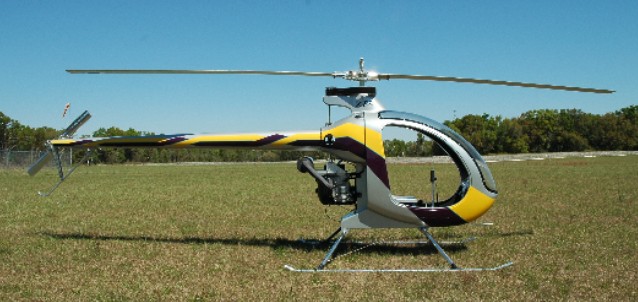
The Mosquito XE is the same aircraft, but the open frame tubing has been replaced with an all fiberglass closed in design. The XE airframe is a unibody construction made entirely of high quality fiberglass in a vinylester matrix. Power is provided by the same Compact Radial Engines MZ202 used for years on the open version of the Mosquito. This two cylinder, two stroke engine has a power output of 60hp, ample to do the work for its 610lbs of gross weight.
Mosquito XE
The power train, controls and rotor systems have been through some minor modifications to suit the XE design. The collective control has been adjusted to adapt to the different mounts in the XE. The main rotor blade diameter has increased by 1.5 ft to account for the additional gross weight. The Mosquito XEL is the same as the XE but is equipped with floats.
Materials provided with the kit include fiberglass airframe parts, machined parts, instruments (Rotor/Engine Tach, redundant digital engine tach with hour meter, dual EGT/CHT, Airspeed Indicator), rotor blades and engine. Many of the airframe parts are already joined. The builder needs only to bolt and rivet the final major components together.
A comprehensive assembly manual is provided along with a full set of part and assembly drawings as well as exploded view drawings. Builder assistance can be provided by phone or email. It requires around 250 to 300 hours of build time. Standard shop tools are required to cut and form some of the simple frame and control parts and for bolt and rivet assembly. A quick build parts set, in which all the parts nomally fabricated and formed by the builder are already finished, is available to save more build time. A small amount of welding is required on the exhaust system.
Optional extras to consider with purchase of the Mosquito include factory paint, tail fins, ceramic pistons, seat covers, governor kits, wheel kits and quick build parts. The Mosquito XE can be ordered in several stages of kit. The 1st kit includes the materials and components for building the composite airframe. This group consists of the composite enclosure, fuel tank, tail boom, landing gear and the full Builder’s Set of Plans and Instructions. The kit is designed to meet the 51% rule. The 2nd kit is for the cyclic, collective, torque tubes, push-pull tubes, swash plate, and rotor controls. The 3rd is the power drive system consisting of primary and secondary reduction units, sprague clutch, engine coupling shafts, tail rotor drive shaft components, gear boxes, main rotor shaft assembly, and associated bearings, couplings, etc. and the 4th group includes the engine, battery, centrifugal engine clutch, fuel tanks, fuel valves, fuel lines, throttle, switches, wiring, and instruments. The final stage is the assembly of the rotor heads, the tail rotor blades, and main rotor blades but the manufacturer likes to see you have some training under your belt before finishing this stage and being tempted or hurried to get airborn.
Delivery on complete kits is around 6 months from placing a deposit, or around 2 months for a kit group, depending on factory demand at the time.
Total Kit Price: US$17,495 after US$2,000 training rebate in 2009.
Mosquito Engine: Compact Radial Engines MZ202, 2 cylinder, 2 stroke, 60 HP (45kW) Frame Length: 16 ft. Overall Length: 20 ft Width: 72 in. Height: 83 in Main Rotor Diameter: 18 ft Tail Rotor Diameter: 40 in. Empty Weight: 254 lb. Gross Weight: 530 lbs Useful (Pilot) Load: 250 lbs Fuel Capacity: 5 US gallons Main Rotor Speed: 540 rpm Tail Rotor Speed: 2500 rpm Fuel Flow at Cruise: Approximately 4.5 U.S. Gallons per hour Flight Duration: Approx. 60 min. Hover in ground effect: 8,000 ft. (estimated) Hover out of ground effect: 6,500 ft. (estimated) Max Speed: 70 mph
Mosquito XE Frame Length: 16 ft Overall Length: 20 ft Width: 72 in Height: 84 in. Main Rotor Diameter: 19.5 ft Tail Rotor Diameter: 40 in. Empty Weight XE: 298 lb Gross Weight: 610 lbs Useful (Pilot) Load: 240 lbs. Fuel Capacity: 12 US gallons Engine: Compact Radial Engines MZ202, 2 cylinder, 2 stroke 64 HP (45kW) Electrical System: 12 volt DC battery, starter, 180 watt alternator Main Rotor Speeds: 540 rpm Tail Rotor Speeds: 2500 rpm Fuel burn: 4.5 gph Range: 150 miles Hover in ground effect: 8,000 ft. (estimated) Hover out of ground effect: 6,500 ft. (estimated) Max Speed: 80 MPH Price: $30,000 including engine/instruments (2009)
Mosquito XEL Frame Length: 16 ft Overall Length: 20 ft Width: 72 in Height: 84 in. Main Rotor Diameter: 19.5 ft Tail Rotor Diameter: 40 in. Empty Weight XEL: 312 lb Gross Weight: 610 lbs Useful (Pilot) Load: 240 lbs. Fuel Capacity: 5 US gallons Engine: Compact Radial Engines MZ202, 2 cylinder, 2 stroke 64 HP (45kW) Electrical System: 12 volt DC battery, starter, 180 watt alternator Main Rotor Speeds: 540 rpm Tail Rotor Speeds: 2500 rpm Fuel burn: 4.5 gph Range: 60 miles Hover in ground effect: 8,000 ft. (estimated) Hover out of ground effect: 6,500 ft. (estimated) Max Speed: 80 MPH Price: $31,000 including engine/instruments (2009)
Mosquito XE3 Frame Length: 16 ft Overall Length: 20 ft Width: 72 in Height: 84 in. Main Rotor Diameter: 19.5 ft Tail Rotor Diameter: 40 in. Empty wt: 360 lb Gross wt: 720 lb Useful load: 290 lb Fuel Capacity: 12 gal Range: 150 miles Cruise spd: 80 mph Max spd: 100+ mph Fuel burn at cruise: 5 gph Engine: CRE MZ301 3 cyl 2 cycle Power 85 hp Main Rotor RPM: 590 Tail rotor rpm: 2500 Hover in ground effect 9500 ft (est) Hover out of ground effect 7500 ft (est) Price: $36,000 including engine/instruments (2009)
Mosquito XET Frame Length: 16 ft Overall Length: 20 ft Width: 72 in Height: 84 in. Main Rotor Diameter: 19.5 ft Tail Rotor Diameter: 40 in. Empty wt: 433 lb Gross wt: 820 lb Useful load (with optional aux tank): 240 lb Useful load (without optional aux tank): 290 lb Fuel capacity: 12 gal Aux tank capacity: 8 gal Range (with aux tank): 160 miles Cruise spd: 80 mph Max spd: 100+ mph Fuel burn at cruise: 8.5 gph Engine: Solar T62-2A1 turbine Power: 90 hp Main Rotor RPM: 590 Tail Rotor RPM: 2500 Hover in ground effect 9000 ft (est) Hover out of ground effect 7000 ft (est) Price: $37,000 excluding engine (2009)
A single-seat very-light multipurpose pusher monoplane (first flown in 1990 as MAI-89 prototype), also available in autogyro and training glider forms.
The Moscow Aviation Institute (MAI) was founded in 1930 on the basis of the aeromechanical faculty of the Moscow National Technical University “Bauman” (MGTU), becoming independent from it due to the wide importance that, since then, the aviation in the Soviet Union. It began with two faculties, aircraft construction and engine construction, since then it has been the most important aeronautical academic institution in the entire region, becoming a leader both in the scientific field, being the first to offer science chairs. aeronautics and training its own teachers and doctors who would make up the university boom, as well as technical-industrial, this is confirmed by the fact that it is the only university in the world that has launched its own aircraft on the market, built by its professors and students since 1932, when the MAI set up its own aircraft construction office.
After the Second World War the MAI expanded its academic and scientific interests, a new teaching system was developed, faculties were added in all aeronautical fields, as well as in physical-mathematical sciences, electronics and robotics. The student campus was built with more than 35 buildings, aeronautical infrastructure, workshops and laboratories were acquired, as well as the aerospace faculty, and in this way the MAI obtained the category of technical university. In 1979, artificial satellites ” Radio ” and ” Cosmos ” were launched into space, built with the participation of a large delegation from the MAI.
Although it is true in Soviet times the MAI as a national university maintained a margin of military defense, together with the state and the armed forces, always collaborating with the country, the university has also specialized its engineering in the commercial and experimental field.
The Moscow Aviation Institute (Russian: Московский авиационный институт (МАИ)) is a Russian university located in Moscow dedicated to the study of everything related to the aeronautical and aerospace industry. However, education is currently multidisciplinary and teaching and research programs are offered in multiple scientific and technological fields.
Over the years, the university grew to become the largest aerospace engineering teaching center in Russia, and one of the most prestigious universities in the world. More than 130,000 students, including 1,000 international students from 40 countries, have graduated from MAI after its founding in 1930.
In 1982 by the order of Ministry of Aircraft Industry the Design Bureau was transformed into a branch-wise experimental students aircraft construction design bureau of the MAI. The work was carried out by professional engineers. If necessary the co-workers from among the MAI students and teachers and also from among the workers of the industry were invited. The production facility of the MAI aircraft development plant (EOZ) in the experimental development shop (shop № 3) are manned by qualified technicians. The OSKBES work on the experimental aircraft engineering constantly received high estimations of the industry. Their technical novelty and utility are confirmed by nine Introduction Certificates and more than twenty Invention Certificates. By the end of 1980s six experimental aircraft of different types were designed and built: Kvant, Elf-D UAV, PS-01 small-sized UAV, Elf, Photon and Yunior aircraft.
The basic structure, address and the industrial areas occupied by it in the OSKBES MAI have remained the same. The EOZ MAI (shop № 3) and the MAPO (Moscow aircraft building plant) were used as an industrial base. On July 27, 1992 the application on realization the inspection work in the OKB MA for reception the certificate for the right to develop the civil aircraft engineering was sent to the Aviaregister of the MAK and the Air Industry Department of the Ministry of Industry of Russian Federation. It was made on behalf of the “Aviatika” joint-stock company. According to the inspection results the Aviaregister of the MAK issued Certificate № R-9 to the “Aviatika” joint-stock company with the right to develop light civil aircraft. It was on February 17, 1993.
Aircraft designed and developed at OSKBES include: A single-seater Aviatika-MAI-890 aircraft — passed certification, had a temporary Certificate of a type of 31 March 1994 № 52В-890, valid till 1 April 1995, is series produced by the RAC “MiG”; A two-seater Aviatika-MAI-890U aircraft is serially produced by the RAC “MiG”; An agricultural Aviatika-MAI-890SKh aircraft is serially produced by the RAC “MiG”; A single-seater Aviatika-MAI-900 aerobatics (“Akrobat”)’ A two-seater Aviatika-MAI-910 with wings, folding on the ground; An Aviatika-MAI-920 glider; A single-seater Aviatika-MAI-890A autogyro, a pre-production model at the stage of flying test. The basis for the “Aviatika” aircraft manufacture at the MAPO plant is the License Agreement concluded by this plant with the “Aviatika” joint-stock company on 10 April 1995 (contract № 4276).
In 1997 Aviatika withdrew from the Design Bureau of Moscow Aviation Institute (Aviatikas) program, after which the manufacturer of Aviatika lightplanes became known as KB MAI.
The personnel of the OSKBES have continued to work in the field of light civil aircraft together with the MAPO MIG. In April 27, 1998 the Aviaregister of Interstate Aviation Committee issued a Design Organization Certificate R-52 of the developer of light civil aircraft.
29 September 1999 eight members of our design bureau, Moscow Aviation Institute and RAC “MIG” were rewarded by “State Prize of the Russian Federation in science and technology” for designing and development of light multipurpose airplanes in a serial production. They are: OSKBES MAI Chief Designer K. Zhidovetskiy (posthumously); OSKBES MAI Deputy Chief Designer (after the death of K. Zhidovetskiy — Chief Designer) N. Goryunov; OSKBES MAI Deputy Chief Designer V. Demin; OSKBES MAI Deputy Chief Designer V. Feigenbaum; Rector of MAI A. Matveyenko; Manager of MAI Experimental Plant P. Ogadzhanov; General Manager of RAC “MIG” plant G. Nemov; Deputy Manager of RAC “MIG” O. Chukantsev. Autogyro MAI-205 made the first flight in 2001, chief designer Andrey Zorin. In 2002 OSKBES MAI has started designing a new plane MAI-223. This plane made the first flight in 2004. In 2003 OSKBES MAI started to work on different aircraft, airships and autogyros. It designed and produced gondolas, nacelles, fly-by-wire power plant controls and empennages of NPO “RosAeroSystems” airships Au-30 and Au-12M. The design and development of Autogyro MAI-208 was started in 2006. The first MAI-208 is undergoing testing. OSKBES MAI presented MAI-208 at the 2nd International exhibition of the helicopter industry “HeliRussia-2009” (21…23 May 2009, Moscow). The new autogyro has caused the big interest of visitors and the press.
July 1, 2008 Vadim Demin was appointed Chief Designer of OSKBES MAI. The same year the design office has started working on a new multi-purpose four-seat twin engine aircraft MAI-407.
In 2009 OSKBES MAI started designing a new training glider MAI-227.
Moscow Aviation Institute (MAI) Volokolamskoe Shassé, Building 4, Moscow, Russia, 125993
Faculties and Departments of MAI: High school. Faculty № 1. Aeronautical Engineering. Faculty №2. Aircraft Engines Faculty №3. Computer Science and Navigation System Faculty №4. Radio and Electronics Institute of Economic Engineering Faculty №6. Aerospace Faculty №7. Robotics and Intellectual Systems Faculty №8. Applied Physical-Mathematical Sciences Faculty №9. Applied Mechanics Faculty №10. Humanities (Social Engineering) Military Institute




 All Aero