Neukom AN-22

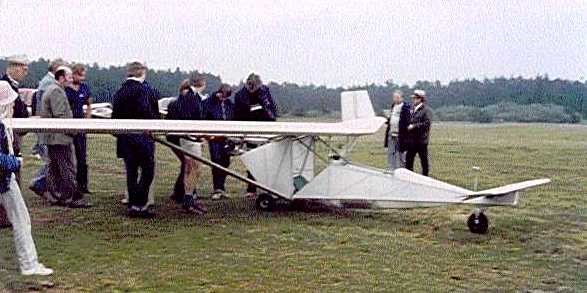
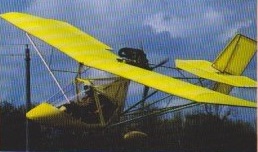
Single seat single engined high wing mono¬plane with conventional three axis control. Wing has unswept leading edge, swept for¬ward trailing edge on outboard half of span, and tapering chord; conventional tail. Pitch control by elevator on tail; yaw control by fin mounted rudder; roll control by half span ailerons; control inputs through stick for pitch/roll and pedals for yaw. Wing braced from below by struts; wing profile NACA 4415; double surface. Undercarriage has three wheels in tricycle formation with addi¬tional tailskid; no suspension on nosewheel and rubber suspension on main wheels. Push right go right nosewheel steering con¬nected to yaw control. Brakes on main wheels. Aluminium tube framework with optional pod. Engine mounted below wing driving pusher propeller.

The AN 22 was designed by the Swiss Albert Neukom who also built the first two examples to obtain certification in West Germany. The AN 22 made its first flights in March 1983 and was shown in the same month at the Aero 83 exhibition at Friedrichshafen. Point Aviation acquired the licence to build and sell this machine throughout the world, the first production machines being built in spring 1983. The model makes use of the original formula tried by Albert Neukorn in 1982 on the prototype AN 20, whereby the three¬cylinder Konig 430 cc engine is carried behind the wing on a mount coming from the large diameter spar which carries the tail. This spar also acts as the axis of the propeller which is driven through a triple V belt reduction drive. The two blades can fold backward parallel to the spar.

Production versions were factory built and sold by Point Aviation in West Germany.

Neukom completed the construction (May 1983) of the AN 22 Twin, a two seater version of the AN 22.

AN-22
Length overall 18.4 ft, 5.60 m
Height overall 4.3ft, 1.30m
Wing span 33.511, 10.20m
Chord at root 3.9ft, 1.20m
Chord at tip 3.3ft, 1.00m
Dihedral 4 degrees
Sweepback 0 degrees
Tailplane span 8.5 ft, 2.60 m
Fin height 3.1 ft, 0.95 m
Total wing area 126 sq.ft,11.8 sq.m
Total aileron area 12.1 sq.ft, 1.12 sq.m
Fin area 6.6 sq.ft, 0.61 sq.m
Tailplane area 11.7sq.ft, 1.09sq.m
Total elevator area 6.5 sq.ft, 0.60sq.m
Wing aspect ratio 8.9/1
Wheel track 6.2 ft, 1.90 m
Nosewheel diameter overall 10 inch, 26cm
Main wheels diameter overall 12 inch, 30 cm
Engine: Konig SC430, 22hp at 4200rpm
Propeller diameter 52 inch, 1.32 m
Belt reduction, ratio 1.8/1
Max static thrust 143 lb, 65 kg
Power per unit area 0.17 hp/sq.ft, 1.9 hp/sq.m
Fuel capacity 5.3 US gal, 4.4 Imp gal, 20.0 litre
Empty weight 232 lb, 105 kg
Max take off weight 464 lb, 210kg
Payload 232 lb, 105kg
Max wing loading 3.68 lb/sq.ft, 17.9 kg/sq.m
Max power loading 21.1 lb/hp, 9.5kg/hp
Load factors +6.0, 3.0 ultimate
Max level speed 75 mph, 120 kph
Never exceed speed 81 mph, 130 kph
Max cruising speed 56 mph, 90 kph
Economic cruising speed 44 mph, 70 kph
Stalling speed 24 mph, 40 kph
Max climb rate at sea level 600 ft/min, 3.1 m/s
Min sink rate 200 ft/min at 32 mph, 1.0 m/s at 52 kph
Best glide ratio with power off 14/1 at 34 mph, 55 kph
Take off distance 330 ft, 100 m
Land¬ing distance 260 ft, 80 m
Range at average cruising speed 124 mile, 200 km

AN-22 Twin
Neukom AN-21 / AN-21R

AN-21R

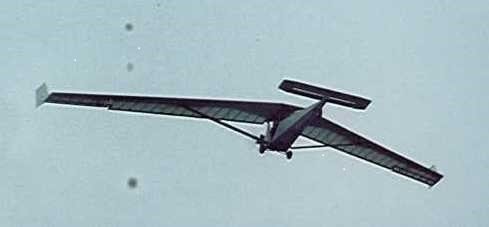
Single seat single engined high wing monoplane with conventional three axis control. Wing has swept forward leading and trailing edges, and tapering chord; no tail, canard wing. Pitch control by elevator on canard; yaw control by tip rudders; roll control by one-third span ailerons; control inputs through stick for pitch/roll and pedals for yaw. Wing braced from below by struts; wing profile Wortmann FX63 137; double surface. Undercarriage has three wheels in tricycle formation; no suspension on nosewheel and glassfibre suspension on main wheels. Push right go right nosewheel steering connected to yaw control. Brakes on nosewheel. Aluminium/tube/fabric fuselage, totally enclosed. Engine mounted at wing height driving pusher propeller.

1980 Wasserkuppe, piloted by Klaus Richter

As Albert Neukorn comfirmed, this machine was never intended for production. In fact, he wanted to design a single seater canard aircraft, as much to try out this formula as for his own pleasure. Of hybrid technology (Duralumin tubular structure with composite materials for the wing, the canard and rudders), the prototype made its first flights in 1980 and remains unique, with no direct descendants. It was originally called the AN 21. Later it was sold to a German purchaser, Klaus-Jurgen Richter, who flew it in the London to Paris in September 1982, and so the aircraft is now called the AN 21R, this last letter referring to Mr Richter himself.

1980 Wasserkuppe, piloted by Klaus Richter

Length overall 16.1 ft, 4.90 m
Height overall 7.9 ft, 2.40 m
Wing span 41.3 ft, 12.60 m
Mean chord 2.8 ft, 0.85 m
Canard span 9.8 ft, 3.00m
Canard chord 1.7ft, 0.53m
Total wing area 132 sq.ft, 12.3 sq.m
Main wing area 115sq.ft, 10.7 sq.m
Canard area 17 sq.ft, 1.61sq.m
Main wing aspect ratio 14.8/1
Engine: Konig SC430, 25 hp at 4200 rpm
Power per unit area 0.19 hp/sq.ft, 2.0 hp/sq.m
Max level speed 81 mph, 130kph
Stalling speed 26mph, 42 kph
Max climb rate at sea level 500 ft/min, 2.5 m/s

Neukom AN-20

AN-20B

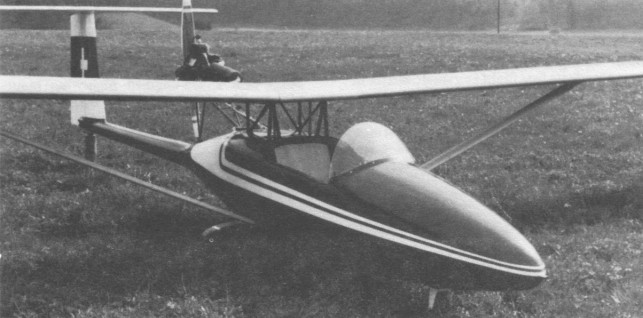
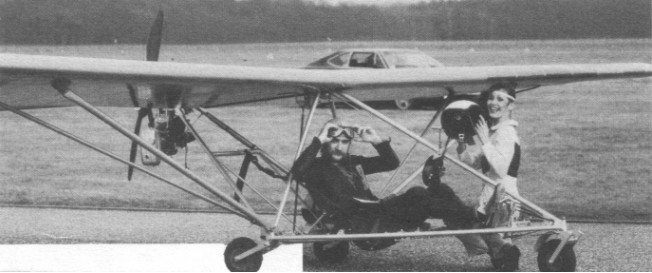
Single seat single engined high wing monoplane with conventional three axis control. Wing has unswept leading and trailing edges, and constant chord; T tail. Pitch control by elevator on tail; yaw control by fin mounted rudder; roll control by one third span ailerons; control inputs through stick for pitch/roll and pedals for yaw. Wing braced from below by struts; wing profile Wortmann FX 63 137; double surface. Undercarriage has three wheels in tricycle formation with tailskid; no suspension on nosewheel and glass fibre suspension on main wheels. Push right go right nosewheel steering connected to yaw control. Brakes on main wheels. Glass fibre fuselage, partially enclosed. Engine mounted at wing height driving pusher propeller. Wing and T tail have wood spars, ribs in styrofoam and covered with expoxied glass fibre.

His first microlight made its first flights in 1978, the prototype AN 20 using a T tail carried on a Kevlar spar of round section. Connected to the fuselage at the same height as the wing, the tubular fuselage carried basically a mono wheel undercarriage but with an additional nosewheel steerable from the rudder bar, the main wheel being positioned directly below the wing. Moreover, the vertical fin below the fuselage spar was provided with a tailwheel in line with the other two.

This machine was shown in various publications under the designation of AN 20M, which was a great surprise to Albert Neukorn, who tells us that he had never called this first model by any other name than AN 20, except that it eventually became AN 20A to distinguish it from the later AN 20B. The prototype was shown at the European homebuilders meeting at Brienne in July 1982.

The AN 20B is directly evolved from its predecessor whose rectangular plan form wing it has retained, supported by a profiled strut under each half wing. A significant change is the inclusion of air brakes, while the AN 20B is provided in addition with an elegant glass fibre fairing with windscreen encompassing all the forward section of the fuselage as far as the trailing edge of the wing, where it joins the spar carrying the tail. Another important difference from the AN-20A is that this spar is no longer level with the wing but mid mounted, a change which required a re design of the T tail. As a result, the fin and rudder no longer continue below the spar. The engine, previously fitted below the spar is now carried by a tubular structure above the rear spar, effectively level with the wing. Production models use the three cylinder Konig SC430 driving a three bladed pusher propeller. Finally, a last important modification, the AN 20B replaced the single main wheel undercarriage of the AN 20A with a tricycle undercarriage whose main wheels are fitted with drum brakes.

The AN 20B was still produced by Albert Newkom himself in 1983, either ready to fly ex works without engine or as a set of plans. An attempt to set up production facility in France with the AN 20B in 1981 has been abandoned.

Length overall 17.7 ft, 5.40 m
Height overall 3.9ft, 1.20m
Wing span 41.3ft, 12.60m
Constant chord 2.611, 0.80m
Dihedral 2 degrees
Sweepback 0 degrees
Tailplane span 8.0ft, 2.45m
Fin height 3.2ft, 0.95m
Total wing area 109sq.ft, 10.1sq.m
Total aileron area 8.5 sq.ft, 0.79 sq.m
Fin area 6.6 sq.ft, 0.61 sq.m
Tailplane area 8.4 sq.ft, 0.78 sq.m
Total elevator area 4.2 sq.ft, 0.39 sq.m
Wing aspect ratio 15.8/1
Wheel track 4.7ft, 1.43m
Nosewheel diameter overall 8 inch, 21 cm
Main wheels diameter overall 8.5 inch, 22cm
Engine: Konig SC430, 24 hp at 4200 rpm
Propeller diameter 42 inch, 1.06 m
Belt reduction, ratio 1.8/1
Max static thrust 121 lb, 55 kg
Power per unit area 0.22 hp/sq.ft, 2.4 hp/sq.m
Fuel capacity 5.3 US gal, 4.4 Imp gal, 20.0 litre
Empty weight 287 lb, 130 kg
Max take off weight 508 lb, 230 kg
Payload 221 lb, 100 kg
Max wing loading 4.68 lb/sq.ft, 22.8 kg/sq.m
Max power loading 21.2 lb/hp, 2.4kg/hp
Load factors; +5.3, 2.6 ultimate
Max level speed 93 mph, 150 kph
Never exceed speed 99 mph, 160 kph
Max cruising speed 68 mph, 110 kph
Economic cruising speed 59 mph, 95 kph
Stalling speed 31 mph, 50 kph
Max climb rate at sea level 500 ft/min, 2.5 m/s
Min sink rate 160 ft/min at 37 mph, 0.80 m/s at 60 kph
Best glide ratio with power off 18/1 at 37 mph, 60 kph
Take off distance 360 ft, 110 m
Land¬ing distance 330 ft, 100m
Service ceiling 11,500 ft, 3500 m
Range at average cruising speed 186 mile, 300km

Nando Groppino

Now considered a classic of Italian ultra-lights, the Groppino is the basic for excellence, for the school and who that want an economic ultralight aircraft, simple and fun. The aircraft is equipped with dual controls and nose wheel steering.

Stall: 26 kt / 30 mph / 48 kmh
Cruise: 46 kt / 53 mph / 85 kmh
VNE: 73 kt / 84 mph / 135 kmh
Empty Weight: 195 kg / 430 lbs
MTOW Weight: 450 kg / 992 lbs

Nando Flotta Sport Cruiser

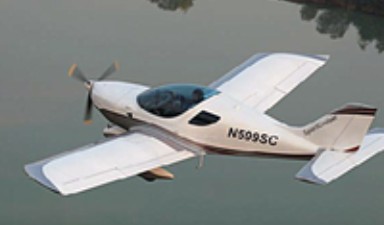
The cockpit offers great visibility and the aircraft is constructed entirely of metal. The aircraft engine is a very sturdy and reliable Rotax 912 ULS so you can travel at a cruising speed of 125 mph (201 km / h) with a fuel consumption of around 17 liters / h.
Price 2009: 61900 EURO

Stall: 30 kt / 34 mph / 55 kmh
Cruise: 109 kt / 125 mph / 201 kmh
VNE: 131 kt / 151 mph / 243 kmh
Climb Ratio: 1200 ft/min / 6 m/s
Take-off distance (50ft obstacle): 360 ft / 110 m
Landing distance (50ft obstacle): 400 ft / 122 m

Nando Trial

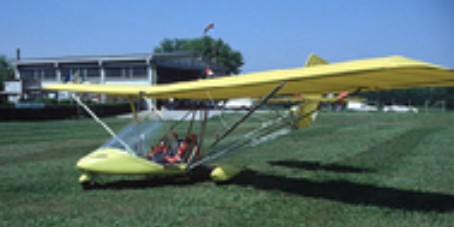
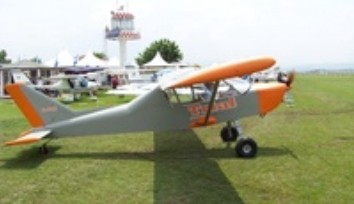
Foldable wings, all metal frame construction with central chrome molybdenum. Large door on right side that allows easy access to front and rear seat. Tundra wheels equipped to operate on rough terrain.
The Jabiru engine ensures efficient and low noise while maintaining excellent performance.

Stall: 32 kt / 37 mph / 60 kmh
Cruise: 86 kt / 99 mph / 160 kmh
VNE: 119 kt / 137 mph / 220 kmh
Empty Weight: 285 kg / 628 lbs
MTOW Weight: 450 kg / 992 lbs
Take-off distance (50ft obstacle): 390 ft / 120 m
Landing distance (50ft obstacle): 330 ft / 100 m

Engine: Rotax 503, 52 hp
Wing span: 9.9 m
Wing area: 16.7 sq.m
MAUW: 450 kg
Empty weight: 180 kg
Fuel capacity: 30 lt
Max speed: 120 kph
Cruise speed: 80 kph
Minimum speed: 45 kph
Climb rate: 4 m/s
Seats: 2
Fuel consumption: 15 lt/hr