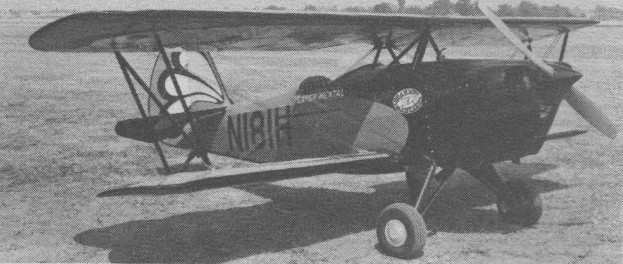
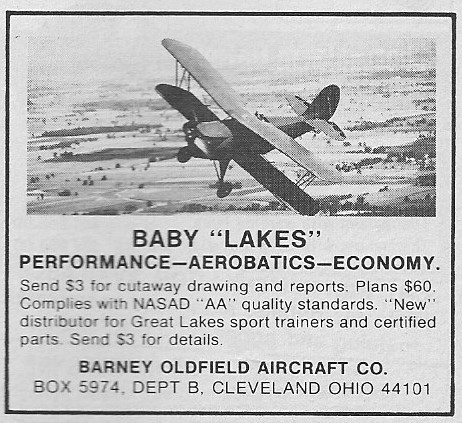
Harvey R. Swack had encountered a fellow named Barney Oldfield no relation to the auto racer who had designed a small, single seat sport biplane for homebuilders. Swack went into business with Oldfield, selling plans of the 2T 1 under the name “Baby Great Lakes” which he was entitled to do, as owner of the name, although the little homebuilt bore only a distant, imitative relationship to the original. When Champ¬lin bought Great Lakes Aircraft Company from Swack, Swack changed the name of the homebuilt design to “Barney Oldfield Special,” though it is still informally known as the “Baby Lakes.”
Dec 1973
Feb 1974
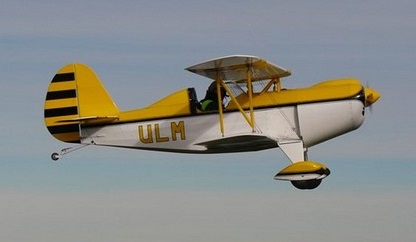
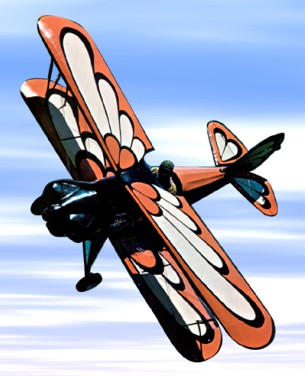
Barney Oldfield’s Baby Great Lakes flys much like its big brother, the Great Lakes Sport Trainer. The Baby “Lakes” was designed to get the same sort of flying ease and performance at lower cost. It uses a steel-tube fuselage, wood wings and fabric cover, and offers unusually lively aerobatic performance when powered by an 85-hp Continental engine. The Baby Lakes can also be fitted with 50- to 100-hp Continentals or the 108- and 125-hp Lycomings. (When fitted with the 108- and 125-hp engines, the airplane is called the Super Baby Lakes.) Its makers say it will out fly aircraft of twice the horsepower, and it is the least expensive, high-performance biplane available to the homebuilder.
Baby Lakes
The Baby Great Lakes (one place) and Buddy Great Lakes (two place) aircraft are well proven designs which are easy to construct and fly, provide classic good looks, and are aerobatic. Construction is of wood and steel tubing and plans are well presented for the first time builder. Aircraft Spruce & Specialty Company acquired all rights to these designs in May 1996 and offers packs, plans, raw materials kits, and pre-fabricated kits for these fine aircraft. The Baby Great Lakes Main Tank Standard holds 10 gallons. The Baby Great Lakes Tank Stretch is 3″ longer and holds 11 gallons.
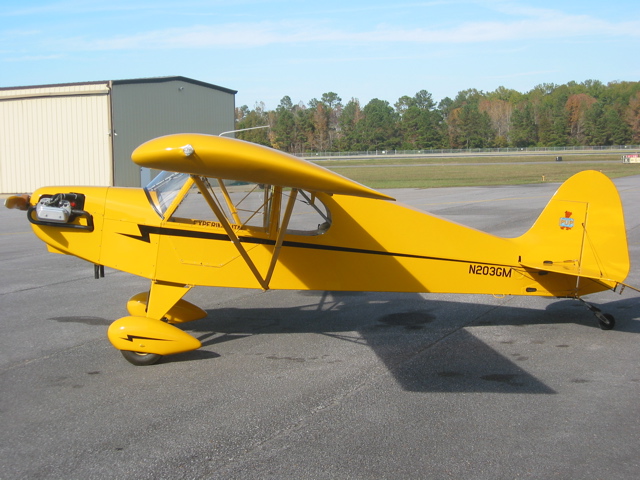
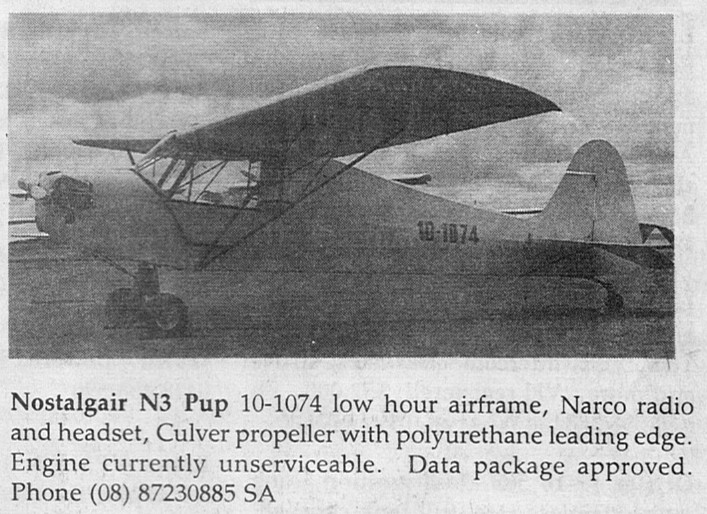
Bob Counts developed the single-seat N-3 Pup in the mid-’80s as what might be termed the third generation of ultralights. The Pup was among the first ultralights to resemble a general aviation aircraft, the Piper J-3 Cub in this case. Like several innovative ultralights, the N-3 Pup won a Best New Design award at its first Sun ’n Fun appearance.
The original N-3 Pup being a ¾ scale Super Cub replica. Centre mounted joy stick, rudder pedals, tailwheel steerable through rudder pedals. The N3 Pup has a welded chromemoly steel fuselage and a two-cylinder horizontally-opposed Global engine to add to its air of authenticity. By 1995 marketed as the Preceptor Aircraft Corp Pup from 1230 Shepard St, Hendersonville, NC 28792, USA.
The N-3 Pup can be ordered with folding wings. In less than ten minutes you can fold your wings and take your pup home with you, or unfold them and go flying. The N-3 Pup is a real joy to fly with easy, docile handling. The N-3 Pup built as a bare minimum plane will meet the FAR 103 requirement.
The N-3 Pup was followed by Counts’ larger, souped up version of the N-3, the Super Pup. Empty weight (450 pounds) and flight speeds take it out of the ultralight category. The Super Pup has folding wings, short takeoff and landings and a reliable 4 stroke engine. Wing sub-kits come with ailerons, all hardware, brackets, fittings, fuel tanks, ribs, skins, spars and lift struts. No fabric.
Fuselage sub-kits come with stabilizers, elevators, rudder, landing gear, seat cusions, control systems, all glass, blank instrument panel, wheels and brakes, tailwheel, stringer formers, shock struts, brackets, fittings, firewall and all hardware and necessary accessories. No fabric.
Firewall forward package comes with engine, exhaust stacks, intake manifolds, carb heat, engine mount, prop, carburetor and hardware Engine prices will vary depending on model, Horsepower and electrical option.
The two place Ultra Pup features folding wings, roomier cabin, and electric starting, which all called for a redesigned fuselage. The CG was shifted to accommodate the extra weight up front. Instead of adding weight in the tail, they used heaver-gauge tubing at strategic locations. Thus, we achieved the desired CG shift by adding strength, not just dead weight. Building smarter safer aircraft for all to enjoy has always been the “Preceptor Way”.
Wing sub-kits come with ailerons, all hardware, brackets, fittings, fuel tanks, ribs, skins, spars and lift struts. No fabric.
Fuselage sub-kits come with stabilizers, elevators, rudder, landing gear, seats cusions, control systems, all glass, blank instrument panel, wheels and brakes, tailwheel, stringer formers, shock struts, brackets, fittings, firewall, all hardware and necessary accessories. No fabric. Firewall forward package comes with engine, exhaust stacks, intake manifolds, carb heat, engine mount, prop, carburetor and hardware. Engine prices will vary depending on model, Horsepower and electrical option.
Stinger
The LSA Stinger uses the same fuselage as the N-3 with front fuselage wider, cabin structure deleted and combing added. The (1995) US$6700.00 kitset came complete with paint and ready to assemble. Skis and floats are optional. Preceptor has taken the same fuselage as used on the time proven N-3 Pup, made the front of the fuselage wider, left off the cabin structure, added a combing and have come up with one of the cutest and nicest flying little open cockpit parasols going. The Stinger brings back the joy of owning and flying an open cockpit airplane that has performance that will keep you smiling. A real beauty that looks and feels like an antique racer of the good old days.
Initially produced by Nostalgair, N-3 kits were subsequently made by Mosler Motors, which eventually sold kit production rights back to Counts. A company named TEC took over engine production from Mosler, but it quit making engines in 1991. At that point, Preceptor began assembling VW-based engines of various strengths. The 70-hp version remains the recommended engine for the Super Pup. Wing and fuselage kits may be bought separately, but one can save $1400 if they’re purchased together. A firewall-forward package for $7600 is for the 70-hp Preceptor VW-based engine that claims a 1400-fpm climb rate. Bob Counts’ son Duwayne runs Preceptor Aircraft by 1995, marketing the Cubs.
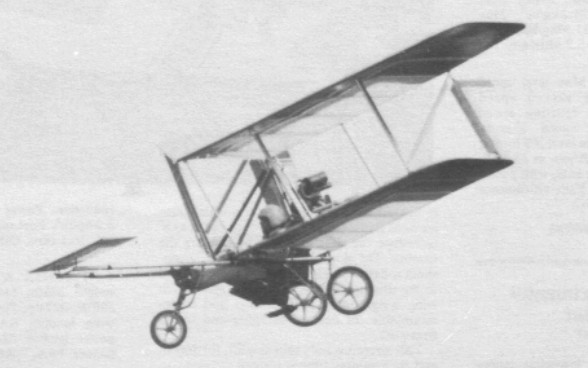
Single seat single engined biplane with two-axis control. Wings have swept back leading and trailing edges, and constant chord; no tail, canard wing. Pitch control by fully flying canard; yaw control by tip rudders between wings; no separate roll control; control inputs through stick for pitch and pedals for yaw. Wings braced by struts and transverse X cables; wing profile; double surface. Undercarriage has three wheels in tricycle formation; glass fibre suspension on main wheels. Push-right go left nosewheel steering independent from yaw control. Brake on nosewheel. Aluminium tube framework, without pod. Engine mounted between wings driving pusher propeller.
Shown at Sun ‘n’ Fun in March 1983 at Lakeland, Florida, the Viking is a variation on the famous Easy Riser theme.Whereas UFM of Kentucky has fitted the Easy Riser with a conventional tail giving rise to the Aeroplane (a 1983 model), Northstar had preferred a canard of variable incidence, thus acting as an elevator, for its Viking.
Designed for cross countries, it gives its pilot comfort and a large speed range. Its Kawasaki TA440 is equipped with an electric start, making it necessary to have a 12 V battery on board. The fuel tank is moulded into the seat back, whose structure is of glass fibre, and other nice touches include a twin blade ground adjustable variable-pitch propeller and a rudder bar which is adjustable according to the height of the pilot. Northstar supplies its Viking in kit form requiring 75 100 h for assembly at an introductory price (March 1983) of $5395. The kit does not require any special tools, assembly being largely with pop rivets.
Engine: Kawasaki TA440, 38.5hp at 6000rpm Propeller 60 in / 1.52 m ground adjustable) inch Micro V belt reduction, ratio 2.25/1 Max static thrust 235 lb, 107 kg Power per unit area 0.22 hp/sq.ft, 2.4 hp/sq.m Fuel capacity 5.0 US gal, 4.2 Imp gal, 18.9 litre Wing span 32.0 ft, 9.75 m Total area of main wings 170 sq.ft, 15.8 sq.m Nosewheel diameter overall 16 inch, 41 cm Main wheels diameter overall 20 inch, 51 cm Empty weight 244 lb, 11.1kg Max take off weight 502 lb, 228 kg Payload 258 lb, 117 kg Max wing loading 2.95 lb/sq.ft, 14.4 kg/sq.m Max power loading 13.0 lb/hp, 5.9kg/hp Load factors +5.0, 3.0 design Max level speed 54 mph, 87 kph Never exceed speed 55 mph, 88 kph Max cruising speed 45 mph, 72 kph Stalling speed 23 mph, 37 kph Max climb rate at sea level 800 ft/min, 4.1 m/s Best glide ratio with power off 7/1
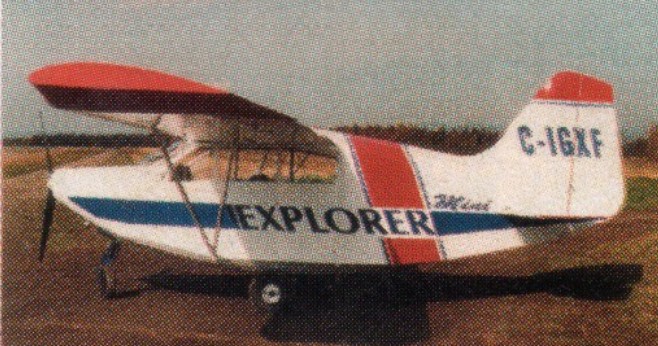
A side by side 2 seater, with room for a bed for 2 at the back. Made of wood, tubing and fabric, no flaps are fitted. Wheel, skis or floats. 2009 Price: 34500 US$
Engine: Rotax 912, 80 hp Length: 21 ft Wingspan: 36 ft Wing area: 180 sq.ft Empty Weight: 297 kg / 654 lbs MTOW Weight: 559 kg / 1232 lbs Fuel capacity: 28 USG VNE: 113 kt / 130 mph / 209 kmh Cruise: 78 kt / 90 mph / 145 kmh Stall: 30 kt / 35 mph / 56 kmh Range: 780 sm Climb Ratio: 850 ft/min / 4 m/s Take-off distance: 250 ft Landing distance: 350 ft Take-off distance (50ft obstacle): 400 ft / 122 m Landing distance (50ft obstacle): 500 ft / 152 m Seats: 2 Cabin width: 48 in Landing gear: nosewheel

 All Aero