Paup P-Craft

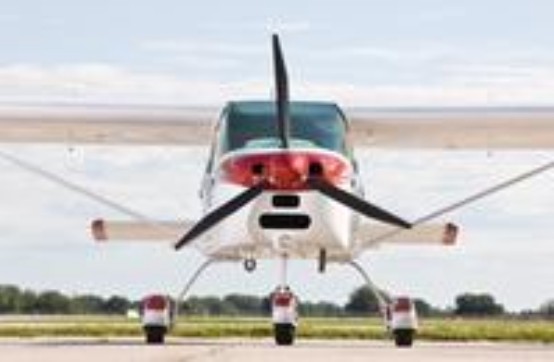
Single seat single engined high wing monoplane with two axis control (optional conventional three axis control). Wing has unswept leading edge, swept forward trailing edge and tapering chord; cruciform tail. Pitch control by elevator on tail; yaw control by fin mounted rudder; no separate roll control (optional roll control by ailerons); control inputs through stick for pitch/yaw and (optionally) pedals for roll. Wing braced from below by struts; wing profile; double surface. Undercarriage has three wheels in tail dragger formation; bungee suspension on all wheels. Push right go right tailwheel steering connected to yaw control. No brakes. Aluminium tube/steel tube framework, without pod. Engine mounted below wing driving pusher propeller. Framework in 2024T3 aluminium and 4130 chrome moly steel. Wing covering is Stits Polyfiber, doped.
Shown for the first time to the public at 0shkosh in August 1982, P Craft from D Paup appears to be a minimum aircraft and as such is directly descended from the Kolb Flyer and Ron Wheeler Scout.

This one offers the choice between two axis control, with steering by induced roll, or conventional three axis control when fitted with ailerons (an option on the standard kit). Where the lower longeron and a higher, nearly parallel tube which carries the pilot seat meet at the nose, there is a horizontal transverse tube on which can be hinged the rudder pedals.

Paup aircraft offers the two axis version in kit form, requiring 150 hours for completion, at the price of $3395 in 1983.

Engine: Cuyuna 215D, 20hp at 6000rpm
Propeller diameter and pitch 36 x 12 inch, 0.91 x 0.30 m
No reduction
Power per unit area 0.15hp/sq.ft, 1.6hp/sq.m
Fuel capacity 2.5 US gal, 2.1 Imp gal, 9.5 litre
Wing span 32.5 ft, 9.88 m
Total wing area 132 sq.ft, 12.3 sq.m
Wing aspect ratio 8.0/1
Main wheels diameter overall 20 inch, 51 cm
Empty weight 165 lb, 75kg
Max take off weight 402 lb, 182 kg
Payload 237 lb, 107 kg
Max wing loading 3.05 lb/sq.ft, 14.8 kg/sq.m
Max power loading 20.1 lb/hp, 9.1 kg/hp
Max level speed 60 mph, 97 kph
Never exceed speed 70 mph, 113 kph
Max cruising speed 50 mph, 80 kph
Economic cruising speed 35 mph, 56 kph
Stalling speed 22 mph, 35 kph
Max climb rate at sea level 300ft/min, 1.5m/s
Take off distance 75 ft, 23 m
Partenavia Costruzioni Aeronautiche Spa

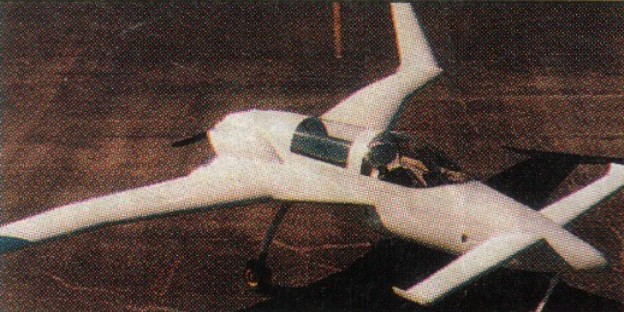
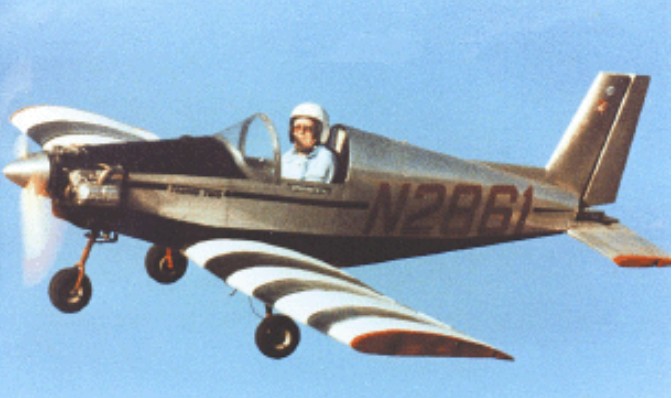
In the postwar period, Luigi “Gino” Pascale and his brother Giovanni “Nino” Pascale of Naples, Italy, having been enthusiastic flying model aircraft makers, decided to work on full-scale aircraft. The first, built while the brothers were college students, was the “P.48 Astore (Goshawk)” — a two-seat aircraft, with the seats in tandem, featuring a high strut-braced wing, fixed taildragger landing gear, and a Continental O-170 / A65 flat-four air-cooled engine with 48 kW (65 HP).

One Astore was built, performing its initial flight in 1952 — by which time Luigi Pascale had become an instructor in mechanical engineering at Naples University, where he would become a full professor and help establish a department of aeronautical engineering. The Astore was followed by other one-off designs:
P.52 Tigrotto (Tiger Cub)
P.53 Aeroscooter
P.55 Tornado
P.57 Fachiro
The Fachiro I was followed by three “Fachiro II” and then 33 “Fachiro III”.

Partenavia Costruzioni Aeronautiche Spa, a Naples company formed in 1949 to build series of light aircraft. First to enter production was the P-57 Fachiro of 1957, a four-seat high-wing monoplane with Lycoming engine. This was followed by various developments including the P.64 Oscar (first flown April 1965), also produced in South Africa under license as the RSA.200 by AFIC (Pty) Ltd, and the P.66 Charlie. Partenavia’s first twin was the P.68 six-seat light transport, first flown in May 1970. It was subsequently placed into production in several forms, including the Observer 2 for observation and patrol. AP.68 TP-600 Viator 11 seat transport followed in March 1985. New projects in the early 1990s included PD.93 Idea four-seat trainer and utility monoplane, but in March 1998 Partenavia ceased work and its P.68 series was bought via auction by VulcanAir SpA.

After financial difficulties the company reappeared, in 1986, as Costruzioni Aeronautiche Tecnam (see Tecnam).

In 2008, Partenavia, an Aeritalia division, announced a decision to transfer manufacturing of single engined aircraft, including the mosquito, to fellow Aeritalia subsidiary Aviolight, which was floated at the end of February 2008.

Parker Teenie Two / Double Teenie

An improved version of the Jeanie’s Teenie, the Teenie Two is an all-metal, single-place monoplane built entirely from aluminum except for the landing gear and controls. Building needs no bending brake, nor is any metal or riveting experience required. Most of the sheet metal bending involved in building the Teenie Two is done by hand and the design is close to optimum simplicity. Power is provided by a Volkswagen conversion. Stressed for aerobatics. The wingspan is optionally 19 feet 10 inches w/wingtips.

Cruise at 3/4 throttle is 110 mph, using 2 1/2 Usgph. The top speed level is 120 mph, and up to 140 mph with full canopy & cowl.

Plans and component kits were available.

The Double Teenie was a two place version.

Gallery

Engine 1600-cc Volkswagen
HP range: 60-80
Wingspan 18 ft – 19 ft 10 in
Length 12 ft 11 in
Height: 6 ft
Wing area: 59 sq.ft
Gross Wt. 550-590 lbs
Empty Wt. 310 lbs
Fuel capacity 9 USG
Usefull load: 240 lb utility to 280 lbs. standard category
Top speed 120-140 mph
Cruise 110 mph
Stall 48 mph
Takeoff run 600 ft
Landing roll 800 ft
Range 400 sm
ROC: 800 fpm
Service ceiling: 14,000 ft
Seats: 1
Tricycle gear 350 x 4 tires & wheels

Paradise Aircraft P-1

The Paradise P-1 complies with all aspects of the Light Sport Aircraft (LSA) ASTM standards, that specify the design and performance requirements of the two types of LSA aircraft. Special Light Sport Aircraft (SLSA) and Experimental Light Sport Aircraft (ELSA). Easy to service and maintain and if registered as an E-LSA can have even the annual inspection made by the owner. 2009 Price: US$108300

The P-1 is constructed using 4130 steel tube frame welded and is covered with aviation grade aluminum. Powered by a 100 HP Rotax 912 ULS, it offers short field take off and landing performance, with excellent climbing rate and cruise speed. The cowling can be removed by one person making it easy to access every component for inspection and maintenance

It is a high wing, two seat, side by side aircraft similar to a Cessna 150, but that is where the similarity ends.
The combination of its wing design and large moving horizontal tail (stabilator) produces a very gentle yet stable aircraft with a good stall characteristic. This, coupled with the ruggedness of its landing gear, dual control system, and a wide range of optional, makes it an excellent trainer. Taxiing is easy with the pedal steered nose gear and large hydraulic brake system.

The large cabin width (43.3 inches), panel mounted yoke, unhindered floor space providing lots of leg room, with, the standard leather upholstery can accommodate two large occupants in plush comfort.

The behind the seat baggage space (largest of its category), with 75 lbs of load capacity and over 18 cubic ft of available space can carry a lot of luggage, including 2 golf bags plus a cooler or perhaps your fishing and camping gear. No hotel, remove the seat, place a sleeping bag for a 6 ft + person to sleep in comfort.
The inherent “nose down” level flight characteristic, offers a superb ahead and all around visibility.

2009 Paradise P-1
Engine: Rotax 912 ULS, 100 hp
Propeller: 3-blade Warp Drive
Gross weight: 599 kg / 1320 lb
Empty weight, std: 370 kg / 815 lb
Useful load, std: 505 lb
Usable fuel, std: 26 USG
Vne: 125 kt
Best rate of climb, SL, two passengers: 800 fpm / 4 m/s
Best rate of climb, SL, one passenger: 1000 fpm
Max cruise speed: 105 kt
Stall: 35 kt / 40 mph / 64 kmh
Range: 630 nm
Takeoff ground roll, one passenger: 260 ft
Landing over 50 ft. obstacle: 760 ft
Glide Ratio: 13/1