In 1995 the owner of Pipistrel was Ivo Boscarol.
2009: GORIŠKA CESTA 50a, SI-5270 AJDOVŠČINA, SLOVENIA
LSA, power pack, trike and glider builder
In 1995 the owner of Pipistrel was Ivo Boscarol.
2009: GORIŠKA CESTA 50a, SI-5270 AJDOVŠČINA, SLOVENIA
LSA, power pack, trike and glider builder
Pioneer announced at the end of May 1983 a two seater version of the FlightStar called the DualStar, also to be sold as a kit.
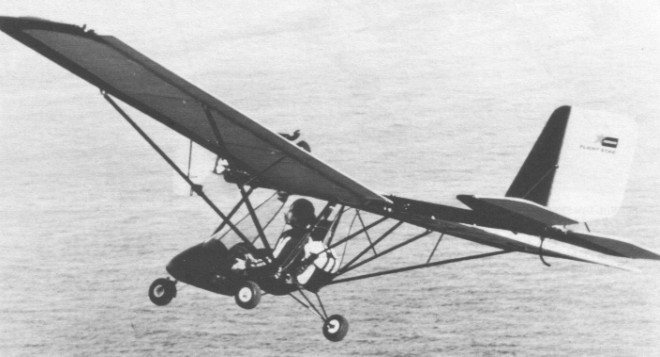
The machine has been developed by Flight Designs, an associate of Pioneer International Corporation and the firm which builds and sells the single seat Jetwing ATV, as well as conducting a research programme on a prototype single seat three axis machine designated 440ST However, at the start of 1983, Andrew N Bohjalian, group president, announced that production and sales of the FlightStar would be taken over by a new associate company called Pioneer International Aircraft. The Pioneer group is well known for its activities in aerospace industry, and includes the Pioneer Parachute Company, which is one of the world leaders in its field. So it is not surprising to find that the FlightStar has been designed from the start to accommodate an emergency 29.0 ft diameter (8.84 m) parachute, which is deployed ballistically and fitted behind the pilot at the rear of the frame.
Pioneer Flightstar / Flight Designs 440 Article
The aircraft is sold as a complete kit requiring 20 h for assembly and at a price of $7495 in 1983. Apart from the parachute, options offered are floats, skis, wheel fairings, electric starter for the Kawasaki TA440A engine, larger diameter wheels (16 and 20 inch, 41 and 51 cm), transport covers and an instrument panel.
The Flight Designs 440 ST was a single seat single engined high wing monoplane with conventional three axis control. Wing has unswept leading edge, swept forward trailing edge and tapering chord; two fin tail. Pitch control by elevator on tail; yaw control by fin mounted rudders; roll control by spoilers; control inputs through stick for pitch/roll and pedals for yaw. Wing braced from above by kingpost and cables, from below by cables. Undercarriage has three wheels in tricycle formation. Aluminium tube framework, without pod. Engine mounted at wing height driving pusher propeller.
This single seat twin¬-boom, twin rudder aircraft exists only as a prototype in 1982, and was being used at Flight Designs to study the flight envelope of such machines.
Single seat single engined high wing mono¬plane with conventional three axis control. Wing has unswept leading edge, swept for¬ward trailing edge and tapering chord; conventional tail. Pitch control by elevator on tail; yaw control by fin mounted rudder; roll control by full span ailerons; control inputs through stick for pitch/roll and pedals for yaw. Wing braced from below by struts; wing profile; double surface. Undercarriage has three wheels in tricycle formation, with additional tailskid; bungee suspension on all wheels. Flush right go right nosewheel steering connected to yaw control. Aluminium tube framework, with optional pod. Engine mounted at wing height driving tractor propeller.
Shown at Oshkosh in August 1982, the prototype FlightStar made its first flights during that summer. It carried trapezoidal planform ailerons, whose chord tapered toward the wing tips and which covered a little less than the full span of each wing, but these have been replaced for the production machines by full span ailerons. In addition, the production FlightStar, on show at Sun ‘n’ Fun in Lakeland, Florida in March 1983, was fitted with a glass fibre pod with a windscreen mounted on top and going right up to the strut carrying the wing.
440 ST
Engine: Kawasaki TA440A, 38.5 hp at 6000 rpm
Power per unit area 0.26hp/sq.ft, 2.9hp/sq.m
Fuel capacity 5.0 US gal, 4.2 Imp gal, 18.9 litre
Length overall 18.8 ft, 5.69 m
Height overall 8.3ft, 2.51m
Wing span 34.0ft, 10.36m
Sweepback 0 deg
Total wing area 144 sq.ft, 13.4 sq.m
Wing aspect ratio 8.0/1
Empty weight 218 lb, 99kg
Max take off weight 529 lb, 240 kg
Payload 311 lb, 141 kg
Max wing loading 3.67 lb/sq.ft, 17.9 kg/sq.m
Max power loading 13.7 lb/hp, 6.2kg/hp
Load factors; +6.0, 4.0 ultimate
Max level speed 60 mph, 97 kph
Max cruising speed 50 mph, 80kph
Stalling speed 22mph, 35kph
Max climb rate at sea level 950ft/min, 4.8m/s
Take off distance 60ft, 18m
Landing dis¬tance 50ft, 15m
Range at average cruising speed 240 mile, 386 km
FlightStar
Engine: Kawasaki TA440A, 38.5hp at 6000rpm
Propeller diameter and pitch 58×27 inch, 1.47 x 0.68 m
Belt reduction, ratio 2.0/1
Max static thrust 270 lb, 122kg
Power per unit area 0.25hp/sq.ft, 2.9hp/sq.m
Fuel capacity 5.0 US gal, 4.2 Imp gal, 18.9 litre
Length overall 16.5 ft, 5.03 m
Height overall 7.5ft, 2.29m
Wing span 30.0ft, 9.14m
Chord at root 4.8ft, 1.46m
Chord at tip 4.5ft, 1.37m
Dihedral 2.5 deg
Sweepback 0 deg
Tailplane span 8.2 ft, 2.50 m
Fin height 4.0 ft, 1.22 m
Total wing area 144 sq.ft, 13.4 sq.m
Total aileron area 26.0 sq.ft, 2.41 sq.m
Fin area 5.0sq.ft, 0.46 sq.m
Rudder area 7.0 sq.ft, 0.65 sq.m
Tail¬plane area 10.0sq.ft, 0.93sq.m
Total elevator area 11.0sq.ft, 1.02 sq.m
Wing aspect ratio 6.3/1
Wheel track 5.1 ft, 1.55 m
Wheelbase 6.0 ft, 1.83 m
Nosewheel diameter overall 10 inch, 25 cm
Main wheels diameter overall 10 inch, 25 cm
Empty weight 247 lb, 112kg
Max take off weight 500 lb, 227kg
Payload 253 lb, 115kg
Max wing loading 3.47 lb/sq.ft, 16.9kg/sq.m
Max power loading 13.0 lb/hp, 5.9kg/hp
Load factors +6.0, 4.0 design; +7.8, ulti¬mate
Max level speed 64 mph, 103 kph
Never exceed speed 75 mph, 121 kph
Max cruising speed 55 mph, 88 kph
Economic cruising speed 50 mph, 80 kph
Stalling speed 25 mph, 40 kph
Max climb rate at sea level 850 ft/min, 4.3 m/s
Min sink rate 350 ft/min at 30 mph, 1.7 m/s at 48 kph
Best glide ratio with power off 7.1/1 at 35mph, 56 kph
Take off distance 100 ft, 30 m
Land¬ing distance 100ft, 30m
Service ceiling 10,000ft, 3050 m
Range at average cruising speed 50 mile, 80 km
In 1981 Flight Designs Inc was incorporated into Pioneer International Corporation which has been well known for half a century in the aerospace industry as specialising in parachutes.
1984: Pioneer International Corp, Pioneer Industrial Park, PO Box 631, Manchester, CT 06040, USA.
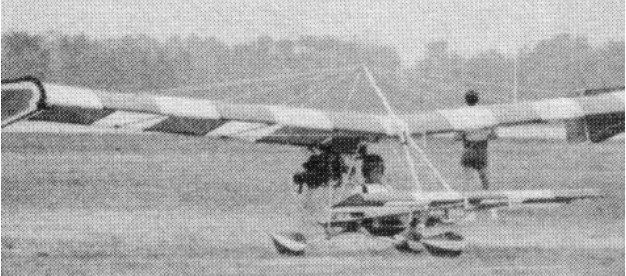
Side mounted joy stick, nosewheel steerable through joystick. Construction: Aluminium, Dacron
Engine: Cuyuna ULII-02 (429 cc) 33 hp
Static thrust: 250 lb
Wing span: 26 ft
Wing area: 130 sq.ft
Height: 6 ft 11 in
Length: 14 ft 2 in
Empty wt: 240 lb
Max wt: 550 lb
Fuel cap: 5 USG
Stall: 22 mph
Max speed: 63 mph
Vne: 75 mph
Climb rate: 600 fpm @ 35 mph
Design limit: +6, -4g
Glide ratio: 8-1
Wing loading: 4.23 lbs/sq.ft
Power loading: 15.71 lbs/hp
1984: 1313 Newton Ave, Evansville, IN 47715, USA.
UL builder
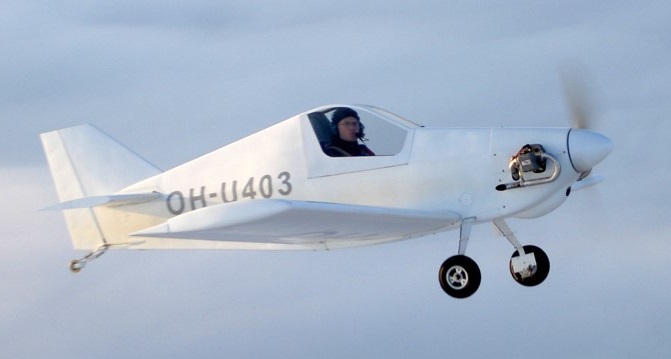
The PIK-26 Mini-Sytky is a single-seater ultra-light aircraft. The structure is entirely wood, except the wing and rudder which are cut from PVC foam. The one-piece wing attaches with two bolts to the main arch of the frame and its rear spar to the lower part of the backrest. Hinged flaps are fitted. The wing can be detached from below, leaving the frame resting on the landing gear.
The cockpit features a sidestick.
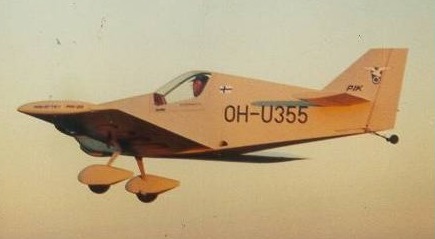
Designed by Kai Mellén and first built in 1996, at least four ave been built: OH-U355, OH-U356, OH-U403, and OH-U404. .
Mini-sytky OH-U403
Engine: Mosler MMCB HO2, 35 hp
Propeller: 48 “(122cm) x 38 “(96.5 cm)
Wing span: 5.24 m
Wing chord: 1.15 m
Wing area: 6 sq. m
Airfoil: GAW-2
Length: 4.33 m
Height: 1.22 m
Load limit: +3.8, -1.5 g
Empty Weight: 144 kg
Gross Weight: 250 kg
Fuel capacity: 27 lt / 20 kg
Useful Load: 106 kg
Luggage capacity: 5 kg
Vne: 190 km/h
Top Speed 3250 rpm: 180 km/h
Cruise@3000rpm: 160 km/h
Stall w/flaps: 55 kph
Stall clean: 60 km / h
Maximum flap speed: 120 km / h
Maximum manoeuvre speed: 125 km / h
Fuel Consumption: 7-8 lt/hr
Rate of Climb: 3.2 m/s
Takeoff Distance: 170 m
Landing Distance: 250 m
TO to 15 m: 600 m
Landing dist from 15 m: 500 m
Climb speed: 100-110 mph
Endurance: 3.25 hr
Range: 475 km
Wing loading: 41.6 kg/sq.m
Seats: 1
Wheel track: 1.21 m
Wheelbase: 3.27 m
Rudder: 0.22 sq.m
Vertical stabilizer: 0.56 sq.m
Vertical stabilizer profile: NACA 0011
Rudder: 0.38 sq.m
Rudder profile: NACA 0009
Aspect Ratio: 4.56
Didedral: 4 degrees
Aileron movement: – 35, + 27
Flap deflection: 16 deg
Rudder movement: + – 28 deg
Elevator movement: 20 deg up, 12 deg down
Tires: LAMB 11.400-5 (6ply)
Wheels: 5 ” AZUZA
Brakes: AZUZA, mechanical
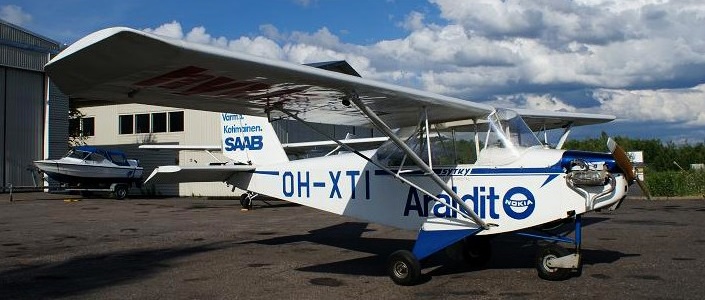
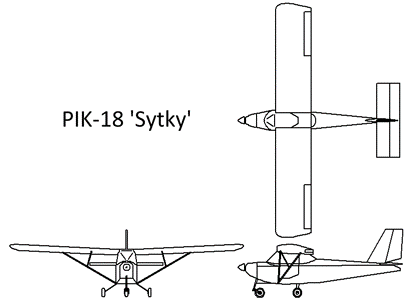
The PIK-18 Sytky is a 1950 designed ultralight. It is a single-seat, high-wing monoplane, powered by a VW 1500 conversion.
Designed by Ilkka Lounamaa, the one built, OH-XTI, flew in 1976.
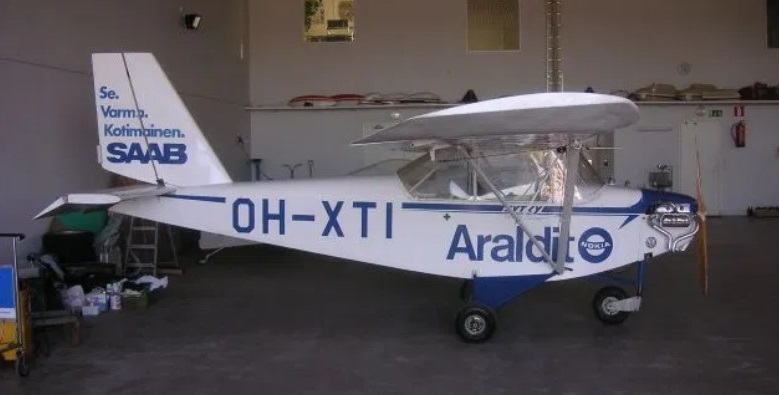
The name Sytky (Phon) is the phonetic sound of a VW motor running.
Bernard H Pietenpol built two early single-place, open cockpit biplanes, one powered by a 50hp Gnôme rotary engine and the second, in 1923, powered with a Ford Model T.
1980: B.H. Pietenpol, Spring Valley, MN 55975, USA
1995: 1604 Meadow Circle S.E., Rochester, MN 55904-5251, USA.
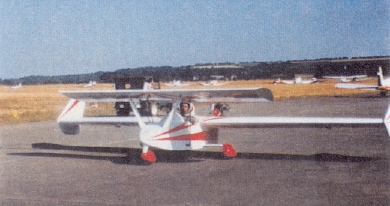
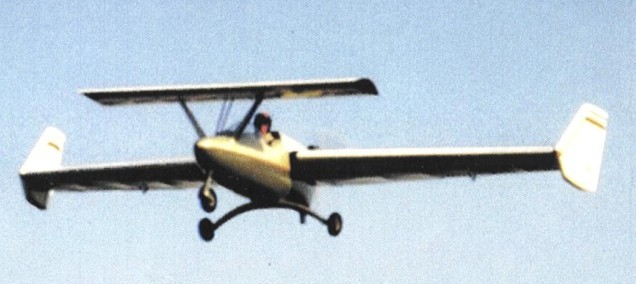
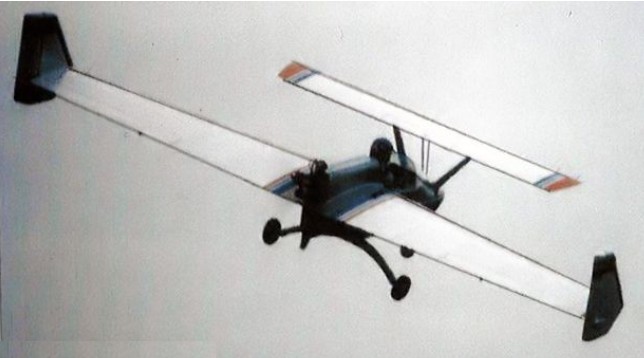
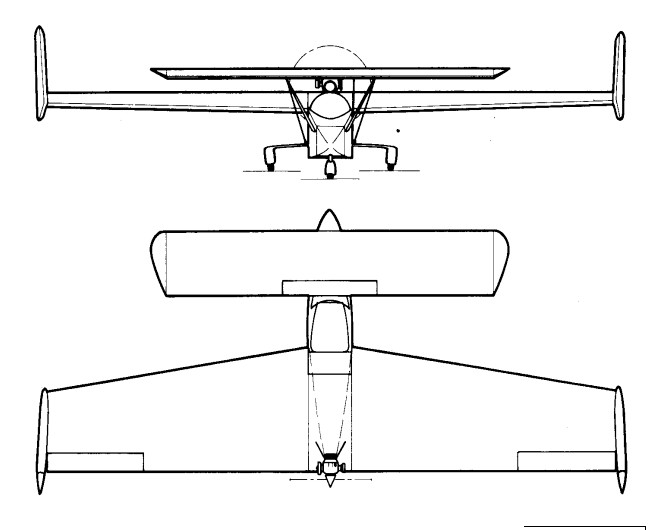
At the end of 1981 Piel completed plans of his CP 150 Onyx microlight it should have flown during 1982 but was held back by the demise of its designer. Single seat single engined double monoplane in tandem with conventional three axis con¬trol. Two fin tail. Pitch control by fully flying wing; yaw control by fin mounted rudders; roll control by ailerons; control inputs through stick for pitch/roll and pedals for yaw. Under¬carriage has three wheels in tricycle formation with additional tailskid; suspension on all wheels. Push right go right nose¬wheel steering connected to yaw control. No brakes.
Wood/fabric fuselage, partially enclosed. Engine mounted above main wing driving pusher propeller. The CP 150 is a double tandem monoplane whose front wing has a NACA 23012 profile and is adjustable for incidence. It thus acts as the elevator and is stabilised by an anti servo tab. It is much smaller than the rear wing which has a NACA 23015 profile and a swept back leading edge but an unswept trailing edge. Both wings are cantilevered, the front mounted on two faired supports on which it is articulated, with incidence control via pushrods. The rear wing is fitted with ailerons and has large fins at the wing tips on which the rudders are hinged. The fuselage is largely made from wood as are the wing, wing spars and vertical tail surfaces. Of rectangular section, the fuselage is covered with plywood, the two wings use a covering of Tergal and are de mountable, so that the Onyx is trailer transportable.
Designed for low power engines, the Onyx was tested at the beginning of 1982 with a Solo 12 hp engine.
The 2nd version had a longer wingspan with a fiberglass body. It was developed by R. Francois, an enthusiast for the design. This was the only version with a steerable nose wheel.
The third version, the one that is available as plans, is the wood fuselage with the longer wingspan of the fiberglass body.
The 4th version was the 2 seat produced by Veritas, probably developed by R. Francois.
Madame Piel distributes plans for aircraft.
Engine (prototype): Solo, 12 hp
Propeller: 35″ dia. x 14″ pitch
Length: 11.6 ft
Total Area: 137.7 sq ft, 12.8 sq.m
Height overall 5.4 ft, 1.61 m
Rear wing span 23.9 ft, 7.30 m
Rear wing chord at root 5.3 ft, 1.60 m
Rear¬wing chord at tip 3.3ft, 1.00 m
Front wing span 14.6 ft, 4.46 m
Front wing constant chord 2.9ft, 0.84m
Empty Weight: 265 lbs
Max Takeoff Weight: 475 lbs
Fuel: 5 USG
Power per unit area 0.09 hp/sq.ft, 0.9 hp/sq.m
Front wing dihedral 0 deg
Front wing sweepback 0 deg
Fin height 3.5 ft, 1. 05 m
Rear wing area 98 sq.ft, 9.1 sq.m
Front ¬wing area 40 sq.ft, 3.7 sq.m
Total aileron area 6.8 sq.ft, 0.60 sq.m
Fin area 8.9 sq.ft, 0.83 sq.m
Rudder area 6.8 sq.ft, 0.63 sq.m
Rear wing aspect ratio 5.9/1
Front wing aspect ratio 5.4/1
Max Speed: 62 mph, 100 kph
Minimum Speed: 28 mph
Cruise Speed: 50 mph, 80kph
Economic cruising speed 37mph, 60kph
Vne: 85 mph
Stall Speed: 22 mph, 35kph
Take off distance 100ft, 30m
Landing distance 200 ft, 60 m
Rate Of Climb: 300 fpm
Complete set of plans 2009: US$90
Wheel track 4.9ft, 1.50m
Wheelbase 5.5ft, 1.68m
Nosewheel diameter overall 8 inch, 20 cm
Main wheels diameter overall 10 inch, 25 cm
Load factors; +4.0, 2.0G
Engine: Solo, 15 hp
HP range: 15-20
Length: 11.6 ft
Wing span: 24 ft
Wing area: 137.7 sq.ft
Empty weight: 265 lb
Gross weight: 595 lb
Fuel capacity: 5 USG
Top speed: 62 mph
Cruise: 50 mph
Stall: 22 mph
Range: 200 nm
Rate of climb: 300 fpm
Takeoff dist: 200 ft
Landing dist: 100 ft
Service ceiling: 5000 ft
Seats: 1
Landing gear: nosewheel
Engine: 18 hp
Propeller: 35″ dia. x 14″ pitch
Span: 24.0 ft
Length: 11.6 ft
Total Area: 137.7 sq ft
Empty Weight: 265 lbs
Max Takeoff Weight: 475 lbs
Fuel: 5 USG
Max Speed: 70 mph
Minimum Speed: 30 mph
Cruise Speed: 60 mph
Vne: 85 mph
Stall Speed: 25 mph
Takeoff Distance: 150 ft
Landing Distance: 100 ft
Rate Of Climb: 450 fpm
Complete set of plans 2009: US$90
 All Aero