1982: P M & T, Whites Close, Alfreton, Derby, Derbyshire, Great Britain.
Built the Honeybird UL
1982: P M & T, Whites Close, Alfreton, Derby, Derbyshire, Great Britain.
Built the Honeybird UL
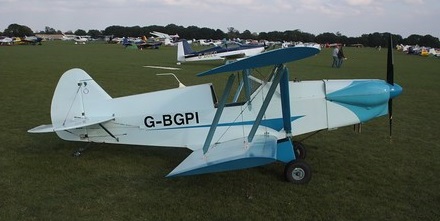
Plumb BGP.1 Biplane PFA 083-10359 G-BGPI
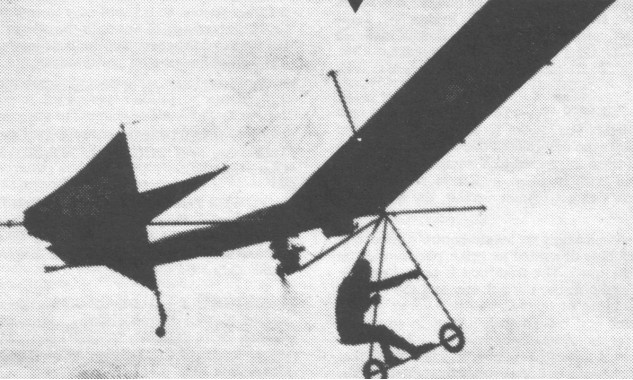
A single seat single engine, high wing mono¬plane with hybrid control circa 1983. Wing has unswept leading and trailing edges, and constant chord; cruciform tail. Pitch control by weight shift; yaw control by fully flying rudder; no separate roll control; control inputs through weight shift for pitch/yaw/roll. Wing braced from above by kingpost and cables, from below by cables; wing profile single ¬surface. Undercarriage has three wheels in tail dragger formation. Metal tube framework, without pod. Engine mounted below wing driving pusher propeller.
It appears to have a rudder to assist the weight-shift in yaw, a combination which is sufficient to class the Zhuravlic as a hybrid, but it is not clear whether a similar arrangement is used for pitch control or whether the pilot relies solely on weight shift for up/down control.
No details are given of the power unit, except that it is of 350 cc and is coupled to a two blade propeller.
Wing span 31.5 ft, 9.60 m
Engine: 350 cc
Empty weight 121 lb, 55 kg
Max level speed 37.5 mph, 60 kph
Best glide ratio with power off: 30/1
Take off distance 66ft, 20m
Landing distance 33ft, 10m
Service ceding 6600ft, 2000m
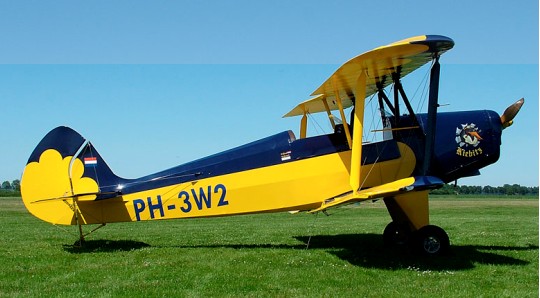
Based on the 1927 Focke-Wulf S-24 “Kiebitz”, the modern Kiebitz was designed by Michael Platzer and has been available as an UL-biplane kit since 1984. Almost 300 Kiebitz biplanes had been built by homebuilders throughout the world.
Various engine options have flown, including Rotax 2 and 4 stroke, Limbach 2000, Sauer 2100, Nissan MA12, and English built 100 hp Mid-West rotary.
Engine: Nissan 12 P, 50 hp
Wing span: 7.6 m
Wing area: 18.3 sq.m
MAUW: 400 kg
Empty weight: 200 kg
Fuel capacity: 50 lt
Max speed: 140 kph
Cruise speed: 125 kph
Minimum speed: 50 kph
Climb rate: 3 m/s
Certification: Vz
Seats: 2
Fuel consumption: 9.5 lt/hr
Plan price (1998): 1500 DM
Engine: Nissan MA12
Seats: 2 Tandem
Wing Span: 7,6 m
Wing Area: 18,3 sq.m
Length: 6,9 m
VNE: 77 kts
Cruise: 60 kts
Stall speed: 38 kts
Empty Weight: 220 kg / 485 lbs
Max. take-off weight: 472 kg
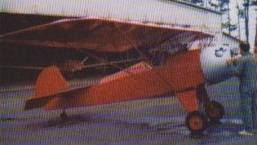
In 1981 Michael Platzer designed and built Germany’s first legal ultralight with three axis control, the P.4 Motte. It has a spaceframe fuselage and dural tube wings.
A parasol UL, the Motte was rebuilt and fitted with a converted Nissan Micra automobile engine.
P4 Motte BR
Engine: Rotax 462, 52 hp
Wing span: 8.2 m
Wing area: 11.4 sq.m
MAUW: 285 kg
Empty weight: 170 kg
Fuel capacity: 40 lt
Max speed: 145 kph
Cruise speed: 125 kph
Minimum speed: 50 kph
Climb rate: 4 m/s
Certification: Vz
Seats: 1
Fuel consumption: 13 lt/hr
Plan price (1998): 1000 DM
1998-2010: Michael Platzer, Am Rohleiber 20, D-34302 Ellenberg, Germany.
In 1981 Michael Platzer designed and built Germany’s first legal ultralight with three axis control, the P.4 Motte.
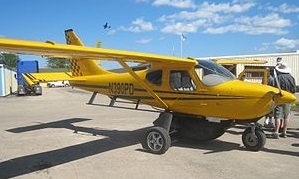
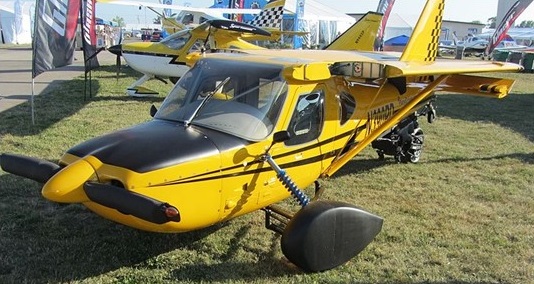
The Plane Driven PD-1 is a modification to the Glasair Sportsman 2+2 to convert it into a practical roadable aircraft. Trey Johnson, a homebuilt aircraft built the PD-1, intended to be an aircraft first, and a car second. The approach uses a mostly stock aircraft with a modified landing gear “pod” that carries a separate engine for road propulsion.
The engine pod carries a separate engine for road travel with its own fuel tank. The wheels are driven through an automatic transmission with a reverse gear. The lightweight fuselage coupled with a low power engine allows 25 miles per US gallon (9.4 L/100 km; 30 mpg imp) fuel economy with 5 US gallons (19 L) of usable fuel. The aircraft is registered in Washington State as a motorcycle due to its 3-wheel configuration.
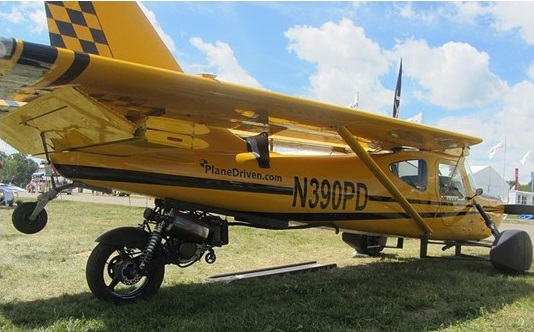
The PD-1’s wings fold along its sides, and the main landing gear and road engine pod slide aft along special rails, creating a driving configuration. The driving configuration compensates for the rearward center of gravity created by the folded wings, and provides additional stability for road travel.
The wings are hinged to allow them to rotate and fold back against the rear fuselage of the plane. The horizontal stabilizer is also hinged to reduce the width of the vehicle in road travel mode.
The prototype was constructed using Glasair’s two weeks to taxi program. It was started on March 29, 2010, and the modified prototype was test flown by July 21, 2010.
The vehicle can cruise at a speed of up to 140 mph in normal flight even with the road engine sitting as dead weight.
The prototype was displayed at the Experimental Aircraft Association Airventure airshow in 2010. The company’s second generation refinement was code named the PD-X, with intention of building a marketable aircraft based on the PD-X test results.
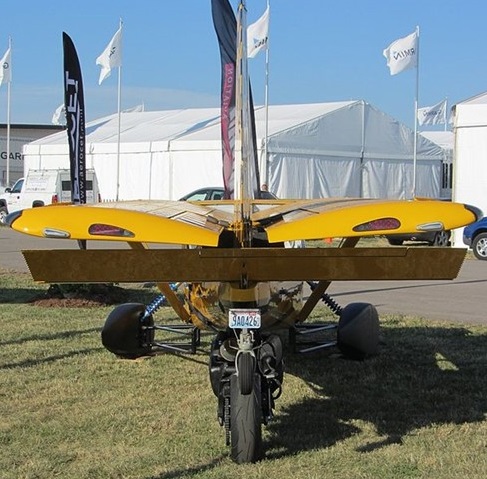
A second generation version of the PD-1 using the same Sportsman airframe as the PD-1, the PD-2, uses two forward mounted wheels with suspension in a conventional landing gear layout. A single rear wheel is mounted aft on the pod containing the second engine for road use. An updated pod was developed using a 50 hp four cycle engine with casters that fits into the baggage compartment. A custom lightweight four-piece carbon-fiber ramp can be used to load the pod without lifting. Gas milage is 24mpg in ground use.
PD-1
Engine: 1 × Lycoming IO-390, 210 hp (160 kW)
Engines: 2 × 500cc Yamaha Phazer 4 Cycle, 80 hp (60 kW) each
Wingspan: 35 ft (11 m)
Wing area: 131 sq ft (12.2 m2)
Aspect ratio: 9.1
Length: 23 ft (7.0 m) 24 feet 8 inches with wings folded
Fuel capacity: 50 US gallons
Cruise speed: 122 kn (140 mph; 226 km/h)
Capacity: 2 persons

Pipistrel’s S-LSA Alpha Trainer debuted 2012 and has sold well. Price: US$90,900 (fully equipped Alpha Trainer w/ballistic chute).
At the end of 2017 the Pipistrel Alpha Electro trainer was officially released to customers with significant success. This aircraft has an endurance of 1 hr plus a 30 min reserve, short take-off distance, and 1000+ fpm climb. The Alpha Electro is also designed to recover 13% of the energy upon each approach.
Pipistrel’s Alpha Electro (UL/LSA in Australia) electric airplane has obtained certification.
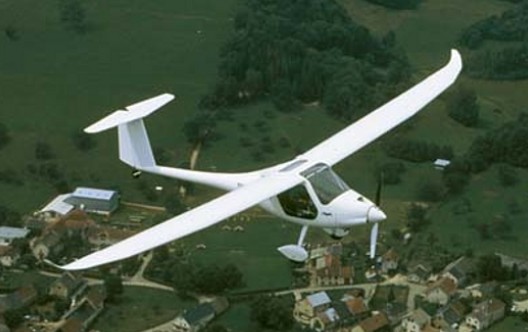
In 1995, Pipistrel d.o.o. Ajdovščina presented a two-seat ultralight aircraft with a wing-span of 15 meters, aimed also at glider pilots. The aircraft was the Sinus.
The Sinus team aimed at a two-seat composite-built aircraft with 15 meters of wingspan, which requires 100 meters of runway to take-off and reaches 200 km/h in horizontal flight, all on a 50 HP engine. The aircraft was is constructed according to EASA CS-22 rules (classic gliders), although it fits into the microlight category, with seats in side-by-side configuration.
The L/D ratio of the aircraft was be close to 1:30, which makes it a decent glider and provides extra safety in case of engine failure, since the engines for microlights are not certified, and must present Short Take-off and Landing (STOL) characteristicts. The aircraft is equipped with airbrakes, which enable the pilot do descent rapidly and use a high angle of approach onto typical ultralight airfields. The empty weight of the whole aircraft was not to exceed 285 kgs.
The small Pipistrel team developed their own airfoil and wing shape as well as a propeller with feathering capability, all drastically decreasing the drag and providing for a satisfactory glide ratio.
When the Sinus flew for the first time she was a subject of aviation magazines around the World and glider pilots began placing orders. They were willing to trade the imperfect glide ratio for the low cost of flying, freedom and independence from glider tow.
Sinus took the World Champion 2001 title, triggered a wave of imitators.
Fully composite construction with a 15-meter wing span, which provide for a glide ratio touching 1:30, the Sinus is equipped with high-tech features such as flaperons, airbrakes and variable-pitch propeller, and can be had in both tricycle or tail dragger undercarriage configuration. Sinus comes in two variants, the 503 and 912 with corresponding Rotax two- and four- stroke engines. Fast cross country flights to destinations 1000 km and further away doing more than 200 km/h (110 kts) are a reality with Sinus, even while burning around 10 liters of automotive fuel (mogas) or avgas per hour.
The Pipistrel Sinus is a ULM certified composite two seater motorglider. The vario propeller with in flight adjustable pitch and possibility to set it in the feather position transform the Pipistrel Sinus in a real low resistance glider. All options are included in the basic 2009 price: 46900 EURO.
Electric starter, recycling fuel pump to fill the wing tanks, warning lights for fuel minimum level, cockpit hot air heating system, main wheel fairings, all engine and flight instruments, etc. The cabin is properly insulated from noise and very comfortable. The seats are ergonomic with an adjustable head rest. The pedals have wheel brake levers on them, are adjustable in flight and made in stainless steel. All controls are easy to use and reach from both seats, and both seats have pedals and sticks.
Sinus was the absolute winner of the World Championship in 2001 and came runner-up in 2005. In 2004 Sinus was the first light aircraft to fly around the World. Since then, our owners have performed remarkable long-range flights including a non-stop flight from Pisa to Lisbon, Athens – Nordkapp flight and the first ever light aircraft Australia – New Zealand crossing!
The Sinus entire cabin area is encased with energy absorbing structures made from Kevlar fibre. The Sinus can also be equipped with the ballistic parachute rescue system. Including honeycomb techniques, Titanium and Magnesium are used on parts of the aircraft.
The wing tanks have the fuel cap on top, as well as a visual check for the fuel level. The main landing gear is profiled, made of composite. The main wheels have strong hydraulic disk brakes. Back wheel is controlled by pedals. The airbrakes allow landing the Sinus in very short distances over high obstacles. Disassembling and assembling is very simple like on normal gliders, all wing control connections are automatically locked on annexation of the wings.
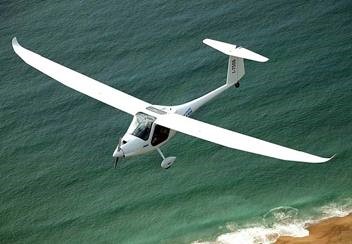
Pipistrel has delivered more than 1,000 aircraft worldwide. All Sinus models can be had as 51% EAB (Amateur-Built Experimental) kits (400 hours est.) too. Price 2014 US$97,450.
Sinus 503
Engine: Rotex 503 UL DCDI 2V 50hp at 6000 rpm
Wing span: 14.97 m
Wing area: 12.26 sq.m
Aspect ratio: 18.3
Airfoil: IMD 029-b, (Orlando, Venuti)
Empty Weight: 265 kg / 584 lb
MTOW Weight: 472 kg / 1041 lb
Stall: 34 kt / 39 mph / 63 kmh
Cruise: 92 kt / 106 mph / 170 kmh
VNE: 121 kt / 140 mph / 225 kmh
Climb Ratie: 600 ft/min / 3.2 m/s
Glide Ratio: 1:28
Take-off distance (50ft obstacle): 710 ft / 215 m
Landing distance (50ft obstacle): 660 ft / 200 m
Cockpit width: 44 in
Seats: 2
Sinus 912
Engine: Rotax 912 UL2, 80 hp at 5800 rpm
Propeller: Pipistrel VARIO
Wing span: 14,97 m
Length: 6,6 m
Height: 1,70 m
Wing area: 12,26 sq.m
Airfoil: IMD 029-b, (Orlando, Venuti)
Rudder area: 1,1 sq.m
Tail area: 1,63 sq.m
Aspect ratio: 18,3
Positive flaps: 9 deg, 18 deg
Negative flaps: 5 deg
Center of gravity: 20% – 39%
Empty weight: 285 kg
Empty weight light version: 275 kg
Max take off weight (MTOW): 450 kg / 472.5 kg / 544kg
Fuel tanks capacity: 2 x 30 l / 2 x 50 l
Useful fuel: 2 x 27 l / 2 x 45 l
Stall with flaps: 34 kt / 39 mph / 63 km/h
Stall without flaps: 66 km/h
Cruising speed (75% power): 108 kt / 124 mph / 200 km/h
Max. Horizontal speed : 220 km/h
Vne: 121 kt / 140 mph / 225 km/h
Max speed with airbrakes out: 160 km/h
Max speed with flaps down: 130 km/h
Manoeuvring speed: 141 km/h
Best climb speed: 120 km/h
Max climb rate (450 kg): 6,5 m/sec
Climb rate at 140 km/h: 1300 ft/min / 6,3 m/sec
Min.sink speed: 90 km/h
Min.sink (prop. 90 deg.): 1,03 m/sec
Max. Sink with airbrakes: 5,5 m/sec
Best glide ratio speed: 95 km/h
Best glide (prop. 90 deg.): 1:27
Glide at 150 km/h (prop 90 deg): 1:18
Take off run ( 450 kg): 88 m
Take off over 15 m obstacle (450 kg): 148 m
Service ceiling ( 450 kg): 8800 m
45° – 45° roll time: 4,2 sec
Fuel consum. At cruis. Speed: 9,2 l/hour
Endurance (std tanks): 5,8 hours
Range distance: 1200 km
Max load factor permitted ( x 1,8): +4 g – 2 g
Max load factor tested: + 7,2 g – 7,2 g
Cockpit width: 44 in
Seats: 2
2009 Price: 57900 EURO
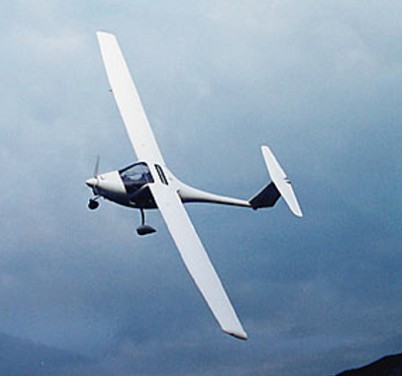
The LSA Virus 912 is a cruise aircraft suited for cross-country flying and aero-clubs and training flights. Full composite construction, 12.4-meter wing span and a glide ratio of 1:24 put Virus alongside motorgliders, with features such as 4-stage flaperons, airbrakes, and a variable pitch propeller with feathering capability. Undercarriage can be tricycle (nose wheel) of tail-dragger type. The engine is the four-stroke Rotax 912.
Virus won the 2007 Personal Air Vehicle Challenge and the 2008 General Aviation Technology Challenge, both events sponsored by NASA.
The Virus equipped with a 12- or 10-meter wingpan. The 12-meter version is a touring motorglider, enabling you to switch off the engine and glide alongside ridges, while the 10-meter fits in every hangar and is faster and more maneouvrable.
The entire cabin area is encased with energy absorbing structures made from Kevlar fibre, and the Virus can also be equipped with the ballistic parachute rescue system.
The Virus meets even the strictest of the noise regulations. Technologies, including honeycomb techniques, are used to build the composites and metal alloys, including Titanium and Magnesium, which are used on parts of the aircraft. The Virus can be disassembled in 15 minutes with all the controls self-fitting.
The ventilated side-by-side cockpit has optional leather interior and adjustable rudder pedals. The choice of either a small or large instrument panel can make the cockpit feel like a glider or fully equipped long-range cruising aircraft.
2009 Price: 57900 EURO
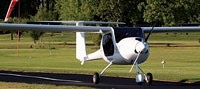
Pipistrel has delivered more than 1,000 aircraft worldwide and registered 7 Virus SW (Short Wing) aircraft in the US in 2012. All Virus models can be had as 51% EAB (Amateur-Built Experimental) kits (400 hours est.). 2014 Price: US$97,450
VIRUS 912
Engine: Rotax 912 UL, 80 hp at 5800 rpm
Propeller: Pipistrel VARIO
Wing span: 12,46 m
Length: 6,5 m
Height: 1,85 m
Wing area: 11,0 sq.m
Rudder area: 1,1 sq.m
Tail area: 1,63 sq.m
Aspect ratio: 13,1
Positive flaps: 9 deg, 18 deg
Negative flaps: 5 deg
Center of gravity: 20% – 38%
Empty weight: 284 kg
Max take off weight: 450kg / 472.5kg / 544kg
Fuel tanks capacity: 2 x 30 l / 2 x 50 l
Useful fuel: 2 x 27 l / 2 x 45 l
Stall with flaps: 62 km/h
Stall without flaps: 72 km/h
Cruising speed (75% power): 225 km/h
Max. Horizontal speed: 240 km/h
Vne: 249 km/h
Max speed with airbrakes out: 160 km/h
Max speed with flaps down: 130 km/h
turbulence penetration speed Vb: 141 km/h
Best climb speed: 130 km/h
Max climb rate (450 kg): 6,2 m/sec
Best glide ratio speed: 110 km/h
Best glide: 1:24
Take off run (450 kg): 90 m
Service ceiling (450 kg): 8100 m
45° – 45° roll time: 3,1 sec
Fuel burn at cruise: 9,5 l/hour
Endurance: 5,7 hours
Range: 1280 km
Max load factor permitted: +4 g – 2 g
Design safety factors & tested: minumum 1.875
Seats: 2
Cockpit width: 44 in
VIRUS 912 SW 80
Engine: Rotax 912 UL, 80 hp at 5800 rpm
Propeller: Pipistrel VARIO
Wing span: 10,71 m
Length: 6,5 m
Height: 1,85 m
Wing area: 9,51 sq.m
Rudder area: 1,1 sq.m
Tail area: 1,08 sq.m
Aspect ratio: 11,3
Positive flaps: 9 deg, 19 deg
Negative flaps: 5 deg
Center of gravity: 25% – 37%
Empty weight: 287 kg
Max take off weight: 472.5 kg / 544 kg
Fuel tanks capacity: 2 x 50 l
Useful fuel: 2 x 47 l
Stall with flaps: 64 km/h
Stall without flaps: 79 km/h
Cruising speed (75% power): 246 km/h
Max. Horizontal speed: 264 km/h
Vne: 302 km/h
Max speed with airbrakes out: 205 km/h
Max speed with flaps down: 130 km/h
turbulence penetration speed Vb: 250 km/h
Best climb speed: 140 km/h
Max climb rate (450 kg): 6,1 m/sec
Best glide ratio speed: 118 km/h
Best glide: 1:17
Take off run (450 kg): 140 m
Take off over 15 m obstacle: 225 m
Service ceiling (450 kg): 6200 m
45° – 45° roll time: 1,6 sec
Fuel burn at cruise: 13,6 l/hour
Endurance: 6,9 hours
Range: 1650 km
Max load factor permitted: +4g -2g
Design safety factors & tested: minimum 1.875
Seats: 2
Cockpit width: 44 in
VIRUS 912 SW 100
Engine: Rotax 912 ULS, 100 hp at 5800 rpm
Propeller: Variable pitch
Wing span: 10,71 m
Length: 6,5 m
Height: 1,85 m
Wing area: 9,51 sq.m
Rudder area: 1,1 sq.m
Tail area: 1,08 sq.m
Aspect ratio: 11,3
Positive flaps: 9 deg, 19 deg
Negative flaps: 5 deg
Center of gravity: 25% – 37%
Empty weight: 289 kg
Max take off weight: 472.5 kg / 544 kg
Fuel tanks capacity: 2 x 50 l
Useful fuel: 2 x 47 l
Stall with flaps: 64 km/h
Stall without flaps: 79 km/h
Cruising speed (75% power): 273 km/h
Max. Horizontal speed: 283 km/h
Vne: 302 km/h
Max speed with airbrakes out: 205 km/h
Max speed with flaps down: 130 km/h
turbulence penetration speed Vb: 250 km/h
Best climb speed: 140 km/h
Max climb rate (450 kg): 8,4 m/sec
Best glide ratio speed: 118 km/h
Best glide: 1:15
Take off run (450 kg): 95 m
Take off over 15 m obstacle: 175 m
Service ceiling (450 kg): 6800 m
45° – 45° roll time: 1,6 sec
Fuel burn at cruise: 17,8 l/hour
Endurance: 5,3 hours
Range: 1450 km
Max load factor permitted: +4g -2g
Design safety factors & tested: minimum 1.875
Seats: 2
Cockpit width: 44 in
 All Aero